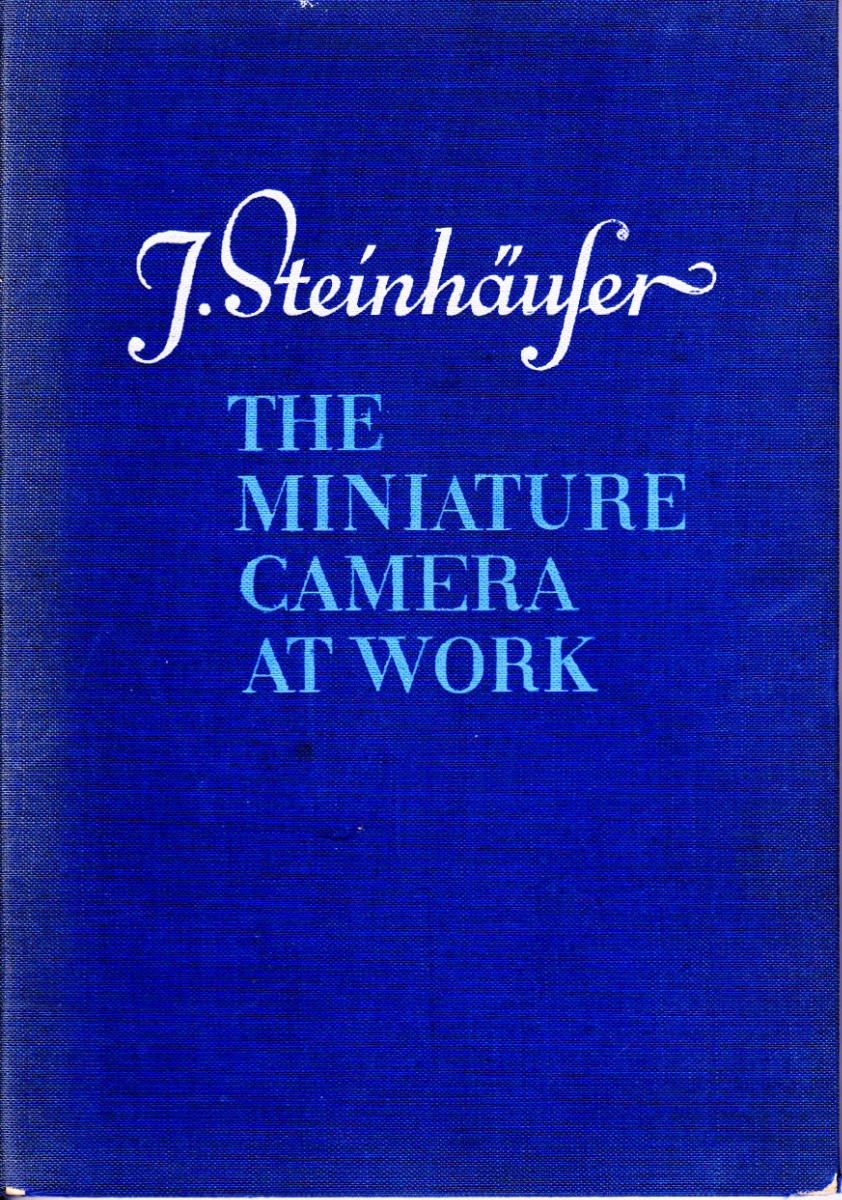
Cover – 1938 book “The Miniature Camera at Work”
Toronto. When Leitz announced the Leica mid 1920s, most photographers used larger cameras and rarely needed to enlarge their negatives. In 1926, the German government arranged for Zeiss to form the mighty Zeiss-Ikon conglomerate in Dresden to rationalize the German camera industry which prior to 1926 was many competing companies often making similar products.
Some high end companies like those making Leicas, Rolleis, etc. decided to waive joining Zeiss-Ikon. In the midst of this rationalization, miniature cameras took off leaving Zeiss ill prepared. By 1932, Zeiss had reacted and offered the Contax I model. They decided to make everything on the Contax better and stronger than the Leica, which was made by Leitz, one of its competitors in microscope manufacture.
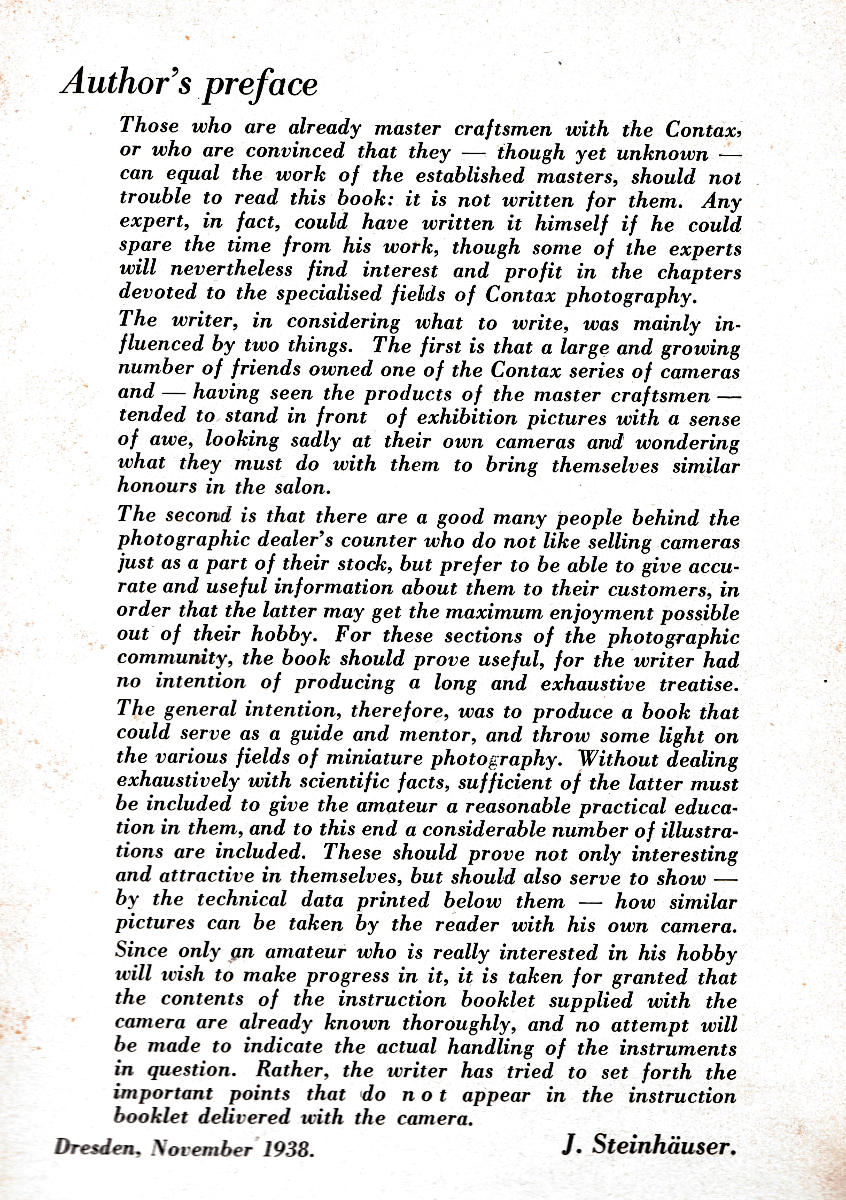
To this end, Steinhäuser, in imitation of Fritz Vith, published a book called ‘The Miniature Camera at Work‘ using Zeiss-Ikon 35mm cameras, and accessories along with Zeiss lenses. While never mentioning Leica by name, Steinhäuser went to great lengths to show how the Zeiss-Ikon cameras were better.
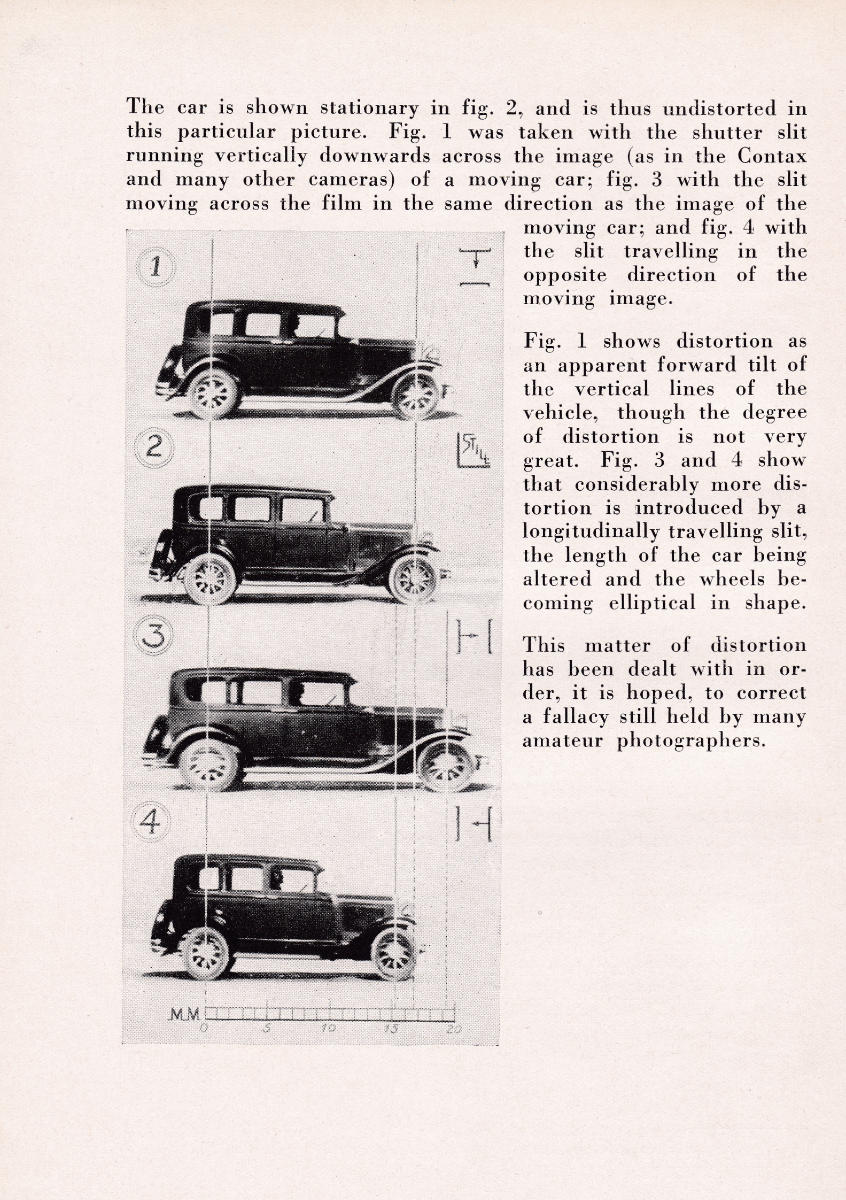
The vertical focal plane shutter of the Contax was made of metal rather than the rubberized cloth horizontal shutter of the Leica. It could sync to flash bulbs at a higher speed and avoided nasty pin-holes caused by the sun. BUT it proved to be an Achilles heel. Made of blackened brass, the slats of the shutter rode on enclosed silk ribbons. As the silk wore and broke, the shutter became slanted and stopped working. The ribbons were enclosed by the brass which often crystallized and broke when being bent to replace the worn ribbon.
Zeiss went to great lengths to make the Contax better than the Leica, but as Lipinski pointed out in his 1955 book, they had to because Leitz had patented all the easy ways to make a sturdy professional miniature camera! Steinhäuser explains the various 35mm camera designs used by Zeiss-Ikon (Contax, Nettax, Super Nettel, Contaflex) while ignoring the simpler approach Leitz used – eliminating items to make their camera cheaper but easily upgraded at the factory.
The one different Leica, the model B, didn’t sell and was only made briefly to offer slow shutter speeds before the regular Leica could accommodate them. Of course today this rarity makes the model B very pricey. By 1930, Leitz had moved to a standardized distance from the film to the lens mount making interchangeable lenses a practicality post camera sales.