and you thought your camera was big!

Article in American Cinematographer (Mar 1935) showing latest colour technology

Toronto. We often seem to be fond of making comparisons. In 1935, Technicolor offered a way to make colour films in Hollywood. The process was downright expensive so only some films – scenes – were in ‘full colour’.   This shows a scene in the movie “Becky Sharp” being shot in Technicolor. The Technicolor Corporation tried  many different techniques to simplify colour and make it more natural.

Surprisingly, they began back in the days of silent movies! The image at left is from the March, 1935 issue of American Cinematographer. Not only were the colour cameras huge, unwieldy machines, but a small army of Technicolor folks were involved in the taking, lighting, and processing of the colour movie.

Posted in history | Tagged , , , | Comments Off on and you thought your camera was big!

a penny for your thoughts …

another use for 3D

Toronto. We have all tossed a quarter into those  clever ‘slot’ machines in arcades or other amusement areas to see a series of stills. In this article from the April 1941 issue of Popular Mechanics is a suggestion to use  3D stills and offer the viewer an experience a bit different from the usual.

As a kid a few years later than 1941, I was taken to visit relatives. In the living room was a basket of old stereo views and a Holmes viewer. The scenes, all in 3D, kept me busy as my elders enjoyed their visit. I never did find any coin machines that offered stereo stills while I was still young enough to find them worth a coin or two.

A thank you goes to that erstwhile seeker of photographic history, my good friend George Dunbar for sharing his find with us.  

Posted in history | Tagged , , , | Comments Off on a penny for your thoughts …

carousel anyone?

Article about an early round tray window projection device

Toronto. For many years the Kodak Carousel series of slide projectors with round horizontal trays were the top of the line in North America. One series was sold for home use and a second series as industrial machines. This short article describes what could well be the ancestor if not the inspiration for Carousel projectors!

The article from the May 1940 issue of Popular Mechanics shows a “16 glass slide apparatus” intended for retail store window displays. I notice that some slides appear to be Kodachrome 35mm transparencies by the frames used.

The slides are positioned 90 degrees from those in traditional Carousel trays. Since Kodachrome was very new in 1940, an author might think of the much older glass slides for this store front automated marketing gadget.

Once again a big thanks to good friend and PHSC member, George Dunbar, for sharing this article with us.

Posted in history | Tagged , , , , , | Comments Off on carousel anyone?

no tanks

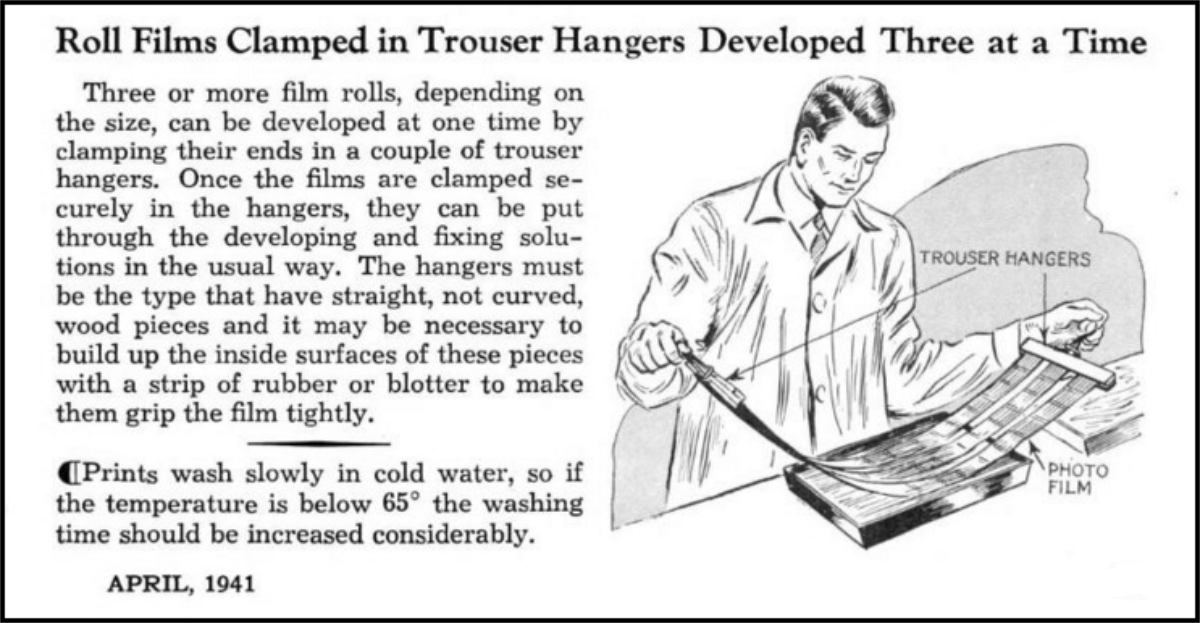
tray development under a safe light.

Toronto. Popular Mechanics often ran short ‘filler’ articles which were interesting and seemed to be practical to the frugal but of  little value. Typical is this darkroom article from the April, 1941 issue on a way to increase productivity when tray developing B&W negatives (it would help if all films were the same speed, type, and exposure).

This approach may have worked to develop orthochromatic film, but panchromatic and colour films demanded total darkness during development. Tanks accommodated the total darkness need while allowing the darkroom enthusiast to follow his/her time and temperature guidelines in full light.

Thanks to good friend and historian, George Dunbar for offering this ad and giving me the idea for this post!

Posted in history | Tagged , , | Comments Off on no tanks

about that land in Florida

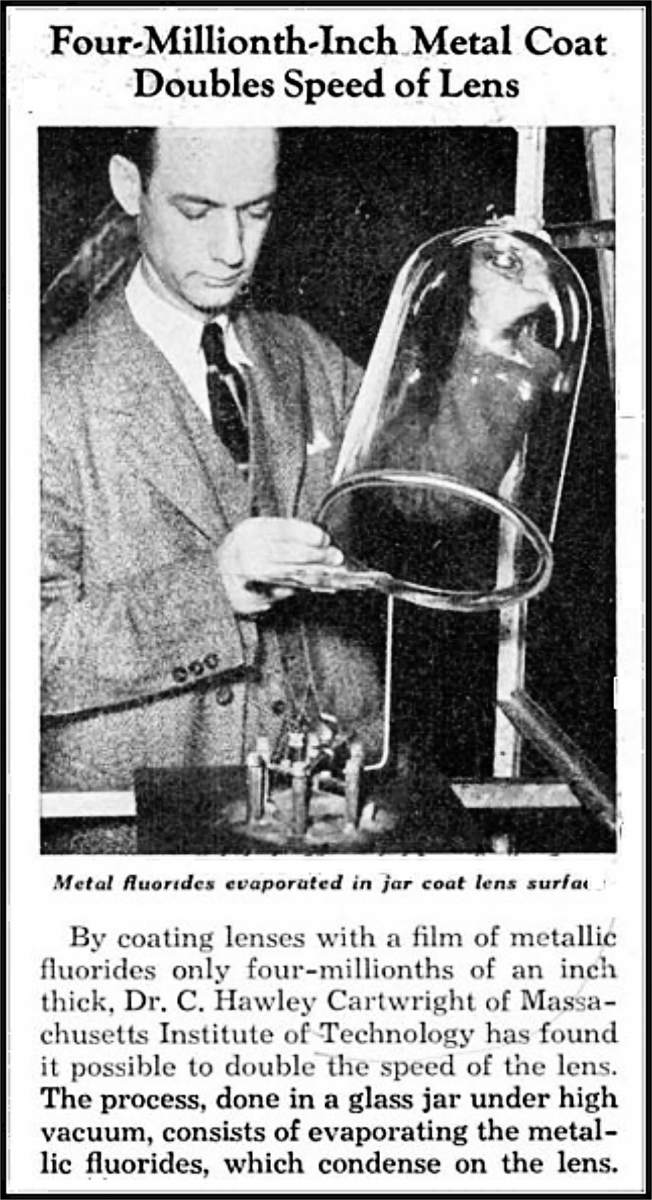
demonstrating lens coating in America just months before they entered WW2

Toronto. An article in the May 1940 issue of Popular Mechanics suggests a coating can double the lens speed (if only this were so …). We used to suggest to gullible people that if they believed something improbable, we have some (swamp) land in Florida they might like.

In reality, coating lens elements does increase the light transmission through a lens and may mean a smaller aperture can give the same amount of light to the sensitive media, but most obvious to a photographer is the increase in contrast and the saturation of colours (plus the capability to increase the number of lens elements without rapidly increasing internal reflections [zoom lenses anyone?]). Wikipedia gives a more technical explanation of lens coatings as anti-reflective coatings.

The lens ‘speed’ or aperture is a basic mathematical function:  focal length divided by the effective lens diameter or simply the f/stop. Compare, for example the coated post war and uncoated pre war Elmar 90mm lenses. Both are f/4 aperture but the coated lens gives far better contrast and colour saturation than its older sibling.

And another ‘tip of the hat’ goes to my good friend, George Dunbar for sharing this article with us.

Posted in history | Tagged , , , | Comments Off on about that land in Florida

Polarization is good for photography

Article shows how polarizing filters let an audience see 3D colour transparencies

Toronto. … but not so good politically. In the days of film, one of the tools available to the photographer was a polarizing filter. Judicious use of the filter could improve contrast and colour saturation by removing reflections from smooth surfaces.

Another major use was in colour stereo for an audience. As is well known, each eye sees a scene from a slightly different angle and the brain combines these images in 3D. Stereo viewers for individuals keep the two images separate for each eye so the brain can do its thing.  Early projection of drawings and monochrome photos overlaid the two images through rad and green filters. Similar filters over the eyes (one eye with a red filter, the other with green) showed a separate image for each eye merged by the brain to show 3D once again.

Polarized filters such as described in this February 1939 article in Popular Mechanics allowed colour transparencies to be projected and viewed in true 3D colour. This was shortly after Kodachrome came on the market.

Our thanks to good friend, George Dunbar, for the suggestion and article. Nice work, George.

Posted in history | Tagged , , , , | Comments Off on Polarization is good for photography

Wilhelm Willi Eduard Nassau 1922 2022

Wilhelm-Willi-Eduard-Nassau-1922-2022

Toronto. I was sorry to hear that a good friend and member of the PHSC passed away a few days ago. Willi was a charter member of our society, having joined in its first year. I learned about his passing in an email from his wife, Hermine. Going online, the following obituary of Mr Nassau was found and is repeated here courtesy of  Nécrologie Canada who in turn used the wording posted by Erb  & Good.

“Passed away peacefully at home in his 100th year on February 6th, 2022 surrounded by his wife, Hermine of 55 years and family. Willi will be deeply missed by Hermine, brother-in-law Josef Seidl, nephews Paul Seidl (Monique), Christopher Seidl (Diana) and son William and daughter Sara, as well as relatives and friends in Austria.

“Willi was born in Vienna where he received his early education. He then studied Fine Arts and Graphic Technology and worked in Photography, Film and Television. In 1959, Willi came to Canada. He worked for CBC and CTV in Ottawa before Willi arrived in Kitchener-Waterloo. He was the founder of the audio-visual department at WLU, then Waterloo Lutheran University, where he also taught photography and film related courses. After his retirement in 1988, Willi volunteered for over 20 years at The Canadian Clay and Glass Gallery. As a result of various projects with museums, WLU awarded Willi the distinction of Dr. honoris causa in 1991.

“Willi had many passions, photography being one of them, which was also his profession, as well as history of Roman and pre-Roman Glass. Willi had a lifelong desire to learn and as a hobby enjoyed building a model railroad based on the steam train period of the Austrian Railroad system.

“We [his family] would like to thank Parish nurse Christine Ramseyer, for her unlimited support and care, as well as our friends and neighbours for their tremendous support.
To attend the visitation and service, personal face coverings are required, and relatives and friends must RSVP at www.erbgood.com or 519-745-8445. Visitation will be held at the Erb & Good Family Funeral Home, 171 King St. S., Waterloo on Tuesday, February 15th from 2 – 4p.m. The funeral service will take place in the funeral home chapel on Wednesday, February 16th at 10 a.m. with interment following at Parkview Cemetery, Waterloo.

“For those unable to attend, a livestream will be available at www.erbgood.com. In lieu of flowers, donations may be made to the Heart & Stroke Foundation or Mount Zion Lutheran Church, Waterloo and can be arranged though the funeral home.”

Posted in people | Tagged , | Comments Off on Wilhelm Willi Eduard Nassau 1922 2022

PHSC News newsletter for February 2022

Kiev 88 – a poor man’s Hasselblad (warts and all)

Toronto. The Kiev 88 shown here is from the right top of page 1 in this month’s PHSC News newsletter. This rather poor copy of a Hasselblad was favoured byHelena Mayans who is featured on page 1.

Well, here we are in February, 2022. The local TV news reports that the omicron variant of COVID has finally crested here in Canada.  The number of COVID cases is falling now,  somewhat eased by our vaccination levels. Helping this high level of vaccinations is a close adherence to common sense guidelines by most of us.

Meantime, our editor, Sonja, and team have produced another thoughtful issue of PHSC News for you.  PHSC News (21-08) has the usual bunch of articles to tempt your fancy – short, crisp, and ripe for argument. Take a few moments and read them and feel inspired (or irritated) once again.

The “Chrome” on page 1 under “Ode to CHROME”refers to colour film by Lomography used by Helena Mayans. Page 2 in “PHSC PRESENTS (virtually)” discusses “Does Equipment Make the Movie“. NB. DON’T MISS THE YOUTUBE LINK – IT”S AN EYE OPENER! Page 3, under NEO PHOTOGRAPHY posits “Reconfiguring the Absurd for Future Photographers“. PHOTOBOOK 101 on page 4, speaks of, “Iconic Photography that Hasn’t Changed America”; while page 5 in THE OTTAWA FILE offers an editorial on the OTTAWA situation with the blockade/seige. In David’s EQUIPMENT REVIEW (always upbeat and cheeky) Classic Nikons are evaluated. John Morden’s thoughtful selection of WEB LINKS on page 7 are all worth a visit (the links are live, no need to ‘cut and paste’).

Page 8 as usual features the poster for our speaker event via ZOOM. This time it’s Dr Christine Slobogin speaking on Percy Hennell’s 1940s photographs (medical humanities). And our friends Ivy & Izzy, on page 9, are “Reflecting on the Meaning of an Original that Isn’t“. We wrap up this issue on page 10 with John’s compilation of shows, events, and exhibitions of interest to collectors/photographers everywhere.

P.S. As usual, every link shown in the newsletter is a hot link just waiting for your click!

P.P.S. You can visit this issue by clicking here, or by g0ing to the menu item NEWSLETTER at the top of the page. There is a drop down menu that takes you to older issues dating back a couple of decades to the very beginning.

Posted in newsletter | Tagged , , | Comments Off on PHSC News newsletter for February 2022

photographic ideas that fizzled

no darkroom needed?

Toronto. In 1939, some people disliked photographic darkrooms because they were ummm – dark. So somebody came up with contact print paper with a built-in orange filter and a special ‘flexible frame’. As a filler, Popular Mechanics published a small article touting the use of this special photographic paper which could be exposed and developed in a room illuminated by an unfiltered 100 watt light.

Great idea once again, but with very poor timing. Two or three unfortunate factors: It was just before WW2 broke out. It was a few years after the minicam craze made enlargers de rigueur and contact paper barely an after thought. And a built-in safelight filter must have made the paper a bit more expensive, plus the cost of the special frame, not to mention a fixed print size – and no cropping post camera!

As is often the case we must thank my good friend and photo historian, George Dunbar,  for discovering this hopeful little article buried in a February, 1939 issue of Popular Mechanics. Thanks, George.

Posted in history | Tagged , , , | Comments Off on photographic ideas that fizzled

February 16, 2022 Presentation via ZOOM

Join us at 8pm on the 16th of February via ZOOM to see and hear Dr Slobogin on “Percy Hennell’s Surgical and Nationalist Colour Photography, 1940-1948”. The poster below was designed for our February PHSC News. It states, “Dr Slobogin showcases the nationalist fervour and anxieties that dominated the consciousness of an English wartime population through the works of British photographer Percy Hennell. Relationships between Hennell’s seemingly disparate projects of reconstructive surgery, homeworkers assigned to military positions and the centrality of the farmhouse in the war effort reveal key aspects of the role of photographic propaganda during World War II.”

Register and see more about the event on EventBrite here. Problems or questions, email our programme coordinator at program@phsc.ca.

Dr Slobogin on Nationalist Colour Photography

Posted in program | Tagged , , , | Comments Off on February 16, 2022 Presentation via ZOOM