
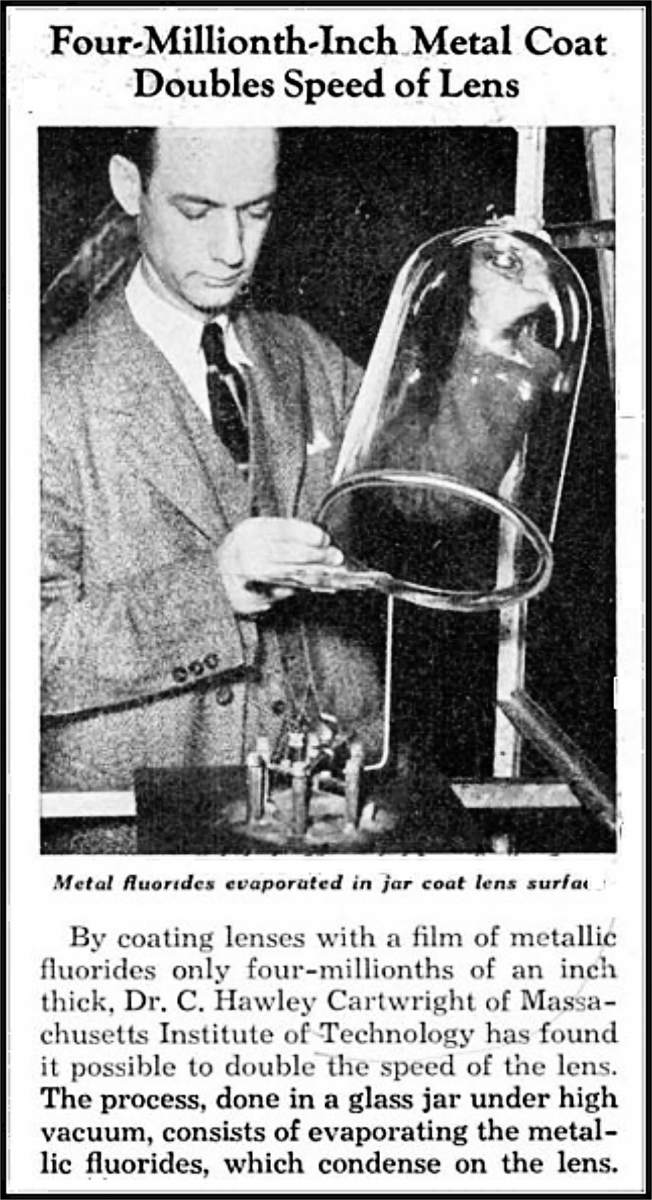
demonstrating lens coating in America just months before they entered WW2
Toronto. An article in the May 1940 issue of Popular Mechanics suggests a coating can double the lens speed (if only this were so …). We used to suggest to gullible people that if they believed something improbable, we have some (swamp) land in Florida they might like.
In reality, coating lens elements does increase the light transmission through a lens and may mean a smaller aperture can give the same amount of light to the sensitive media, but most obvious to a photographer is the increase in contrast and the saturation of colours (plus the capability to increase the number of lens elements without rapidly increasing internal reflections [zoom lenses anyone?]). Wikipedia gives a more technical explanation of lens coatings as anti-reflective coatings.
The lens ‘speed’ or aperture is a basic mathematical function: focal length divided by the effective lens diameter or simply the f/stop. Compare, for example the coated post war and uncoated pre war Elmar 90mm lenses. Both are f/4 aperture but the coated lens gives far better contrast and colour saturation than its older sibling.
And another ‘tip of the hat’ goes to my good friend, George Dunbar for sharing this article with us.


