flattened

NYC Flatiron building by Steichen

Toronto. Wow! Just over a century ago Steichen photographed the then recently completed ‘flatiron’ building in NYC (so called from its shape – we have a similar building here).

According to the article, “Edward Steichen’s The Flatiron, an iconic photo of New York, has sold for $11.8 million, making it the second-most expensive photograph ever sold.”

Apparently only three prints were ever made by Steichen. The tonality and mood of the print showed that photography could be used for artistic rendering. A fine example of the ‘pictorialism’  trend of the period.

My thanks to my good friend, George Dunbar, who discovered this article recently on the petapixel website and shared it with us.

Posted in history | Tagged , , , , | Comments Off on flattened

Bob Chambers 1939 – 2022

Bob Chambers, courtesy of son-in-law Graham Yeates

Toronto. We were sorry to hear from son-in-law Graham Yeates that Bob Chambers had passed away this November 10th. Bob spoke to the PHSC back in 2011 along with  fellow photographer and speaker, Tom Bochsler, both of the Hamilton/Niagara  area.

It was a memorable night for both the society and our two guest speakers who were very well received. The pair had accumulated well over 100 years of experience in photography.

As mentioned in the obituary, Bob was 83 years old. I personally have fond memories of that evening and the charm and wit of Bob as he showed some of his photos and explained the thinking and reasoning behind each shot. Memorable indeed!


Posted in people | Tagged , , | Comments Off on Bob Chambers 1939 – 2022

pirates of New York City

ad for the Univex Buccaneer 35mm camera

Toronto. Univex (Universal Camera Corp) advertised its Buccaneer 35mm camera in November, 1947, a few years before declaring bankruptcy. Known for their unusual camera designs, the company was said to be ethically challenged. The body of the Buccaneer shown in this Popular Mechanics ad is made of bakelite (usually used for cheap cameras).

To the unpracticed eye, the advertisement’s long list looks impressive, but to one skilled in the art of photography the list is rather long with items either redundant or simply not pertinent to good photography. The use of Bakelite is not mentioned.

My good friend, George Dunbar, spotted this ad and shared it with me. The ad reflects a bit of photographic history from over 70 years ago when American companies tried to beat the post war European and Asian competition.

Note: The post title is a riff on a Gilbert & Sullivan operetta, “The Pirates of Penzance” and couples the camera name and the maker’s supposed practices.

Posted in history | Tagged , , , , , | Comments Off on pirates of New York City

history in photos

WW1 Soldier Arthur Rawlinson from the Junction area in Toronto (west end). Killed in Action.

Toronto. Our co-editor of the Photographic Canadiana journal, David Bridge,  recently sent me a link to a CTV news item called,”Rare photos of 44 Toronto First World War soldiers discovered“.

The glass slides are professional portraits of WW1 soldiers in the Junction area of Toronto. The slides  were discovered in the estate of a Canadian military officer and are now held by Vice President Juan Jose Besteiro  of the Canadian Society of Military Medals and Insignia who was interviewed by Jon Woodward CTV News Toronto Video Journalist.

Once again, we see how photography can add interest to textural history. Some of the soldiers, like Rawlinson, died, some were injured, and others returned unscathed from the Great War. Many are listed in local area churches. Their  portraits were taken by photographer Charles Potter, who had a studio at the time at 191 Yonge St, Toronto. Potter’s studio has long since gone. Interestingly, we have an article in  issue 26- 5 of Photographic Canadiana on instrument maker Charles Potter. One and the same?? Coincidence??

Note: David is an active member of the Junction Historical Society, an area of Toronto familiar to me from various relatives who once lived in the Junction. (My dad often mentioned my grandmother had relatives there and in West Toronto). Without photography, these century old images may never have been captured.

Posted in activities-other | Tagged , , , , , | Comments Off on history in photos

she’s baaack!

WW2 – working to make weapons for Canada. Courtesy of Heritage Mississauga

Toronto. I did a post back on June 2nd noting that the iconic Sunday Antique Market in St Lawrence Hall was closing. I saw in the November 10 Etobicoke Guardian (the local free rag) that Marlene Cook was reopening her Sunday Antique Market (SAM) in the Small Arms Inspection Building (SAIB) just down the road from where we hold our auctions (just the other side of Marie Curtis park in Lakeview – my grandfather once worked there).

The folks at the SAM write on their website, ” In 1940 the site [SAIB] became a large munitions plant, manufacturing rifles and small arms for the Canadian Army through the Second World War. It was a key industry in Lakeview.

“By 1943 the factory employed more the 5300 workers, two thirds of whom were women, playing a major role in the allied war effort during the Second World War and demonstrating their ability in a field that had traditionally been considered “men’s work.” This new role was instrumental in recognizing women’s importance to the workforce in Canada, creating significant change in Canada’s work life.

“The factory, known as the Small Arms Inspection Building (SAIB), was slated for demolition in 2008 and purchased by the City of Mississauga in 2017.

“Located at 1352 Lakeshore Road East it’s a three minute drive from the Long Branch Go Station or a brief 10 minute walk. It’s also a short stroll to the lake for those who want a few moments to commune with nature.”

Some members had tables at the SAM as well as at our events. Drop by and see if you can augment your collection!


Posted in activities-other | Tagged , , , , , , , | Comments Off on she’s baaack!

win some … lose some …

Sunflower from our garden in 2004 taken with a Nikon E990 3.3mp digital camera in daylight outdoors.

Toronto. Did you ever think about technological trade-offs? Overtime better ways to manufacture; better quality; lower cost; broader acceptance; etc. all worked together to wring out lower cost and better quality to the consumer.

Just consider photography. In the early days a photographer was a businessman, an artist, and a scientist – or a failure. As time moved on, photography became easier, cameras more complex and lens design improved to ease aberrations while helping to add light to the dismal speed of sensitive media.

A successful photographer had to understand the effect of aperture setting and lens focal length on depth of field; shutter speed on the success in capturing a ‘decisive moment’; the correct choice of film to balance off contrast, resolution (grain) and speed; lighting and light positioning; choice of subject; subject framing; colour temperature of the lighting; white balance; etc. While in the darkroom, the choice of chemistry and paper were critical to the final result.

To today’s smartphone users, almost all this is passé. Only some of the artistic side remains. Most shots are technically correct and the artistic eye reigns supreme. As long as there is enough light, then choice of subject and framing are key to a memorable photo. Lenses are of such a short focal length that depth of field is very wide (and some phones like the iPhone have software that can ‘fake’ depth of field/aperture setting and even light positioning – all post shooting).

On the other hand, digital images can be taken by the dozens at no apparent added cost. Many smart phones even take multiple sub-second shots and choose the ‘best’ using a built-in algorithm. Once snapped, a photo can be saved in the phone, in a computer, uploaded to the cloud, or sent to friends and family anywhere in the world in seconds!

Posted in history | Tagged , , , | Comments Off on win some … lose some …

do you remember …

This is the grave of a soldier who died in WWII on July 8, 1944 at 26 years of age.

Toronto. Take a break and honour our fallen soldiers today. In Canada, we hold Remembrance day on November 11th with the minute of silence at 11am. During the silence we remember all those fallen who gave their lives to let us live in this democracy.

At left is the grave in Europe of a cousin I never met who died in WW2. Our family had uncles and grandfathers in the great war and uncles and cousins in WW2.

In Flanders fields the poppies blow … is a line from the haunting poem written by a local doctor in 1915. He died in Europe just three years after penning this tribute. He was 45. We learnt McCrae’s poem as children.

Posted in activities-other | Tagged , , | Comments Off on do you remember …

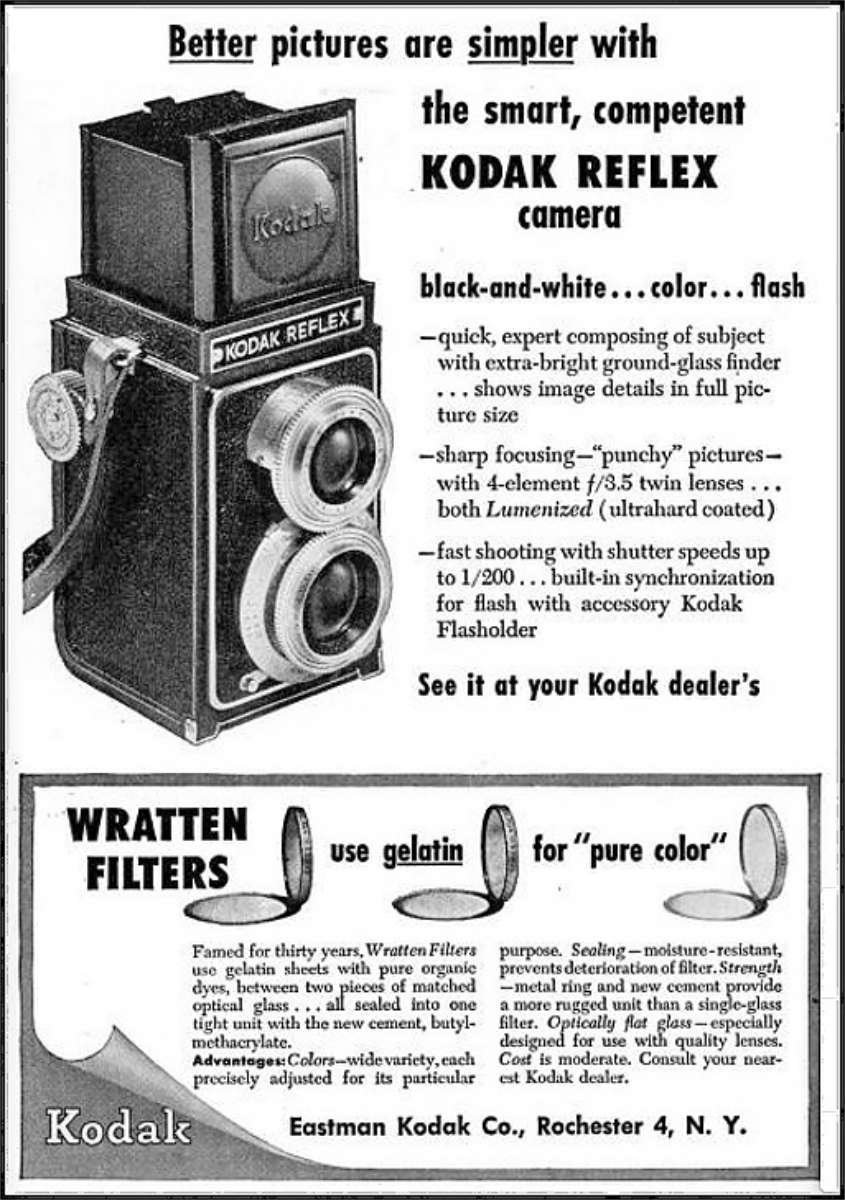
a Kodak ‘Rollei’

1947 ad for an American TLR made by Kodak

Toronto. In its hey day, Kodak made a variety of camera formats. One was a twin lens reflex design competing in a market held by Rollei at the high and medium end.

Like its German competitor, this TLR captured photos in the familiar square format, but on 620 rather than 120 roll film. Not as well designed as the Rollei, it was a ‘made in America’ competitor.

Thanks once again to our good friend and fellow photographic historian, George Dunbar, for sharing this bit of post war history with us.

Please note: if you want one for your collection, visit one of our events. The auction next month may be a source for this and other user and collector cameras and other gear. Check it out.

Posted in history | Tagged , , , , | Comments Off on a Kodak ‘Rollei’

shooting star

Ad for the Meteor camera – a $15 wonder according to its maker, Universal Camera Corporation

Toronto. This May, 1947 ad from Popular Mechanics touted the Meteor – a cheap 620 camera designed like a 35mm camera – as ideal for “photo-eager folk who want to start on the streamlined path to a great photo-future”.

The maker goes to great lengths to list the ‘professional features’ of this camera – and its low price! Aside from Kodak’s high end models, US camera makers mostly went for the low hanging fruit – and a good bottom line over design or quality.

The Meteor hung around briefly but McKeown’s 11th (2001-2) shows a clean camera was worth 5 to 15 dollars to collectors before the digital era trashed prices on most cameras. We owe a big thanks to my good friend George Dunbar for sourcing and sharing this post war bit of photo history.

Posted in history | Tagged , , , , , , | Comments Off on shooting star

the Leonards of Port Perry

1991 article from the Port Perry Star

Toronto. The brief newspaper article titled “Port Perry recorded on film by the Leonards” caught George Dunbar’s eye. George writes, “This item from the Port Perry Star of Oct. 1, 1991 leads me to believe that the skylights of Leonard’s Studio may be seen in the photos I made at the corner of Queen and Perry Streets (see photos below from 2016).

“A PHSC member living near Port Perry may wish to investigate this interesting speculation.”

Click the respective links to see photo 1 and photo 2. George has added a yellow ring to highlight the area of interest to him. Let me know via info@phsc.ca if you can help and I will forward your message promptly.

Posted in history | Tagged , , , | Comments Off on the Leonards of Port Perry