leaping’ lizards, Sandy!

Article on the popular View-Master projector in Popular Science magazine

Toronto. … as Little Orphan Annie often said to her mutt … This article from the start of 1950 reports a colour projector for less than a sawbuck!

While the inexpensive bakelite device projected Kodachrome slides, there was a small hitch. It accepted only View-Master reels – those seven scene, 14 slide, marvels that were viewed as stereo in  a viewer or projected as ‘flat’ slides with this little guy.

We were blessed on our September, 2006 Stereo night to have the Sells (Mary Ann and Wolfgang) as featured speakers on View-Master of which the two were preeminent collectors.

NB. Since we borrowed Annie’s favourite saying as the post title, I felt it was appropriate to feature the best song from the stage and movie production of Annie, “Tomorrow“.

Posted in history | Tagged , , , , | Comments Off on leaping’ lizards, Sandy!

moonshot

Astronauts on the moon – summer 1969

Toronto. Nearly 54 years today, on July 21, 1969, our world changed forever. Exciting news – man first walked on the moon. This photo, of Buzz Aldrin was taken by Neil Armstrong with a 70mm ‘Lunar Surface Camera’.

Science students for decades were told the first step to the ‘stars’ was to have an engine strong enough to break free of earth’s gravitational pull. Post WW2,  rockets had the potential but it took over another decade to refine the rockets and engines and fuel to succeed.

In the late 1950s, we were electrified to hear the sounds from Sputnik – Russia’s and the world’s first man made satellite to circle the earth. A bit over a decade later an inspired USA managed to land on the moon. And here we are again on the eve of the second effort to land on earth’s natural satellite. Meantime, we have landed on Mars, shot giant telescopes to circle beyond our atmosphere, sent rockets and robots to the farthest reaches of our galaxy – and relied upon photography to remotely record images and findings and carefully send them back to earth line, by painfully slow line, all electronically.

From the beginnings of photography man has taken photos of the sky and its celestial bodies. And as noted above, in modern times, cameras have been placed on board rockets,  capturing images and sending them back to earth for viewing and scientific analysis.

Photography has come a long way from artistic portraits and landscapes for the wealthy and middle income folk to being indispensable for the scientific in all walks of life. I wonder if anyone thought of photography’s potential? Certainly a far cry from the idea of automatically creating printable images in books, magazines, etc.


Posted in history | Tagged , , , , , | Comments Off on moonshot

treasure in the trunk

a sunny summer day in 2015 at the Trunk Sale

Toronto. Our spring auction and spring fair can be seen in the rear view mirror, if you look carefully. The next PHSC event is in July: the Trunk Sale – held in memory of one of our founders, the late Larry Boccioletti who began these sales in his own back yard.

As you see by the right hand side bar, this July the fair is on JULY 16th (Sunday) 2023 outdoors at the Trident Hall located at 145 Evans Ave (Islington and Evans), Toronto. As usual we will have free parking. Keep an eye on this web site for details.

Meantime call Clint fair@phsc.ca for more info. Space is limited but on a first come basis as usual.

Note: I first thought of the expression, “junk in the trunk”, but decided to use treasure instead as after all, one man’s junk is another’s treasure …  And like my collection, your’s likely has more than a few gems that others simply saw as ‘junk’ resulting in a good price.

Posted in activities | Tagged , , , , , | Comments Off on treasure in the trunk

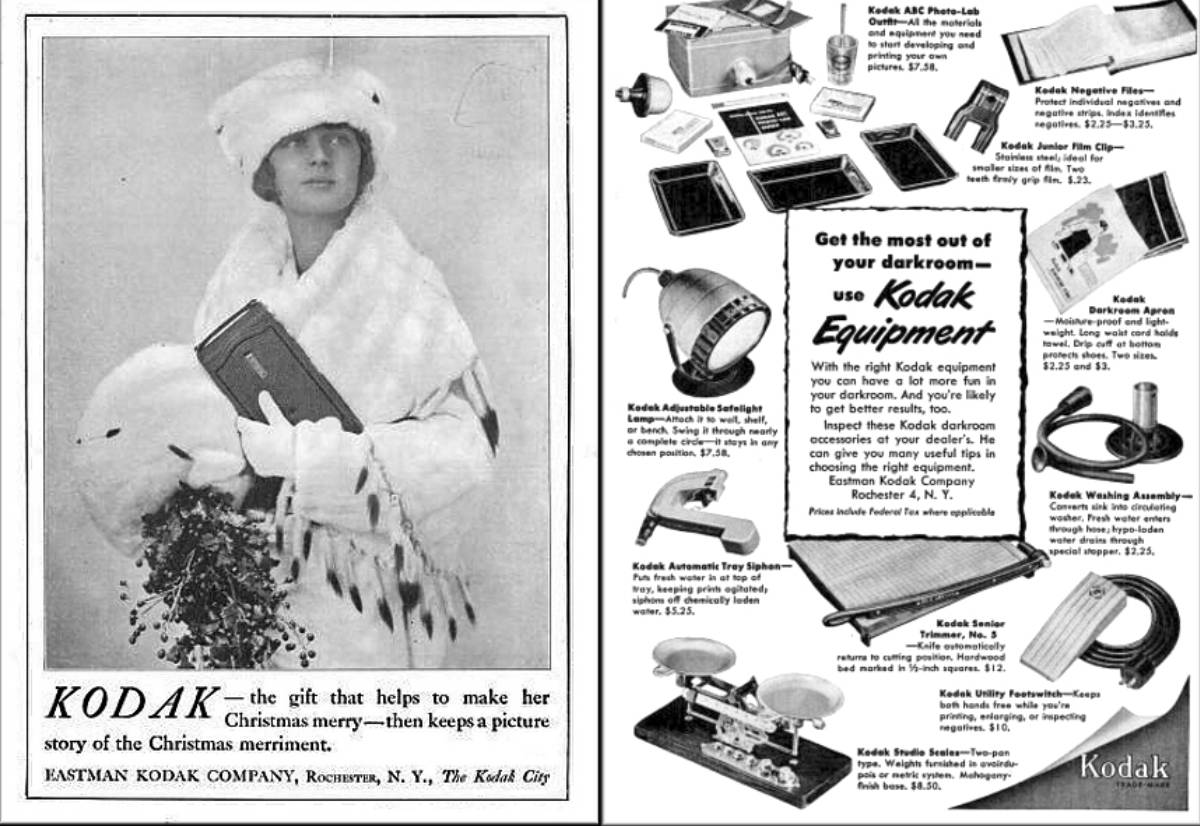
a tale of two ads

the Kodak Girl and camera – Jan 1920 ad

Toronto. That persistent seeker of photo history, George Dunbar, spotted these ads by Kodak while browsing issues of Popular Science.

George thought it interesting that Kodak chose to feature a young lady carrying an autographic Kodak camera in its January 1920 ad while three decades later, the far larger company chose to feature the darkroom equipment it manufactured and sold, all in the interest of selling films, chemicals and paper devoted to amateur photography.

By January, 1950 the use of women in ads was very common, so perhaps Kodak, then well established, chose intentionally to feature products it and instead to attract the burgeoning amateur market. In any case a short time later it became unwise to feature the fair sex in advertising.

NB, The title of this post is a riff one one of Charles Dickens’s book titles, “A Tale of Two Cities“.

Posted in history | Tagged , , , | Comments Off on a tale of two ads

casting away

A bronze casting of a sailing ship as a night-light c1945

Toronto. When I was a kid around the end of WW2, my dad took me to visit a relative who had a metal casting business, Bill made sailing ship lights, ‘doggie’ banks, souvenir lights, etc. like the sailing ship light shown here. He used something called a lost-wax process to cast his wares, mostly in bronze.

Seeing the items Bill made in the 1940s, reminded me of the thick catalogues of the day which contained photographs of hundreds and hundreds of items, each with specifications and price (of course). Such photography is another example of how photographers and studios carefully work with other industries. In this case to produce product photos for catalogues, brochures, advertisements, and more.

In fact, one of our editors, the late Ev Roseborough, did considerable catalogue work for major department stores who had large mail-order clientele beyond the city. The capturing of retail items for these catalogues etc. was a busy industry in the days of film. Today, many products are on the internet but photographers (mainly digital) remain very active providing the necessary images. Different times. Different processes.

Posted in history | Tagged , , , , | Comments Off on casting away

Wolfgang Tillmans at the AGO

Toronto. The PHSC saw presentations by AGO staff  member Maia Sutnik a number of times, both at the North York Hall and at the AGO building. we first met Maia when she was curator of the AGO’s Photography section. She was a long time member of the PHSC and her successor, Sophie Hackett is also a PHSC member.

This year, the AGO is featuring an exhibit of the works of German photographer Wolfgang Tillmans. The exhibit runs from April 7th to October 1st.

An article by Matthew Rolfe, in Foyer says in part, “Wolfgang Tillmans was recently named by TIME as one of the one hundred most influential people of 2023. His extensive oeuvre of photographs, video projections, sound installations, and his ongoing project Truth Study Center spans almost four decades, symbolizing his ardent passion for the human condition. On view now at the AGO, Wolfgang Tillmans: To look without fear represents the world-renowned German artist’s first-ever comprehensive survey exhibition in Canada.

“Organized at the AGO by Sophie Hackett, Curator, Photography, with Marina Dumont-Gauthier, Curatorial Fellow, Photography, To look without fear debuted last year at The Museum of Modern Art in New York. The show features more than 400 artworks, including vivid images of nightlife, intimate portraits, documents of social movements and the 2SLGBTQ+ community, astronomical phenomena, abstract works and rarely-seen videos.”

Posted in activities-other | Tagged , , , | Comments Off on Wolfgang Tillmans at the AGO

photography and real estate? really?

A look c1960 at the back of a home on a corner lot

Toronto. Real estate is a huge user of photography, even today. In the 1930s, Realtors like CYRIL R. DEMARA CO. LTD. would own engraved cameras (the engraving shown is on a 1937 Leica IIIa).

Others then and now would choose to hire a professional to take representative photos, etc., often using wide angle lenses, special lighting and (in the days of film or videos) tripods.

Photographs let potential buyers view the property in advance and later at their leisure. Today the photographs are in colour showing every room, the house exterior, and the property. Often a short video would be taken, or a slide show of stills created, or a form of VR offered letting  the prospective buyers and the just plain curious look through the house and all its staging on their  computer sitting in a comfortable chair.

More recently, there is a growing trend to photograph empty rooms and then via computer fill them digitally as desired by prospective buyers using their choice of furniture, colours, and placements.


Posted in history | Tagged , | Comments Off on photography and real estate? really?

for the record

A train wreck on the QNSL railway carrying ore from the mine at Schefferville, Quebec – May 1959

Toronto. One very special use of photography is recording problems for insurance or police.

We often think of portraiture, street scenes and landscapes, but this important function gives visual detail not easily conveyed by the written word.

Disasters like this train wreck over sixty years ago are given vitality even today in photos long after the issue was restored to normal and financial arrangements made.

As to photography’s use in crime resolution, even books have been written on the topic. And in 2007 we had a member of the local police do a presentation of photography’s valuable contribution to crime solving here.

Posted in history | Tagged , , | Comments Off on for the record

another one bites the dust

dead beetle taken in closeup with Leica M4 and bellows

Toronto. Well, May 2o23 is but a memory. I guess the late Freddie Mercury said it  best (just ignore how he looks).

Speaking of closeups, capturing photos of tiny objects at life size or even larger takes extra care with the film camera, lighting and tripod.

And you need a means to extend the lens to film distance, usually by extension tubes or a bellows but occasionally by closeup lens elements (most standard focal length lenses cover down to 1 metre or in some cases a 1/2 metre).

If you haven’t attempted closeups, be sure to try them. The magnification sheds a whole new light on what were otherwise mundane subjects. Today’s digital technology with auto focus down to a few inches/cm kinda spoils closeups – and auto focus in itself can be a real challenge…

Many books cover closeup techniques. One excellent book is “The Manual of Close-Up Photography“, a soft cover book c1979 (not 1784 as listed)  by Lester Lefkowitz and published by Amphoto. I learned a lot from Mr Lefkowitz and occasionally loaned this book to friends.

Posted in history | Tagged , , , , | Comments Off on another one bites the dust

computer to the rescue

Employment selection before AI – Popular Mechanics Oct 1953

Toronto. In the early 1950s we were blessed with very costly and very crude computers (and little idea of how they could be used). A decade later, massive ‘mechanization’ projects were underway to use computers to do the work of clerks doing routine tasks – like preparing and printing telephone bills.

Another example was a ‘robot psychologist’ to match employees with jobs based on their perceived skill set. This 1953 article discovered by George Dunbar in his diligent pursuit of photographic history shows how photography was the preeminent recorder of history.

The article shows the American Army finding ‘the right men for the right jobs’. Photography helped illustrate the gigantic control centre of the computer with what is now deemed a ‘tiny brain’ –  32 kilobytes or less …

The title of this post is a riff on a 1960s song by a rather gross band. The song is, “Jim Dandy to the Rescue” by  the Black Oak Arkansas.

Posted in history | Tagged , , , | Comments Off on computer to the rescue