A Mystery Tower 35mm Camera

Stan’s Mystery 35mm Sears Tower camera

Toronto. Years  ago it was common practice to rebrand products from national factories for sale in large chain stores. Sears was no exception. Its line of cameras were branded “Tower” but actually made by mainstream companies in Europe and Japan with slight modifications to the originator’s other models.

It was common practice as well to use leaf shutters and a removable front element to adjust a better quality camera’s focal length. Steinheil, now long disappeared, made excellent quality photographic lenses last century.

The body, lens and shutter choice suggests this particular camera was a product of Germany’s famous Braun factory.  Confirmation and more historical details are most welcome – drop me a line.

Posted in Uncategorized | Comments Off on A Mystery Tower 35mm Camera

PHSC News 16-9

Bolex H16 camera famous as a high end consumer movie camera.

Toronto. The latest issue of PHSC News, issue 16-9 has been distributed. With this issue, we shift the editorial duties from David Bridge to Sonja Pushchak. Sonja was instrumental in redesigning the newsletter to modernize the approach of PHSC.

A big tip of the hat to David for his successes in editing the newsletter and seeing it was released on time. David was the spark to moving the distribution list from a private system to MailChimp with its wealth of statistics. David remains the Assistant Editor, testing cameras, writing a column on cameras, and distributing the newsletter.

You can click here or on the Bolex icon to see this edition. The lead story has a Valentine’s theme; our February speaker is introduced; and film revival is discussed along with the first of a series of articles on trying traditional film photography. We wrap up this issue with the popular Ask Vicky column, coming events, and classified.

Posted in newsletter | Tagged , , , , , , | Comments Off on PHSC News 16-9

With Film, you can feel the photography…

New film for old 35mm cameras

Toronto. George Dunbar mentioned this wonderful link to CBC news the other day. Journalist and native of PEI, Sara Fraser of CBC wrote this article about a little camera store on Queen Street in Charlottetown.

The store, P.E.I. Photo Lab, has operated for over 3 decades. With film photography experiencing a small renaissance, it’s happy to be part of the excitement. The operators will develop and print film both new and old, keeping the customer cost down by processing below their cost. Students from nearby Holland College make frequent visits to the store.

Photographer Alhan Ashnaei purchased the store in 2012. In addition to selling photographic goods and services (film and digital), he and his brother display many old cameras including a view camera once used by his grandfather in Iran. The family moved to Kuwait and founded a successful photographic studio there before deciding to emigrate to Canada.

Posted in camera, miscellaneous | Tagged , , , , , , , | Comments Off on With Film, you can feel the photography…

Review of Shanebrook’s epic “Making KODAK Film”, 2nd Edition

Making KODAK Film 2nd Edition by Robert Shanebrook

Toronto. Newsletter impresario David Bridge shows his other talents in this erudite and thoughtful review of Shanebrook’s massive 2nd edition of his Making KODAK Film book. Well worth the price of $100 USD, the book provides technical details showing just how important Kodak was to the photographic world in its pursuit of perfection in photographic films and papers. You can order the book (recently reduced after a lower than expected production cost) by visiting Robert Shanebrook’s website here.

I took the liberty of including a pdf version of the review here. The review is included as a SUPPLEMENTAL EXTRA with the latest edition of Photographic Canadiana, 42-4.

Posted in book | Tagged , , | Comments Off on Review of Shanebrook’s epic “Making KODAK Film”, 2nd Edition

A Little Paint, A Little Pencil

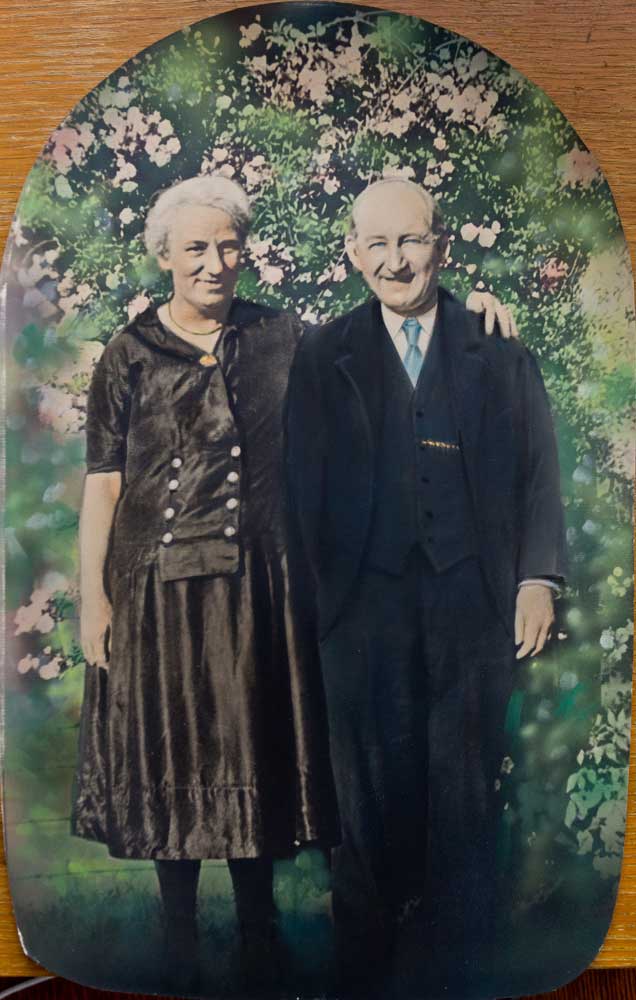
Lizzie and Art Mosher in the late 1930s

Toronto. Professionals liked the larger negatives and glass plates last century before the onslaught of the minicam. The plates and cut films could be easily retouched by a skilled practitioner.  Contrast could be varied or features emphasized by careful use of pencil lead and an x-acto knife. The lead could emphasize detail or lighten highlights while the x-acto knife could carefully scrape away layers of emulsion to deepen the shadows.

Colour was a fading proposition in the mid last century. More  permanent black and white prints could be coloured with inks applied to the surface. Special dyes were sold that covered a wide gamut of colours. I remember a studio in Midland, Ontario that offered large hand coloured prints based on a monochrome portrait taken by them. They emphasized the durability and permanency of this rather expensive approach.

My grandparents had a black and white portrait taken outdoors in the mid to late 1930s at their home in Long Branch. When their daughter married my father and moved north of the city, my dad had the print coloured. Continue reading

Posted in Uncategorized | Comments Off on A Little Paint, A Little Pencil

A Wide View Vista

An air nozzle used to operate a spinner on the Goerz Hypergon lens of 1900.

Toronto. The earliest camera lens designers were more concerned with plate coverage than aperture. Often a lens was described in terms of coverage –  half plate, full plate, etc.

Numerous strategies were used to allow a greater coverage – mechanical devices like the little air fan Goerz used in its Hypergon lens to lower the light from the central rays, a special filter to reduce the light from the central rays like Zeiss used for its 1970s 15mm Hologon lens – or simply reduced apertures like the Leitz Hector 28mm f/6.3 and many other lenses used.

The Hypergon used its spinner for about 5/6 of the exposure to hold back light from the central rays. The last 1/6 of exposure, the little fan was flipped back and the central rays allowed to exposed the plate too. Continue reading

Posted in camera | Tagged , , , , | Comments Off on A Wide View Vista

A Repeating Flashbulb (November 1941)

Mechanix Illustrated –  a repeating flash

Toronto. We never think about flash or flash bulbs today. With our digital cameras or smart phones a built in flash automatically goes off  (or the camera/phone warns us) to provide sufficient light. Even in the 1950s (unless you were well heeled or a pro) people used flash bulbs and flash guns to add illumination so the painfully slow film of the day could be used indoors or at night.

Edgerton at MIT in the USA experimented with electronic flash that operated at an astonishing speed of 1/20,000 second (give or take). And the November 1941 Mechanix Illustrated (not always the most reliable source – great in this day of alternative ‘facts’) reported on a repeating flash. The flash was depicted in use by a diminutive young women holding a massive news camera to her eye. Attached is the ‘repeating’ flash gun and over her shoulder hangs the heavy case holding the batteries and capacitors that trigger the flash. I had a used Ultrablitz Reporter IIL in the late 1950s that was only slightly smaller in size and fired at 1/800th to 1/400th of a second. It was capable of firing two flash guns simultaneously.

This 1941 ad is courtesy of an email from George Dunbar. George adds this comment, “That’s quite a portable power unit there. Then again it’s also a pretty big camera. I think it’s funny that they always use female models for these things. While I get the ‘it’s so easy a woman can do it!’ angle, it tends to make big things look more unwieldy.”

Posted in camera | Tagged , , , , | Comments Off on A Repeating Flashbulb (November 1941)

JollyLook Instant Camera

JollyLook Instant Instax Camera from Popular Photography article.

Toronto. Thanks to Russ Forfar for this link to a blast from the past as a Toronto AM music radio station used to say before playing a musical oldie. In my youth a number of photography magazines served us instead of Google and the web to show the newest ideas, how to do better at photography, test and compare camera gear, etc.

Russ passed on this link to Popular Photography. An article called “Jollylook Is an Instant Film Camera With a Vintage Look and a Body Made of Paper and Cardboard” is the subject of the latest GEAR column by Stan Horaczek. The little camera is another user of Instax Instant Film, a film brand by Fujifilm of Japan. The link has a short video loop showing how you crank the print through the rollers in camera to develop and fix the image. The company plans to make this camera and is raising money through crowd sourcing a recent phenomenon which circumvents traditional means of raising funds. Continue reading

Posted in camera | Tagged , , , , , | Comments Off on JollyLook Instant Camera

It’s a digital world after all!

Fibre Cable ready to be installed underground

Toronto. I woke this week to a heavy rumble. Bell finally began to install fibre lines on our street. In the next few weeks we will be able to switch our TV and land line telephone over to the internet and the internet protocol. This system, called Fibe TV, offers fibre to the home and high speed internet downloads and uploads, plus IPTV up to 4K – about 8x the resolution of the over the air TV I grew up with. Our best TV receiver at home at present is HD or high definition which is 4x the resolution of traditional TV.

We have seen the digital wave wash over and nearly crush traditional film based photography, nearly bring newspapers, magazines, and books to their knees, wipe out travel agencies and the music business, push traditional stores to the brink, and revolutionize our appliances and automobiles. This week I had my teeth x-rayed (a two year routine). The  dental assistant used a tiny sensor in my mouth and a small x-ray machine against my cheek. In seconds the result was on her computer screen. Low dosage and rapid results all thanks to digital technology.

Today’s cameras are almost all digital – in fact they are often smart phones. The most common camera on Flicker is the iPhone. It’s a digital world after all!

Posted in miscellaneous | Tagged , , , | Comments Off on It’s a digital world after all!

Watch the Birdie

Toronto. My thanks to friend John Linsky for reminding me of the old photographers who used a novelty to attract the attention of smaller subjects (John has some of these too). In the 1800s and early 1900s it was important that subjects sit still for a few seconds – or minutes – to have a decent portrait captured in the studio.

A typical gadget was this small brass bird which was mounted on the big studio camera and would chirp when the photographer pressed his rubber ball to snap the photo.

One of our members had an original birdie which he happily displayed at a meeting for all to see. The little brass bird sparked the popular expression “watch the birdie“. The icon and link will take you to an article on the birdie at Smile for me Toys.

Posted in camera | Tagged , | Comments Off on Watch the Birdie