Rochester Library Website

Cover – 1906 Kodak Catalogue at Rochester Library

Toronto. My good friend Werner Drechsel pointed out the interesting “Central Library of Rochester and Monroe County” website. On it is a Kodak 1906 catalogue in pdf format which  makes a great read and research tool.  Have a peek at it. If it is oversize in your browser, download it and view it in a pdf reader.

Werner mentions that the site came up when he was researching B&L shutters.

Posted in history | Tagged , , | Comments Off on Rochester Library Website

Zeiss and Photography book goes on sale

This gallery contains 1 photo.

Toronto. Larry Gubas has asked Petra Kellers at Camerabooks to discount his opus on the iconic Zeiss organization and its involvement in photography. This massive 7 pound book has letter size pages in full colour plus an added DVD containing … Continue reading

More Galleries | Comments Off on Zeiss and Photography book goes on sale

100 feet of Pan-X

100 feet of Pan-x film

Toronto. I mentioned a while back that bulk film loads saved money. You spoolled just what you needed in 24 or 36 frame increments using new, used, or special cassettes – and a bulk film loader plus a reel of bulk film.

100 feet came in a sealed light tight metal can 4 inches across and 35mm deep. The reel of film was encased in a light tight black paper bag and secured with a strip of paper forming a ring around the reel.

Some colour films, like Anscochrome, were pre cut in 36 frame lengths with special template cuts marking off each 36 frame length of film. Other films, like Kodak’s Pan-X or other Kodak and Ilford black and white negative film came in simple spools of 50 or 100 feet.

Some makers like Leitz sold special cassettes while users could buy new empty cassettes or save up used cassettes and ignore the “single use” caution (these cassettes used felt light traps which might trap dust and dirt making “tram tracks”along the film strip as each new frame was moved in place in the camera).

I used all three varieties of cassettes over the years with no apparent difficulties. Leitz cassettes where heavy brass and used a special light tight door which opened wide once the cassette was loaded in their Leica cameras. Their cassettes started out cheap but near the the end sold for about $100 each retail!

Posted in camera | Tagged , , , , | Comments Off on 100 feet of Pan-X

1958 – what a year! what a decade!

August 11, 19958 article in LIFE

Toronto. On page 13 of the August 11, 1958 issue of LIFE magazine is the lead article touting the amazing rise of photography in the States (and, although left unmentioned in this American-centric magazine,  around the world, too) over the decade of 1948-1958 – and 1958 was barely half over at the time.

Like I noted in the recent posts, it was indeed the golden age of photography. The photo selected here is a convention of Jehovah’s Witnesses at Yankee Stadium in the big apple. Sitting on the dugout roof are a flock of photographers – most if not all amateurs. Cameras range from dead-simple box cameras to the most elaborate models made at the time.

All cameras then used film. In fact, most amateurs used black and white negative film. Marketeers struggled mightily to encourage the shutter bugs to move to colour and flash using American made cameras, films, and bulbs. Short years later American cameras (except Kodak) and flash bulbs had sunk beneath the waves of history seldom to be seen again. This was mostly followed around the end of the century by film itself as digital and smartphones took over.

Today, film technology is a stubborn niche process practiced by students and historians alike. Fairs and auctions like our PHSC ones serve these communities as well as collectors with cameras, accessories and materials no longer sold in retail shops!

Posted in magazine | Tagged , , , | Comments Off on 1958 – what a year! what a decade!

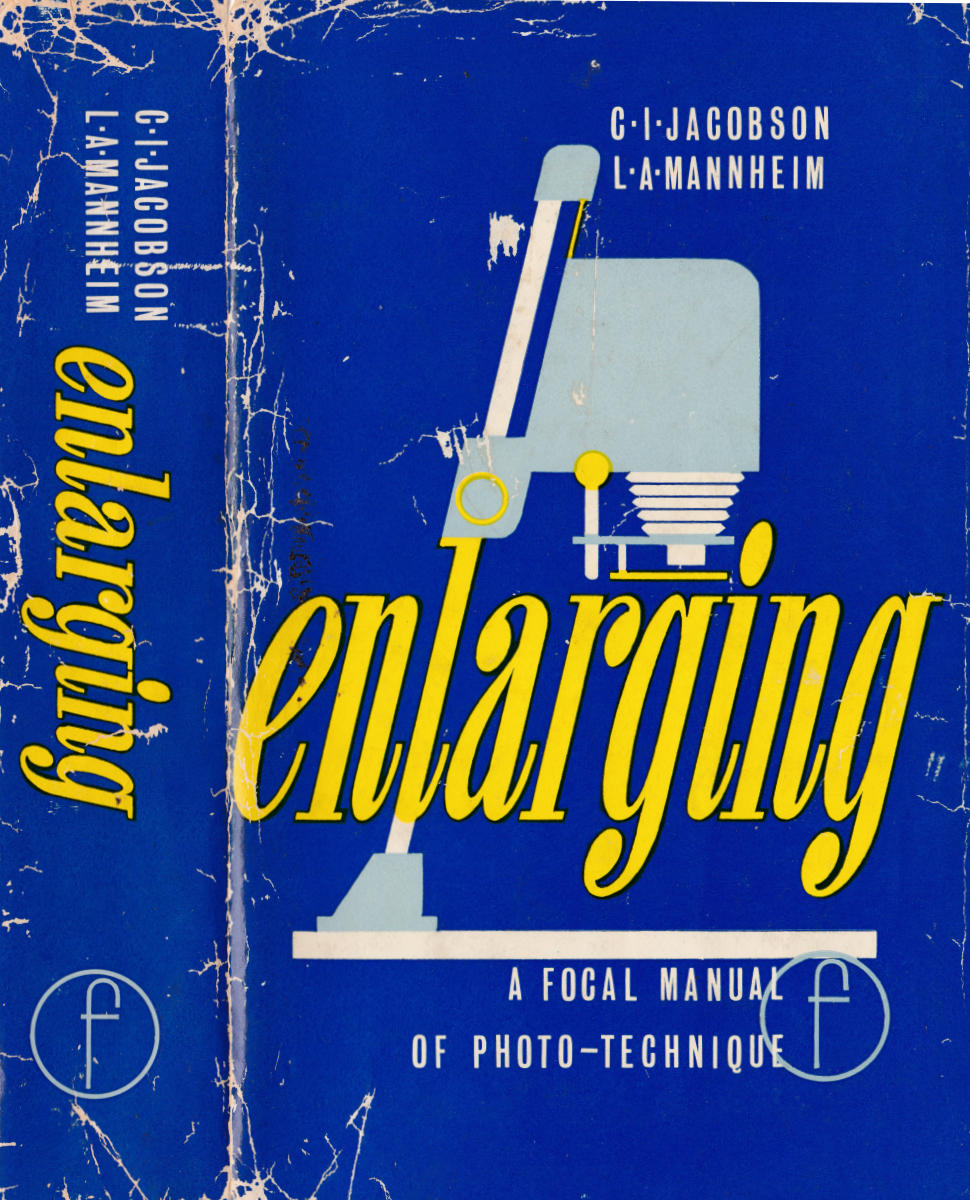
enlarging

19th edition of enlarging (1969), by Jacobson and Mannheim. Published by focal press

Toronto. Well into the late 1940s, most photographers made contact prints. A camera was chosen for the size of the negative it made. In the mid 1930s, the so called minicam revolution was under way. After the second world war the use of small negatives and enlargers became almost universal.

Even newspapers switched from the bulky large format cameras and contact prints to the small negatives and enlargers. Darkrooms without enlargers became a thing of the past.

In 1939, the very first edition of C. I. Jacobson’s book, “enlarging” was published by the focal press. By 1967, the book had reached nineteen editions and was now co-edited and co-written by L. A. Mannheim. I bought my copy new from Rodick’s Booksellers on St Catherine Street in Montreal, a few blocks west of Peel, in August of 1969 for the princely sum of $9.95.

The 525+ pages of this edition covered the finer points of darkroom work for the films of the day. Those who have grown up in the era of digital photography, computers, and smart phones have no idea how much skill and effort it took in the darkroom to create a technically solid print even before art considerations entered the picture and turned a snap-shot into a work of art!

Posted in book | Tagged , , , , | Comments Off on enlarging

exposure

Exposure by W.F. Berg 1955 focal press

Toronto. Mid last century was the golden era of photography. The processes were getting better, cameras were becoming more ergonomic and precise, and technical and coffee table books were offered in wild profusion. Capitalizing on this renaissance was focal press in England. The publisher produced books on every imaginable photographic topic.

The books had a style all their own. Text was profusely illustrated with tables, nomograms, and diagrams galore.  A few plates of photographs were printed and tipped in in clusters to illustrate a particular technique.

Exposure by W.F. Berg was typical of the focal press books. It was first published in 1950 and again (second edition) in 1955. Mine is a second edition which I bought used ($3.00) in October of 1960 at Mitchell Photo Supply which faced Dominion Square in Montreal.

Exposure was one of the single word titles in the Photo-Technique series edited by A. Kraszna-Krausz. Exposure actually covered the fundamentals of camera technique in about 440 or so pages. I bought many of the focal press books over the years and educated myself reading them from cover to cover and applying the learned knowledge and skills behind my camera and in my darkroom.

It was a far cry from today’s digital mavins who often get excellent photos without a thought about technique or concept. In the days when you had to understand the technology to get a decent photograph, materials cost money which was often in short supply. I look back on my negatives today and marvel at how few shots were taken during any one event. Every shot counted so technical skill and good framing were essential.

With our digital camera or smart phone, we take dozens of shots expecting at least one to be technically sound and worthy of saving. As all the others were basically zero added cost,  we can delete them with a clear conscience.


Posted in book | Tagged , , , , | Comments Off on exposure

light and bright

LIFE ad for Argus projector

Toronto. What could those 8mm movie fanatics really, really want in a projector? Tiny? Compact? Light? Room filling? Bright? All of this and more?

According to this September 15, 1958 ad in LIFE, Argus created all these things. Through engineering, the projector was shrunk in size and reduced in weight. A fast (f/1.5) wide angle lens made it room filling and the use of a special Sylvania projection bulb with a built-in reflector solved the brightness issue. (Sylvania owned Argus at the time.)

With this wizardry, a family could sit in a darkened room and watch fuzzy, low resolution movies stutter across the screen. Hard to imagine today when you can view a high resolution, sharp, bright video in daylight on a screen so small it fits in your pocket!

Commercial movies, how-to guides, works by students and little kids, TV shows and series (streaming), and tons more free shorts on sites such as Youtube. Even school kids have the skills and tools to make video shorts that were simply impossible half a century ago. Amazing!

Thanks George for another thought provoking ad from the ubiquitous LIFE magazine that spread the words and pictures of a middle class American way of life in the mid last century.

.

Posted in processes | Tagged , , , , | Comments Off on light and bright

great camera equals great photos… yeah, right

Argus C-44 ad in the 1958 LIFE

Toronto. The marketeers were at it again in the September 15, 1958 issue of LIFE magazine. Argus was busy marketing its latest marvel, the C-44 (C44) camera, replacing the awkward but loved old brick (C-3) and the follow-n C-4.

The suggestion was that a great camera like the C-44 would help you develop your skills and in no time you would be taking great photographs, using its wide angle and telephoto lenses along with the special turret viewer accessory.

A tip of the hat to George Dunbar for suggesting the C-44 advertisement.


Posted in camera | Tagged , , , , , , , | Comments Off on great camera equals great photos… yeah, right

Photo Cuba 2020 with Simon Bell

moderator Simon Bell

Toronto. PHSC member and past president (etc.) Les Jones sent me a note regarding a photo workshop  in Cuba next January.

Les writes, in part, “… we like Cuba & have never been to Santiago de Cuba area. Air & hotel & food for one week is around $900 !!!!  with Sunwing DIRECT …”. Les goes on to say the workshop is another $1,000 dollars and hosted by author, photographer and  PHSC speaker, Simon Bell.

Looks like a great vacation and workshop for anyone photographically inclined.


Posted in events | Tagged , , , | Comments Off on Photo Cuba 2020 with Simon Bell

who needs Photoshop, anyway?

Photoshop in 1958??

Toronto. A few days back, my friend, George Dunbar, sent me this picture from the Miscellany column, page 96 of the August 18th, 1958 issue of LIFE magazine. The photo shows how careful framing can trick the eye – just like Photoshop can decades later on a whole new technology (digital).

In this case, it was purported to be in-camera magic, not the more common darkroom type of which all those of a certain age can verify, often from personal experience.

Posted in magazine | Tagged , , , , | Comments Off on who needs Photoshop, anyway?