down periscope …

Periscope Lens in Smartphone courtesy of How-To Geek

Toronto. Do you remember submarine movies? Somewhere in the plot you would hear “down periscope” before a dive alarm sounded. Recently, I was surprised to see the term being used today to refer to a smartphone-sized telephoto lens design,

By using this technique, a lens physically longer than the width of a smartphone can be used. An alternative of a smaller size lens and a smaller sensor instead would cause a deterioration of the image.

You can read about this lens design and why it is needed in today’s world of smartphones. (It is said that a smartphone camera is the most popular in the world today.) The blog, “How-To Geek” published an article by Harry Guinness on August 4th titled, “What Is a Periscope Lens for Smartphone Cameras?. At the bottom of the page that I linked in this post is a paragraph about Harry Guinness including this link to his bio.

Posted in camera | Tagged , , | Comments Off on down periscope …

both sides now

4×5 glass dry plate wth interior flash

Toronto. Most of us collect photographs as well as cameras, equipment, books, ephemera, etc. The photographs are usually selected for their process, quality, studio, or possibly subject matter. The picture at left is a positive image of a 4×5 dry glass plate negative. I chose it originally as an example of dry plates and flash.

The other day, my good friend and fellow PHSC member, George Dunbar, sent me this thought provoking article by Bill Shapiro. The article titled, “Other People’s Snapshots” was printed in the August 2nd edition of New York Times Magazine. Shapiro uses old photos from his personal collection to offer this different perspective – who is the subject? What were they doing then? Now?

The photograph at left of the young fellow in my dry plate seems to have been taken some 125 years ago (give or take). The shadow he casts suggests a flash exposure, but the room illumination suggests it’s fill flash. The room’s wall paper and furnishings shout out Victorian era. The negative shows no sign of retouching to modify its contrast. There is no signs of electricity here. The piano suggests a degree of prosperity, as does the diploma on the wall. Where was the house? What did the young man do with his life? Did he Prosper? Go to University? Enter a profession? What was his name?

NB. My post title is from Joni Mitchell’s 1969 tune ( her album called ‘Clouds’). Her song was covered by many artists of the time.

Posted in history | Tagged , , , , | Comments Off on both sides now

Penta ZOOM Meeting

Toronto. We held our fifth COVID-19 inspired exec meeting via ZOOM. Kudos to Celio for arranging the meeting once again. Key changes are shown below. As Toronto has entered stage 3, we can now schedule our trunk show. The July Trunk Show will now take place August 23rd, 2020 from 8am to Noon outdoors at Trident Hall. More details will be posted shortly. Save the date!

Posted in activities | Tagged , , , , , | Comments Off on Penta ZOOM Meeting

a wonderful talk on photographic history

Girls at Switchboard, courtesy of Luminous-Lint

Toronto. It seems everyone has gone on line in reaction to the COVID-19 pandemic. Founder Alan Griffiths of Luminous-Lint fame (down in Halifax, NS) will be speaking this coming August 9th (Sunday). As with some of these talks, there is a small fee involved.

Alan says his talk is, “An introduction to Luminous-Lint with ample time for questions.

“Grasping the complexity of photohistory is dependent upon research, analysis and the creation of visual examples and texts that clarify the issues. Luminous-Lint seeks to delve deep to spot the trends but always using the photographs as the research base.

“Since 2005 Luminous-Lint has been working from the images towards the arguments and explanatory texts. By bringing together over 100,000 hand-picked images from over 3,600 public and private collections one can start to see patterns. For the last seven years the major concentration of effort has been on how to construct increasingly meaningful histories of photography. These started out as naive pages on different genres and regions of the world but they are now evolving into well-structured pieces and some have grown into book-sized topics illustrated with thousands of examples.

“This illustrated talk will provide an overview to Luminous-Lint, how it all comes together and why. It will be a light-hearted romp but will give you meaningful insights into the history, present situation and future plans for Luminous-Lint.

“Many of you subscribe to Luminous-Lint and provide photographs and information to enhance it. This is a rare opportunity to see what is going on at a very personal level.

“Space will be limited so book early.”

Posted in history | Tagged , , , , | Comments Off on a wonderful talk on photographic history

you scratch my back …

LFE ad for a Revere 1966 camera offer by Scotch Tape (USA only).

Toronto. … and I’ll scratch yours. Or so the saying goes. In an August 5th, 1966 ad on page 71 of LIFE magazine, Scotch tape maker 3M in Minnesota collaborated with camera maker Revere to offer a Kodak 126 cartridge camera for just $3.95 US plus a plaid tab from  a roll of Scotch tape.

The offer was, “Not good in Canada”. While LIFE magazine was sold here, its contents, editorial and commercial, were solidly American. Many of the products advertised in LIFE were also sold here from branch offices or separate companies. Some goods were manufactured here, others imported, either in parts or fully assembled.

Revere, better know for inexpensive 8mm movie cameras, made a few still cameras too. The camera offered, a “Revere Automatic 500”, was nothing more than a glorified box camera. Other models of the camera offered a flash cube mechanism and an exposure meter. The limitation to American addresses usually indicated the products were distributed in Canada by an independent company who elected not to offer the same “deal”.

My thanks goes out to friend George Dunbar who shared his research with me.

Posted in history | Tagged , , , , | Comments Off on you scratch my back …

a little BIT more

Exakta VX IIa Shutter setting dial for B, T, Speeds c1958

Toronto. Over the years from photography’s beginning in 1839 to current times there have been a few trends. Cameras have gotten smaller. Images became more realistic beginning with monochrome photos across part of the visible spectrum, then across all of it (panchromatic), colour – first by hand then with rudimentary dyes trying to mimic life and finally digital colour covering a much wider gamut. Cameras and processes were very technical and difficult at first on down to so simple anyone can take a decent photo today. Media and lenses were dog slow at first, moving on to super fast media and fast lenses. Costs have continued to spiral downwards.

In a post a few days back called “why the tripod?” you met ‘B‘ and ‘I‘ – the Bulb and Instantaneous shutter settings used when dry plates came into vogue (c1870). The instantaneous setting bloomed as media increased in speed. ‘I‘ changed into a series of shutter speeds eventually reaching and exceeding 1/1000 second. And the Bulb setting, where you hold down the shutter release to keep the shutter open, was augmented by a ‘T‘ setting where you pressed the shutter release to open the shutter and then pressed it again to close the shutter. The ‘T‘ stands for Time (sometimes it was ‘Z‘ or Zeit which is Time in German).

Over the years after shutters came out, the shutter settings often reverted to eitherB‘ or ‘T‘ since the speed timed could be measured using either setting.

Posted in history | Tagged , , , , , , , | Comments Off on a little BIT more

Ted Catton (1941 – 2020)

Ted Catton (1941-2020)

Toronto. Sad to hear that Ted Catton died this past July. Ted was a regular at our Toronto meetings since joining the PHSC in 2008. He did some Show & Tell sessions, was a frequent contributor to all Q&A sessions, and a willing helper to others. He will be missed by the society. My thanks to president Clint Hryhorijiw for alerting me last week of Ted’s death.

His obituary, courtesy of the Toronto Star and Legacy reads, “CATTON, THEODORE (TED) WALTER 1941 – 2020. On July 20, 2020, Ted Catton died, not unexpectedly, but ever so reluctantly, in the loving and tender care of his family, just six days shy of his 79th birthday.

“Ted is survived by his dear wife Bev Rodegard and his three treasured daughters – Laura, Emily and Rebecca. As well, he leaves his siblings, James (Sandra), Valerie (John) and Barbara (Cam); sisters-in-law, Dorothy, Judy, and Linda (Richard). Ted is also fondly remembered by his many nieces, nephews, cousin Sue, and his 4-legged companion Sadie. Fondly remembered by dear friend Jim Jamieson. Predeceased by his father Ted and mother Pearl (nee Hartshorn).

“Ted’s early years were spent in The Beaches neighbourhood of Toronto before the family moved to Lambeth, where he attended local schools. He entered the University of Western Ontario in the Science department, graduating in 1965. Two years of employment as a food inspector helped him see a different light, and in 1968, he graduated from the Ontario College of Education. That September, he began his career teaching science and math with the Peel Board for two years before joining the Toronto Board for the remainder of his 42-year career.

“Ted particularly enjoyed teaching advanced mathematics during the summer to students who shared his love of math. Old teaching friends from Humberside Collegiate and Eastern Commerce Collegiate would fondly remark on his lengthy career…partly a result of venturing into being a family man late in life. Ted and his growing family had many remarkable trips together, including skiing in Ontario, Quebec and the northern U.S., camping, boating, and just plain vacationing in Canada and the United States. Each trip became both an expected and unexpected adventure, as he sought to include elements of his myriad interests into side trips to museums, galleries and exhibits that both dazzled and dazed his “girls”.

“Intensely interested in science, fascinated by math, intrigued by history, amazed by politics, loving life…Ted had many sidelines and hobbies. Herein, a short list: Ted was president of the Toronto branch of the Ontario Vintage Radio Association (OVRA) (and loved radios of all kinds); a longtime member of the Photographic Historical Society of Canada (and took great pains with his photographs); a member of Canadian Modeling Association for Meccano and Allied Systems (CMAMAS); an unpaid political commentator to anyone who would listen.

“Ted enjoyed watching a variety of sports, but his loyalty belonged to the Toronto Blue Jays and UWO Mustangs. He was very proud to tell people that his daughter Emily was born on the same day Joe Carter hit the iconic home run to bring home the World Series. Ted witnessed both events, though Emily defined the day. A gentle heart, an open mind, a family man, a life well-lived.

“Due to COVID-19, a private family service will take place on Thursday, July 30, 2020, at Cardinal Funeral Home, 92 Annette Street, Toronto, with private interment. In lieu of flowers, any donations you wish to make in memory of Ted may be made to The Dorothy Ley Hospice or St. Joseph’s Health Centre Foundation. A celebration of Ted’s life will be held at a later date, when restrictions have been lifted.”

Posted in people | Tagged , | Comments Off on Ted Catton (1941 – 2020)

summer in the city

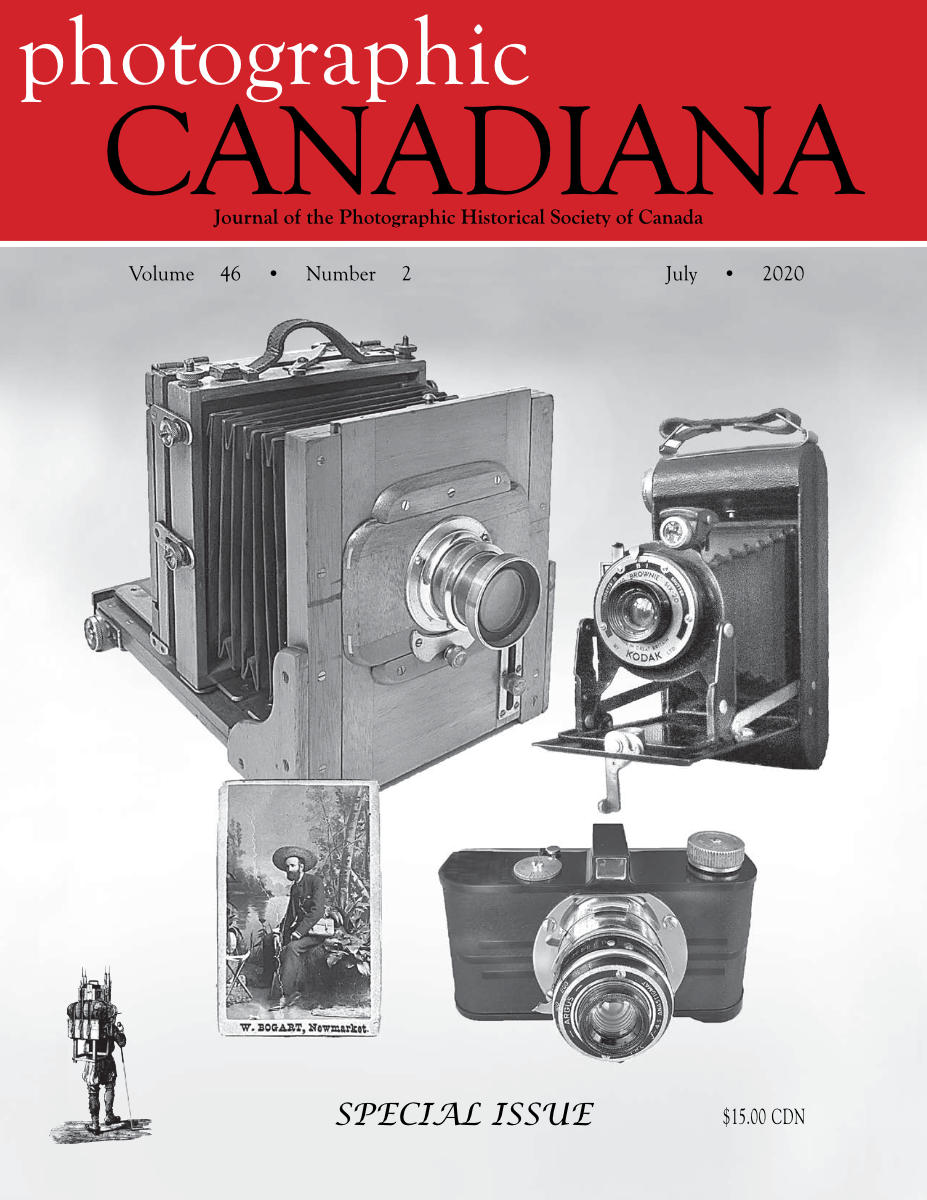
Toronto. Enjoying the balmy swelter of summer yet? Yesterday, members WITH an email address received another delightful special via pdf. It  is  the Photographic Canadiana edition 46-2 “Special Issue” dated July 2020 (although we usually take a break in the summer).

This 26 page marvel in full colour was envisioned by editor Bob Lansdale as his “Show and Tell in July” issue to create the excitement we all have at the annual December Show and Tell meeting in Toronto. A request for short, illustrated, articles on favourite items in member collections went out a few weeks ago and resulted in this issue (after careful scrutiny and layout by its protagonist, Mr Lansdale).

Drop me a line at info@phsc.ca if you are a member and haven’t received this special pdf edition. Not a member? Easy-peasy, just break out your plastic (VISA, MasterCard), follow the rules at the upper right of this page and sign up via PayPal (no PayPal account needed – we will pay the modest fee). Membership is an incredible bargain. Period!

NB. The title is from the 1966 song of the same name by the Lovin’ Spoonful. Groovy.

Posted in journal | Tagged , , , | Comments Off on summer in the city

at yer Beck and call …

Beck Cornex (image © 2014 – 2020 David Purcell)

Toronto. You may have come across a British camera called a Cornex or one by Houghton’s called a British Ensign. Both camera lines were made by a microscope manufacturer on Cornhill Street in London, England.

It was not uncommon for microscope makers to branch out into photographic lenses and even cameras (Leitz and Zeiss come to mind in Europe). The Smith and Beck company was founded in 1853 as the Lister Works after the famous surgeon. In 1865 the company moved to 31 Cornhill Street and became R & J Beck. The company became one of the most important firms in the British microscope industry.

Conrad Beck signed on in 1879 as an apprentice. Over the years he wrote or co-wrote numerous books and papers including Photographic Lenses – A Simple Treatise written jointly with Herbert Andrews. In 1881, the firm moved along Cornhill street to number 68. I have the 7th edition of this photography book which saw the light of day around 1920. A small catalogue at the end of the book covers the filters, lenses, and cameras sold by the company.

The above image is courtesy of David Purcell via www.redbellows.co.uk and looks much better than a black and white scan from my c1920 catalogue photo. For more material on R&J Beck, see “Notes on Modern Microscope Manufacturers” by the late Brian Bracegirdle.

Posted in camera | Tagged , , , , , | Comments Off on at yer Beck and call …

a photograph never lies …

Photo of new MP Rathika Sitsabaiesan. In retouched image (left) to meet government standards

Toronto. As a kid  some 70+ years ago, this was a common bromide, “a photograph never lies”.  As I grew older and learned to develop my own prints, I learned that photographs could and did lie!  Most negatives were simply retouched to change the contrast, but in some cases negatives too could be altered. And prints were an obvious target in the darkroom.

I have a large print of my maternal grand parents and mentioned one day that my grandfather had dressed up in his suit for the photo. Dad laughed. He said when the photo was taken, my grandfather was in overalls! The photographer changed the overalls to a suit. When the print was made and coloured, the photographer even added a gold chain as if my grandfather used or owned a pocket watch!

When I was older, I found I could add people to a print in the darkroom sometimes by double exposure and sometimes by carefully adding to the print and rephotographing. Never lies? Indeed!

Modern digital photos are far easier to retouch and fake  Heads from one photo can be added to another using photoshop after digitizing the two prints. Care makes it difficult to see the changes. The site, “Photo Tampering Throughout History“,  gives you an idea of how manipulation can occur and which popular images were modified to deceive the viewer or enhance the subject. While the site no longer verifies photographs, its gallery remains. You can check out photographs by year, and by type of manipulation.

Legitimate newspapers, TV stations, etc.  limit any digital corrections to exposure/contrast. Perhaps that is why we see so many tilted buildings on TV these days …

George Dunbar was kind enough to send me this link. He says, “This web site will be of interest to those who believe ‘a photograph never lies’. The site contains dozens of examples to prove the opposite. The Canadian House of Commons is included in the category of altered images.” Above, I show an example provided by George from the site.

Posted in photos | Tagged , , , , | Comments Off on a photograph never lies …