that’s life

J.R. Eyerman, Audiences Watches Movie Wearing 3-D Spectacles, 1952. Gelatin silver print, 11 1/2 x 8 1/2 in. Museum of Fine Arts, Boston, 2018.3341

Toronto. Ol’ blue eyes sang “That’s Life” back in 1966. The magazine called LIFE is a fascinating history of the middle class American psyche. Thanks to Google Books, every page can now be read. The magazine’s advertisements are a fertile ground for photographic history research on that art in America – especially its cameras. As the American public is a trend setter, the ads (and often the editorial content) show the historic progress of photography as it evolved from an outdoor, primarily black and white, art form to an outdoor/indoor full colour means to record family history.

The Princeton University Art Museum has produced an exhibition called “LIFE Magazine and the Power of Photography“. Online, a number of videos show what the magazine represents to Americans (and history).

Earlier this month my friend and fellow PHSC member, George Dunbar, wrote, “An absolutely “must watch” video (28 minutes) of Life Magazine and how it came to be an outstanding user of great photography is online [now].

George recomended the first video in the series (upper left on the university site) titled “Exhibition Tour | LIFE Magazine and the Power of Photography”. Enjoy the video bearing in mind that the magazine promotes an American perspective on history. And it was read all over the world. Back when I was a kid in Ontario, my local barbershop had copies of magazines including LIFE and Saturday Evening Post to entertain and educate his shaggy haired cliental waiting for their trim.

Posted in history | Tagged , , , | Comments Off on that’s life

focus magic

Focus Magic

Toronto. A reoccurring problem with photos whether taken with film and scanned or with digital cameras is blur due to either camera motion or being slightly out of focus. Many imaging applications try to fix this issue, usually via the unsharp mask.

Focus Magic is a small app and plugin for other image software programs. Focus Magic works incredibly well. Initially, it was Windows only, but now it comes as a 64 bit Mac plugin for programs like Photoshop or Affinity Photo. While a little pricey for a plugin, the app is a one time purchase with lifetime updates.

I first used Focus Magic about 20 years ago on a Windows computer. It was by far the best application for correcting an image suffering from slight blurring. Take a serious look at the web site, read the reviews, and try it for yourself. Continue reading

Posted in photos | Tagged , , | Comments Off on focus magic

take a (down)load for free – Part B

Lanterns Part B

Toronto. This special is titled, “ALL ABOUT LANTERN SLIDE PROJECTORS (PART B)”. It was sent out Friday to all current members with an email address. If you did NOT get a copy, please email me at info@phsc.ca and I will send you a copy after verification of your membership. Not YET a member? Grab your plastic and register via PayPal on the upper right of this page!

This is a reprint of a 1992 publication in California. The preamble inside the front cover states, “The advertisements and illustrations in this supplement originally appeared in The Photographist, number(s) 93/94, the journal of the Western Photographic Collectors Association (WPCA) in 1992. The WPCA was affiliated with the University of California Museum of Photography and stopped publishing circa 1996, going into dissolution in 2001. For the story of the history of the WPCA, see the article in Special Supplement Vol. 1 No. 1.

“In an effort to make this material available to collectors, historians and those interested in the history of photography, this content was digitized by the Photographic Historical Society of Canada (PHSC) and Milan Zahorcak from the U.S. in 2019 for distribution to PHSC members as a seven part series. Subsequent issues of the series, forthcoming in the following months, are shutters, posing chairs, flash lamps and two parts covering early enlargers. If you have any questions or would like higher resolution scans of any of the images, please contact the PHSC at info@phsc.ca.”

NB. The title of this post is a riff off a line from Robbie Robertson‘s song, “The Weight“. Robertson wrote the song in 1968 after he formed a group called simply, “The Band“.  I bought the first album by the Band called “Music from Big Pink” many years ago. At one point,  Robertson headlined concerts for Bob Dylan. Their final concert was in San Francisco, and was featured in a movie called, “The Last Waltz”. Robertson was born near Brampton and now lives here in Toronto. I saw him down at Indigo on Bloor a few years ago with Leonard Cohen. You can learn more from a documentary on the Band and Robertson featured recently by the CBC.

Posted in journal | Tagged , , , | Comments Off on take a (down)load for free – Part B

taking the red-eye out

red eye courtesy of  Skydocu

Toronto. When we hear that phrase today, we think the speaker is flying over-night to the coast to wake up bleary eyed and fuzzy for breakfast thousands of miles from home But that wasn’t always so. In the 1950s, colour film and on camera flash bulbs combined  to create a new problem. Even today with the ubiquitous modern smartphone cameras and flashes we somes times see red eye pupils.

In dim light, our pupils expand to let in more light. If light reflects back off our retina, the retina appears to be red. With an on camera flash close to the lens. this reflection makes people in the photograph have red, not the usual black pupils. Professional photographers would use off camera or bounce flash to avoid this issue.

When computers and image correction applications came along, a tool was added to allow the red pupils to be covered by a same size-disk of black with soft edges replicating natural pupils. Modern day smartphones have a sufficiently high ISO ratings that in most cases the flash becomes a fill flash and red eye is avoided. If not, similar edit tools on the smartphone apps usually do the job without recourse to computer-based applications as shown in the above image, courtesy of Skydocu Inc. on its iPhone site.

Posted in history | Tagged , , , , , , | Comments Off on taking the red-eye out

ruby red window

Toronto. George Eastman’s company announced the Kodak camera in 1888.  Kodak used roll film – originally in 100 exposure rolls. Exposed films were processed and cameras refilled by the Eastman Co. Now, have you ever thought of an easy way to wind the film so each snap is captured on its own bit of film with no overlaps or wasted areas?

S. N. Turner of the Boston Camera Manufacturing Co came up with a simple, inexpensive idea. Wrap the back of the roll film with black paper. Mark each frame with a white number. Snap a shot, then wind the film until the next number appears in a little red window on back of the camera. This technique solved Eastman’s problem with the Kodak camera line too.

Turner first used this idea in 1892 on his Bull’s-Eye camera. In 1895, Turner received patent rights to the idea, forcing Eastman who had been using Turner’s idea to licence its use. A few years later Eastman bought out Blair camera who in the meantime had bought Boston Camera. This eliminated licence fees for Mr Eastman.

The  red window works because for decades film was orthochromatic – it could not register the much less energetic red end of the visible spectrum. After over a half century when panchromatic film became popular, the tiny red window worked if capped and exposed only in dim light. Tiny red windows and white numbers came to an end when colour film and miniature cameras (35mm, 120, 126, etc.) gained a huge market share.


Posted in history | Tagged , , , , , , | Comments Off on ruby red window

time to learn more …

NFRCC Speaker Series

Toronto. Our friends down in Niagara are tackling the current COVID-19 pandemic with a series of on line speakers. The NFRCC is linking with Hunt’s Photo and Video in New England to present their monthly speaker program.

The NFRCC says, “[it] is excited to offer you the opportunity to participate in our Speaker Series event.  We have 11 presentations lined up on a monthly basis, by well known speakers which will span a 12 month timeframe September 14, 2020 to August 2021.

“Here are some of our Speakers: Noah Buchanan; Doug Hansgate; Emily Hojnowski; Don Komarechka; Tim Shields; Harold Davis; Roman Kurywczak; Cheryl Belczak; Ellen Anon covering many genres of photography. ”

So if you are into current photography, click here and see the details of each talk and what you can learn!


Posted in activities-other | Tagged , , , , | Comments Off on time to learn more …

it’s on! it’s on!

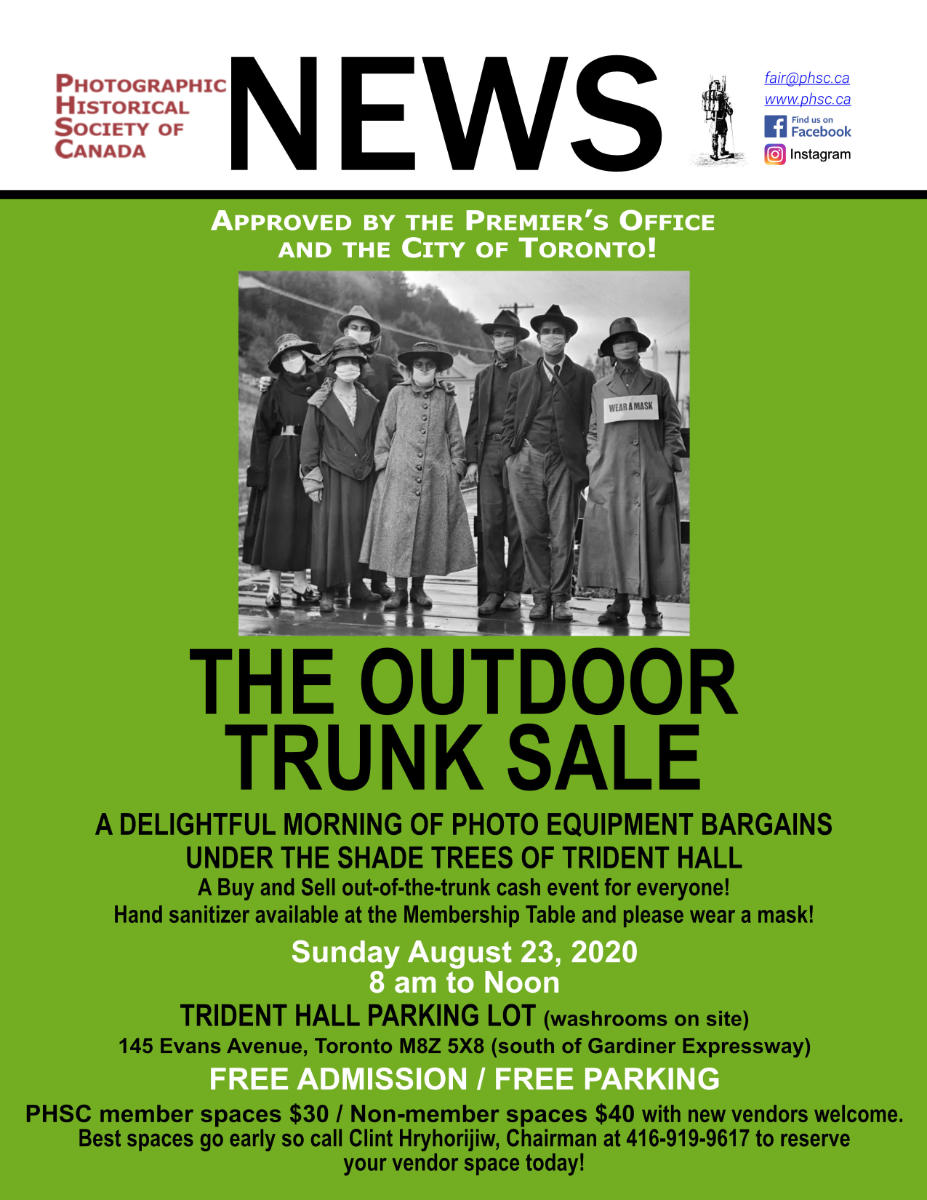
Trunk Sale August 23, 2020 8 to Noon.

Toronto. After months of COVID-19 restrictions, we can finally host an outdoor event at the Trident Centre. Our first camera show is the Trunk Sale delayed from last month and now ready to go August 23rd!

Click on John and  Sonja’s poster icon at left for a larger poster filled with the pertinent details!

Cameras, accessories, film, darkroom, images etc. have all been available at past sales. One of the first shows in the area this year!

Posted in fair | Tagged , , , , | Comments Off on it’s on! it’s on!

doing the Nile in style

c1884 Canadians are off to help Britain on the Nile

Toronto. In 1884-5, Egypt was at war with the Sudan. Britain (and France) controlled the country and Britain fought to keep the Suez Canal open as it materially shortened the route to the East.  To bolster the forces trying to re-capture Khartoum in Sudan, Britain’s Lord Wolseley cabled his friend in Manitoba’s Red River fight, Colonel George T. Denison to recruit “a force of river-men such as had won his admiration in the past”. These volunteers came from all across the Dominion.

The result was this collection of men sent to the Nile via the ship Ocean Queen. They be came part of the forces fighting the Mahdist Revolt or War. Thanks are owed to friend and fellow PHSC member for sharing this bit of history. Canadians on the Nile in 1884! Who would have thought such a thing was possible?

Posted in history | Tagged , , , , | Comments Off on doing the Nile in style

it’s in the bag

Get genuine Kodak Processing in America

Toronto.  Remember film? The exposed film had to be processed so the results (good, bad, or indifferent) could be viewed. For years Kodachrome was purchased with processing included, but along the line the American government decreed Kodak had to separate the film cost and the processing cost so other companies could process slide film.

Kodak then joined the fray by offering the prepaid mailers so American customers could still get guaranteed Kodak processing for both Kodachrome and Ektachrome slides. As far as I can recall, in Canada, we always sent Kodachrome back to Kodak for processing since the mailer was included with the film price. I rarely used Ektachrome which being a simpler process like Agfachrome could be processed locally.

The above ad appeared on page 72 in the August 26, 1966 issue of LIFE magazine. My heartfelt thanks goes out to fellow PHSC member George Dunbar for sharing his research with us.

Posted in history | Tagged , , , , , | Comments Off on it’s in the bag

hop on the band wagon

Ad in LIFE for Yashica’s Electro 35 camera

Toronto. Last century many new (to North America and Europe) camera makers incorporated and touted the latest fads hoping to increase market share. Yashica was no exception with its Electro 35. Yashica used Space Age, Atomic age, and Transistors while promoting its Electro 35.

Two big ideas in the 1960s were transistors (remember transistor radios?) and lasers (holograms, CD and DVD readers/writers, pointers, etc.). Each transistor is equivalent to a simple triode vacuum tube but far smaller and more efficient. Transistors took off first, predating the integrated circuit which runs today’s personal computers and has 3 million or so transistors on one tiny chip.

Yashica called its latest 35mm camera the “Electro 35” and touted its precision FOUR silicon transistor light sensor and its f/1.7 lens. This combination allowed shutter speeds from 30 seconds to 1/500th second depending on the light and film speed. All for a measly $100 US in the USA.

This ad for the Electro 35 appeared in the August 19th, 1966 issue of LIFE magazine on page 77. The ad focussed on American consumers since another company represented Yashica in Canada. The Electro 35 was just one of the many steps from the seriously technical Daguerreotype process and its primitive cameras of the 1840s to the ubiquitous smartphone cameras of today. Thanks to my good friend George Dunbar who shared this piece of history with me.

Posted in history | Tagged , , , , , | Comments Off on hop on the band wagon