once upon a time in Canada

Leitz Canada Summicron

Toronto. A few years after the second world war ended, Ernst Leitz established a factory in Midland, Ontario. At this subsidiary factory cameras were assembled from Wetzlar parts, manufactured, and lenses were assembled, manufactured and designed.

In our journal, issue 13-2, the son of the Canadian distributor of Leica and Minox cameras and accessories, David Carveth, wrote an article on the creation of the ELC (Ernst Leitz, Canada) factory. Initially, assembly of Wetzlar parts was done in Midland. Later cameras and lenses were also manufactured there. Few cameras were signed as Leitz Midland. It was necessary to use the serial number to tell whether a camera was assembled in Midland or Wetzlar. From the beginning of manufacture at Leitz, batches of serial numbers were assigned to different models and locales (after multiple factories were in operation) each year.

The head of ELC, Walter Kluck, brought over the equipment to make the M4 camera line when it was discontinued in Wetzlar after the CL and  M5 models arrived. The Canadian versions were the Leica M4-2 and M4-P. Doctor Walter Mandler moved to Midland to help set up the factory and stayed in Canada. His lens designs, such as the summicron 35mm f/2 shown at left, became world famous. Mandler retired in 1990. By the time the M6 was designed, manufacture and design of cameras and lenses had moved back to Germany.

In time, the majority of work and profit at ELC stemmed from American Military contracts such as those for Hughes Aircraft. Leitz discontinued retail equipment manufacture in Midland and in 1990 the Canadian factory was sold to Hughes in Los Angeles ending the storied manufacture of high end cameras and lenses here.

NB. The title is a riff on a movie, “Once Upon a Time in Hollywood“, and a line from the poem, “The Daring Froggie”  which I learned as child many decades ago in grade two and used to recite to my kids to their delight.

Posted in history | Tagged , , , , | Comments Off on once upon a time in Canada

stretching it

can you stretch emulsion?

Toronto. Good friend, PHSC member, and photographic historian George Dunbar shared this bit of whimsey with me. The February 1928 issue of “Science and Invention” included an article titled, “Enlarging Photos by Stretching” attributed to an “A W Herbert”.

Herbert posits that a formula developed by “Dr A Junghahn” of Berlin can separate the emulsion from its glass plate support and make it stretchable. Later, using a water bath the emulsion is stretched and moved to a larger glass plate. Depending on the emulsion thickness and the water bath temperature, he quotes Junghahn as saying the emulsion can be stretched up to 10x saving the aspect ratio and eliminating need for an enlarger. The formula like the doctor cannot be located.

This may be wishful thinking on the part of A W Herbert. A Doctor Alfred Junghahn did exist in Berlin as an assistant to Vogel but the only reference I could find was a paper that referenced an “Alfred Junghaun”as an assistant to Vogel. For a modest $44 US I could get a pdf copy of the paper.

The only photographic media I am aware of that purposely had the emulsion removed for printing was Eastman’s stripping film. This was the earliest film for a Kodak camera. It used an optically impure backing material so the emulsion was “stripped” and placed on a glass table for contact printing. There was never a mention of “stretching” to enlarge the image.

I haven’t seen any other reference to this idea. It is telling that the formula is incomplete in the article. Such magazines depended on these fillers to attract readers so they could attract advertisers. If you have any ideas  just send me a note at info@phsc.ca. For this post I checked out Google, Eder’s 1905 edition, and Jenkins’s “Images and Enterprise”.

Posted in history | Tagged , , , , , | Comments Off on stretching it

take it and show it

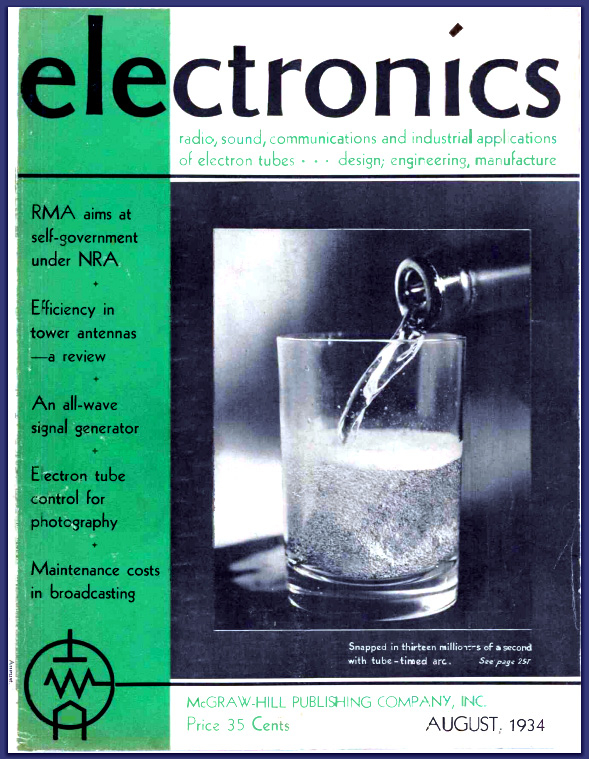
Home Movie Camera from MAy 1929 article

Toronto. One of the headaches facing the home movie crowd was the fact so many different gadgets were needed to take and show movies. One idea was to use just one instrument as both the camera, and with added illumination, the projector.

The camera and projector idea was touted in the May 1929 edition of the magazine “Science and Innovation“. The idea of a combined gadget never caught on. Wittnauer (the watch company) promoted this idea again in the 1950s and 60s selling in Jewellery stores, with the same degree of success … (A few years ago, Bob Wilson showed us a Wittnauer camera/projector at one of the Show and Tell sessions.)

It seems a bit like the ill fated Shop Smith – a machine that combined various power tools in one. Great idea; an even greater pain to use.Thanks to my friend George Dunbar for sharing this bit of history from days of old.

Posted in history | Tagged , , , | Comments Off on take it and show it

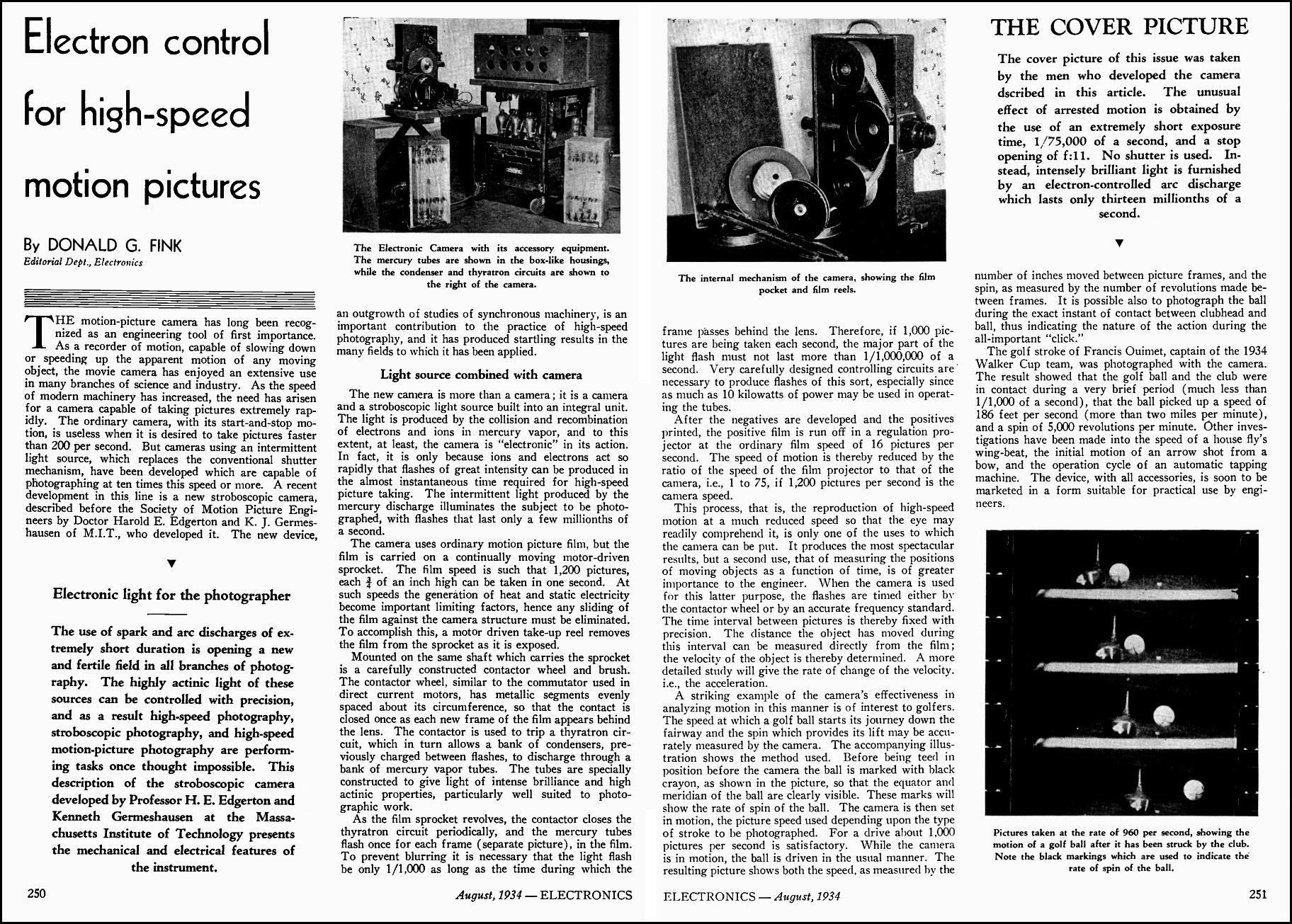
shudder and stutter -our shutter supplement

All About Shutters

Toronto. This special (Vol 1 No. 3 September 2020) is titled, “ALL ABOUT SHUTTERS”. It was sent out Friday to all current members with an email address. If you did NOT get a copy, please email me at info@phsc.ca and I will send you a copy after verification of your membership. Not YET a member? well, for Pete’s Sake! Grab your plastic and register via PayPal on the upper right of this page!

This is a reprint of a 1993 publication in California. The preamble inside the front cover states, “The advertisements and illustrations in this supplement originally appeared in The Photographist, number 97, the journal of the Western Photographic Collectors Association (WPCA) in 1993. The WPCA was affiliated with the University of California Museum of Photography and stopped publishing circa 1996, going into dissolution in 2001. For the story of the history of the WPCA, see the article in Special Supplement Vol. 1 No. 1.

“In an effort to make this material available to collectors, historians and those interested in the history of photography, this content was digitized by the Photographic Historical Society of Canada (PHSC) and Milan Zahorcak in 2019 and 2020 for distribution to PHSC members as a seven part series. The first two instalments were about magic lanterns. Subsequent issues of the series, forthcoming in the following months, are posing chairs, flash lamps and two parts covering early enlargers. If you have any questions or would like higher resolution scans of any of the images, please contact the PHSC at info@phsc.ca.”

Posted in journal | Tagged , , , | Comments Off on shudder and stutter -our shutter supplement

ZOOMin’ in the SIX

Toronto. We held our sixth COVID-19 inspired exec meeting via ZOOM. A big thanks to Celio for arranging the meeting once again. Key changes are shown below. Toronto has entered stage 3, so we held our trunk show on August 23rd – it was a great success as pent-up demand helped fuel the excitement. Next month, we plan to hold our auction OUTDOORS at the same spot. Stay tuned for details and a poster. PHSC News will go out shortly for September. Remember to sign up at news@phsc.ca for a free pdf copy.

Posted in activities | Tagged , , , , , | Comments Off on ZOOMin’ in the SIX

illuminating and breathless

camera and lighting in 1960 for a scene in the movie “Breathless”

Toronto. This is a photo of a cameraman slowly moving by a wheelie while the lighting and actors stay in place. The lady in the striped dress is none other than the tragic Jean Seberg with her French co-star Jean Paul Belmondo.  The 1960 film was called “A bout de souffle“. Or Breathless as it was known to English audiences. Seberg died a few years later.

The photograph of the cameraman and lighting in 1960 are from an article by Rob Baker in July, 2018 on the website Flashbak titled, “The Life of Jean Seberg in Pictures“.

Posted in history | Tagged , , | Comments Off on illuminating and breathless

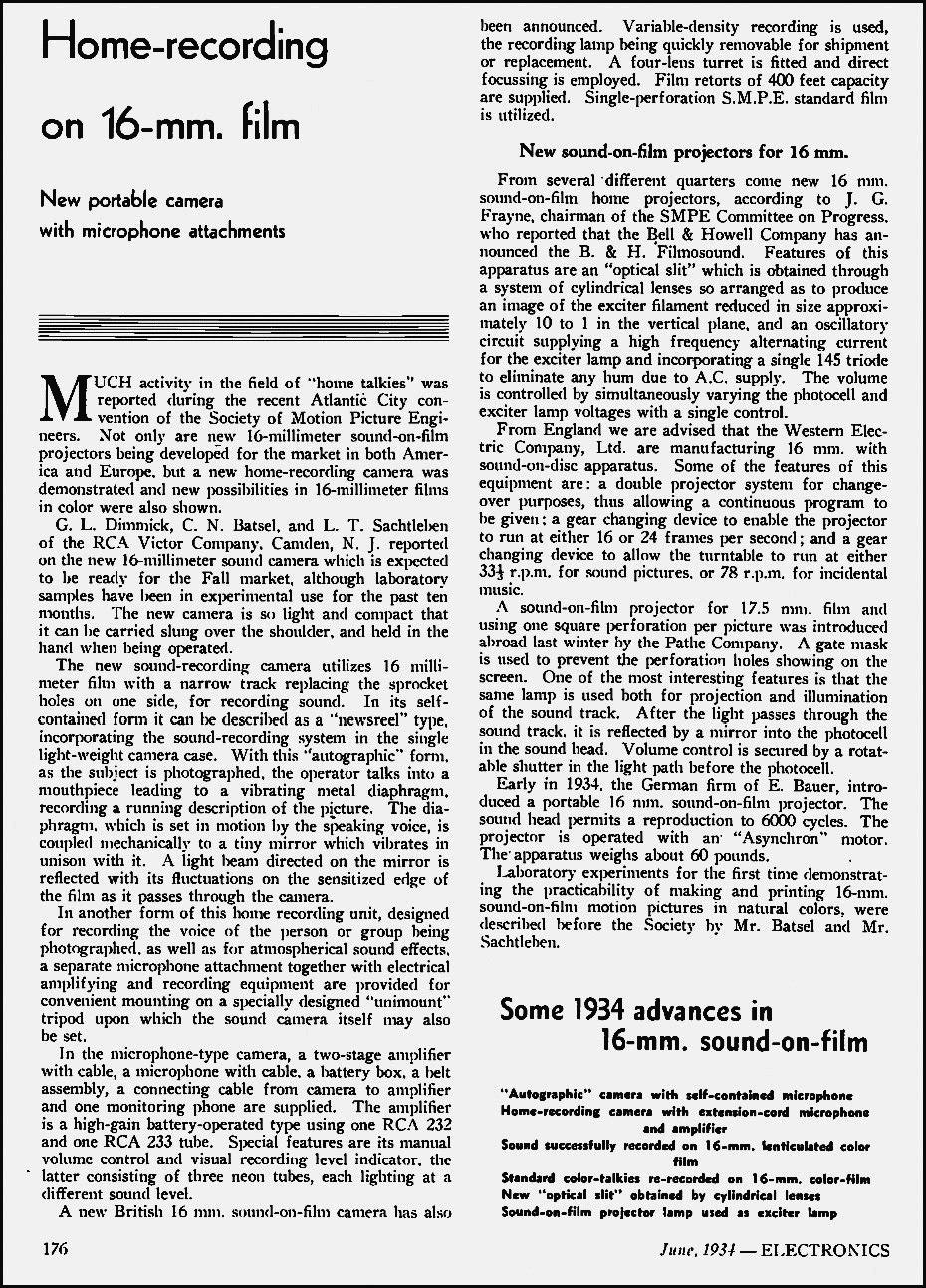
colour home movies in 1929

An Idea For Colour Home Movies in 1929

Toronto. Even today, we use ways to separate and re-combine primary colours to create realistic viewable colour images, be they prints, computer screens, smartphones, or TV. The concept itself is over a century and a half old. James Clerk Maxwell demonstrated this idea with a tartan ribbon in 1861.

This particular scheme uses a rotating series of filters on the movie camera lens to make each monochrome frame record the intensity of a particular colour. A second rotating filter on the projector lens is synchronized with the correct frame to project the colours as seen (more or less). The process and the need to use filter density to control the light level for the various colours is explained in the article, “HOME MOVIES – How Filters and New Color Attachment Enable You to Capture True Color Values” by Don Bennett in the October 1929 issue of the magazine Science and Invention.

The system may have proven to be impractical, since it seems to have quickly disappeared from the market place. A few years later, Kodachrome burst on to the scene. It was a process that worked and was backed by the mighty Kodak corporation.

My thanks to George Dunbar, a professional videographer, photographer, and member of the PHSC, for sharing this bit of photographic history with me. For much of the last century effort was expended to allow the humble camera to capture colour as we see it –  from the dyed potato starch grains of the Lumière Brothers to the sophisticated Red-Green-Blue pixels of modern day smartphones.

Posted in history | Tagged , , , , , , | Comments Off on colour home movies in 1929

most gifted

Kodak Instamatic 104

Toronto. Today when someone says, “most gifted”, we usually think of a very bright child worthy of accelerated and/or in-depth learning. Today, when we think of compact cameras we usually mean smartphones.

In the summer of 1967, a Kodak advertisement in LIFE magazine called its Instamatic 104 camera both “the world’s most gifted” and “compact”. While emphasizing the price of a colour kit as “less than $20”, the ad neglects to mention (and rightly so) that the camera is both limited in use, and to many eyes (mine included) down right ugly.

The ad on page 41 in the June 2, 1967 Issue of LIFE does hit all the buzz words of the day: colour, flash, indoor, compact, easy to use, etc. A big thank you to good friend George Dunbar for sharing this historical note with me.

Posted in history | Tagged , , , , , , | Comments Off on most gifted

girls of Dawson City

Dawson City girls c1900

Toronto. We often heard of the gold rush and the men “who moil for gold” as Robert Service says in his poem “The Cremation of Sam McGee“, but we seldom heard of the girls of questionable virtue attracted to the “wild west”.

The Daily Mail in the UK carried an article titled, “The ‘soiled doves’ of the Wild West: Photos reveal the everyday lives of prostitutes in the brothels of the American Frontier” which includes the photo at left from Dawson City in the Yukon.

One of our members once had a studio in Dawson City and gave a talk on the Chilkoot Trail in September 2o15. It was about the realities of the Chilkoot Trail and the gold rush. Like so many things, it took money and good fortune just to survive let alone succeed!

Posted in history | Tagged , , , | Comments Off on girls of Dawson City

not only elephants have them

Photo at our Trunk Sale this month courtesy of Lewko (Clint) Hryhorijiw

Toronto. Trunk and trunk sales that is. Ours was held this year on August 23 at the Trident Hall in south west Toronto and will be featured in our next journal issue.

Note that our journals are for members. Not a member yet? See the right hand panel and join/renew via PayPal. It’s easy, just have your plastic ready and we will pay the modest fee. Check here if you don’t think you are missing out!

In past years we have held camera fairs and auctions. Pandemic willing, we will have an image show this fall and hopefully an auction too.


Posted in fair | Tagged , , , , , | Comments Off on not only elephants have them