it’s a long way

Koda VP ad on Kodakery cover courtesy of Mario Groleau

Toronto. One of the popular cameras in the great war was the Kodak VP folder. Not only did it use the newly released 127 size roll film, it was small, metal bodied, and compact. A soldier could slip it in a pocket along with a roll or two of film and be ready to get snaps for home or history! This later autographic version was featured on the back of the small Kodak magazine “Kodakery”.

In the summer of 1924, the American magazine “Science and Invention” was busy touting ways to make use of the new home alternating current electricity. George Westinghouse and his central AC system distributed to homes had won over Tom Edison’s direct current set up that required a generator in every home since the power loss was just too great to allow central generation and distribution. One of the pages of the August 1924 S&I magazine suggested h0w one could  make a home-made enlarger using an electric light bulb to enlarge the tiny 127 prints for easier viewing.

NB. My thanks to George Dunbar for the suggestion; and to the WW1 song, “It’s a Long Way to Tipperary“.

Posted in history | Tagged , , , , | Comments Off on it’s a long way

new tricks

Self Portrait by Stan White

Toronto. Stan White sent me an email the other day. At 91 he has posted a website of photos, poems, and stereo. Stan was born in England and emigrated here. He was an industrial photographer in England and a commercial photographer here, teaming up with the late Everett Roseborough in Ev’s Studio (Ev was our journal editor before handing control over to current editor Bob Lansdale). Stan went on to teach traditional film photography at Sheridan College in Oakville.

In 1982, Stan Joined us and held a number of positions on the executive of the Toronto chapter (including president). Stan was chair of the PSA Stereo Division. He was publisher of PSA’s “Dimensions Three” newsletter. He is an author and poet as well as a photographer. A speaker numerous times at the PHSC on stereo. Stan had a column (Stan White’s Corner) in the PHSC journal. He wrote many articles for the PHSC journal as well. Stan was featured in his December 2013 journal article, “Annals of a 1940s – 50s Industrial Photographer in England“. Organized our initial archive of 3D material at Sheridan College (later moved to the AGO). Did the layout for one of our early mail auctions of member collections (a massive effort) and much more.

When Stan retired, he and his late wife moved out to a small town some 2 to 3 hours drive from Toronto. Eventually the trip here became too onerous and Stan resorted to other means like email to stay in touch with us.

Note that the title of this post is from a favourite British TV program “New Tricks” and in particular Dennis Waterman’s whimsical song of the same title.  Fits well with Stan’s whimsey!

Posted in people | Tagged , , , , , , | Comments Off on new tricks

all about flash lamps

Toronto. What do you do when the light is too low for a photo? Use a flash! Years before electronic flash, or even flash bulbs, flash powder was used in variety of holders. See what was used for flash illumination in this special members-only supplement (vol 1-5).

Vol 1-5 was sent out last Friday afternoon to all current members with an email address. If you did NOT get a copy, please email me at info@phsc.ca and I will send you a copy after verification of your membership. Not YET a member? well, for heaven’s sake! Grab your plastic and register via PayPal on the upper right of this page!

This is a reprint of a 1995 publication in California. The preamble inside the front cover states, “The advertisements and illustrations in this supplement originally appeared in The Photographist, number 105, the journal of the Western Photographic Collectors Association (WPCA). The WPCA was affiliated with the University of California Museum of Photography and stopped publishing circa 1996, going into dissolution in 2001. For the story of the history of the WPCA, see the article in Special Supplement Vol. 1 No. 1.

“In an effort to make this material available to collectors, historians and those interested in the history of photography, this content was digitized by the Photographic Historical Society of Canada (PHSC) and Milan Zahorcak in 2019 and 2020 for distribution to PHSC members as a seven part series. The first instalments were about magic lanterns (two parts), shutters, and posing seats. Subsequent issues of the series, forthcoming in the following months, will be two parts covering early enlargers. If you have any questions or would like higher resolution scans of any of the images, please contact the PHSC at info@phsc.ca.”

Posted in journal | Tagged , , | Comments Off on all about flash lamps

Jim Wills, photographer and collector 1942 – 2020

the late Jim Wills of Burlington, ON

Toronto. I received an email Nov 4th from our PHSC President, Lewko (Clint) Hryhorijiw that Jim Wills of Burlington died recently.

Mike Fast, who sent the note to both Clint and Maureen Tucker over in London, said, “… He boasted of having over 900 SLRs, every one of them different, if there were any differences between the Japanese, American and European models he had one of each. He wasn’t just a camera nut or a collector of many things, but he was well versed and extremely knowledgeable in many, many different areas.

“I will truly miss him.”

His funeral was handled by Smith’s in Burlington. Smith’s noted on their website, “James ‘Jim’ Robert Wills passed away peacefully at the age of 78 in his Burlington home on October 29th, 2020.

“Born in Hamilton, March 21, 1942, Jim was predeceased by his parents Dorothy and Arthur Wills and his daughter Tracy Wills. He is survived by his daughter Sandra Wills, partner Christine McCombe, and step-sons Paul and Martin Garster.

“Jim had a brilliant mind. He was an avid gardener, photographer and was unfailingly generous with his time and energy.

“There will be no public service. The family asks that donations be made in memory of James Robert Wills to The United Way.”

Posted in people | Tagged , , , , , | Comments Off on Jim Wills, photographer and collector 1942 – 2020

the eighth by ZOOM

Toronto. We held our eighth COVID-19 inspired exec meeting via ZOOM (This is beginning to feel like normal). Thank you Celio for arranging the meeting once again. Key changes are shown below. Toronto is in stage 2 modified at present as we enter the second wave of COVID-19. ALL live events are cancelled at least until 2021. Our monthly meeting venue (North York Memorial Hall) is closed to events by the city until at least December 31, 2020. We hope to do meetings beginning November 18 via video. Stayed tuned.

PHSC News goes out shortly for November. Sign up at news@phsc.ca for a free pdf copy. Members get specials plus the journal via pdf. Contact me if you are a member and HAVE NOT seen the pdfs. Some members have unsubscribed to MailChimp; some emails are invalid; and others have no email on file with the society. Any questions? Just drop me a note at info@phsc.ca

Our October Exec meeting via ZOOM

.

Posted in activities | Tagged , , | Comments Off on the eighth by ZOOM

Stanley, I presume?

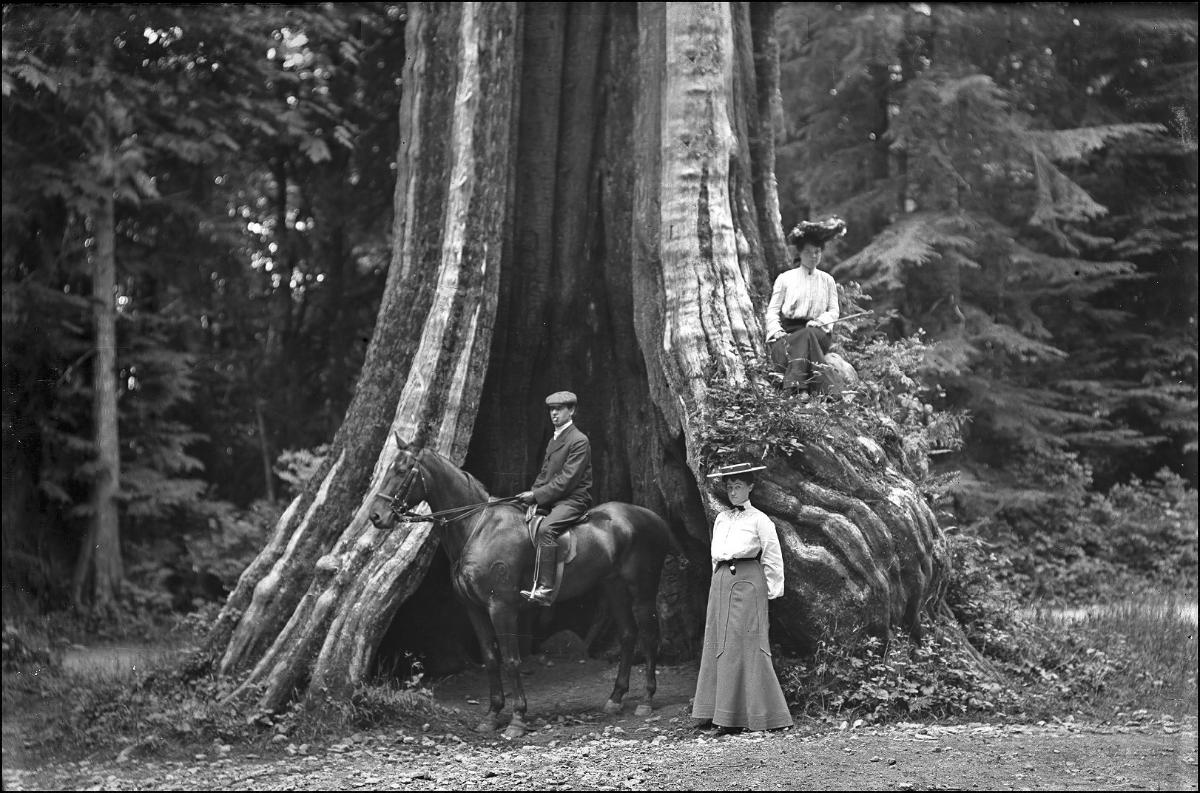
Stanley Park c 1910-1910 by Philip Timms

Toronto. About three years ago I did a post on Stanley park’s beautiful and massive old trees showing an ancient (today) automobile nestled in the trunk. Here you see another huge tree, this time shrouding a horse and rider!

The glass plate negative was taken by photographer Philip Timms. The Timms font is held by the Vancouver Public Library, one of our long time members. Timms is also represented in the City of Vancouver Archives collection.

A big thanks to George Dunbar, a fellow PHSC member for sharing this beautiful and historic find from Canada’s great west coast city of Vancouver.

NB. The title of this post is a riff on the famous quote by Henry Stanley when he came upon Dr Livingstone deep in Africa in 1871 (Dr Livingstone, I presume?).

Posted in history | Tagged , , , , , | Comments Off on Stanley, I presume?

an f/2 lens in 1924

photo of a 1924 camera with f/2 lens

Toronto. We (read old guys) often think of f/2 lenses as a 1930s phenomena, but this photo in the July 1924 edition of Science and Invention on page 266 begs to differ. The pdf version of the magazine is a bit big for this site so take a look at it on the link shown above.

The camera boasts a sports finder and a focal plane shutter of all things. No name is mentioned but Ernemann had similar cameras in that era. And it does look European.

Note that the magazine ads promise big money in electricity or radio – the big fresh ideas of the time. Photography was over 80 years old by then and serving as a filler or an idea for elecricity.

Thanks to my friend George Dunbar for sharing this historical item with me.


Posted in camera | Tagged , , | Comments Off on an f/2 lens in 1924

what’s leaves got to do with it

Autumn Leaves of fall

Toronto. Falling leaves. Cold. Damp. Windy. November in the city and winter is about to rush in. As I write this post on the 1st, we are seeing our first snow flurries of the coming season.

Leaves have a lot to do with photography both in the aperture and the speed setting of film cameras.

The Waterhouse stop and the slot in the side of a lens were in time replaced with a diaphragm device whereby the rotation of a ring on the lens would vary the size of the aperture by causing a change in the diameter of the centre circle and thus control the amount of light hitting the sensitive media, the depth of field (what parts of the scene would be in or nearly in focus), and the look of out of  focus secular light (the bokeh of the lens). This diaphragm device was composed of a series of leaves attached to the ring.

When the media for photography reached an in-camera speed calling for sub-second exposure outdoors, shutters became mandatory. They evolved into various designs including a leaf shutter which used a series of metal leaves, like the diaphragm. This time the leaves were tightly shut and when released, quickly opened fully then snapped shut once again.

The leaf shutter could be synchronized to operate a flash at any speed. Unfortunately its top speed was limited by physics – about 1/400th second for 35mm cameras. Also the ideal location was midway in each lens resulting in expensive lenses. Optionally the elements in front of the leaf shutter could be changed to vary a lens’s focal length slightly (before we had zoom lenses). As a result, leaf shutters were mostly used for mid price range 35mm cameras.

Note that the title of this post is a riff on the title of Tina Turner’s hit song “What’s Love Got To Do With It?” sung here by the lady herself

Posted in history | Tagged , , , , , | Comments Off on what’s leaves got to do with it

1932 – Technicolor and Doctor X

Scene from 1932 Technicolor Doctor X

Toronto. The first time I saw a Technicolor two colour process colour film was the other evening when I viewed the 1932 film “Doctor X” via TV courtesy of TCM who ran the UCLA Film Archive recreated version on safety film. When it comes to colour, I usually think of still images and the struggle I had to process and print three process colour media in the 1970s.Today, digital media and smartphones make the task dead simple be it still or movies (I mean videos).

I found Doctor X interesting for a couple of reasons. Firstly, it was a talkie made just a few years after talkies first came on the market. As such, the film was rife with audible sound effects. The industry wanted to fill every moment with sound of some sort.

Secondly, it used the two colour Technicolor process aiming to make skin tones realistic resulting in everything else looking greenish or brownish. In Technicolor movie cameras, the process made clever use of prisms and filters on reels of film made on nitrate based B&W film. With a bit of film magic, positive dye sublimate prints were made for projection in big cities of the States while the rest of us abroad or in small American towns saw only black and white prints.

I had read about Technicolor’s two colour process but didn’t realize how old it was nor how many process updates occurred to reduce grain and improved colour clarity. Since it was a subtractive positive colour, it took much less light to project, allowing standard projectors to be used.

Posted in history | Tagged , , , | Comments Off on 1932 – Technicolor and Doctor X

what a bargain!

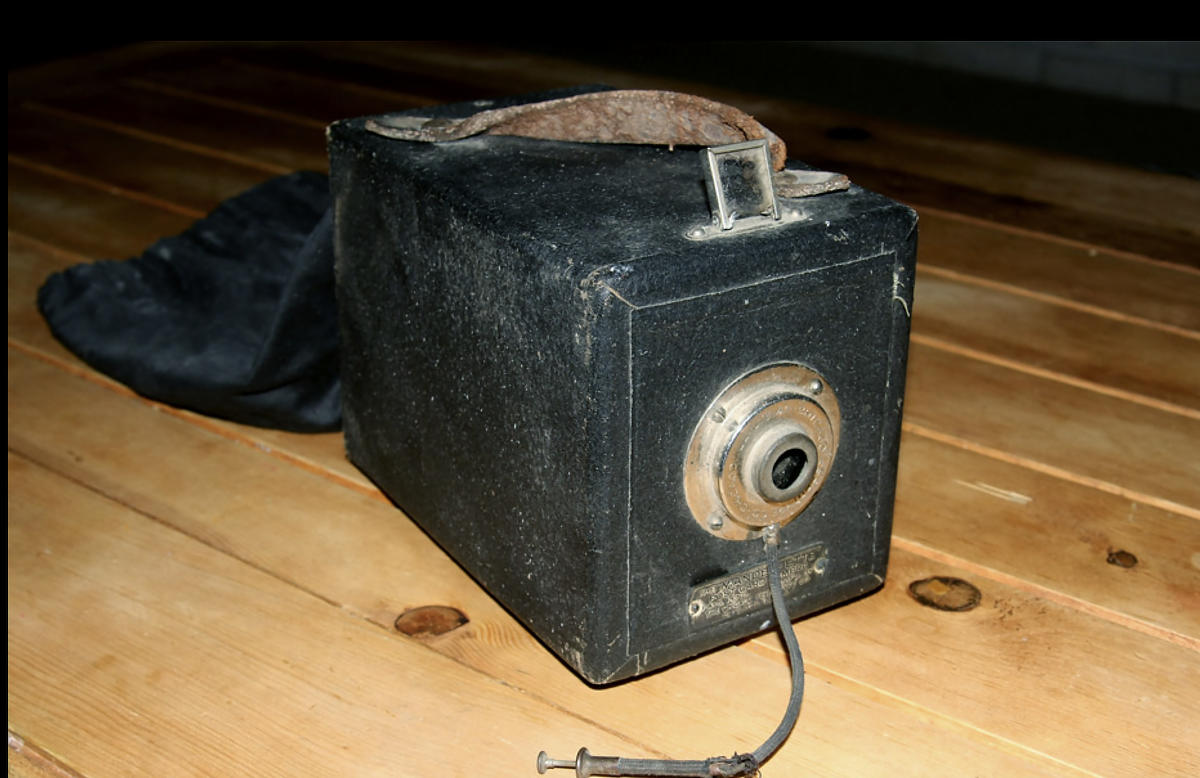
Mandel-ette courtesy of Jason Penney on Flickr via  Camera–Wiki

Toronto. Do you remember street photographers? They were itinerant photographers who snapped people as they walked along city streets and sold their work accordingly. Sometimes the photo was a ferrotype (tintype) and the finished photo was ready in a minute or two. Other times the subject was given a number to call next day to pick up the photo.

Those who took tintypes may have used the Mandel-ette made by the Chicago Ferrotype Co. (CFC), described in McKeown’s as, “Founded by Louis & Mandel Mandel, the Chicago Ferrotype Co. was the United States’ leading producer of direct positive ‘street’ cameras for tintypes, button tintypes, paper prints, and post cards.

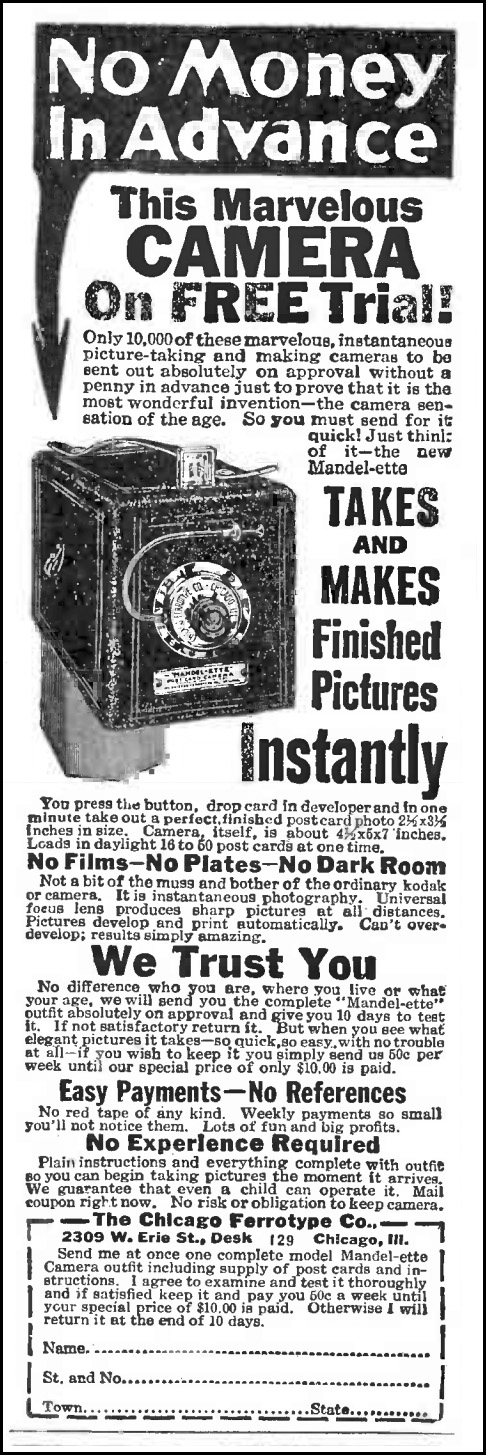
A Mandel-ette today is worth about 8x its original cost.  An ad from 1924 offers about 10,000 cameras for a free 10-day trial. Budding businessmen could pay just fifty cents US a week for twenty weeks to buy the $10 camera if they kept it.  CFC also sold supplies by mail. Interestingly, the camera seemed to be a basic box camera (fixed focus, small aperture) but offered prints in a minute long before Polaroid’s famous “pictures in a minute” system that was offered shortly after the second war ended.

Click here to see the manual or visit Camera-Wiki and after reading the material, follow the link at the bottom of the page (same manual). My thanks to George Dunbar for sharing this 1924 ad he unearthed recently.

Posted in camera | Tagged , , , , , | Comments Off on what a bargain!