our late editor remembered in the Sunday Star.

the late Robert Lansdale by K MacLeod courtesy of the Toronto Star

Toronto. The current interim editors of Photographic Canadiana, Louise Freyburger and David Bridge sent along this link in last Sunday’s Life/Remembrance column by Tracey Tong titled, “Remembering prolific Star photographer Bob Lansdale“.

Our treasurer and PHSC News editor (John Morden and Sonja Pushchak) also sent me the article link from the Sunday Toronto Star.

The article used the watercolour illustration at left by artist Kagan MacLeod as a frontispiece. Samples of Bob’s work and narrative from an interview with his eldest son amongst other information was also in the article.

Posted in people | Tagged , , , , , | Comments Off on our late editor remembered in the Sunday Star.

gifts, Kodak, f/2 again

Christmas gifts ad- a Kodak Pupille for the minicam enthusiast

Toronto. Big Yellow Father was hitting on all cylinders when advertising for Christmas in the  January, 1934 issue of Popular Mechanics (page 114A and 115A in the Advertising section of the magazine) released before Christmas, 1933 of course.

The ad offered the well known Pupille  camera with a super fast f/2 anastigmat lens for the minicam crowd. This camera was designed by August Nagel and rebadged as Kodak when Kodak bought the Nagel factory in Germany. There are both 16mm and 8mm movie cameras in the ad for movie buffs, and a box camera and two folders for those with rather shallow pockets but an urge to snap photos.

It seemed like all companies had or would soon hop on the bandwagon of f/2 normal lenses for minicams to try and compensate for the rather slow emissions of the day.

Once again my good friend, George Dunbar, has shared this delightful find in photographic history. George has often contributed ideas and links for many posts on the website. Well done, George!

Posted in history | Tagged , , , , | Comments Off on gifts, Kodak, f/2 again

Curious Curtis Captures Indians

1899 Portrait of Edward S. Curtis courtesy of Auction Daily.

Toronto. The late John Craig was a vendor at our early fairs. One one occasion, John commented about Edward  S. Curtis. One night, after doing our fair, John visited Barberian’s on Elm Street for a steak. To his delight, there on the wall hung a photograph of an American Indian taken by Curtis, the American photographer who was noted for his photographs and writings on the North American Indians.

In September, 1996 (journal issue 22-1), the late editor, Ev Roseborough, celebrated Curtis with a cover display of Kyaiyi-stamik (Bull Bear) a member of the Blackfoot Nation, Alberta, 1926, photographed by Edward S. Curtis. This image is copyright  National Archives of Canada (© NAC, C-019753).

NB. this article was sparked by the previous post by our exchange organization, the Daguerreian Society, and the Andrew Smith gallery in Tucson auction of Curtis prints on December 1, 2021.


Posted in history | Tagged , , , , , , | Comments Off on Curious Curtis Captures Indians

Curtis Photography Auction December 1, 2021

Got over six grand burning a hole in yor pocket?

Toronto. On the 26th of November, I received an email from our friends at the Daguerreian Society. The Andrew Smith gallery is holding an online auction of materials from the famous photographer Edward S Curtis.

The message states, “Andrew Smith Gallery Photography Auctions LLC is pleased to announce our upcoming live, online, no reserve auction: EDWARD S. CURTIS.

“100 Copper Plates from The North American Indian and Other Important Photogravures and Rare Photographs of the American Indian from 1852-1930.

“Auction date is Wednesday, December 1, 2021. The live auction begins at 9:00 am Pacific time on LiveAuctioneers.com and Invaluable.com.

“The auction is currently open for bidding.”

So image collectors everywhere, this is your chance to augment your collection with some famous photographs etc. by Edward Curtis!

Posted in photos | Tagged , , , , | Comments Off on Curtis Photography Auction December 1, 2021

mounting a standard

Leica M-series bayonet mount

Toronto. A camera’s lens mount does many things: keeps the film to lens distance unchanged in spite of 1,000s of lens changes so one can reliably focus to infinity at any aperture opening; keeps the lens firmly attached to the body (my first Exakta used metal with less ‘spring’ so in time the lens felt loose); the diameter is wide enough to accommodate any lens without vignetting; mounts were intended to allow quick lens changes in the field; the design of the mount limited the use of third party lenses to those that matched the camera; etc.

Until interchangeable lenses hit the market, lens mounts could vary the film to lens distance slightly. As long as the mount diameter accommodated available lenses, the diameter was of no consequence. The first Leicas used a screw mount made of hardened metal. To counteract publicity by competitors, Leitz emphasized that a screw-threaded mount was more precise than a bayonet – then in their post-war design, embraced a bayonet mount!

Earlier cameras used lens boards to join camera and lens, while a ground glass eliminated any need for precise distancing between film and lens. The zoom lens era allowed for a wide adjustment of focal length without changing the lens. Many modern cameras (especially the smaller digital cameras popular before smart phones and their fixed lenses) used a zoom lens instead of a removable lens/camera design.


Posted in history | Tagged , , , , | Comments Off on mounting a standard

photographs at a museum

Christine Keeler beside chair, 1963,
photograph, gelatin silver print, by Lewis
Morley, 1963, London, England

Toronto. The Victoria and Albert Museum in the UK has a long and storied history.  The V&A has collected photographs for many decades (since 1852!). The image at left is a photograph of the notorious Christine Keeler taken in 1963 by Lewis Morley.

Take the time to browse the online images, articles and videos  at the V&A to learn anew of the wonderful history of our passion. If you should find some of particular interest, visit the V&A shop where many of the photographs can be licenced for use.

George Dunbar’s email the other day on Jack Lowe and his modern day wet collodion process inspired this post.

Posted in history | Tagged , , , , , | Comments Off on photographs at a museum

when f/2 was super fast

Screw mount Leica c1937 with Summar lens

Toronto. In the 1930s, the films and plates were very slow by today’s standards. Normal lenses were usually around f/3.5. To help this lack of sensitivity, Leitz designed a new lens around 1933. The 6 element lens was a modified Gauss design. With an aperture of f/2  wide open, the 5cm lens was a stop and a half faster than the little 4 element 5cm Elmar.

The new standard lens, called “Summar”, was promoted in advertisements such as this one on page 469 of the March, 1934 issue of American Cinematographer magazine. The Summar was originally a rigid lens in nickel as shown in this ad. It was changed to a collapsible nickel or chrome lens in 1934. An example of the collapsible lens is the 1937 version shown above.

I snapped the Leica and Summar with my iPod Touch and cropped and adjusted it in Affinity Photo with the Focus Magic Plug-in. The advertisement is a scan courtesy of good friend, George Dunbar, himself a retired Industrial Cinematographer and Photographer who has generously shared his historical research.

Posted in history | Tagged , , , , , , , | Comments Off on when f/2 was super fast

Bob’s Zeiss Miroflex

Zeiss Miroflex press camera as an SLR

Toronto. Our late editor, Bob Lansdale favoured Canadian photographic history and photographs, especially Chromotypes, over cameras and hardware. He was always concerned that there would be too few hardware/camera articles in each issue of Photographic Canadiana. To this end, Bob chose to collect cameras of interest to him.

As an old news photographer mid last century, Bob picked up a nice Zeiss Miroflex. This European Press camera lived two lives – one as a standard ground glass back press camera with the vertical tower and viewer collapsed and the mirror locked up, and the other as a press SLR as shown here. Mike Butkus has a copy of the instruction manual (English) as a pdf file.

The above image is from Bob’s article in the 46-5 issue of the journal as included in the hard copy version, “Special 2020 Annual Issue”. 46-5 and the hard copy annual were only available to society members (and the hard copy version by request only).

Posted in camera | Tagged , , , | Comments Off on Bob’s Zeiss Miroflex

an early marketing phrase …

Summer 1933 as for a Leica ‘autofocal’ camera

Toronto. In the 1930s, the minicam rage was taking off, so how could you differentiate one camera from another? Leitz chose to call its camera an AUTOFOCAL camera in advertisements in various early 1930s magazines.

An example is this small ad from the June 1933 issue of American Cinematographer  found on page 67 in the amateur section (check out the jaw dropping list price for a Leica Standard or a Model D with an Elmar 5cm lens …).

The term ‘AUTOFOCAL’ was used to mean that focussing any interchangeable lens would automatically adjust the rangefinder setting to match the two images. At the time, many cameras allowed the rangefinder to be adjusted to bring a subject into focus and then distance was read off and the lens adjusted to that distance – added steps since lens and rangefinder were uncoupled.

Today, the era of auto everything digital cameras and smartphones leave one wondering at what all the fuss was about. Autofocal, indeed.

Thank you to good friend and fellow PHSC member for sharing this piece of photographic history with us. It reminded me that I saw a similar ad years earlier in an old National Geographic magazine. That ad too called the Leica an ‘AUTOFOCAL’ camera.

Posted in history | Tagged , , , , , | Comments Off on an early marketing phrase …

Kodak – not just photo supplies and cheap cameras

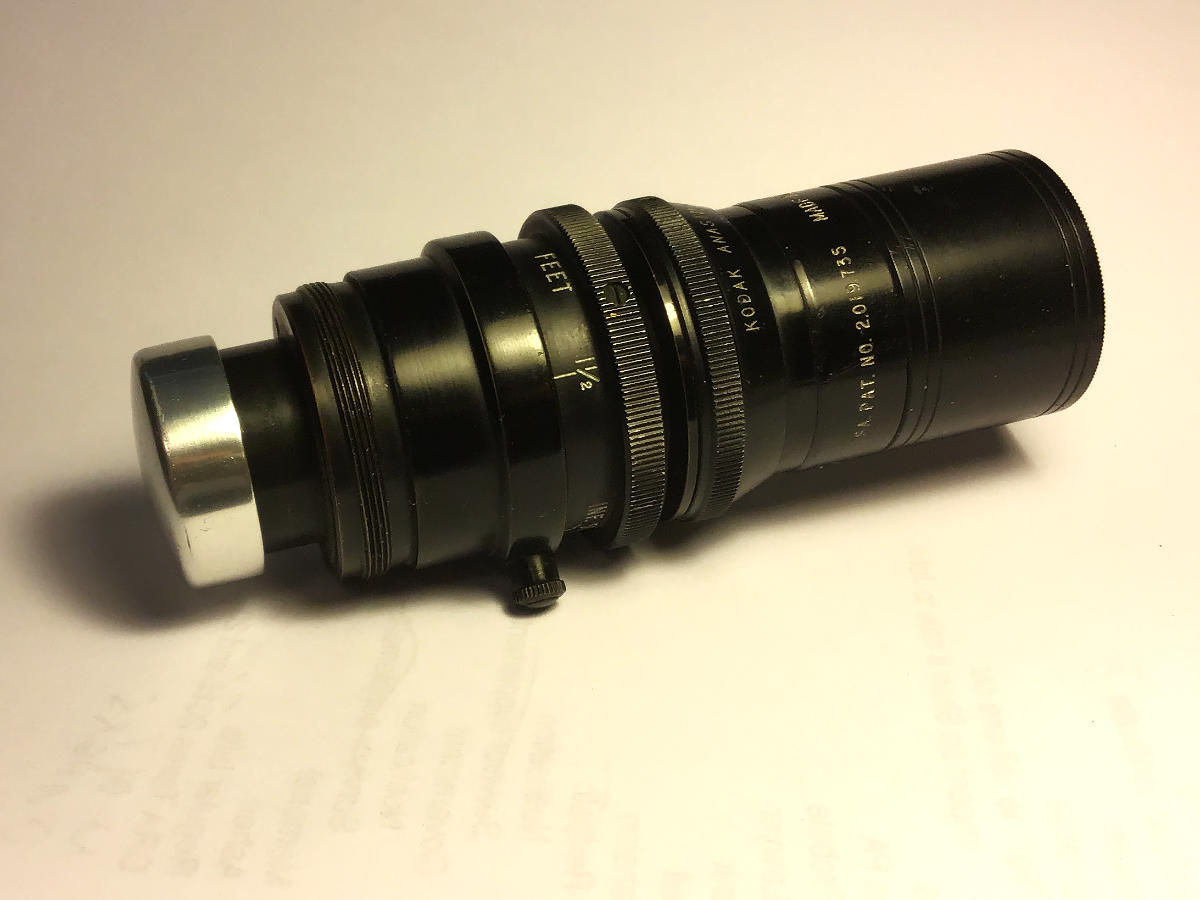
Kodak 67mm f/2.7 Anastigmat 16mm movie camera telephoto lens

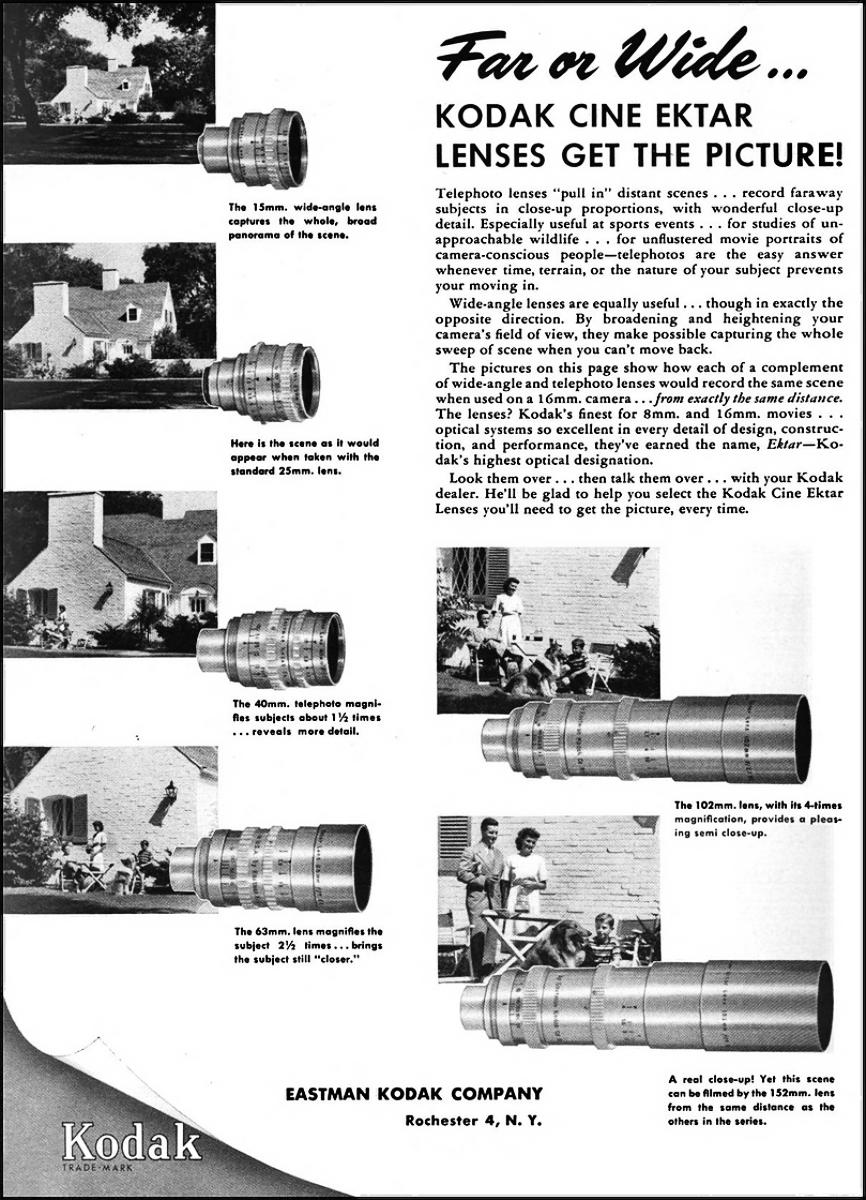
Toronto. We often think of Kodak in the film days as a maker of films and other photographic supplies along with a multitude of inexpensive cameras, both still and movie, and other accessories, projectors, etc.

However, Kodak also made a few high end cameras and lenses such as the Ektars once even used on Hasselblads as well as good quality cine lenses for its 16mm movie cameras.

The movie lenses were promoted to customers in advertisements like the one in this advertisement back in 1951.  The icon for this post is an earlier (c1943) uncoated black enamel Kodak 16mm cine lens called a Kodak Anastigmat. Its 63 mm focal length acted as a telephoto lens on a 16mm camera. As the ad shows, it was replaced by a satin chrome Cine Ektar mid last century.

A thank you goes to photographic historian and retired industrial cinematographer, George Dunbar,  for sharing this bit of photographic history with us. The ad appears in the June, 1951 issue of Popular Photography magazine on page 86.

Posted in history | Tagged , , , | Comments Off on Kodak – not just photo supplies and cheap cameras