Morse and Photography

Samuel F B Morse in 1857

Toronto. Samuel F B Morse was both an artist (painter), and teacher. Closely involved with the North American telegraph, his name lives on as the co-inventor of the Morse Code.  This a code known to telegraphers and amateur radio operators alike.

Morse is also famous (or should be) to photographers. Morse happened to be in Paris in 1839 after Daguerre made his iconic presentation via M Arago. Being an artist, Morse was fascinated with the concept of ‘light painting’. So much so that he met Daguerre in person and later wrote to his younger brother’s newspaper, the “New York Observer“, promoting the Daguerreotype concept in North America helping to raise awareness of that most famous of photographic processes. Caution: much of the linked article for the New York Observer addresses the later use of the name as a newspaper associated with Donald Trump, not it’s original newspaper name (long ended) which was association with the Morse family.

So the next time you hear/see the name ‘Samuel Morse’, think photography as well as telegraph!

Posted in history | Tagged , , , | Comments Off on Morse and Photography

outta da blue

Konica C35 courtesy of Kona Markets, Japan via Ebay

Toronto. After my girls were graduated (about 1999), I bought them each a Konica  film camera with built-in metering, flash, and 35mm f/2.8  lens. One camera was red; the other blue. Both came with a matching case.

One daughter was using hers to capture scenes in Barcelona when ‘out of the blue’ a thief ran up and snatched the ‘camera’ as it hung from her knapsack. Ironically she had taken the little camera out of its case to be more ready for action leaving the thief only the empty case.

These little cameras saw lots of use over the years – sadly one sans case … Konica made many versions of the C35 over the years including the two beautiful coloured ones that gave my children great pleasure. Visit our fairs or auctions and you may find one for your collection (or use if you are into film technology).


Posted in history | Tagged , , | Comments Off on outta da blue

ol’ two (three) eyes

Cover of Stereo Realist Manual c1954.

Toronto. The art of stereo predates photography. Every half century or so this niche art becomes popular once again and companies publish papers and books; make movies; and even make cameras devoted to stereo. Even Kodak jumped in at one point with a 35mm Kodak Stereo Camera (c1954-59). I borrowed one from a PHSC member to try out a few shots.

Mid last century, an expensive and well built 35mm camera called the Stereo Realist was produced and sold by David White Co. of Milwaukee (David White Company has more details shown here). At the time, it was more than a Leica!

When Morgan and Lester of “Leica Manual” fame wrote their manual shown here, covering not only the Realist, but stereo photography along the lines of the many Leica Manual editions with chapters by guest authors. Many of the illustrations are actual stereo photos readily viewed in 3D using the included viewer. The introduction was by Actor Harold Lloyd – a well known stereo enthusiast. In 1976 “Photographic Memorabilia” even reprinted the instruction booklet for the Realist.

Note: The title of this post is a play on the nick-name for Frank Sinatra – “old blue eyes”. Here is one of old blue eyes’ favourite songs, “Strangers in the Night“.


Posted in history | Tagged , , , | Comments Off on ol’ two (three) eyes

I see, I measure

an outing at Craighleith beach in the 1950s – a Kodak moment!

Toronto. Photography by its very nature demands a certain amount of light. Surprisingly, measuring light was not an easy task until well into the last century. From photography’s inception, books and pamphlets gave suggested lens settings and timings for a variety of outdoor scenes. In fact, large companies like Kodak added an instruction sheet to each roll of film well into the last century.

Calculators came along to simplify the decision of exposure. Some meters were invented that let the amount of light determine the suitable camera settings. One such meter was the extinction meter. You looked at the subject while peeking in the meter and used the barely visible number as a reference. Unfortunately, the human eye grows quickly more sensitive in darkness possibly making the reading erroneous.

When selenium cell meters came along, for the first time the amount of light could be converted to electricity to cause a meter to record a setting. Great for daylight, but no value in dim light situations. And the size of the selenium cell was large.

This changed with cadmium sulfide (CdS) cells. In their case the resistance varied with the light rather than any current being created. With a suitable circuit and battery, the light meters worked well into the darkness.

Initially selenium and later CdS cells were used in meters that slid into accessory shoes and connected (usually) with the shutter dial. Setting the shutter would allow the meter to show the necessary f/stop for a given film speed. In time these became built-in meters, automatically changing the camera settings so the camera had to be set to ‘aperture priority’, ‘shutter priority’ or ‘program’ (a pre-selected sequence of shutter and lens settings).

Today smartphones do this automatically, freeing the photographer to concentrate on the subject matter and framing.

Posted in history | Tagged , , , , | Comments Off on I see, I measure

a book for the bug brigade

beetle photo from cover of a 1970s Kodak book

Toronto. In the days of film photography large manufactures produced not only advertisements for their products but many booklets, books, brochures, pamphlets, etc showing how to do various photographs using a manufacturer’s products.

Kodak was no different. Their written materials were legion. This soft cover book (available in hard cover  too) from 1977 offers good ideas for creating close-ups and macro shots on film. Originally it was released as two separate brochures/booklets. Techniques include ways to photograph insects and other small objects so the details may easily be seen.

For many years, minicam lenses offered focussing to 1 metre. To go closer, you were offered many accessories from the maker of the cameras or a third party who made and sold accessories. These included extension tubes, supplementary lens, bellows, framing devices, distance gauges etc. Some even included a mirror box to convert rangefinder cameras to SLRs for longer focus length lenses.

I have often enjoyed close-ups of blossoms and insects, etc. like the bug shown below.

close-up of a raspberry ‘bug’ I found in our garden in 2004

You may spot a copy of this book at one of our auctions, fairs, or sales to add to your collection – or offer you  some new ideas if you are one of those ‘niche’ photographers preferring the look of film over digital.

Posted in history | Tagged , , , , , , | Comments Off on a book for the bug brigade

our February 15th presentation via ZOOM!

Toronto. Whether you are a professional or amateur photographer, or a collector of cameras or images, this ZOOM presentation will be of interest to you. To register, go to Eventbrite. Any questions? Contact our programs co-ordinator, Celio Barreto, at program@phsc.ca. Please note, older Eventbrite programs by the PHSC are available here. Just click on the “Past (nn)” button.

NB, the poster below is a jpg file without live links – sorry.

presentation by Ms Lauren Regier


Posted in program | Tagged , , , | Comments Off on our February 15th presentation via ZOOM!

just another name

Street Photography by Steve McCurry courtesy of the Street Photographers Foundation

Toronto. The photo at left by Steve McCurry caught my eye. To me the name Street Photographer always meant a lone soul who scoured the city streets to snap photos of willing tourists, or wandered the streets like Fred Herzog recording the look and life in our downtown world.

Note: If you read National Geographic in the 1980s, you saw a cover shot by McCurry whether you recognized him or not. Forty years later I can still remember the young girl with the startling blue eyes!

I was surprised when George Dunbar emailed me the link to the Street Photographers Foundation with its amazing list of well known names not usually considered as Street Photographers (yet their very photos say otherwise). I only recognized Fred Herzog and his work in Vancouver as Street Photography. I knew many of the other names but never thought of them as Street Photographers!

Take a look at the story titled, “The Best Street Photographers of All Time” and see what I mean. And give a vote of thanks to that energetic old timer George Dunbar for ferreting out this amazing site and sharing it with us!

Note: The title of this post is a riff on part of a line in Janice Joplin’s sad 1970 rendition of Kris Kristofferson’s 1969 song, “Me and Bobby McGee” recorded shortly before her untimely death.

Posted in history | Tagged , , | Comments Off on just another name

a collector’s dream …

a typical photo history book

Toronto. Sports photographer, author, long time member (and past president) of the PHSC, Les Jones, is having a sale of some of his collection as noted below. Please email him directly for more information. This is a terrific chance for you to augment your collection!

BOOK & IMAGE SALE
Hundreds of photography books for sale – monographs, photo history, biographies, annuals, cameras, early (1900s), instructional, techniques, Canadian, American etc.  New & used.
Bargain prices and even better for bulk.
Thousands of vintage & early photos for sale at reduced prices BY THEME (e.g. Military, Sport, Babies, Beards, Spectacles, Railways, Autos, Marine, Air, Interiors, Music, Hunting, Pets, Horses,
Photographers, Buildings, 3D, Holograms, First Nations, Toronto, Niagara, Occupations, Religion, VIPs, Machines, Circus, Dolls, etc). Plus cabinet cards, cdv’s, lantern slides, ambros & dags.
Too many to list. Please send list of wants or arrange for an appointment to view. We are in the Beaches.
Also available. Dozens of used frames – all shapes & sizes. Wood/plastic/metal – Photo Auction catalogues – Photo Magazine Annuals. Low prices.
 
Posted in activities-other | Tagged , | Comments Off on a collector’s dream …

an ‘Arctic Madonna’ c 1937

Arctic Madonna by Margaret Bourke-White in the Canadian Arctic, in the late 1930s (Courtesy US Camera Annual & LIFE Magazine)

Toronto. Many of us have seen and enjoyed the photography of the late George Hunter, including his iconic portraits of the Inuit people.

Surprisingly, an American photographer visited the far north to photograph its people for LIFE magazine back in the late 1930s. The photographer was none other than Margaret Bourke-White and two of her photos appeared in a photo magazine  – “U.S. Camera Annual 1939, Edited by Thomas J. Maloney, NY: William Morrow, 1938. ‘Arctic Madonna’ by Margaret Bourke-White, p. 13”.

The article lead continues, “One of two photographs by Bourke-White in U.S. Camera Annual 1939, ‘Arctic Madonna’ was taken in August 1937 on assignment for Life magazine, which published two photo essays taken in the Far North by the photographer in its October 25 issue.

“Bourke-White made this portrait in Coppermine, Northwest Territory, at 10pm, in the ‘land of the midnight sun.’ The Inuit woman had come several hundred miles in an open boat to greet the Bishop of the Arctic, with whom Bourke-White was traveling by air. At one point, due to bad weather, the party was forced down in the Arctic Ocean two hundred miles from the magnetic North Pole and spent time on a small island far from any human habitation.

“During this trip, Bourke-White was besieged with telegrams from love-struck Erskine Caldwell, addressed to ‘Honeychile’ from ‘Skinny,’ asking her to return and marry him. One was even read on the radio when she was marooned in the Arctic.”

My thanks goes to good friend and fellow photo historian, George Dunbar, for finding and sharing this bit of history. George writes, “An exceptionally interesting and detailed bio of Margaret Bourke-White’s career will be found here, on Gary Saretzyk’s web site.”

Posted in history | Tagged , , , , , | Comments Off on an ‘Arctic Madonna’ c 1937

blinding me with flash bulbs

blinding me with a news photographer’s flash – courtesy of eazywallz.

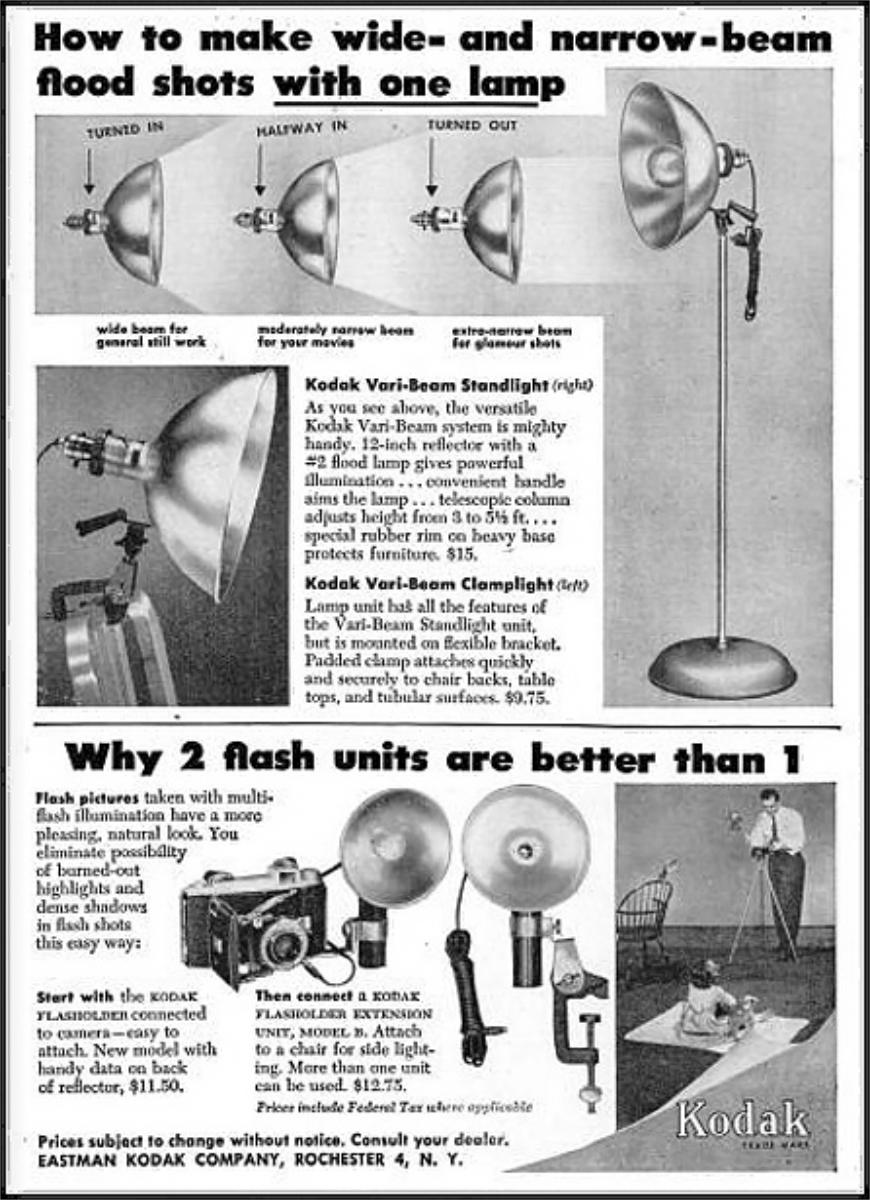
Toronto. In the 1800s, efforts to use photography and its very slow media under poor lighting (i.e. less than full sunlight) resulted in the invention of flash powder ignited in a long narrow tray held high(ish) by the photographer.

As usual, the law of unexpected consequences stepped in: photographers unfamiliar with flash powder – or very inept in general came away from a session eye-brow-less  or worse! To solve that problem, flash bulbs were perfected. Many sizes were made over the years to vary the illumination, sync with various kinds of shutters, balance colour temperature, etc.

The image used here is from a website, eazywallz which sells wall paper and murals. (Late PHSC executive Larry Boccioletti amassed and sold flash bulbs. I once quipped he could advertise the bulbs as ‘only used once’. He never did.)

Mid 20th century efforts went towards harnessing Edgerton’s strobe light experiments and the detachable electronic flash was born. Early models were expensive and photographers often resorted to using flash bulbs instead. As electronic flash guns got smaller, they were equipped with an accessory shoe for camera body mounting. Eventually they became so small that electronic flash was incorporated in camera bodies.

By the time digital cameras became prominent, all cameras sold to amateurs came with built-in electronic flash. This idea carried over to the smartphones of today with even tinier built-in electronic flash and they evolved to both flash and a built-in flashlight – very handy.

NB. The title here is a riff on Thomas Dolby’s 1983 song, “She Blinded me with Science” (I have Dolby’s CD which includes this song).

Posted in history | Tagged , , , , , | Comments Off on blinding me with flash bulbs