a collector’s dream …

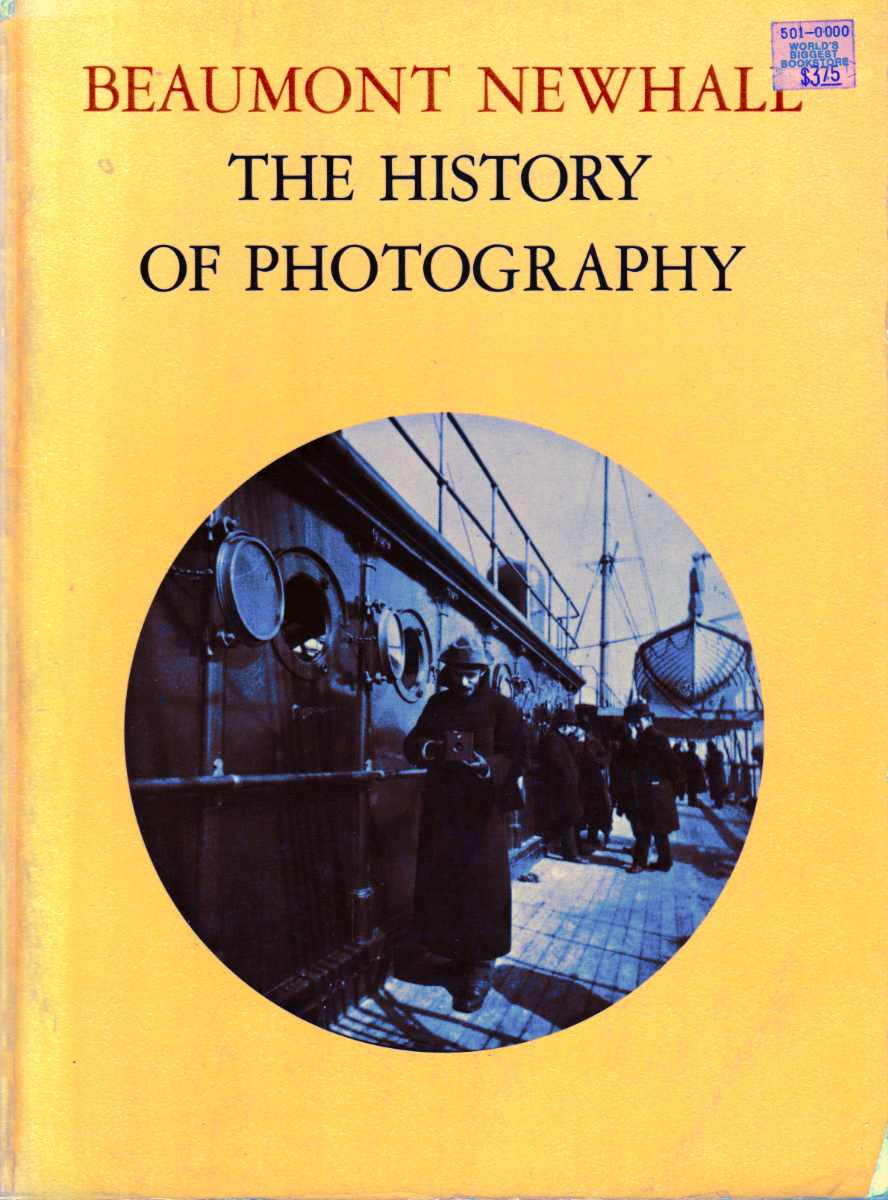
a typical photo history book

Toronto. Sports photographer, author, long time member (and past president) of the PHSC, Les Jones, is having a sale of some of his collection as noted below. Please email him directly for more information. This is a terrific chance for you to augment your collection!

BOOK & IMAGE SALE
Hundreds of photography books for sale – monographs, photo history, biographies, annuals, cameras, early (1900s), instructional, techniques, Canadian, American etc.  New & used.
Bargain prices and even better for bulk.
Thousands of vintage & early photos for sale at reduced prices BY THEME (e.g. Military, Sport, Babies, Beards, Spectacles, Railways, Autos, Marine, Air, Interiors, Music, Hunting, Pets, Horses,
Photographers, Buildings, 3D, Holograms, First Nations, Toronto, Niagara, Occupations, Religion, VIPs, Machines, Circus, Dolls, etc). Plus cabinet cards, cdv’s, lantern slides, ambros & dags.
Too many to list. Please send list of wants or arrange for an appointment to view. We are in the Beaches.
Also available. Dozens of used frames – all shapes & sizes. Wood/plastic/metal – Photo Auction catalogues – Photo Magazine Annuals. Low prices.
 
Posted in activities-other | Tagged , | Comments Off on a collector’s dream …

an ‘Arctic Madonna’ c 1937

Arctic Madonna by Margaret Bourke-White in the Canadian Arctic, in the late 1930s (Courtesy US Camera Annual & LIFE Magazine)

Toronto. Many of us have seen and enjoyed the photography of the late George Hunter, including his iconic portraits of the Inuit people.

Surprisingly, an American photographer visited the far north to photograph its people for LIFE magazine back in the late 1930s. The photographer was none other than Margaret Bourke-White and two of her photos appeared in a photo magazine  – “U.S. Camera Annual 1939, Edited by Thomas J. Maloney, NY: William Morrow, 1938. ‘Arctic Madonna’ by Margaret Bourke-White, p. 13”.

The article lead continues, “One of two photographs by Bourke-White in U.S. Camera Annual 1939, ‘Arctic Madonna’ was taken in August 1937 on assignment for Life magazine, which published two photo essays taken in the Far North by the photographer in its October 25 issue.

“Bourke-White made this portrait in Coppermine, Northwest Territory, at 10pm, in the ‘land of the midnight sun.’ The Inuit woman had come several hundred miles in an open boat to greet the Bishop of the Arctic, with whom Bourke-White was traveling by air. At one point, due to bad weather, the party was forced down in the Arctic Ocean two hundred miles from the magnetic North Pole and spent time on a small island far from any human habitation.

“During this trip, Bourke-White was besieged with telegrams from love-struck Erskine Caldwell, addressed to ‘Honeychile’ from ‘Skinny,’ asking her to return and marry him. One was even read on the radio when she was marooned in the Arctic.”

My thanks goes to good friend and fellow photo historian, George Dunbar, for finding and sharing this bit of history. George writes, “An exceptionally interesting and detailed bio of Margaret Bourke-White’s career will be found here, on Gary Saretzyk’s web site.”

Posted in history | Tagged , , , , , | Comments Off on an ‘Arctic Madonna’ c 1937

blinding me with flash bulbs

blinding me with a news photographer’s flash – courtesy of eazywallz.

Toronto. In the 1800s, efforts to use photography and its very slow media under poor lighting (i.e. less than full sunlight) resulted in the invention of flash powder ignited in a long narrow tray held high(ish) by the photographer.

As usual, the law of unexpected consequences stepped in: photographers unfamiliar with flash powder – or very inept in general came away from a session eye-brow-less  or worse! To solve that problem, flash bulbs were perfected. Many sizes were made over the years to vary the illumination, sync with various kinds of shutters, balance colour temperature, etc.

The image used here is from a website, eazywallz which sells wall paper and murals. (Late PHSC executive Larry Boccioletti amassed and sold flash bulbs. I once quipped he could advertise the bulbs as ‘only used once’. He never did.)

Mid 20th century efforts went towards harnessing Edgerton’s strobe light experiments and the detachable electronic flash was born. Early models were expensive and photographers often resorted to using flash bulbs instead. As electronic flash guns got smaller, they were equipped with an accessory shoe for camera body mounting. Eventually they became so small that electronic flash was incorporated in camera bodies.

By the time digital cameras became prominent, all cameras sold to amateurs came with built-in electronic flash. This idea carried over to the smartphones of today with even tinier built-in electronic flash and they evolved to both flash and a built-in flashlight – very handy.

NB. The title here is a riff on Thomas Dolby’s 1983 song, “She Blinded me with Science” (I have Dolby’s CD which includes this song).

Posted in history | Tagged , , , , , | Comments Off on blinding me with flash bulbs

a super lens

The 5cm f/2 Super Rokkor lens c 1950s

Toronto. In the late 1950s, I volunteered to serve in Labrador on a then new Tropospheric Scatter telephone network joining a few remote towns and mines to the outside world.

While training for the job, I bought my first 35mm camera – a Minolta Rangefinder camera equipped with a leaf shutter and a fixed 5cm f/2 lens. Until I owned a camera made in Japan, I was unaware of the quality build and resolution of Japanese photographic products.

The Super Rokkor lens was coated and incredibly clear to my eyes. The image shown is courtesy of the Canon Rangefinder web site.

A year or so later, I sold the camera and lens to buy a USSR made 35mm SLR, the Exakta VX IIa from Dresden, East Germany. I also bought two well made German Steinheil lenses and an equally well made French lens (an early retro-focus 28mm wide angle design that allowed the SLR mirror to move freely at the cost of severe geometric distortion).

The Super Rokkor? Beautiful. Only later did I understand that even a ‘normal’ prime lens for my SLR was slightly retro-focus in design affecting its resolution (if measured, but not especially evident in practical use) and focal length.


Posted in camera | Tagged , , | Comments Off on a super lens

the image maker

The Bigger Picture
The Need for a Photographic Community by Bharat Mistry, O3C Past President

Toronto. Being located in Toronto, we are a member of the “Ontario Council of Camera Clubs”, AKA O3C.

The O3C periodically issues its own newsletter called, “The Image Maker“,  For Ontario Leaders in Photography Education.

Have a read and if you collect images or cameras, please join the PHSC (see the right hand sidebar for details, fees, etc.). If you take photographs and live in the GTA, join your local camera club. Outside the GTA? No Council like the O3C? Consider creating a Council!

Posted in activities-other | Tagged , | Comments Off on the image maker

February 15, 2023 PHSC Presentation via Zoom

Where I stand is fair and square [Silo City, Buffalo, New York] (Performance Art by Lauren Regier, photographed by Taralyn Brinkman)

Toronto. We are very please to have Ms Lauren Regier as our speaker this month.

A blurb about Ms Regier says, “Lauren Regier is an interdisciplinary artist based in Niagara, Ontario with a Graduate Diploma in Arts Management from Queen’s University.

“Her practice explores the ways in which humans perceive their surroundings and the roles they play. In bringing forth intrinsic elements of a healthy ecosystem, she draws parallels in how humans relate, or diverge from these paths.”

Whether you are a professional or amateur photographer, or a collector of cameras or images, this ZOOM presentation will be of interest to you. To register, go to Eventbrite. Any questions? Contact our programs co-ordinator, Celio Barreto, at program@phsc.ca. Please note, older Eventbrite programs by the PHSC are available here. Just click on the “Past (nn)” button.

Posted in program | Tagged , , , | Comments Off on February 15, 2023 PHSC Presentation via Zoom

the way we were – updated and corrected.

A quiet-looking King Street, Saint John, NB, circa 1870, Canada from the LAC in Ottawa courtesy Daily Mail article. (ERRATA: Shown as Toronto initially, not Saint John.)

Toronto. Thanks to Trish J who diligently searched the LAC site and discovered this photo is NOT King St TORONTO, but King St SAINT JOHN NB!

Trish J writes, “A photograph of King Street, Saint John NB is mistakenly labelled as King Street, Toronto.  The article is “The Way We Were” from Jan. 20, 2023.

“I went to the Library Archives of Canada’s website and did a search for King Street, Saint John, NB and this is the 2nd photo that I hit.  It dates from 1867-1873 and is found in box 55016.

“King Street in Toronto is not hilly and it doesn’t run down to the harbour.  This mistake had been copied on to Facebook’ vintage Toronto page.   Please publish an errata.”

I really appreciate viewers taking the time to email me any errors or corrections to posts. Just email info@phsc.ca and show the post name and date so I can find it easily (this site has been in operation over two decades).

Posted in history | Tagged , , , | Comments Off on the way we were – updated and corrected.

how much is enough?

Camera Lens view of a Samsung Galaxy S23 Ultra smart phone

Toronto. Did you hear? the newest Samsung Galaxy S23 Ultra comes with a 200MPX camera! A How-to Geek article called,”The Samsung Galaxy S23 Ultra Has a Wild 200 MP Camera describes this astonishing phone. Last fall, the same site notes the first 200MPX camera in,”We’re Now in the Age of 200MP Smartphone Cameras“.

As astonishing as this news may be, film still reigns supreme for fine details if all else is high quality, including the photographer. Ken Rockwell has a delightful article comparing pixels to film called,”Pixel Count of Film“. I was surprised to see that even at 200MPX, film can still do better. I suspect that digital convenience and capabilities far outweigh the raw resolution issue.

When I was using a Windows system, I had special printer driver software from SilverFast that wrung the very most from the printed image – it was an eye-opener. Unfortunately it isn’t available for the Mac.

In the days when I had a 3MPX camera, I was told one needed at least 35MPX to match Kodachrome … I must say that my iPod Touch with its 8MPX camera and the Focus Magic plug-in for AffinityPhoto (and other software that uses the Photoshop plugin standard) gives me very acceptable photos making the tiny iPod Touch my go to camera.

Posted in camera | Tagged , , , , , , | Comments Off on how much is enough?

to print or not to print

Toronto. The popularity of mid 1800s printing made possible the Victorian practice of making a photographic album. This practice carried on well into the next century.

When the idea of albums disappeared, a drawer, shoe box or other small space served to hold photos of family interest and history.

When digital photography came along, most images were simply filed in a computer or smart phone. Sadly, changes in technology may mean the files cannot be opened in the future, or viewer formats may change making old files forever un-viewable.

A simple solution would be to routinely print those images felt to be of future interest to a family genealogist or historian.

Note: The title of this post is a riff on Shakespeare’s famous soliloquy from Hamlet, “To be or not to be”. And the title of the photo is a riff on a line from a 1966 song by Simon and Garfunkel, “59th Street Bridge Song“.

Posted in history | Tagged , , , | Comments Off on to print or not to print

a bank clerk makes good

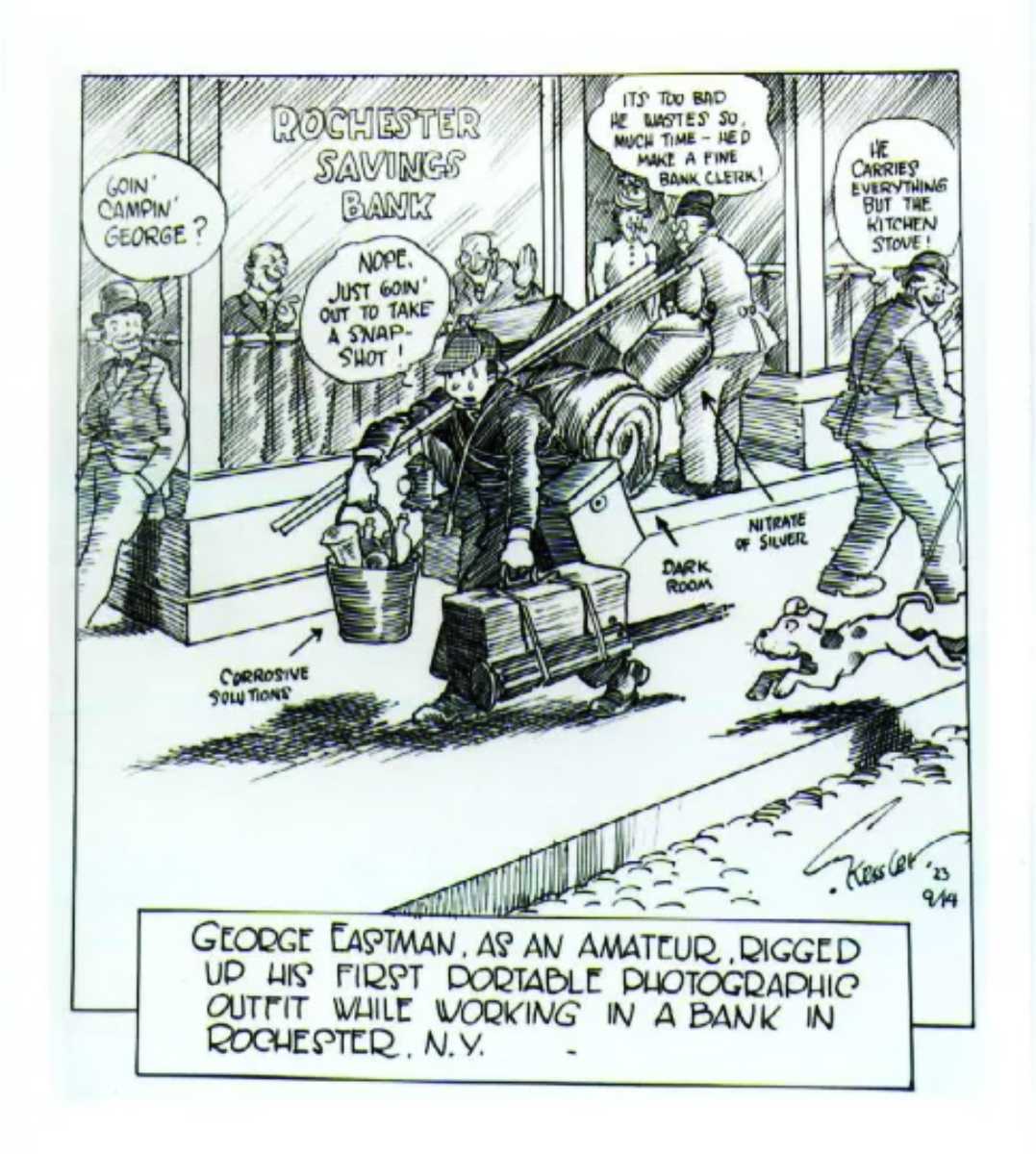
a cartoon showing Eastman when he discovered photography – Courtesy of the Eastman Museum (I have a book with this image somewhere)

Toronto. When Englishman Richard Maddox discovered a dry plate process fast enough for use in a camera, he set in motion many things including the shift in technological revolution from the old world to the new. During the 1870s in the USA, three companies developed and made dry plates for sale in stores.

Two of the three were professional photographers who immigrated from Europe. The third was a young American-born person with no professional experience. He was George Eastman, a junior clerk in a Rochester bank. Eastman left the bank and after many experiments founded The Eastman Dry Plate Company aided by a well established businessman with deep pockets.

Eastman’s savvy led to film, the famous Kodak and Brownie lines of cameras, plus many merges and acquisitions, and the discovery of a high quality colour transparency process (Kodachrome), filters, darkroom chemicals and eventually to his company, now called Eastman Kodak, becoming the world’s largest photographic enterprise offering still cameras, movie cameras, film, darkroom products, and more for amateurs and professionals alike.

George never married and in 1932 he perished by his own hand after famously writing, “My work is done. Why wait?”. A few years later, Kodachrome came on the market and ‘black and white’ film continued to be improved in speed and resolution – just a few of the massive creations by Kodak post 1932, Hint: The first digital cameras began life in a Kodak Laboratory but the discovery was never acted on until it was far too late for Kodak.

Posted in history | Tagged , , , | Comments Off on a bank clerk makes good