flighty photos

a 1959 photo of Montreal by air

Toronto. Some photographers use propeller driven aircraft in their activities. Exec member Wayne Gilbert often used a small aircraft as he shot views of buildings. This ceased when his friend and pilot retired. The use of a small aircraft circumvented the very restrictive limitations on using and flying the little drones that are the rage this century.

Some speakers have also used small aircraft. George Hunter did so, sometimes with frightening but hilarious results. George recounted how he ‘borrowed ‘a plane and pilot out west. His process was to remove a door (he had regulation pins to restore it later) and have the pilot fly low and slow to get a good shot. In this case George fell out of the plane, landed on a wing strut, and was hauled in at the last minute – camera and body.

A few years later the pilot emailed me to confirm that George had used his plane that fateful day!

George mentioned doing work for LIFE magazine and taking photos across America in the early evening balancing city lights and waning daylight. At one point he noticed he was tailed by military aircraft and promptly landed. Turned out he had accidentally shot a NO PHOTOGRAPHS military compound (he was allowed to send the non military shots off to LIFE in NYC)!

The photo at the upper left was taken on Kodachrome out the window of a propeller driven commercial aircraft. I adjusted the sharpness and contrast as much as possible. Now-a-days commercial aircraft all use jet engines and fly miles above the clouds. The old propeller driven aircraft flew low enough that you could see the ground easily on a cloudless day.

Posted in history | Tagged , , , | Comments Off on flighty photos

drop it!

a local little league game with players facing off (early 2014)

Toronto. One of the specialities photographers often chose was sports photography. We have had sports photographers and sports topics at the society from time to time. At least one sports photographer and author (Les Jones) has even been president (plus programme secretary and an inspiration to others). Les favours soccer as his sport of choice and follows the game world wide.

In the days of film, a good shot could be selected and paid for at a good price by newspapers and magazines. Digital technology made the sports shots much easier to capture (eg, remote control of cameras strategically placed, far greater sensitivity reducing the amount of light needed for action shots, etc.). The down side was the ease with which an entire batch could be transmitted for choice by a remote editor within hours. This seemed great at first but it cut the fee per selection to a fraction of its earlier value.

At above left are kids playing in a small hockey league. A very few will go on to the minors (farm clubs) and even fewer to the NHL. Growing up, our local team was a farm team for the Boston Bruins making it difficult to choose an NHL favourite (in the original six teams Canadians generally favoured the Leafs or Habs).


Posted in people | Tagged , , , , , | Comments Off on drop it!

Gary’s next CAMERAMA show is April 23rd

April 23, 2023 is the next CAMERAMA show

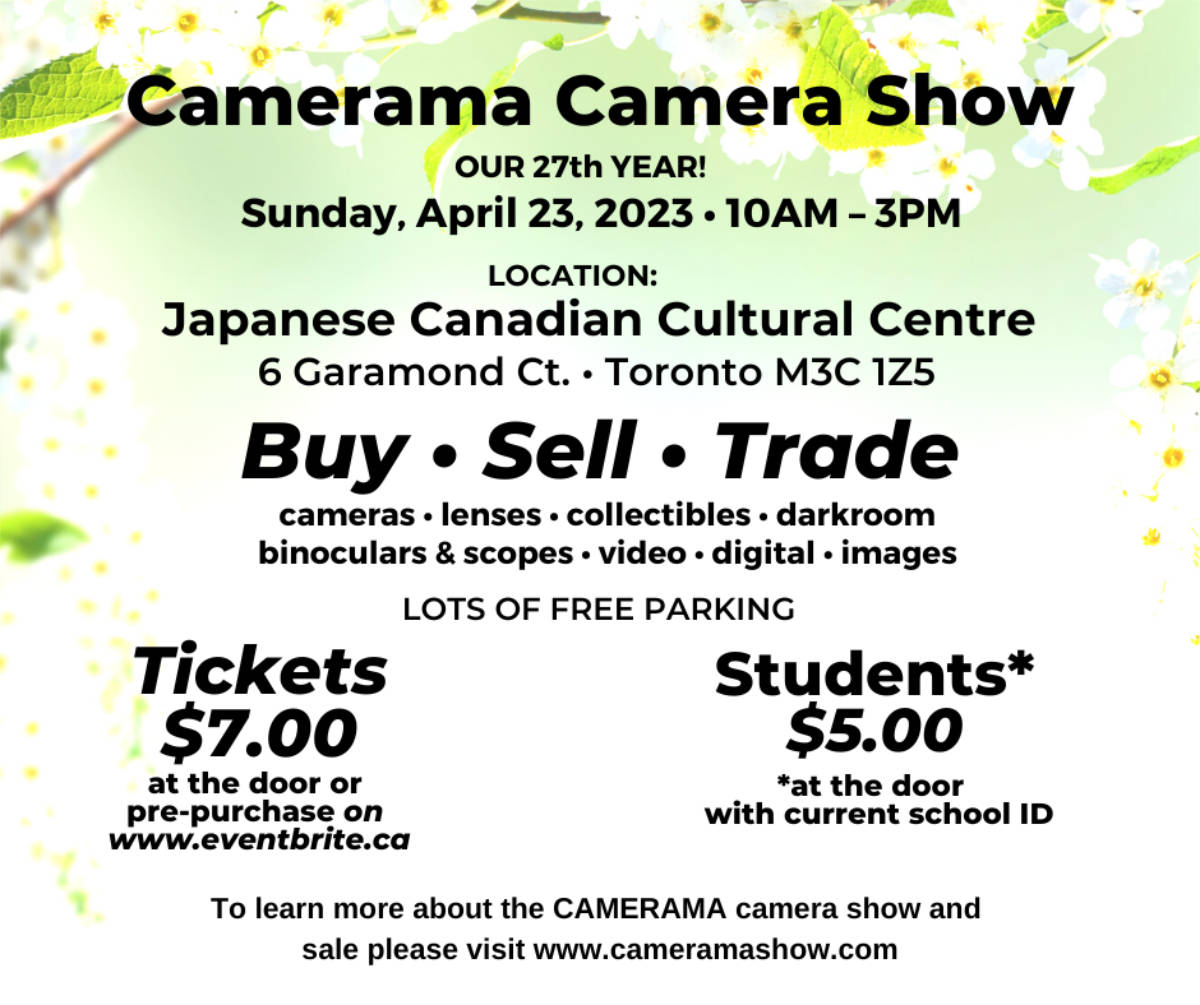
Toronto. Our good friend Gary Perry writes, “Our next Camerama Camera Show is next month: Sunday, April 23rd, 2023 Time: 10am – 3pm

“Please see attached flyer for details or go to our website or Facebook page. [Click icon at left to see larger poster]

“Hope to see you there!


“Gary Perry
Show Coordinator”

Website: www.cameramashow.com

Facebook: https://www.facebook.com/cameramashow

Posted in activities-other | Tagged , , , , , | Comments Off on Gary’s next CAMERAMA show is April 23rd

lots will get hammered this spring

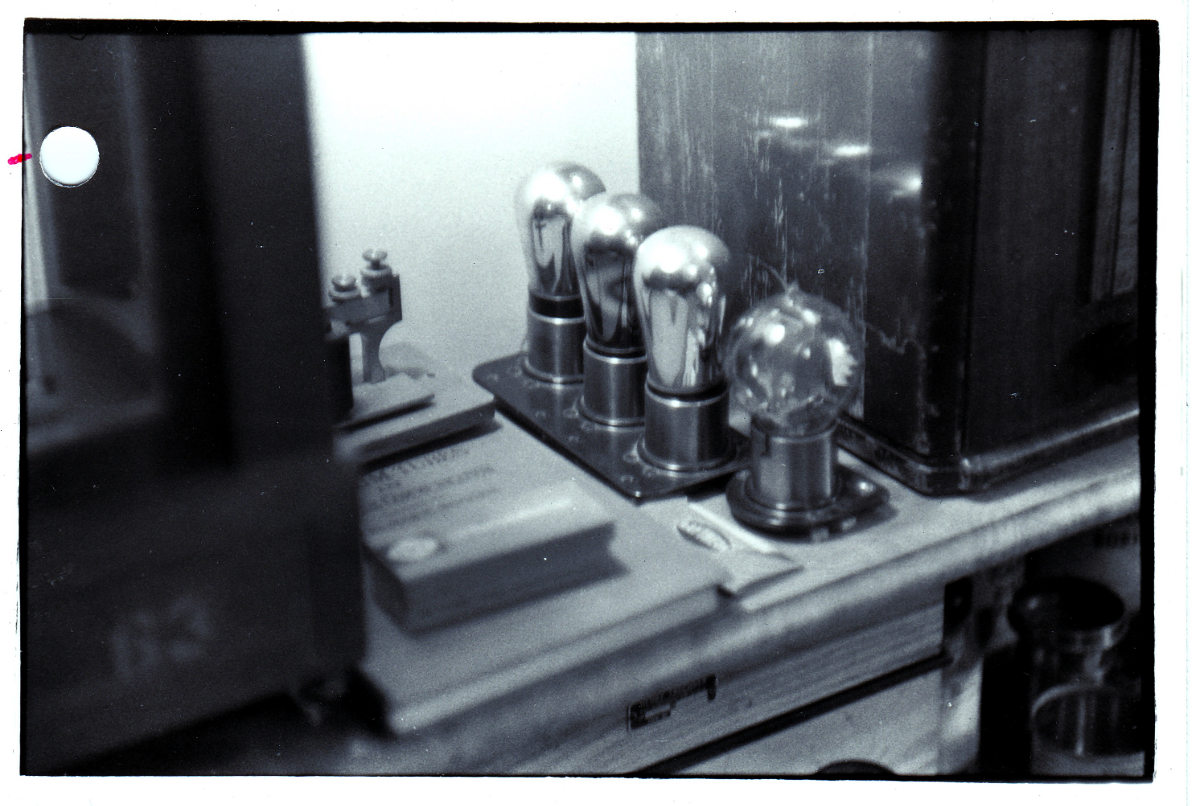
Photo taken wide open with a 1935 73mm Hektor lens and a Leica M4 (plus adaptor)

Toronto. Okay folks, time to get over this nasty March weather and think about auctions and cameras and stuff! Our spring auction this year is on April 30th BUT at a slightly later time (so you can catch an extra snooze, wife and kids permitting …).

I will add more details in April (see right hand side bar for now). Hint: send Clint photos of what you are thinking of including. Those accepted will go up as part of our slide show.

While I haven’t picked up a lot for some time, I have sold cameras, books, lenses, etc. at our auctions. For example, the photo at left was take with a Leitz 73mm Hektor lens at f/1.9. The lens went to a new home in the PHSC spring 2012 auction. This lens is significant as it was the first fast lens ever offered by Leitz for the Leica. First offered in 1931, some 7,225 were sold, almost all before WW2 ended. I sharpened the photo and made it slightly more contrasty as the lens is a bit soft wide open and has lower contrast as it is uncoated.

Keep your eye on these posts to see more as we approach April 30th!

Posted in auction | Tagged , , , , , , | Comments Off on lots will get hammered this spring

what a find for the image collector

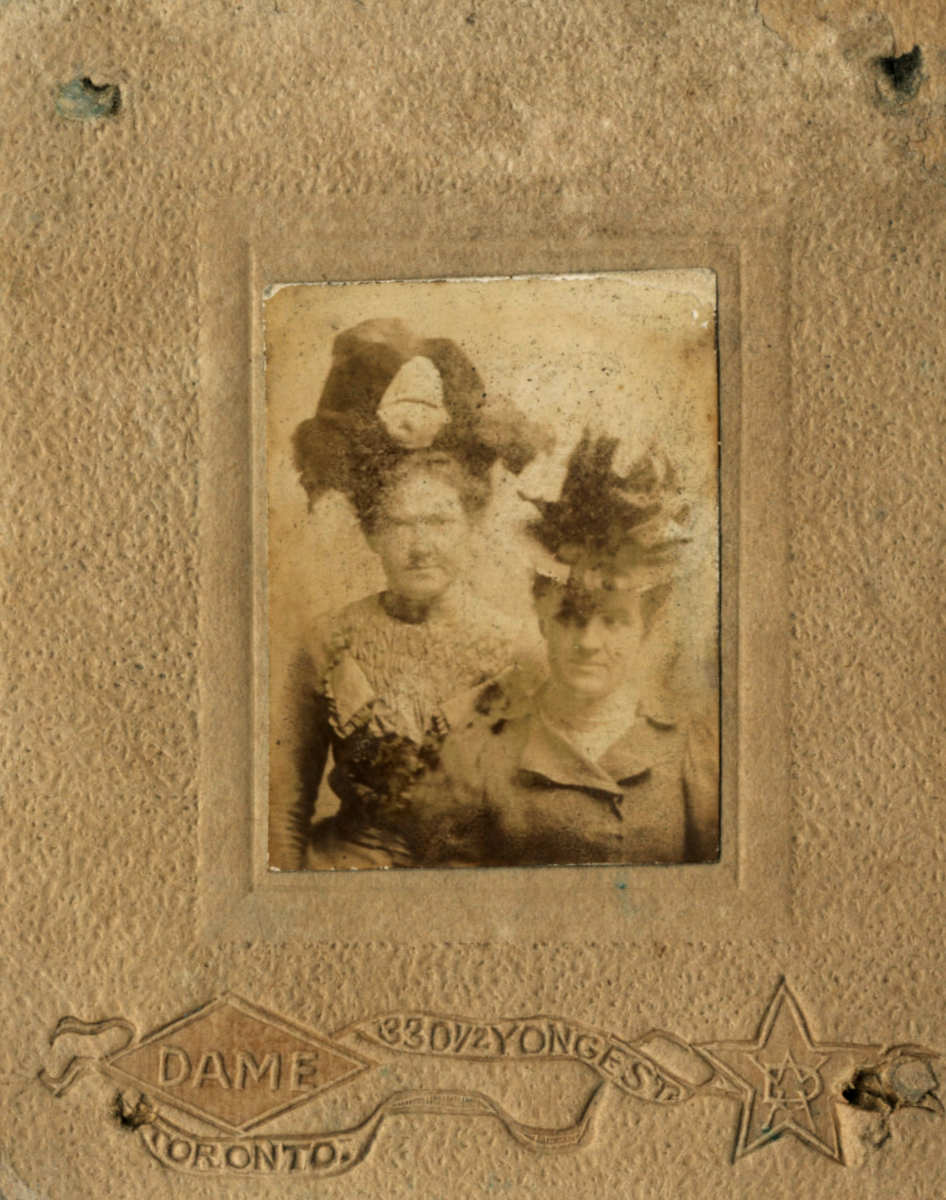
a portrait of two ladies photographed by William Dame at 339 1/2 Yonge St., Toronto, c1900

Toronto. I always enjoy emails from George Dunbar. George diligently researches photographic history and comes up with the darnedest things! This time it is a doozy for those of us who collect photos by long ago Ontario photographers.

George writes, “Plenty of images here [Search Ontario] for a pleasant exercise in browsing, such as this portrait made by William Dame at 339 1/2 Yonge St., Toronto, c1900.”

All you need to know is the photographer’s name and do a search. The web site at Search Ontario is linked to many Ontario archives and can quickly track down and show photos by the same person.

This saves you from searching each archive (given you even know the archive) trying to track down a source. Try it on your own selection of old Ontario photos …

Posted in history | Tagged , , , , | Comments Off on what a find for the image collector

forgotten photographers

Retrospective exhibit by Neil Newton

Toronto. Like many callings, occupations, etc., the majority of photographers live a quiet life and are soon forgotten in the dimness of time. I think of Red Favero in Barrie or Bud Mitchell in Midland, just two the many who are not particularly known outside their communities.

Few photographers like our late editor Bob Lansdale have the presence of mind to donate their negatives to archives. Bob did this with his U of T work, donating the images to the university’s archives where they will  live beyond him in future publications.

An email from George Dunbar along with his copy of a Canadian Statesman (Bowmanville) newspaper article from June 29, 1976 on Neil Newton’s catalogue from his ‘Retrospective’ exhibit at ‘The Robert McLaughlin Gallery in Oshawa’ sparked my memory.  Neil has many prestigious awards and clients from his time in photography. I met Neil decades ago and bought one of his 1978  ‘Retrospective‘ catalogues. Small world!

Posted in people | Tagged , , , , , | Comments Off on forgotten photographers

a baleful eye on historic events

Train wreck summer of 1959 at Washago when two passenger trains collided head-on

Toronto. Not long after its invention, photography and photographers recorded exotic landscapes, famous people, disasters, wrecks, wars, etc.  Before the evolution of such photographs, we relied on wood cuts, steel cuts, and the written word to describe events near and far.

War benefitted from photographers. They roamed the battlegrounds with only a camera and recorded stills and later movies too that resonated with those at home. Wrecks such as this train wreck at Washago, Ontario in 1959 would be forgotten in the mists of time if not recorded by photography. Some times the photographer was famous, or became famous.

Other times – like in this case – the photographer chose to keep his efforts hidden to all but family. A freight train headed south for Toronto was waylayed in a siding to let a busy passenger train pass. A few miles down the track at Washago the passenger train crashed head-on with a second train headed north. The engine crew in the south bound train were killed instantly.

The freight train that would have crashed, but for the directive to pull into a siding to let the ill-fated passenger train pass, went by unscathed after the line was cleared and restored. The freight engineer was my grandfather …

Posted in history | Tagged , , , , , , , , | Comments Off on a baleful eye on historic events

… and everything nice …

My first good 35mm camera (bought new but found two decades later to be terminally ill). The camera, an Exakta VXIIa, became my first collectible …

Toronto. From the earliest days of photography to the invention of dry plates, shutter speeds were unnecessary – the media were far far too slow. A simple hat or lens cap (and verbal counting) served as a shutter. As to ‘shutters’ all was sugar and spice …

With dry plates, a shutter became necessary since for the first time under daylight a glass plate had sub-second sensitivity. The shutters could be set to ‘I’ for instantaneous (about a 15th of a second) or ‘T’ for time (some times shown as ‘Z’ – time in German –  or as ‘B’ for bulb) as a nod to the older media.

Various mechanical shutters evolved mounted on or in the lens (leaf shutters). Springs or gears could vary the speed of  the leaf rotation to set shutter speeds. Then the shutter was moved to the film plane, was made larger, and used a variable width between two light tight curtains, or two parts of a single curtain. Various springs and gear trains could slow down the second curtain to vary the gap (or the curtain could be wound to set the various fixed length gaps).

As media sensitivity improved, more elaborate shutters were concocted to allow various sub second speeds to be set. This became critical when the minicam era began around the late 1920s. Some cameras relied on leaf shutters while other varieties used focal plane shutters – complexity grew as the pre 1870s media drifted into history.

Note: The title of this post is a piece of an early (about 1820) nursery rhyme called, “What Are Little Boys Made Of?“.

Posted in history | Tagged , , , , | Comments Off on … and everything nice …

George finds more on George

Photographer George Hunter by Simon Bell

Toronto. One of the more illustrious of our speakers and members was the late George Hunter. My good friend George Dunbar found this article written by Jodie White in the summer of 2011, a couple of years before Mr Hunter died.

The article in Maclean’s magazine is titled, “The most famous Canadian photographer you’ve never heard of“. This was followed by a second email hard on the heels of the first. A second link on George Hunter was included, this time a eulogy and photos on the NFB website. Be patient and scroll down to see the options (your computer really did not hang) – the show begins on its own.

Mr Hunter spoke to us a few times as did Simon Bell whose photo of George we use as an icon for this post.

Posted in people | Tagged , | Comments Off on George finds more on George

a Jolly Irishman makes photography colourful

Flower photo taken with the Joly process filters

Toronto. One of the goals of photography was to let light create natural colour. All the methods possible were recorded by the Frenchman, Louis Ducos du Hauron and based on the experiments of James Clerk Maxwell.

Of course today with digital technology and especially with smartphones, it is hard to believe that monochrome photography was the norm, or that the media was so insensitive that colour was impractical for most shots. Imagine!

So it was no wonder that inventors strived to create natural colour photographs. After many years of experimenting, the first commercial colour process went on sale in 1895 using a process that was patented a year earlier by professor John Joly of Dublin.

The website, filmcolors.org, says in part, “In 1894 Professor John Joly of Dublin patented a process for producing a screen of red, green and blue-violet lines by ruling them on a gelatin-coated glass plate. … The Joly process was introduced commercially in 1895, and was the first additive screen-plate process to appear on the market. …”.

The text and some images are from the late Brian Coe’s 1978 book: Colour Photography. The First Hundred Years 1840-1940. London: Ash & Grant, (pp. 46-48).

After a few years this process was superseded by a plethora of colour processes culminating in 1907 with the famous Autochrome process by Auguste and Louis Lumière.

And a happy St Patrick’s day to all you viewers!

Posted in history | Tagged , , , | Comments Off on a Jolly Irishman makes photography colourful