whatcha doin’ this Sunday?

our editor, Bob Lansdale, catches a snooze after the 2017 spring fair!

Toronto. Like many of us, come on and join in at the Spring Photographica-fair! Meet old friends, get some added pieces for your collection, buy some stuff for your film or digital gear.

Now that COVID is well on the way to being but a distant smear on history, we are holding spring and fall fairs on a Sunday at the Trident Hall.

Click the above link for poster and directions for the Spring Fair this coming Sunday.

Don’t don’t miss out on the fun and food at this grand event in the west end of the big smoke! Lots of food, free parking, bargains, and like minded people ready to chat and visit.

See you Sunday!

Posted in fair | Tagged , , , , , , , , | Comments Off on whatcha doin’ this Sunday?

shooting at the moon

Full moon. December 2010 with Sony NEX-5, tripod, remote control and a Leitz Telyt 200mm lens plus a conversion ring

Toronto. Happy Victoria day to all. According to the TV, this holiday’s name eludes most people these days as they seem to be non-British folk. The actual holiday is celebrated the first Monday on or just before the 24th. Initially, it was celebrated in Canada as Queen Victoria’s birthday. It has since been designated as the day we celebrate the birthday of the reigning Queen/King of England and the commonwealth.

Meantime, back to the post title. Eventually we all seem to decide to take a photograph of our moon. This is best done during a full moon and with a camera and telephoto lens sturdily mounted on a tripod. The moon at that time is surprisingly bright. It reflects our sun in the darkness of the night sky. In the above photograph, I used software to crop and sharpen the image captured by my little Sony mirrorless digital camera.

The moon or other celestial bodies can be included in a photograph to add charm and peace. If you haven’t yet tried your hand at ‘moon shots’, try some out. Our fairs (our spring fair is this coming Sunday May 28, 2023) are a great source of telephoto lenses and tripods. Come on out and visit – you may find ‘must have’ items for your collection too!

Posted in fair | Tagged , , , , | Comments Off on shooting at the moon

get some halifax-shun

end of an era in Halifax, NS

Toronto. George sent me a few photos the other day including this gem from the Nova Scotia Archives Photo Collection. This is simply another example of the importance of photography in recording history and the ability of archives to hold and display such photographic resources.

I wonder who today would otherwise know that in March of 1949 tram-car service in the main part of Halifax was ended?

Thank you, George Dunbar, for discovering the Archives and this photograph.

Note. The title of this post is a riff on the 1965 song sung by the Rolling Stones, “I Can’t Get No Satisfaction“. While I tend more to Beatles, the ‘Stones song brings back memories to me as it was often played on radio back then.

Posted in Uncategorized | Comments Off on get some halifax-shun

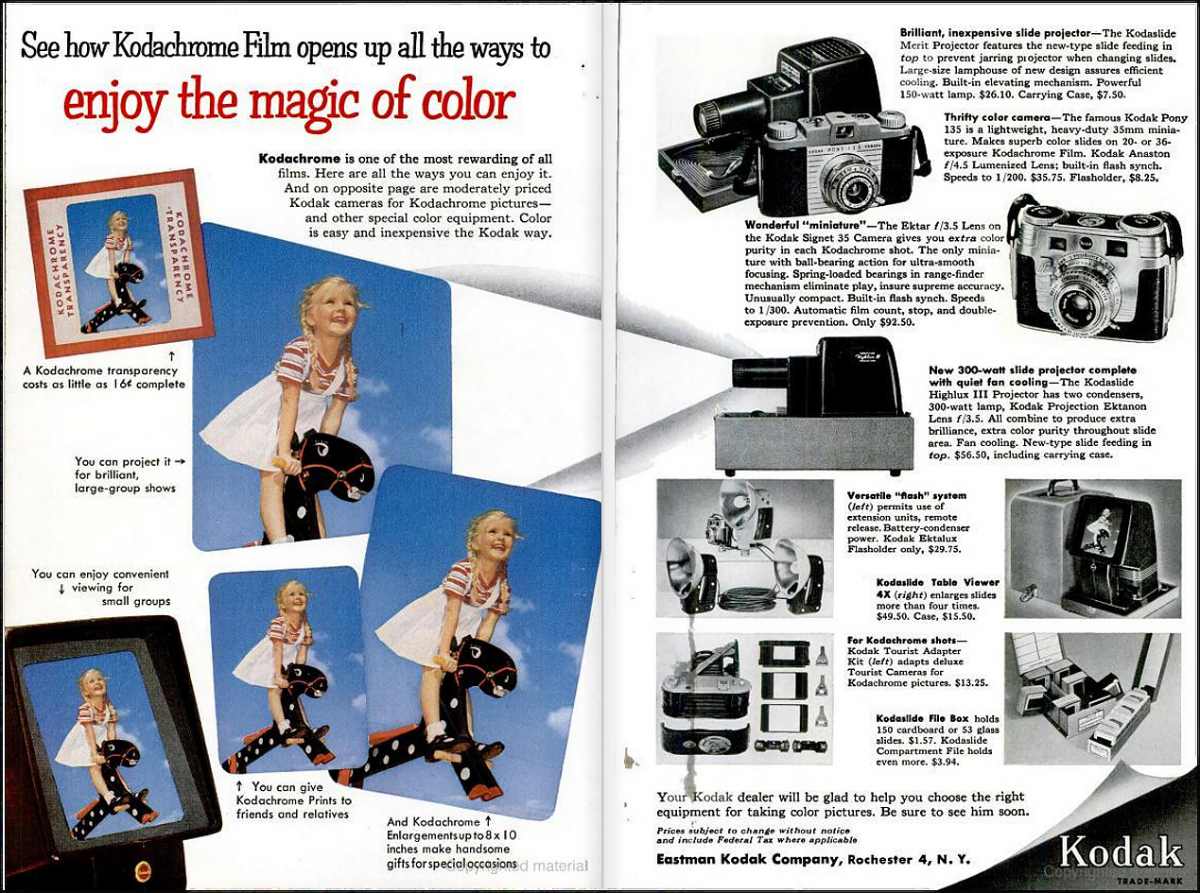
do you remember Kodachrome?

1953 – A Kodachrome slide carefully exposed in bright sun

Toronto. From the late 1800s to pre WW2, colour was a huge challenge. The additive colour process was very slow. Mosaics and fine screens were used to record and display colour photographs.

Colour photography was revolutionized in 1935 when Kodachrome subtractive colour film came to market. While faster than the old processes, it was still slow and contrasty but with an  incredibly increased resolution.

Kodachrome development was so complex (numerous baths, tight time and temperature demands) that customer bought both film and processing with exposed film returned to Kodak for processing. Shades of the original Kodak Camera of the 1880s!

Eventually the American government intervened and film price was separated from the processing cost opening the door to third party developers.

The following year, Agfa in Europe marketed a subtractive system. The proprietary system used larger molecules resulting in a simpler development process and a difference in colour emphasis than Kodachrome. After WW2, spoils of the war included the Agfa process, opening the somewhat faster, less contrasty, and simpler development to all.

With the Agfa style films, it was possible to bulk load colour 35mm film and process it at home, something that was ‘beyond the ken’ for Kodachrome.

In the summer of 1953, Kodak advertised the ‘magic’ of Kodachrome colour and the many Kodak products that recorded and displayed the Kodachrome slides. A grateful thank you is in order to George Dunbar for his discovery and sharing of the above two page June 1953 advertisement in Popular Mechanics.

As all thing eventually must, Kodachrome disappeared from the market. The last processing run in North America was the end of 2010 followed/preceded by other colour transparency films.

Today, with digital technology many have never sat in a darkened room to view projected slides. Smartphones create tons of colour images seemingly without effort and seconds later all chosen images can be sent next door or around the world at the touch of the screen!

Posted in history | Tagged , , , , | Comments Off on do you remember Kodachrome?

golden rule days

Gordon Bay School c1905/6 in Muskoka Area of Ontario

Toronto. Remember your grade school days? My dad went to a little one room country school. At his school, children couldn’t attend unless they could walk the miles from farm to school house. He was seven when he started school. Until then, he was home taught by his mother.

This photo, enhanced by George Dunbar, is courtesy of the Humphrey Museum in Parry Sound.  As mentioned in earlier posts, museums and archives are a rich source of photographic images and history. In this case the Museum is located in Northern Ontario.

A big thanks to George for finding and sharing this piece of Canadian history and the idea of searching for school images.

Posted in history | Tagged , , | Comments Off on golden rule days

another way to make money …

a book for a quarter – and a sleeve from Westinghouse flash bulbs

Toronto. … with photography! Weegee in NYC last century seemed to find many ways to make money from his photography besides taking street photos at night of crimes, etc. –  like books and promotions.

George Dunbar writes, “Weegee, one of the greatest examples of an entrepreneur extraordinaire.

“He appeared in this ad for flashbulbs in Popular Mechanics Magazine, March 1953.

“It wouldn’t be surprising if he received a few year’s supply of Westinghouse bulbs for this.”

Many of our readers remember Arthur Fellig (a.k.a. Weegee) and his night time shots on the streets of New York with his Speed Graphic and flash gun. We owe my friend and fellow PHSC member a hearty thanks for finding and sharing this 1953 ad about a promotion between Weegee and Westinghouse.

Posted in history | Tagged , , , | Comments Off on another way to make money …

cool!

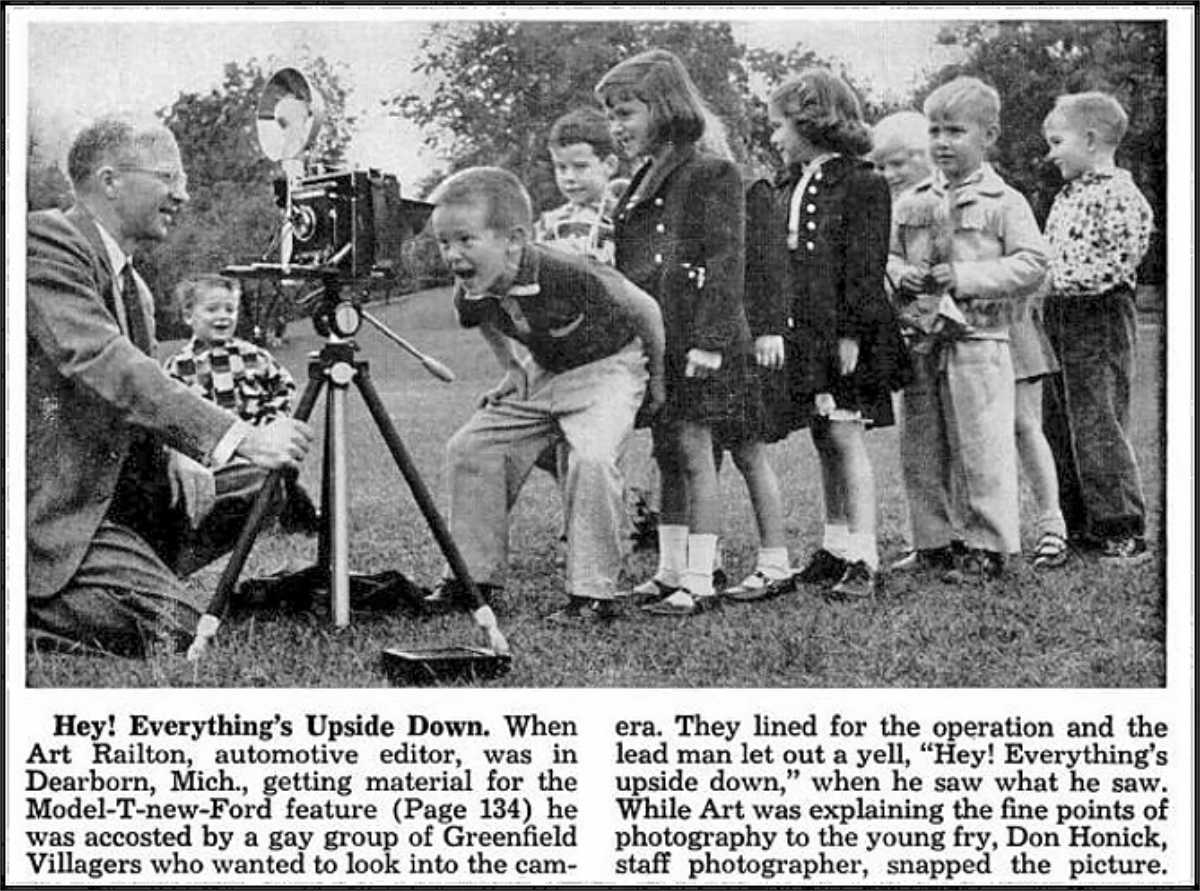
an upside down view – February 1953 article in Popular Mechanics

Toronto. When I saw this article sent to me by George Dunbar, it reminded me of two things: the movie shorts about  ‘Our Gang‘ and the Saturday Evening Post sketches by well known illustrator, Norman Rockwell.

Anyone who studied optics or anatomy knows the world we see is really upside down, and righted by our brain. Modern generations often have smart phones – even grade school kids – and no idea that the old film field cameras with a ground glass back for framing and focussing show the scene reversed and upside down! Photographers of that period were use to the ground glass image.

A big thank you goes to George Dunbar, that great photo historian, for finding and sharing the article with us.

Note: This post is in memory of an old 1960s band called, “Spanky and Our Gang“. Here they sing one of their top songs on Sunday night’s Ed Sullivan Show, “Sunday will Never be the Same“.

Posted in history | Tagged , , , | Comments Off on cool!

what’s in a name?

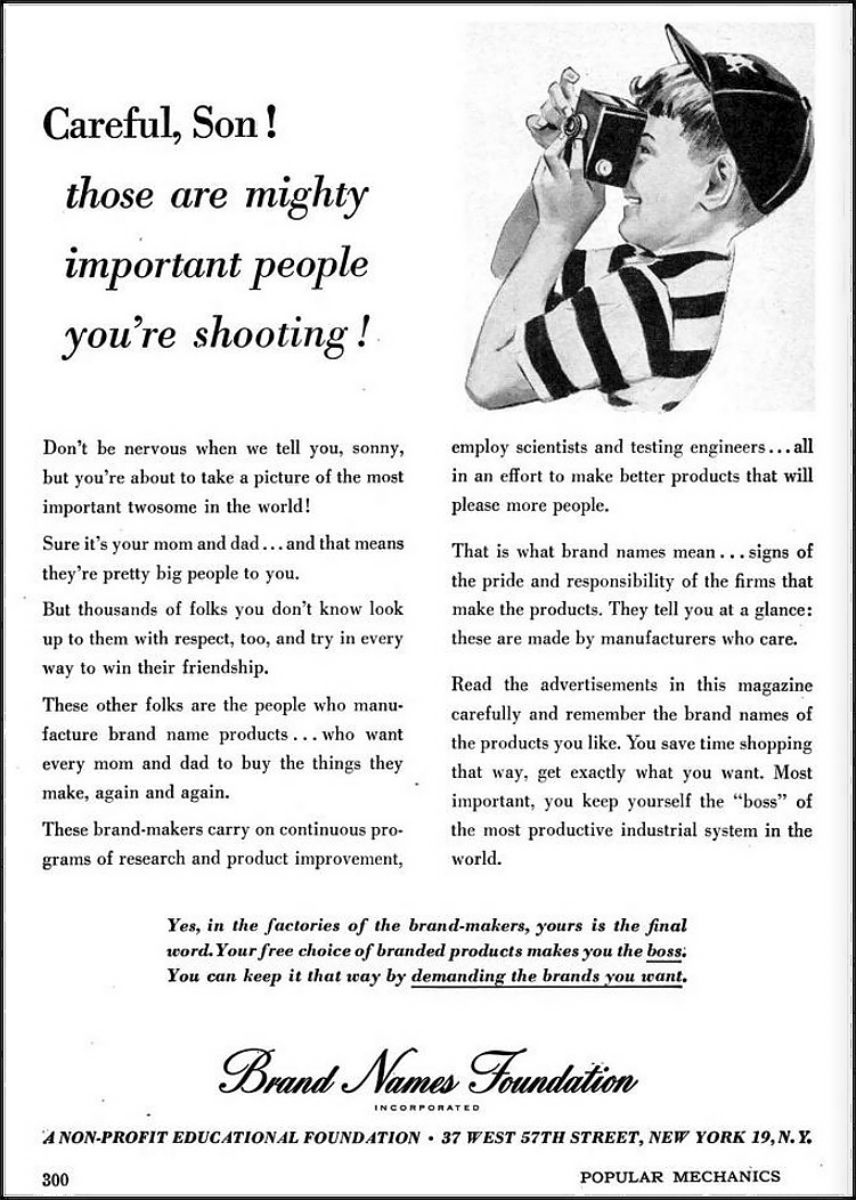
1953 ad for Brand Names Foundation

Toronto. A brand name denotes the style and quality of a company’s products. Post war, an American foundation was incorporated to promote national or international names over small local firms. The foundation was called, “Brand Names Foundation, Inc.” and was discussed in the book “Advertising in the Age of Persuasion” , a brief précis of which is cited in the above link. The book evolved from a CBC series by Terry O’Reilly which I listened to  a few years back,

The premise of the foundation was promotion of national brands and encouraging people to switch from possibly less capable local brands to the far bigger nationals/internationals like Kodak or Ansco in photography.

A big thank you to my good friend and fellow photo enthusiast, George Dunbar, for sharing this full page ad from the January, 1953 issue of Popular Mechanics.

Posted in history | Tagged , , , | Comments Off on what’s in a name?

to do or not to do …

two gentlemen from Paris, Ontario. c1890

Toronto. In the vast number of antique photos in archives, libraries, collections, or available for purchase, many have suffered the slings and arrows of time – fading, foxing, bent, broken, torn or worse.  When modern digital technology came along, it became very easy to ‘fix’ many of these old photos.

And there-in, like Hamlet, lies the quandary: to do or not to do the digital fix to enhance damaged or faded prints. A few weeks back, my friend George and I swapped emails on the topic. We agreed that IF the photo was not for sale, THEN digital scanning and fixing to increase the available data would be appropriate. The caveat of course was NOT to enhance any photos online for sale as it might misrepresent the photo to a discerning potential buyer.

Above, an image from the Brant Library  on the ‘Images Our Ontario’ website showing a c1890 shot of two people in a Paris, Ontario, studio. The faded version is the online digital scan of the donation to the library. The much contrastier version is the same image enhanced by George.

My thanks to good friend and serious photo historian, George Dunbar, for the link to the Brant Library image and his enhanced version.

Note: Apologies to Bill Shakespeare and his famous soliloquy, “to be or not to be …”, from his play, “Hamlet”.

Posted in history | Tagged , , , , , | Comments Off on to do or not to do …

PHSC Monthly Toronto Meeting for May 2023

Toronto. The May meeting via  ZOOM features Clint (president) and Celio (programme) in conversation with Vincenzo Pietropaolo. Tickets are free and may be ordered here on Eventbrite.

In addition, Vince is part of the two man exhibition this month at the James Rottman Gallery from May 3 – May 31. The exhibition  features  Vince Pietropaolo, and Rafael Goldchain, both of whom have spoken at earlier PHSC Toronto meetings, Vince in February 2008, March 2012 and Rafael in January 2008.

The event is the kick off of Vincenzo Pietropaolo’s latest photograph book, “Toronto as Community: Fifty Years of Photographs.  Join us and enjoy ‘in conversation’  with this author.

Posted in program | Tagged , , | Comments Off on PHSC Monthly Toronto Meeting for May 2023