a debt unpaid

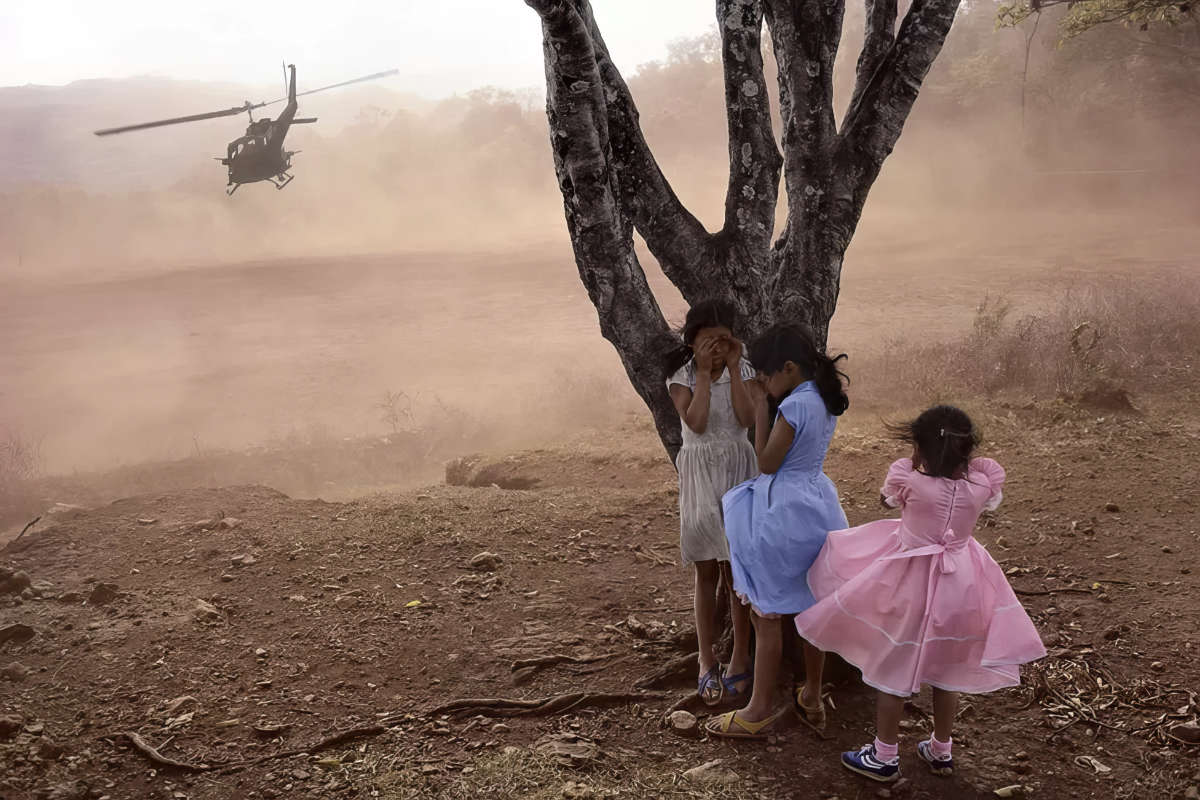
children and military helicopter in El Salvador, by James Nachtwey, courtesy of BBC News

Toronto. … promise made is a debt unpaid … as Robert Service wrote in his 1907 epic Yukon poem, “The Cremation of Sam McGee“. Service was born in England and lived in many places, including Canada (he once worked for the Toronto Star).

The ‘debt unpaid’ is by all of us to the photojournalists of the world who bravely burst into areas of natural disaster, human disaster, and  conflict  (war, civil insurrection, etc.) to bring us more timid souls the stories and photos of what is happening.

It should be noted that our society has had many Canadian photojournalists as guest speakers over the years, most recently Louis Palu in May of 2019.

Typical of photojournalism is the life and work of, “James Nachtwey: The last of the great photojournalists” as captured by Jonathan Head for the BBC News.

As to Nachtwey, who often worked in black and white film, Head writes in part. ” … In some images, though, the colour really stands out. An early photograph from the El Salvador civil war [top, left of this post] shows a military helicopter evacuating an injured soldier. But it is the three little girls crouching behind a tree in the foreground, their dresses of white, pink and pastel blue standing out in the orange dust cloud, who give the image its haunting loveliness.”

My thanks to my good friend, George Dunbar, who recently came across this BBC News article and shared it with me.

Posted in history | Tagged , , , , | Comments Off on a debt unpaid

expensive words

Sir John Franklin c1845 courtesy of Sotheby’s

Toronto. The old chestnut says a picture is worth a 1000 words. If so, the 14,000 words for these 14 daguerreotypes are worth nearly $39 USD each! Many Canadians remember the stories of Franklin and his two ill-fated vessels, the HMS Erebus and the HMS Terror which became locked in our ice while searching for the NorthWest Passage. The ship wrecks were discovered nearly a decade ago in this century.

Long unseen, the set of 14 portraits were auctioned off recently by Sotheby’s and realized about $545,580 USD on September 21, 2023. The daguerreotypes were taken on board the HMS Erebus in 1845 just days before it set sail on its last voyage. The portraits were taken using technology less than seven years old. Needless to say, they were the last portraits taken of the senior crew of the two vessels and the officers of the HMS Erebus.

My thanks to PHSC President, Clint Hryhorijiw, for alerting me to this sale.  You can read about the set and the last voyage of Franklin and his crew here on ArtNet News. Remember, it is the subject as well as age, photographer, and condition that determines a daguerreotype’s value. Expensive words, indeed!

Posted in camera, history | Tagged , , , , , , , , | Comments Off on expensive words

hot pix, it’s a phoney; hot pix it’s a phoney …

cover of latest Canada’s History Magazine

Toronto.  … with apologies to Karen Shopsowitz and her family. You couldn’t live here 60 years ago without hearing the jingle, “hotdog, it’s a Shopsy” or visit the city without buying one of those delicious hot dogs from her father’s delicatessen.

Karen spoke to the PHSC at the September 15, 2004 meeting recounting her father’s enthusiasm for home movies.

Any art item deemed rare, expensive, or famous is at risk of duplication. Paintings, cameras, photographs are typically copied and presented for sale.

For example, towards the closing of one of our shows, an old gentleman showed up and offered a dealer an old Leica with a brass nameplate across the back engraved with the name of an infamous Nazi officer who had died at the Nuremberg trials. The dealer bought the camera but I missed photographing it.

Calling the dealer later, he said the camera was a well preserved fake. The camera’s age, colour, engravings and serial number made the ownership plausible leading to his decision to buy. Once home, he carefully inspected his bargain only to discover a single glaring error: the name had a missing umlaut – just as bad as a spelling error in English! Nevertheless, the camera was in fine condition and he elected to keep it as an example of a fine fake.

The latest issue of Canada’s History magazine sparked this post. In notifying me of the magazine’s article on a famous military photograph that proved to be fake, George Dunbar writes, “Canadian photo historians will certainly be interested in this feature article, ‘Over the Top,’ in the latest issue of Canada’s History magazine (Oct/Nov 2023).

“This is a fascinating exposé of the creation of faked First World War photographs by Canadian officials and a British photographer.”.


Posted in history | Tagged , , , , , , , , , | Comments Off on hot pix, it’s a phoney; hot pix it’s a phoney …

you can call me Max

the Berek designed 5cm Elmar lens in a Barnack designed lens mount

Toronto. As you know, a camera needs a lens to capture an image. Leitz had just such a lens designer. In 1912 according to Dr Kingslake in his 1989 book, “A History of the Photographic Lens“, a young Dr Max Berek joined the Leitz microscope company in Wetzlar. Max was “…devoted almost entirely to the theory of the microscope, in particularly the polarizing microscope used in mineralogy.”.

A rather highly corrected sub-stage microscope condenser was named after Berek. In the photographic world, Berek was of assistance to Oskar Barnack as the designer of the 5cm f/3.5 Elmar. According to Kingslake, “When the Leica camera was being developed by Oskar Barnack in the early 1920s, Berek designed several suitable lenses, including the Elmar, Summar, Summitar, and Hektor series.”

The patent sheet above is for the lens mount designed by Barnack to house the lens designed by Berek. Some attribute the Elmar design to a variation of the Zeiss Tessar, but others note that at the time the Tessar design could not cover the inch by 1.5 inch (24 x 36mm) field of the Leica at f/3.5 and suggest the Elmar is based on another fundamental lens design.

Note: The title of this post is a riff on Paul Simon’s song, “You Can Call Me Al” from his 1986 Graceland album (I have the CD).

Posted in history, lens | Tagged , , , , , | Comments Off on you can call me Max

an Oscar for design

NYC street scene in 1914

Toronto. In 1914, a young German visited NYC. He brought along a tiny experimental ‘device’ that looked nothing like the cameras of the day.

He took photos like the one at left with the people on the street oblivious to his activity. The man was the son of the German owner of a microscope factory with a branch operation in NYC.

The man was Ernst Leitz II and the strange device was later known as the ‘Ur-Leica’ manufactured by his father’s company just months before his voyage and visit  to the ‘New World’. The design was the ‘brain child’ of a mechanic at Leitz known as Oskar Barnack. Oskar was fascinated by movies and had made a moving picture camera. The process of the day demanded a film strip be exposed at various stops and developed to determine the correct exposure.

According to the 15th edition of the Leica Manual, the device used a fixed shutter speed of 1/40th second, matching the moving picture camera’s speed. Properly exposed, the resulting negatives routinely gave a good image easily enlarged. For many years others  debated whether the tiny gadget was intended to determine a moving picture camera’s ideal aperture or as an alternative camera using the common 35mm movie film of the day.

In any case, the designer of this tiny, precision and utilitarian camera was Barnack. After the great war, Germany sunk into a massive depression and rampaging inflation. In an effort to retain skilled staff, Ernst Leitz II decided to manufacture the Leica in spite of the scepticism of his company board and the changes in the 35mm movie film that traded off resolution for softer contrast and a greater sensitivity.

The Leica was a phenomenal success. The built-in rangefinder was also the brain child of Barnack who decreed its small size (Leitz made rangefinders well before Leicas). Slight magnification compensated for the shortened rangefinder base. As Lipinski hinted in his book, “Miniature and Precision Cameras”, Leitz used and patented all the simpler ways to make a precision camera thus handicapping competitors by forcing greater complexity and  higher manufacturing costs.

It was only after WW2 that the basic design created by Barnack was replaced with the Series-M cameras – so successful that even today the design can be seen in digital Leicas and in lens mounts made by some competitors.

Posted in history | Tagged , , , , , , | Comments Off on an Oscar for design

celebrating niche enthusiasts

Cover Shot of Classic Cameras by Ivor Matanle

Toronto. You may have noticed that a small group of photographers continue to use film, preferring its ambiance  over digital technology. It may be a novelty to you having old technology linger on, but this has occurred over the centuries as new replaced old in many other disciplines.

Hindsight of time shows the benefit of the new over the old, but at the time a change was introduced, benefits were far less obvious. For example, photographers who had an investment in daguerreotype photography were reluctant to spend more money and learning time on ‘new fangled’ ideas.

I noticed this overlap of old and new while digging into the history of our chosen art. While I can see the benefits, practitioners of old were far slower to adopt the new ideas – sometimes taking many years. A modern day quandary is here now! Digital technology has been around for a couple of decades and has generally improved to the point were the majority of professionals and serious amateurs prefer digital only processes.

But not all! There is still a small selection of totally or partially film based photographers. These folk are well served by PHSC events such as the coming Fall Fair on October 15th. Both collectors and users may find films, film cameras and film accessories ready for their collections and user gear.

The cover shot above is Ivor Matanle’s 1986 opus on ‘Classic Cameras’ which I bought directly from Ivor. In his 224 page book with 320 B&W illustrations – cameras and the photographs taken with them – he covers both collecting and using these mechanical marvels from the ‘golden age’ of minicam photography. Now out of print, you can track down a used copy (this soft cover printing is dated 1992) or try to borrow a copy via your local library.

Posted in history | Tagged , , , , | Comments Off on celebrating niche enthusiasts

having a blast

book cover of Oppenheimer biography that is the basis for the very successful movie

Toronto. While not directly related to photography – other than the book’s photos, this book was the basis for the recent movie whose release prompted  an unexpected box-office success. I first learned of Oppenheimer as a youth interested in the Atomic and Hydrogen bombs and the history around their invention.

My good friend and fellow reading enthusiast, George Dunbar,  sent me a note recently regarding the book and ‘biopic’ of this famous scientist. George writes (in part), ” …  to tell you about the “Oppenheimer” film I saw a couple of weeks ago and the book from which it was adapted. I love ‘biopics’ and this was a good one, but I’m always aware that such films have a tendency to alter facts for greater entertainment value.

“After seeing the film, I got the book, America Prometheus, J.Robert Oppenheimer (1904-1967) by Bird & Sherwin 2005 ( 721 pages), from the library.

“Apparently, this comprehensive biography was 5 years in the making. So much detail in the book that, obviously, could not be contained in a film, although this film is 3 hours long.

“There is one scene, in particular, that is certainly altered from the authors’ descriptions.
Oppenheimer met with President Truman in the White House in 1945 and the President’s (quite shocking) closing remarks are altered (faked?) in the film.

“I’m assuming here that the book’s description of that meeting is more accurate. I think we all know by now, that Hollywood never misses an opportunity to alter dialogue for box-office appeal.

“I certainly enjoyed both book and film.”

Posted in history | Tagged , , , | Comments Off on having a blast

magazine photography

1998 book of photos and conversations with many of the LIFE magazine photographers

Toronto. A big presence in the magazine world of last century was LIFE magazine. The magazine, based in NYC, had its own stable of photographers. In October, 1998, a book by John Loengard, called “Life Photographers: What They Saw” was released by Bullfinch Press.

The 456 page book, “A collection of interviews and 270 photographs traces the work, experiences, and careers of the original staff photographers of LIFE magazine, documenting how they pioneered the picture story and the photographic essay.”

In a recent email exchange with George Dunbar, he explained, “I’ve been doing a lot of reading recently—–books, magazines, newspapers.

“A few books from the public library and others out of my own library that I’d forgotten about. Finally read this marvellous book of interviews with 44 of LIFE magazine’s photographers.  It’s been in my library for the last 25 years. I probably only looked at the photos back then, but now decided to read the text. A wonderful experience!

“Between 1936 and 1998 Life had, at various times, 91 different staff photographers. They all, apparently, had careers of wonder, excitement, danger, fear and success.

“I suppose photographers, like the rest of us, have many and varied beliefs … ”

Visit your local library or buy a used copy of the book to learn more about many famous America photographers and see some icon photographs.

Posted in history | Tagged , , , , | Comments Off on magazine photography

a crash course

an accident in the summer of 1960 in a small town

Toronto. We are so accustomed today to full colour photos/videos if not the actual people, scenery,  concerts, theatre, etc, that we never give it a second thought.

That was not always the case. Think about not having photography or photographers. We would have to either be there or be able to read and comprehend text in great detail relieved perhaps by the odd wood-cut or steel engraving.

When this accident happened, black and white film and photos or short movies were the norm. TV was low resolution black and white showing short movie clips during the news before and after the half hour or  hour programs interspersed with ads. At night, on the weekends the movies shown were old, and cropped to fit the allotted time period, ads, and TV aspect ratios. Not exactly the same as shown years before in movie theatres.

New films by then used the far more expensive and finicky colour processes of the day. Even in the silent era, some films used one colour (toning) or two colour processes  – usually for the positives sent to theatres in large American cities.

Post war, newspapers regularly used B&W photos. The pricier magazines could afford colour covers and selected colour in their ads. By the 1950s/60s, the novelty of colour home movies attracted some brave souls to ‘commemorate’ events like weddings, retirements and birthdays with their movie cameras.

Today everyone has a smartphone with a digital still camera and video camera included. Once taken, images can be viewed instantly and ‘edited’ right there or on a computer. The images can be sent anywhere in a flash. No waiting for the mail, no scrounging projection gear and a darkened room – just view and enjoy! “How To” videos are much preferred to static manuals even if they come with lots of stills!

Without photographic processes, there would be no photos, just tons of text and engravings. And paintings of the rich and famous. We would need to rely on this  –  and old buildings plus a colourful imagination – to give us some idea of history … perhaps even taking a crash course in reading and comprehension.

PS. If you would like more film/digital gear for your collection or use (for example as a niche user of film) be sure to visit our fall fair, “The Big One” this coming October 15th.


Posted in history | Tagged , , , , , , , , , , , , , | Comments Off on a crash course

it’s that time again …

Toronto. … time for our fall fair – October 15, 2023! After the fantastic ESTATE Auction a few days ago we are gearing up for our Fall Fair. Click on the poster icon below to see a full size poster ready to be read or printed and read. Lots of tables of film and digital goodies to add to your collection or user gear.

Date: Sunday, October 15, 2023 from noon to 5 pm with table set up from 10 am to noon.

Place: Trident Hall 145 Evans Av in South west Toronto (usual venue).

Admission: $7 – Students with ID enter for free – parking free.

More information/questions: email fair@phsc.ca (Mark Singer) or phsc.ca

PHSC Fall Fair October 15, 2023


Posted in fair | Tagged , , , , , , , , | Comments Off on it’s that time again …