Lazarus

A ‘new’ Leica M6 courtesy of Leica Camera, AG

Toronto. The famous little Leica and 35mm film have a long and storied history. The evolution of the current Leica Camera group from the old E Leitz organization is nicely covered by Dennis Laney in his 1992 “Leica Collectors Guide“.

Moving to Toronto in the late 1970s, I found Leica in Toronto was called Wild-Leitz – Leitz and Wild Heerbrug had formed a partnership. A few years later Wild Heerbrug, the Swiss microscope and optical instrument maker absorbed the Leitz organization. The camera and other consumer products were moved to a separate organization and later  became totally independent from Wild Heerbrug.

When the balance of Wild Heerbrug was merged with Cambridge Instruments [CI] in England, CI renamed itself as Leica, PLC. The small Leica Camera Group continued to make precision cameras and lenses, choosing quality over quantity.

When digital technology replaced traditional cameras and film, the group slowly moved to digital products and even better lenses at ever higher prices. To expand market share – and keep the old machines operating – the group reproduced the old film cameras and new lenses at significantly higher prices from the original price when first introduced.

Latest in the line of film cameras is Leica’s first small size Leica with built-in exposure reading, the Leica M6. As one executive at  the group said, “In our factories, you can still see old machines dedicated to film cameras in operation. But in 2015, we thought about throwing everything away because we were only producing 500 film cameras per year. But there has been a nice rebound since then and, in 2023, we will produce nearly 5,000 M6 and MP analogue devices.”

Our president Clint Hryhorijiw reminded me of the Leica Camera Group’s decision to reintroduce film Leicas in these articles from Kosmo Foto  and Photrio. Both sources suggest other makers may plunge into film once again. A similar announcement on the M6 was made directly by Leica Camera AG (the group).

A big thanks goes to Clint for noticing this epic announcement. If you visit any of our events, you can pick up a film camera, perhaps even a Leica. Mind you, the newer lenses are very attractive (to those with the cash). And film? Well “it ain’t dead yet” just ask any film enthusiast.

Posted in history | Tagged , , , , | Comments Off on Lazarus

mr roboto

my IIIf Leicavit Leica base c1958 –  a drop down lever lets the photographer shoot quickly while keeping the camera to the eye.

Toronto. After the 1807s when the faster ‘off the shelf’ dry plates became available, camera makers looked at ways to speed up the photograph taking process. It became evident that the way to speed things up was to find a way to exchange an exposed negative with an unexposed one.

In the dry plate era, some cameras used a mechanical means to ‘drop’ the exposed plate and pop a fresh plate in the ‘film’ plane without opening the camera or resorting to dark slides and swapped holders.

When mini cameras became common, various way were devised to wind a fresh negative in place using a rapid lever or a clockwork spring mechanism. Some camera makers like Otto Berning & company’s Robot line had the mechanism built in so the cameras could shoot in burst mode.

Others used a ‘winder trigger’ in a custom base plate to let the photographer quickly wind the film on one frame after the shutter button was released. These gizmos were often beautiful in their own right like the famous Leitz ‘Leicavit‘ shown here at left. It was made for the IIIf for a decade beginning in 1953. An even more streamlined version was made for some M series cameras.

For professionals, a motorized base was offered. The film was wound to the next unexposed frame by a clockwork mechanism and later by a tiny electric motor.

Modern day users of digital cameras or smartphones have no need for such mechanical  marvels since once activated the digital technology keeps the ‘shutter button’ in an ever-ready state for the next photo, burst, or video.

Note: The post title is based on an iconic 1983 song by the Styx, “Mr Roboto“.

Posted in history | Tagged , , , , | Comments Off on mr roboto

will that be cash or …

Extra battery for an older Nikon digital camera. The camera’s internal battery which once retained user preferences is long dead.

Toronto. … ChargeX (later VISA)! The digital era in photography brought many things – both good and bad. For much of the glass plate/silver plate/film era, cameras were all mechanical and relatively easy for an experienced camera repairman to clean and adjust (some cameras like the ‘bullseye’ Contarex took a seriously trained repairman to even begin to ‘CLA’ the beast).

Digital technology brought miniaturization, increasing sensitivity, and speed between taking and seeing the result. As digital progressed, sensor resolution increased and noise fell. But these virtues came with penalties. Batteries. Non standard sizes. Differing terminal voltages. The batteries were no longer held to a rigid dimensional or terminal standard. AA, AAA, button, C, D, continued to be improved, made and sold.

But where once digital cameras took 2 or 4 AA batteries, they now take batteries shaped and sized to fit within the allotted area created by the device maker. Freed of any general battery standards, every camera and smartphone could be made with its own rechargeable battery. All batteries have a relatively short life span whether measured in shelf life or number of discharge/charge cycles.

We could collect mechanical cameras and with care each one could be used. With rare exception, digital cameras and smartphones use uniquely designed batteries likely to be unavailable years later as newer camera models emerge on the scene. Older digital cameras can be collected but very likely no longer usable.

In our home we have four digital cameras plus an iPod and two smartphones all three of which have a camera. None of them take the same battery! And yet three of the four cameras are made by the same company – Sony. So there you have it. Speed and clarity at the cost of long term usage. My M4 and Exaktas are now over 50 years old and can still be used. The same for my father’s Kodak Folder (hitting 80+ these days).

I have some spare batteries (for the oldest Sony and for the Nikon) but they are the age of the cameras with less and less time before they no longer function.

Posted in history | Tagged , , , | Comments Off on will that be cash or …

In Search of Geraldine Moodie

Cree woman and boy c1895 – PC journal 24-5, page 8 review

Toronto. Yesterday’s post on PhotoEd items mentioned Geraldine Moodie. This triggered in my mind an article on Ms Moodie in our journal.

It was actually a book review of the book, “In Search of Geraldine Moodie”. The review is in the March, 1999 issue (24-5). Written by editor Bob Lansdale, the review discusses Donny White’s book about Ms Moodie and some of her photographs.

The book was published by the Canadian Plains Research Center,
University of Regina in Regina, Sask. at the end of 1998. Both a paperback version and an electronic version seem to be available today.

Consider checking your local library or picking up your own copy.There you can learn the fascinating story and photos of a Canadian photographer as she and her husband faced the unforgiving Canadian north a century or more ago.

Posted in history | Tagged , , , , | Comments Off on In Search of Geraldine Moodie

happy birthday, Hannah

Hannah Maynard courtesy of PhotoEd

 Toronto. The lovely Rita of PhotoEd fame sent this announcement out.

It celebrates many things – have a peek at this Canadian oriented photographic teaching magazine.

We have featured Ms Maynard  and other Canadian Female photographers in our Journal over the years.

Have a look at the above announcement and consider a personal subscription to a very worthy magazine (and we do our bit too by advertising in each issue).

Posted in activities-other | Tagged , , | Comments Off on happy birthday, Hannah

six things to know

The famous Dorothea Lange c 1930s courtesy of the National Gallery of Art in Washington

Toronto. In the course of browsing the web for photo history, George Dunbar came across the American “National Gallery of Art” website in Washington DC. Included on the site was this article on Dorothea Lange, “Who Is Dorothea Lange? 6 Things to Know“.

Ms Lange was the subject of a few earlier posts on this site (I managed to misspell her first name). While her memorable photos are in Washington, collectors may have copies and her technique is always worthy of careful attention.

A thank you to my good friend George for spotting and sharing this site with us.

Posted in history | Tagged , , | Comments Off on six things to know

for the image collector – Jan 24, 2024

tintype of Studebaker Works c1850-60 courtesy of Michael Lehr (ML Antiques)

Toronto. Michael Lehr of ML Antiques sent me an email recently to announce their first auction. A typical lot is this (shown at left) full plate tintype of the Studebaker Works, a supplier of wagons during the American Civil war.

In his notice, Michael writes, “Welcome to the first Michael Lehr Antiques auction Saturday, January 27th, 2024. My inaugural auction will feature a diverse collection of historical and rare photographic treasures. Whether you’re a seasoned collector or just starting out, there will be something for everyone in this curated offering.

“I have prepared a captivating auction lineup that includes a half plate scenic daguerreotypes by George Johnson which captures the essence of California gold mining.  We will also offer a half plate daguerreotype of a stone bridge under construction. Additionally, portraits and post-mortem daguerreotypes by quintessential 19th century artists by Mathew Brady, CR Williamson, and Southworth & Hawes among others will provide a glimpse into the past, with a rich tapestry of historical moments frozen in time.

“A range of tintypes, showcasing a range of occupations such as a banner girl, a sausage maker, and a blacksmith.  Another standout is the full plate tintype of the original Studebaker wagon factory who produced 1000s of coaches for union troops in the civil war, a testament to the industrial history of a bygone era.”

You can see and read a sampling of the images offered by Michael. Serious image collectors should definitely check things out!

Posted in activities-other | Tagged , , , | Comments Off on for the image collector – Jan 24, 2024

when Kodak was King

drawing of the Eastman (Kodak) Automatic Shutter which was affixed to many of the company’s simple box cameras.

Toronto. For much of the 20th century, Kodak and photography were synonymous. By the mid 20th century Kodak was among the biggest – if not the biggest – in the industry, world-wide. Home base was Kodak Park in Rochester.

George Dunbar, in his pursuit of photographic history came across this remarkable site in Rochester, run by the Rochester Public Library, and graciously chose to share it with us. Amongst many things on the site are a number of Kodak ‘trade’ catalogues. Have a browse and see why Kodak became such a force in photography.

The sound and action of the Eastman Automatic Shutter shown at left may be familiar to many of you (Topaz Photo AI was used to enlarge the drawing and resulted in some rather weird edges and screw heads). The catalogue describes the shutter operation as follows, “To make a snapshot, press down lever”B”  [top left unmarked lever].  To make a time exposure: press down lever ” A ” once to open, and again to close the shutter. That’s all there is to operating the Eastman Automatic Shutter. It is always set.

“The lever “C ” operates the [lens] stops, of which there are three.”

As a child, many of us remember the shutter moving back and forth as the lever “B” was pressed over and over. One press was all that was needed to create about a 1/15 second exposure on the film.

Posted in history | Tagged , , , , | Comments Off on when Kodak was King

Executive Meeting No 43 via ZOOM

PHSC President Clint Hryhorijiw

Toronto. A little chilly out these days! ZOOM lets us meet yet stay indoors and warm.

The latest PHSC newsletter draft by editor Katrin Faridani is ready for review. Those who want a  personal copy of the newsletter but haven’t yet joined the PHSC can drop me an email at news@phsc.ca to be added to our MailChimp list.

Our new Membership Secretary is Lilianne Schneider. If you have some time to help as a volunteer at our meetings and events, drop me a note using this email address: info@phsc.ca. Since we now issue the journal only in pdf format, we are investigating the effect on our records. Remember, if  you UNSUBSCRIBE  to our MailChimp list, you will not receive any journals or other info. And if you change email addresses, please tell us as MailChimp flags such old addresses as CLEANED and cannot add the new address automatically.

*By the way, please note as of 2022, our membership year ends December 31st.** Also as of 2024 memberships are $35/$100 1 yr/3 yr Canadian regardless of the member location (one of the perks of pdf format for our journal).

Our next Toronto meeting is February 21st. We will have a “Show and Tell” meeting via ZOOM. Further details willl be in a post closer to the meeting date.

Co-editor David Bridge and partner Louise Freyburger are writing the next (49-4) issue of Photographic Canadiana.  This issue of our journal is scheduled for release in the first quarter of 2024.

It is important that you are notified as each new journal edition is released. If you are a member but HAVE NOT seen any notification for any journal issue since you registered/renewed, please email me at info@phsc.ca.

And remember to bundle up if you are in the colder part of the world!

some members at the Jan 2024 Executive Meeting

Posted in activities | Tagged | Comments Off on Executive Meeting No 43 via ZOOM

lots of stuff …

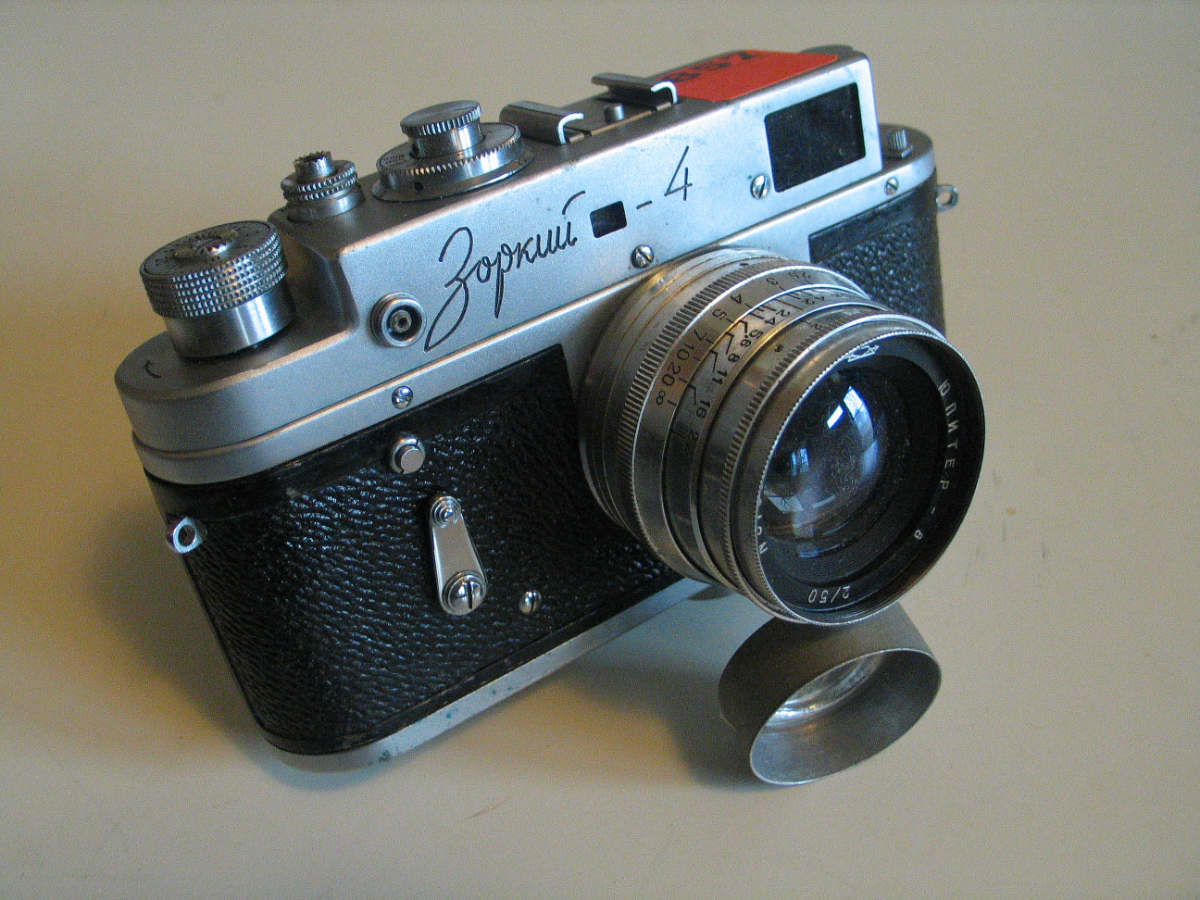
A Zorki 4 camera with Cyrillic lettering – made in a Moscow suburb from a recent Auction lot

Toronto.  As we start another new year, PHSC has began to get some dates firmed up. Our next Toronto Meeting will be a Show and Tell on ZOOM next month (February, 2024); The next auction takes place May 5th at the Legion Hall in south-west Toronto (Long Branch) and the spring fair is set for May 26th at the Trident Hall in south west Toronto.

Check this site as the dates approach – added details will be shown. Meantime, enjoy the weather! And the Zorki 4 shown at left. It was in a lot we (PHSC)  auctioned this past fall.

One of the songs back over a half century (1959) ago by Johnny Horton talked about the weather Canada is experiencing just now (hello, Edmonton), “When it’s Springtime in Alaska, it’s 40 below“.

Posted in activities | Tagged , , , | Comments Off on lots of stuff …