
OK folks, our popular Trunk Sale is July 14th this year at the Trident Hall (rain or shine). Visit from 8 am ’til noon. Want a space? Have a question? Drop Clint a line fair@phsc.ca

PHSC Summer Trunk Sale this July 14th
OK folks, our popular Trunk Sale is July 14th this year at the Trident Hall (rain or shine). Visit from 8 am ’til noon. Want a space? Have a question? Drop Clint a line fair@phsc.ca
PHSC Summer Trunk Sale this July 14th

Possibly the first daguerreotype produced in Canada, Niagara Falls by Hugh Lee Pattinson, 1840
Toronto. … to paraphrase a bit of “British history” (1066 and all that). We are fortunate that photography was invented years before 1867 when the Dominion of Canada was formed. The British North America Act(s) combined the British colonies of Canada East (Quebec), Canada West (Ontario), Nova Scotia, and New Brunswick into the Dominion of Canada in reaction to the American civil war. The act(s) set the stage for other colonies to join the Dominion, We celebrate July1st each year now as ‘Canada Day’.
The photo at left by Hugh Pattinson is believed to be the first photograph ever taken in ‘Canada’ – some 27 years before we became a country. At the time Niagara Falls was in the colony of Upper Canada, shortly to become Canada West and then the Province of Ontario.
Image collectors who know their history seek out such rare pre-confederation photos taken in the future Dominion. Have a great holiday everyone, and remember the significance of July 1st, 1867.
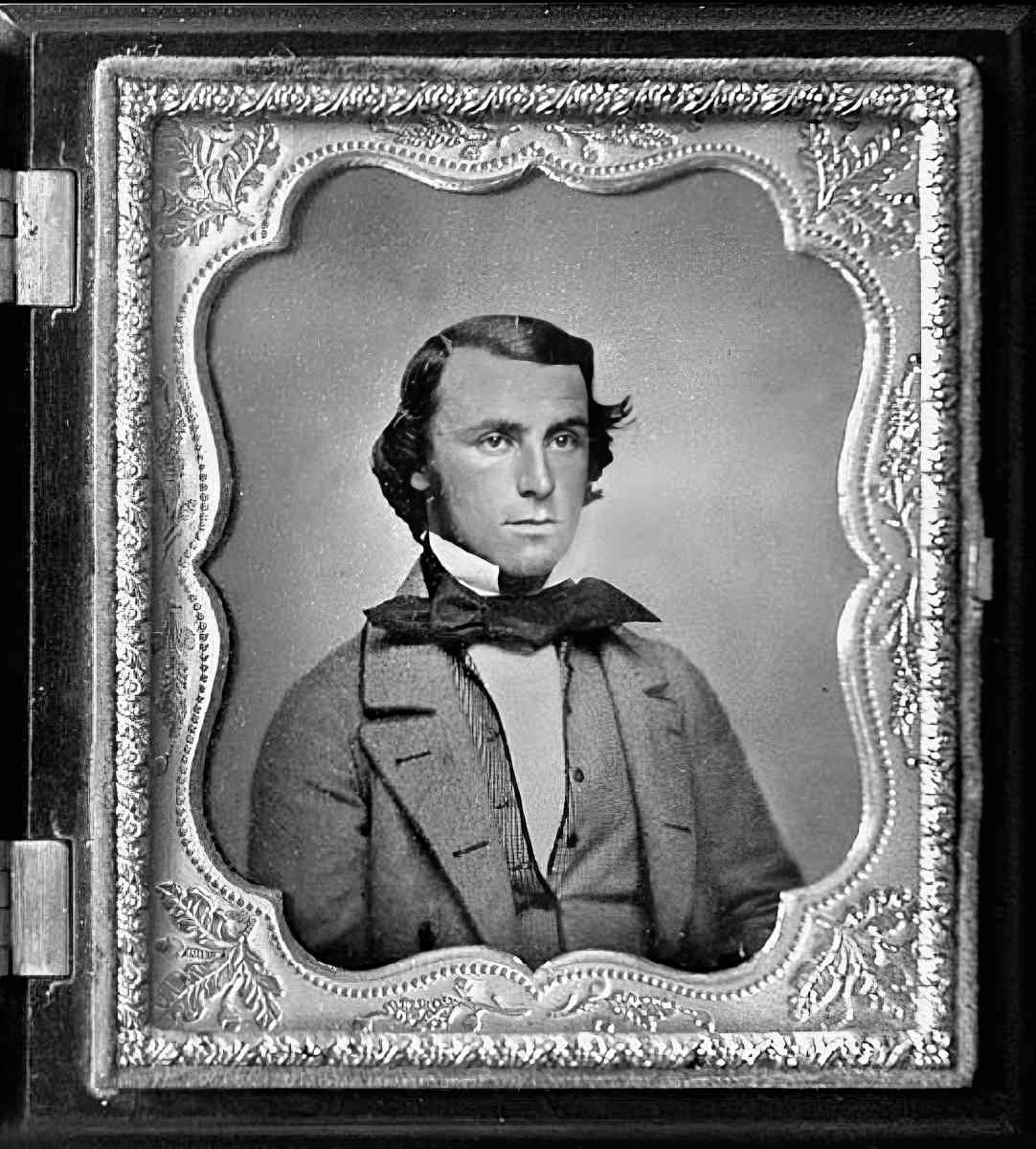
A cased Ambrotype portrait c1862 with a mystery
Toronto. The next step after the Daguerrotype was the use of glass plates. Initially glass plates used a wet solution (wet-plate) and years later a dry solution (dry-plate).
To make the sensitized emulsion ‘hold’ to the glass, a sticky mixture of guncotton was used (collodion). Guncotton itself was a liquid mixture of cotton and some acids.
A spin-off of the wet-plate process was the Ambrotype – a cased image using the wet-plate to replace the Daguerreotype and allow other photographers to compete with the Daguerreotypists using the less expensive Ambrotype process.
A way down south (dem ol’ cotton fields of home) in Atlanta GA, the Daguerreian Society held its convention. There, one member asked another attendee (PHSC editor Bob Lansdale) a curious question: “What does Canada West mean?“. It turned out he had an Ambrotype complete with the packaging and label addressed to someone in Hamilton, Canada West (now Ontario). Bob photographed the cased Ambrotype and its packaging.
Bob writes, “A chance meeting this fall at the Daguerreian Symposium in Atlanta GA, brought forth the query from Robert Lisle of Hardeeville, South Carolina as to what Canada West meant. It was part of a script label on a box containing an ambrotype of a gentleman mounted in a thermoplastic case. I was intrigued as here I had a lead to a Canadian story.
“The hand-written label was addressed to a mysterious Frank D???, Hamilton, Canada West.
“I was allowed to photograph it thoroughly so back home I hit the library and found there were very few Franks. But persistency paid off as the 1862-63 Hamilton street directory provided a Frank Dunn, listed as a wine and spirit merchant. See page 20 for more details.”
Wow! What an interesting find! Of course issue 36-3 with the full story was mailed to all paid members back then (more recent members can read 36-3 on their DVD (covers Photographic Canadiana volumes 1 – 40)). Not yet a member? It’s easy – just follow the steps to the right, or view the MEMBERSHIP menu item above.

Daguerreotype from Cameron family fonds – taken by Eli Palmer c1850
Toronto. Eli Palmer was a Canadian photographer who created many Daguerreotype portraits.A Wikipedia article here covers a broad range of Canadian photographers including one very very brief mention of Palmer.
Our late editor, Bob Lansdale introduces the research into Mr Palmer as spanning two journal issues (36-2 and 36-4). Bob states, “Beginning on page 6 [36-2] we commence our feature article tracing the history of photographer Eli J. Palmer who arrived in Toronto as a Daguerreian artist in 1849. Ryerson [now called TMU] Photo Arts student Alana West, completing the Photographic Preservation course, has pulled together facts and illustrations for an essay on this early Canadian photographer who remained in business until 1878.
“Palmer quickly rose to prominence and was noted in 1850 as one of the fifty most prominent men in Toronto. Leading social personalities and politicians came to his studio to have their images recorded for history. We have enough material to continue the story in Part Two which will be published in our next issue of December [actually in the 36-4 issue, not 36-3].
The detailed and well researched articles on Palmer in issues 36-2 (by Alana West) and 36-4 (Robert Lansdale and Graham Garrett) were mailed to the members back then – or if members joined more recently, on their DVD (covers Photographic Canadiana volumes 1 – 40). What? Not a member? It’s a snap – just follow the steps to the right, or view the MEMBERSHIP menu item above.

patent drawings and Cirkut camera (camera photo courtesy Bill McBride)
Toronto. Group photos have always been a challenge. In Photographic Canadiana issue 36-1 dated May-June 2010, our late editor Bob Lansdale covers two things near and dear to him: group photos with special cameras; and Canadiana.
This issue includes a detailed article by the late Bill McBride, “Evolution of the No. 10 Cirkut Camera”; an obit about Bill McBride who passed away in late 2009 down in California; “The Inventors of the Cirkut Camera and its parts…” by Bob Lansdale, including the Canadian connection; plus a photograph of the “Monster sized panoramic prints as they were found under the attic flooring of the Ontario Legislature buildings”.
Bob introduces Mr McBride as follows, “Bill McBride is considered the best source of information about the Cirkut camera as he has researched and written for years about this exceptional panorama camera which altered the history of photography. Capable of recording a full sweep of 360 degrees of the horizon it was used to photograph great crowds of people on one long strip of film.
“Beginning on page 10 we reprint an article by Bill McBride that was published in the Graflex Historic Quarterly and also in The Photographist. We follow it with biographies of three of the men who pooled their inventions to produce the first Cirkut camera in 1904.”
The articles on the Cirkut camera are in issue 36-1 mailed to all members back then – or if members joined more recently, on their DVD (covers Photographic Canadiana volumes 1 – 40). Not a member? It’s easy – follow the steps to the right, or view the MEMBERSHIP menu item above.

W. Butcher & Sons Ltd. “Empire” Home Kinematograph, c.1905 – photo by Bob Lansdale
Toronto. Movies began with small machines at penny arcades, home movie projectors and finally movie theatres. Our resident movie expert, the late Robert Gutteridge, amassed a collection of old movie cameras, projectors, etc. An author of both books and articles, Robert was a retired teacher and frequent exhibitor at our fairs.
Robert recounts how he acquired the beautiful instrument at left in an article titled, “An Encounter With Serendipity” in the early 2010 Photographic Canadiana. His story begins, “Being an avid eBayer, while seeking cinematographic equipment in mid-July of 2009, to my delight I stumbled upon an early 35mm combination moving-picture/magic lantern projector announced as “c.1895 Warwick Cinematograph Slide & Movie Projector & Case.”
“From my knowledge of early ciné? equipment, I knew immediately that not only the date was too early, but also that the machine could not be a Warwick Trading Co. (Charles Urban) “Bioscope.”
“Suspecting it to be of English origin, I investigated all well-known English cinematograph manufacturers of the early 1900s, and despite being without a name-plate, usually located on its lamp house above the side door, I determined it to be a W. Butcher & Sons Ltd. “Empire” Home Kinematograph, c.1905.”
Robert’s story continues in issue 35-4 where members can read the rest of the article – or if members joined more recently, on their DVD (covers Photographic Canadiana volumes 1 – 40). Not a member? It’s easy – follow the steps to the right, or view the MEMBERSHIP menu item above.

The UNA Traveller, a c1927 field camera featured in John Kantymir’s column.
Toronto. This c1927 British field camera, ‘The UNA Traveller‘ is well named. The robust yet light construction meant it was reliable world wide – from jungle to desert to arctic.
In his column for the early 2010 issue of Photographic Canadiana, John Kantymir begins, “Long ago my father, Bill Kantymir, and I created a “Wish List” of cameras that were either historically significant or highly unusual – the Una camera is both.
“It is made of Duralumin which was developed for the skeleton framing of the Zeppelin air-ship where light weight was a must. The camera was perfect for the tropics or anywhere – hence the name Traveller.
“I purchased it overseas and believe it to be from the collection of Michael Auer. Its image can be seen in his book.”
John’s story continues in issue 35-4 where members can read the rest of the column – or if members joined more recently, on their DVD (it covers Photographic Canadiana volumes 1 – 40). Not a member? It’s easy – follow the steps to the right, or view the MEMBERSHIP menu item above.
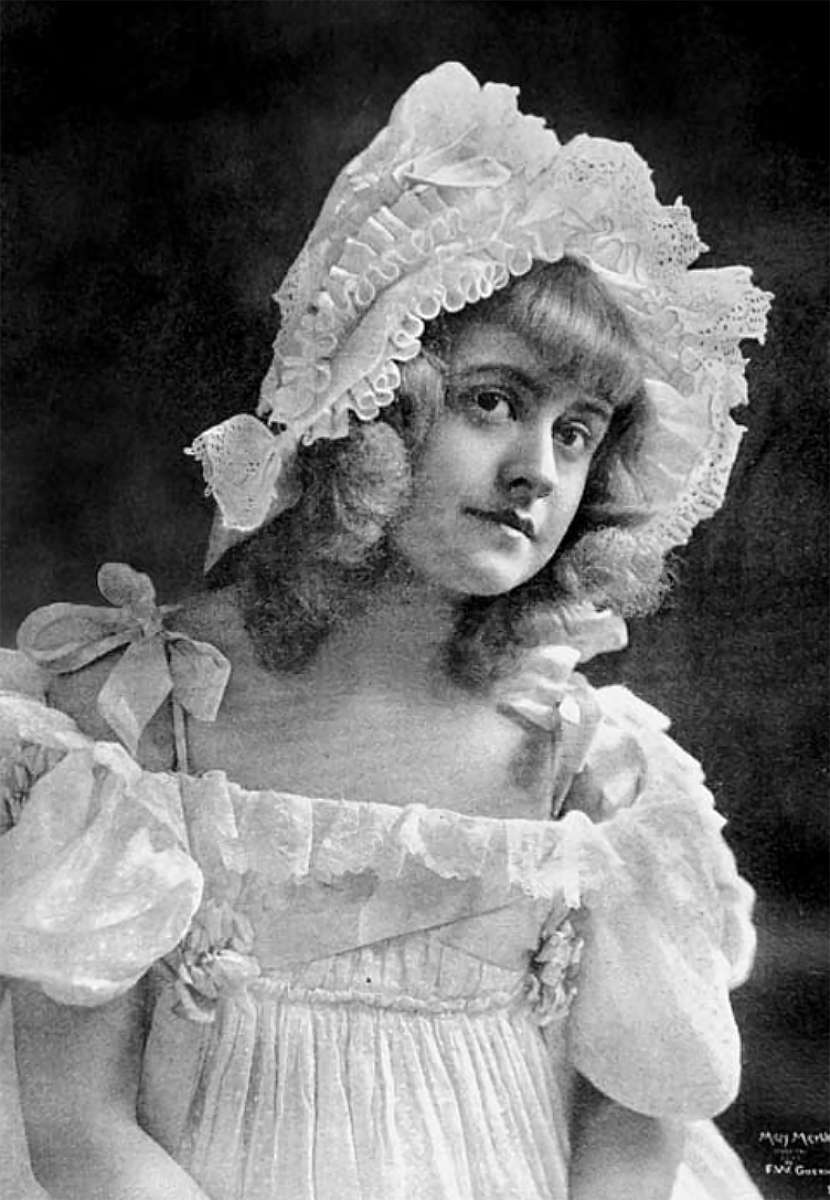
Ms Mary Marble c1895 by F W Guerin using a newly invented ‘flash machine’
Toronto. The slow speed of dry plate emulsions in the 1890s resulted in two situations: The plates were very contrasty and very slow. Unless a very soft light was used (carefully, highlights would be burnt out (no detail) or shadows would block up (again no detail). Motion was almost impossible to conquer.
However, in the studio of F W Guerin both feats (proper exposure and a sense of motion) were accomplished – using various tricks; special ‘flash machines’; pre testing trials with soft northern light, etc. In the portrait at left of a young miss, details can be seen in her white dress and bonnet – an incredible accomplishment back then.
Today’s devotees of smartphone cameras have no idea of the effort involved over a century ago to create a (today) simple portrait or ‘capture’ motion.
Introducing the talents of Mr Guerin, editor Bob Lansdale writes, “A chance purchase of a small book revealed the secrets of how F. (Fitz) W. Guerin in St. Louis, Missouri was able to create such quality photographs back in 1898. Capturing the detail in white clothing was quite the challenge, as seen in our cover portrait of ‘Mary Marble.’ [The ‘lines’ on the photograph are scanning artifacts and do not appear in the book].
“There are also other photographic secrets revealed in this book Portraits in Photography by the Aid of Flash Light and you can read all about them starting on page 18 of this issue.”
Note: the above link is to the Internet Archive where you can read the book online as originally printed. A facsimile version is also available from Amazon.ca.
Members can read Bob Lansdale’s review of Guerin’s tips from his 1898 book in issue 35-4 of the journal on their DVD (it covers Photographic Canadiana volumes 1 – 40). Not a member? It’s easy – follow the steps to the right, or view the MEMBERSHIP menu item above.

CHIEF OSHAWAHNAH
Tecumseh’s chief warrior at the Battle of the River Thames.
From an ambrotype, copyist unknown. Courtesy: Library and Archives Canada / C-008543
Toronto. Anyone who knew Graham knew two things about him: Firstly: he was very prickly and difficult to know (he abruptly appeared on my doorstep one day professing unhappiness with the journal editor of the day). And Secondly he was meticulous and fussy about the history he knew so well. A writer of many articles, Graham also produced a CD called, “A Biographical index of Daguerreotypists in Canada 1839-1871”
For many years Graham was involved with the PHSC as a journal author writing pieces such as, “Tecumseh’s Warrior” in this issue (35-3). In addition to his writing, Graham was our keynote speaker for the 20th anniversary dinner (where the germ of this web site was first cast).
The article noted was sub-titled, “Early photography and the making of a North American legend”. The tale begins, “There is a photographic portrait of a native person that has appeared with a variety of printed works since the mid-nineteenth-century and usually identified as a close confidante and principal subordinate of Tecumseh, or Tecumthe (1768-1813), a prominent name in North American military history. In 1868 an American author by the name of Benson J. Lossing (1813-1891) was the first to publish a woodcut likeness of this individual whom he identified as an Ojibwa warrior by the name of ‘Oshawahnah.’”
Recent PHSC members received a DVD of the first 40 volumes of our journal. This includes issue 35-3 and Graham’s tale of Oshawahnah. Not a member yet? You can easily become a member and read all the journal articles now on DVD. Just follow the instructions to the right.

John Kantymir’s SOHO Tropical Reflex SLR – photo by Bob Lansdale
Toronto. In the early 1900s, various English companies made glass-plate SLRs. The idea was to use the same lens for both viewing and photographing. A mirror changed the direction for viewing (vertical) to photographing (straight through).
In the tropics, the regular softwood body with a leather covering suffered from the extreme heat, dampness, and mildew. A tropical camera is made of hardwood (walnut, Honduras mahogany, teak, etc.) and varnished. Brass is used rather than ferrous metal avoiding the risk of rust. The only leather used is for the bellows and viewing hood.
The camera shown at left once belonged to the late John Kantymir and appeared in his column back in the December, 2009 issue of the journal (35-3). John’s story begins, ‘If there’s an index of “golden oldies” for camera collectors then I would have to place the tropical model of the SOHO Reflex camera high on that list. Its rugged varnished mahogany wood and bright brass fittings make it a stand-out amongst other classics.
‘The Soho Reflex camera was first introduced in 1905 as a single-lens reflex to rival similar cameras such as Newman & Guardia “Reflex,” Adams & Co’s “Minex,” and Thornton Pickard’s “Ruby Reflex.” [all British-made SLRs]’
Members can read John’s full story of the SOHO in issue 35-3 of the journal on their DVD that covers Volumes 1 – 40. Not a member? It’s easy – follow the steps to the right, or view the MEMBERSHIP menu item above.


EVENTS
 Click the above icon to download the form and mail a copy with your cheque. You can include your donation with the join/renew form too.
 Stan White – Poems & Photos


 Mise Au Point – sur la photographie Quebecois