Executive Meeting No 46 via ZOOM

PHSC President
Clint Hryhorijiw

Toronto. April and hot weather is forecast. Did you all see the eclipse of the sun on the 8th? Eerie … Here is a brief recap (and update).

As our fiscal year end remains April 30th, our treasurer asks that all cheques outstanding be cashed by month end and any outstanding expenses submitted ASAP.

PHSC newsletter editor Katrin Faridani issued the March newsletter and plans to send newsletters off every 5-6 weeks if possible. She has a number of suggestions for content. If you didn’t get your copy, drop me an email at news@phsc.ca and I will add you to the MailChimp list.

Membership Secretary Lilianne Schneider continues to handle the membership records and has offered many new ideas as well. Contact her via info@phsc.ca if you have any questions. Remember, we always need volunteers. If you feel you can help in any capacity, email me at info@phsc.ca.

Our journal is in pdf format with the latest issue available after a MailChimp notification. If  you have UNSUBSCRIBED, you will not receive notification nor Photographic Canadiana nor other info. MailChimp does not permit me to reinstate that specific email address. Renewal by me of such addresses is possible via a form, not yet on our site. And if you change email addresses, please tell us as MailChimp flags such old addresses as CLEANED (they cannot add your new address automatically).

*By the way, note that as of 2022, our membership year ends December 31st.* Also as of 2024, memberships are $35/$100 1 yr/3 yr Canadian regardless of the member location (one of the perks of pdf format for our journal).

The April Toronto meeting is a special seminar chaired by our program director on April 12th. We will notify those on our MailChimp list how to join the event. Further details will be posted closer to the 12th. NOTE: We just heard word on the 8th that this session has been cancelled.

The problem with Eventbrite has been resolved successfully and we will continue using it. If you are not yet on MailChimp, please contact Clint or Celio via info@phsc.ca for connection details. We will forward the message.

Our presence on Instagram continues to grow. Social Media Coordinator, Markovic, suggested some broader advertisement ideas via our newsletter and email blasts (Instagram is already linked on this site).

Co-editor David Bridge and partner Louise Freyburger have issued volume 49-4 of Photographic Canadiana.  They are presently writing issue 50-1 which is scheduled for release around late June, 2024. As 49-4 was a courtesy issue for 2023 members, those who do not renew now may not receive issue 50-1. Please renew or join now if you haven’t already. See the MEMBERSHIP menu above and/or our PayPal button at right.

We notify all members via MailChimp as each journal issue is released. If you are a member but HAVE NOT seen the notification for 49-4 since you registered/renewed, please email me at info@phsc.ca.

Our spring events are starting beginning with our auction on May 5th. We plan to add  details and a ‘lot’ slide show beginning the middle of this month. Meanwhile, enjoy the lovely weather!

Posted in activities | Tagged | Comments Off on Executive Meeting No 46 via ZOOM

in the dark of the day

safely viewing the eclipse April 8, 2024

Toronto. Well yesterday was a rare day in Toronto! We saw the total eclipse of the sun! Shades of Carly Simon and Nova Scotia decades ago. Last fall I posted the 1912 eclipse in Lisbon. Keep in mind these are literally once in a life time events. While eclipses are frequent over a life time, they seldom block the sun over a major city – especially one in which you happen to reside.

The Toronto event was experienced by many, including some PHSC members. David, our journal co-editor writes, ” In the interest of science, here’s a chart of exposure at f11 with my trusty Sekonic during the eclipse. And here’s our viewer [see image at left] (some might recognize part of this).  We got a brief bit of sun until about 3 PM so got to see a bite out of the disc at the beginning….socked in though, during the crucial hour.”

As for me, I was watching TV as the daylight slowly changed into an afternoon of night then rose again to, by our supper time (8ish), full sunlight.

Note: What could be better for this post than Carly Simon singing her 1970s song, “You’re So Vain“?

Posted in events | Tagged , , , | Comments Off on in the dark of the day

when art and science collide

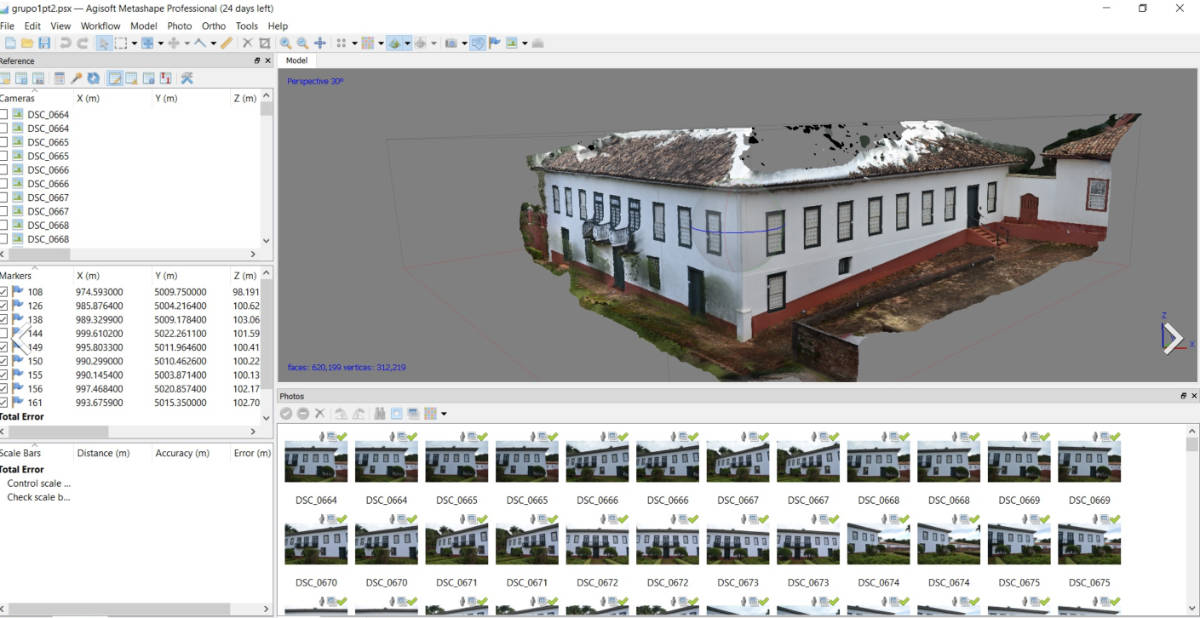
This media is a faithful reproduction of a portion of the Núcleo de Pesquisa em Estudos de Linguagem em Arquitetura e Cidade (N.ELAC) collection. This file is licensed under the Creative Commons Attribution-Share Alike 4.0 International license.

Toronto. This post is about 3D, not media nor lenses nor cameras, all of which also benefit from scientific analysis.

In the days of film and glass-plates, the angle/distance between our eyes was used to create two images – one for each eye. Various means are used to ensure each eye sees only the desired image. The human brain is then used to merge the images and ‘see’ them in 3D.

In the era of digital photography, another technique became popular – photogrammetry – a concept dating back to c1867. Many thousands of overlapping 2D images are taken  from all sides and levels of the subject. The thousands of images are fed into a software program which creates a 3D model of the subject viewable by virtual reality glasses.

In a 4+ year old episode of “Exploration Unknown” on the Science channel, protagonist Josh Gates visited Normandy to celebrate the 75th anniversary of D-Day (June 6, 2019). Gates has a degree in archeology but claims to be an explorer, adventurer, etc. Near the end of the D-Day anniversary episode, Gates joins a French expert in under water photogrammetry to visit ships lost in the English Channel, never arriving for that iconic battle.

The wrecks are marked on a map of the channel off Normandy. The channel’s closeness to both the British Isles and the continent results in very strong tides with twice a day brief periods of calm. The purpose of the visits to the wrecks – military graves – is two fold: to confirm the map is correct; and to preserve the wrecks as a 3D model for others to see without recourse to immediacy and 100 foot dives. Long term, the incessant tides will delete all evidence of the wrecks; and not everyone is able to visit in person and do a 100 foot dive.

This is another example of how photography enhances history – in this case in conjunction with technology specific to the 3D model. Digital photography allows the necessary  thousands of images to be taken economically, accurately, and rapidly, ready to be read by the specialized software.  Today, our world is enhanced beyond belief by the combination of photography and science!

Posted in activities-other | Tagged , , , , | Comments Off on when art and science collide

it’s twins

Lot 794 at May 5th auction. A Primo Jr TLR

Toronto. Even before the  minicam revolution, many cameras suffered from tiny squinty viewfinders to frame a subject. In 1929, a German company came up with an idea that changed everything – at least once their camera design became popular.

The Rollei Twin Lens Reflex (TLR) as it was known made a few more problems while solving the squinty viewfinder issue.

The TLR used two lenses stacked one on top of the other. The viewing lens was as fast or slightly faster than the taking lens ensuring that carefully focussing the subject through the viewing lens assured the taking lens was in sharp focus as both moved as one.

Great idea, BUT to take a landscape shot meant turning the camera on its side making it very hard to use the viewing lens. The solution was to go with a square negative on a 120 roll film so the negative could be cropped to portrait or landscape size in the enlarger and still have as good or better resolution than the ‘double frame’ 35mm films offered. This way the camera was always held upright (usually at belt level).

A second headache was interchangeable lenses (once the idea became popular with the minicam bunch). A sorta solution was to add removable lens elements to create a medium wide angle or medium telephoto lens.  Cropped negatives always meant ‘telephoto’ images but no amount of cropping would ever give a wide angle view!

Don’t have a TLR in your collection/user gear? No problem! Come out to our auction on May 5th and you might be able to solve the dilemma. If not, there will be many other goodies available for bidders. See the right hand sidebar for location. A post will go up mid month showing details, a poster and a slide show of lots as photos of the lots are received (About 100 so far).

Posted in auction | Tagged , , , , , , | Comments Off on it’s twins

room with a view

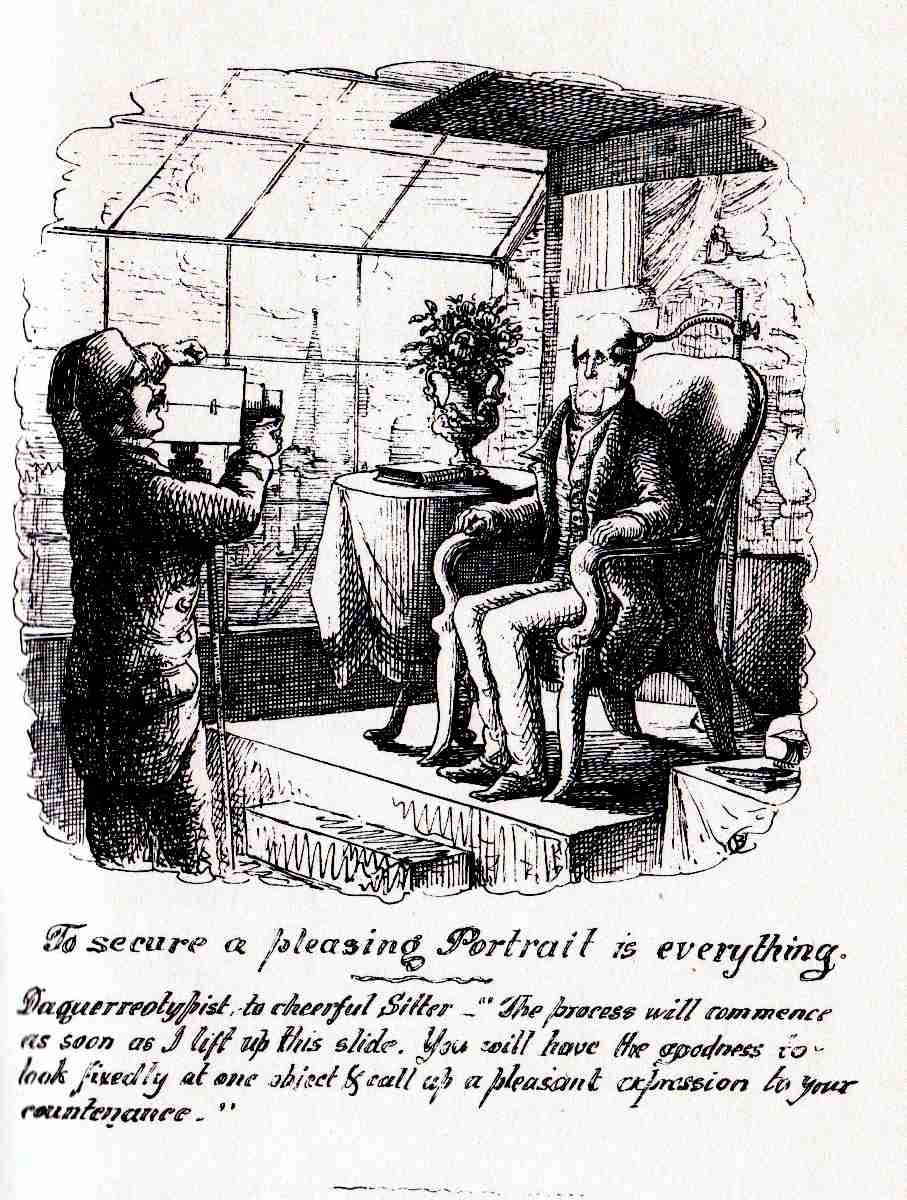
an illustration from “Photographic Pleasures” by C Bede dated 1855.

Toronto. In the days of Daguerreotype portraits, photographers opened studios illuminated by daylight. Given the slowness of the media and equipment of the day, many studios chose northern lighting. Sunlight from the north had softer shadows and a more pleasing ‘likeness’ could be obtained.

In 1855, the book “Photographic Pleasures” by Cuthbert Bede was published. This book, written and illustrated by Bede, poked fun at the new highly technical art of photography. Long out of print, Amphoto published a facsimile version in 1973.

The illustration at  left is an example of Bede’s delightful work. Not only do you see the “Northern lighting, but the view camera and the studio fixtures for subject support – including a special head clamp. The text by Bede is a tongue in cheek explanation to the subject to ‘hold that smile’, no easy task with the slowness of  the process and the mandatory head clamp …  Room with a view indeed!

NB: The post title is from an E F Forster 1908  novel of the same title. Here is a 1928 song sung by Noel Coward himself.

Posted in history | Tagged , , , , | Comments Off on room with a view

London air

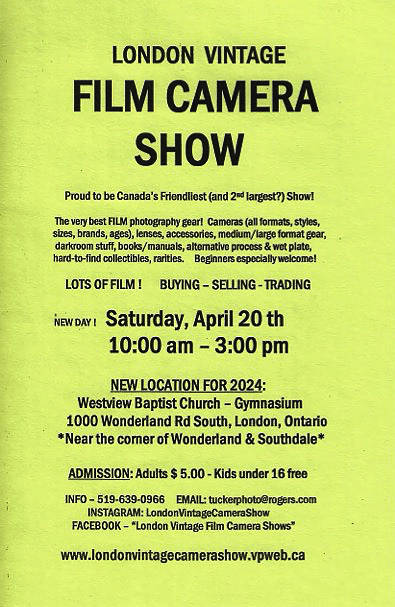
London poster – Sat. April 20, 2024

Toronto. Okay folks, the famous London show for this spring is on Saturday, April 20th this year so scoot down the 401 and pick up some neat goodies for your collection and/or user gear!

NEW LOCATION FOR 2024: Westview Baptist Church – Gymnasium, 1000 Wonderland Rd South, London, Ontario *Near the corner of Wonderland & Southdale*

Check out the poster at left for more details (the web site URL shown on the poster seems to link to the service provider, not to the camera show).

A few years ago we did a post on their show when it was at the old location. They are on Facebook here. The show was recently announced in the LFP classified ads.

NB: The post title is a riff on the Irish classic “Londonderry Air [folk song]” also known as “Danny Boy“.

Posted in activities-other | Tagged , , , | Comments Off on London air

April showers …

These aggressive insects were sipping rain drops from a shrub in our front garden.

Toronto. … bring May flowers … as the old saying goes. A few posts back I mentioned that inclement weather can improve landscape/cityscape photos. Witness the famous jumping man shot by Cartier-Bresson, or the mood set in various ‘film noir’ movies by weather and time of day.

Anyone familiar with those nasty bald faced hornets will know this is not an April shot. The Euonymus leaves are correct as the shrub is an evergreen, so its leaves look the same year round.

Since this is a close-up, it covers both landscape and close-up photography. By the way, come to our May 5th auction – old friends, collectibles, and even user gear go under the hammer. President Clint has many excellent lots at his disposal. I will add a slide show post this Month.

Posted in history | Tagged , , , | Comments Off on April showers …

the camera that wasn’t there

Stirn camera courtesy of Brian Coe’s CAMERAS by Crown Publishers, 1978

Toronto. The production and sale of dry plates brought with it a different kind of camera,  one that could be handheld (by steady hands) or even worn rather than requiring a special support like a tripod.

These cameras, especially those that did not look like a camera, were known as detective cameras. The original idea centred around the turn of the previous century say 1880 to 1920. Illustrated at left is a sketch from the delightful Brian Coe book simply titled CAMERAS and dated 1978.

During WW2, subminiature cameras like the chewing gum package size Minox renewed interest – in what was then called spy cameras.

Today every smartphone has an even tinier built-in camera, and houses galore are protected by so called ‘security cameras’ (and door bell cameras) that can seem invisible unless you know were and what to look for.

NB: This post title is a riff on a movie I saw decades ago called, “The Man Who Never Was“. In particular post title is based on a poem in the film’s preamble: Antigonish [anti gone ish].


Posted in history | Tagged , , , , , | Comments Off on the camera that wasn’t there

Kodak’s contribution to the war effort

A January 1944 Kodak ad showing their war efforts

Toronto. WW2 brought war photography to a new level – along with  advertisements and non-German cameras etc. The ad at left shows how Kodak continued to support the war effort in the States with military goods manufactured of ‘Tenite’ – a Kodak product developed from a film base material.

At that time, as a Dominion, we were lumped in with the British effort. Canadian efforts were all touted locally or perhaps in England.

This ad tells how Kodak inventions in the States helped the American war effort using materials developed for photography. The products were repurposed to create better, cheaper war time goods for the military.

Many pivotal organizations like Magnum and iconic images of war came from the terrible battles just prior to and during WW2.

Our thanks to my good friend George Dunbar for suggesting this ad while he was researching photographic history.

Posted in history | Tagged , , , | Comments Off on Kodak’s contribution to the war effort

a man from Kinmount

Keith Stata (courtesy of Scott Ramsay). Keith spoke to us about 3 decades ago.

Toronto. My good friend and fellow photo historian, George Dunbar, sent me a note the other day about Keith Stata and his Kinmount theatre/museum.

George writes, “A wonderful documentary featuring Keith Stata, a movie fan who built his own cinema and movie museum in a small Ontario town (Kinmount, Pop. 300).  Great story of Canadian cinema and entrepreneurial spirit. It’s now available online and at some theatres [This is the YouTube link to the movie trailer].

Keith built his complex to house various artifacts he acquired over the years. Back in November of 1995 Keith spoke to us about his hobby of collecting old movie theatre gear. At the time, the late Larry Boccioletti (a PHSC founder) was both a member of the PHSC and the Movie Machine Society (MMS). Larry had Keith speak with us and he arranged for interested PHSC members to join the group of MMS folk visiting Keith’s ‘museum’/theatre in Kinmount. George mentioned to me that he joined that trip to Kinmount.

I remember Keith saying at the time, his biggest challenge was getting the movie gear from closed theatres before the wrecking crew turned it to junk. Theatres were failing en mass at the time and the buildings were demolished. The huge projectors were of little value and too big to move so they were simply trashed in place.

Today we have large screen flat TVs, TV programs delivered over fibre, and either a PVR or a variety of streaming services. Some channels, like TCM, are devoted to old movies. Our society favours stills and the associated technologies, but a small contingent of members are also devotees of movies and the projectors, cameras, etc associated with that art form.

Remember to visit our auction this May 5th – there are already lots for both the stills and movie folk – be they film oriented or digital!

Posted in history | Tagged , , | Comments Off on a man from Kinmount