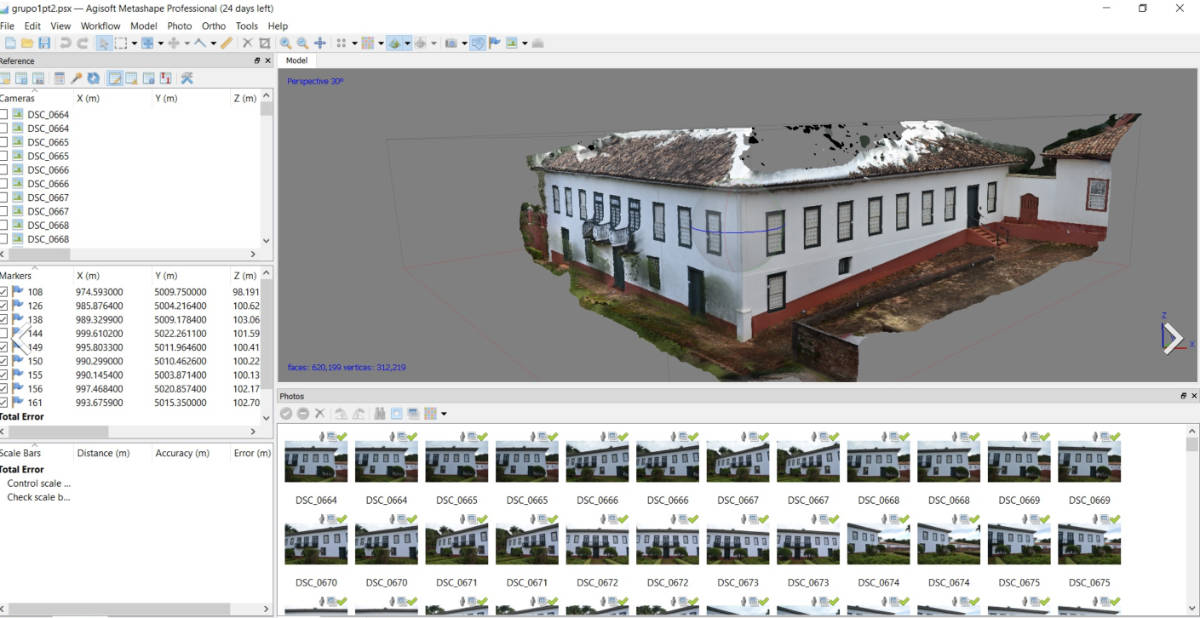
This media is a faithful reproduction of a portion of the Núcleo de Pesquisa em Estudos de Linguagem em Arquitetura e Cidade (N.ELAC) collection. This file is licensed under the Creative Commons Attribution-Share Alike 4.0 International license.
Toronto. This post is about 3D, not media nor lenses nor cameras, all of which also benefit from scientific analysis.
In the days of film and glass-plates, the angle/distance between our eyes was used to create two images – one for each eye. Various means are used to ensure each eye sees only the desired image. The human brain is then used to merge the images and ‘see’ them in 3D.
In the era of digital photography, another technique became popular – photogrammetry – a concept dating back to c1867. Many thousands of overlapping 2D images are taken from all sides and levels of the subject. The thousands of images are fed into a software program which creates a 3D model of the subject viewable by virtual reality glasses.
In a 4+ year old episode of “Exploration Unknown” on the Science channel, protagonist Josh Gates visited Normandy to celebrate the 75th anniversary of D-Day (June 6, 2019). Gates has a degree in archeology but claims to be an explorer, adventurer, etc. Near the end of the D-Day anniversary episode, Gates joins a French expert in under water photogrammetry to visit ships lost in the English Channel, never arriving for that iconic battle.
The wrecks are marked on a map of the channel off Normandy. The channel’s closeness to both the British Isles and the continent results in very strong tides with twice a day brief periods of calm. The purpose of the visits to the wrecks – military graves – is two fold: to confirm the map is correct; and to preserve the wrecks as a 3D model for others to see without recourse to immediacy and 100 foot dives. Long term, the incessant tides will delete all evidence of the wrecks; and not everyone is able to visit in person and do a 100 foot dive.
This is another example of how photography enhances history – in this case in conjunction with technology specific to the 3D model. Digital photography allows the necessary thousands of images to be taken economically, accurately, and rapidly, ready to be read by the specialized software. Today, our world is enhanced beyond belief by the combination of photography and science!