Finding Canada in the NYT Archive

<

Dr Denise Birkhofer RIC

Toronto. Dr Denise Birkhofer of the Ryerson Image Centre spoke on Finding Canada in the New York Times Archive at our January 17th meeting augmenting her recently ended exhibition  at the RIC called “The Faraway Nearby” which uses selected photographs from the Rudolph P. Bratty  Family Collection donation of some 25,000 photographs from the New York Times Photo Archive related to Canada. The exhibition itself was featured in a September 18, 2017 post on our website.

A  few years ago, people visited the NYT press morgue and pulled any files with a reference to Canada. Denise’s talk began with a four minute video highlighting the NYT press morgue titled “Inside The Lively Morgue”. She discussed examples of entries in the NYT press morgue and which date to as early as the First World War (the Archives had very few colour photos).

Gerald McMaster and Dr Birkhofer curated the exhibition. They chose to group the prints as they would appear in a newspaper: National News, International News (some interesting overlaps), Arts & Culture, Peoples of Canada, Travel, Business and Sports. They decided to retain the NY Times retouching lines, cut lines, and red litho separation of elements in many pictures (hand retouching was used to cleanup a print for newspaper use).

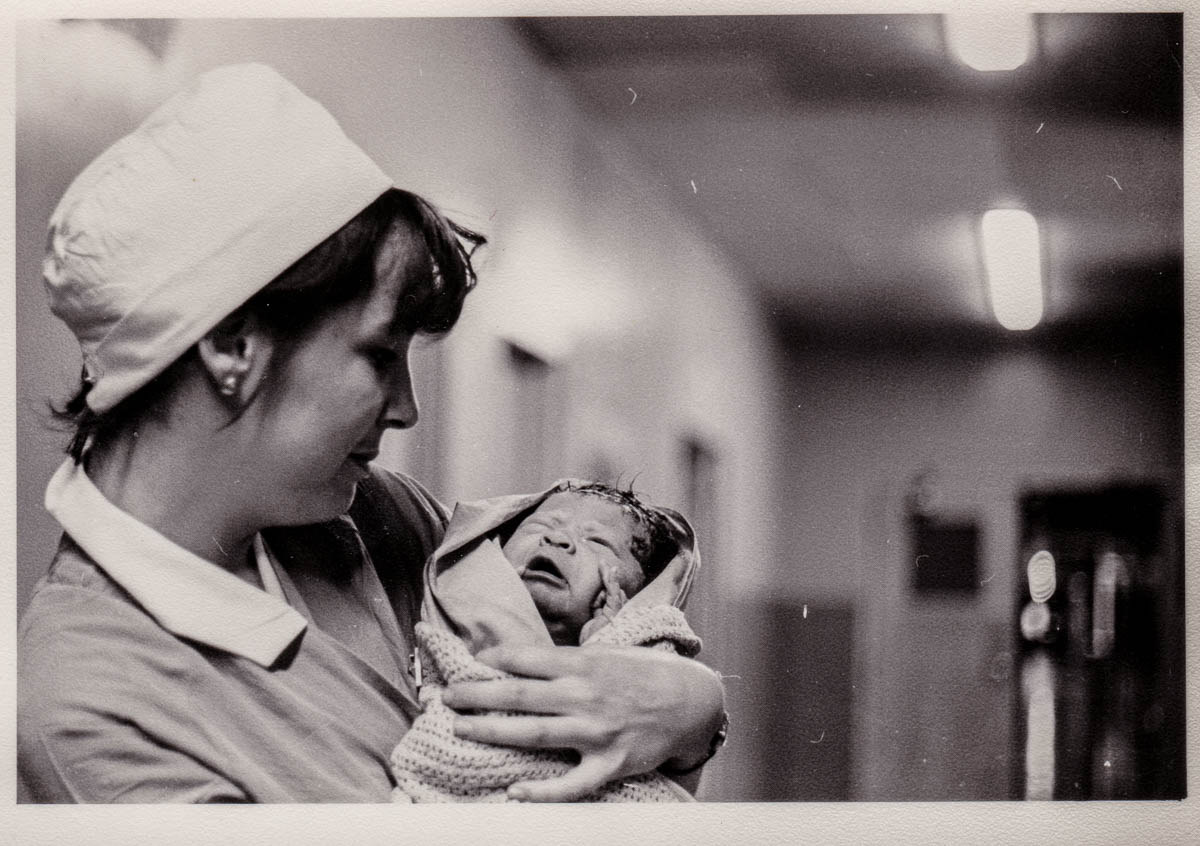
The Travel part of the exhibition promoted tourists and tourism. A print of the Dionne Quints had ruby litho to isolate the doctor and baby quints, and two typed cut-lines on yellow “post-it notes” show how the print was used in a NYT article.

One c1930 print from the Newfoundland-Labrador Film Company showing Arctic ice floes and seal hunters was taken by Frank Kirby. It was used on the cover of the exhibition’s companion book. The print was originally reproduced in a photo montage within the NYT’s photogravure section. An earlier advertisement for the exhibition showed the Canadian women skaters who went to the Olympics at Lake Placid NY. The retouching marks proved to be the most interesting since one Canadian skater was cropped out for the NYT’s article. The Sports photos wrapped up the talk and for the next twenty minutes Dr Birkhofer entertained her audience with a spirited Q&A session. And editor Bob Lansdale recorded a portrait of our gracious January speaker.


Posted in program | Tagged , , , , , | Comments Off on Finding Canada in the NYT Archive

Toronto Skyline in 1908

Toronto 1908
Owen Staples, artist

Toronto. The artist Owen Staples (1866 – 1949) was born in England and emigrated to Canada (Hamilton) with his family in 1872. He moved to the States where he began his arts studies. He moved again, this time to Toronto where he was hired by the Telegram’s Robertson. He returned briefly to the States to complete his artist training, returning to Toronto and Canada for the rest of his life.

An oil  painting of Toronto’s skyline in 1908, four years after the devastating fire of 1904, resides today in the City Archives. A photograph “coloured with water colour and gouache, of [the] oil painting [resides in the Baldwin room of the Toronto Public Library]. [It is] laid down on canvas and mounted on [a] stretcher”.

My thanks to the ever prolific and curious PHSC member George Dunbar for discovering this panorama painting/photograph of the city’s 1908 skyline.


Posted in photos | Tagged , , , , | Comments Off on Toronto Skyline in 1908

good grief – it’s spring fair time again!

The BIG ONE – PHSC’s
Spring Photographica-Fair
May 27 2018

Toronto. For over forty years we have hosted the spring photograpica-fair – the BIG ONE! Click on the icon at left to see the poster with full details. Need a map to get there? Then click HERE and see the book mark for our spring fair in the south-west end of the city.  TODAY, SUNDAY MAY 27, 2018!

The poster and bookmark you see were designed by our newsletter editor, Sonja Pushchak. Enjoy them  and print them! All are welcome to this edition of our show – free parking, tasty pirogies, and lots of bargains. It doesn’t get any better!

Posted in fair | Tagged , , , , , , , , | Comments Off on good grief – it’s spring fair time again!

close-ups with a Leica

Leitz Accessory Front lenses
for their 5cm Elmar

Toronto. For many years Leitz made standard lenses for the Leica that focussed as close as a metre. Want to get closer? Too bad. This all changed in around 1927 when Leitz offered supplementary front lenses for its standard 50mm lenses – the Elmar, Hektor and later the Summar.

Leitz offered three lenses to allow close-ups from 39 1/2 inches to 10 1/2 inches. The trio called ELPRO (1*),  ELPIK (2*) and ELPET (3*) were sold from about 1927 to 1958. A special ring adapted the tiny marvels to the larger f/2 Summar lens. The ones marked without the * were meant for very early cameras and lenses.

I bought my trio of Elmar supplementary lenses nearly forty years ago from Stan Weyman down in Connecticut and they arrived by mail on January 10, 1980. Leitz went on to make and sell the famous spider legs, extension tubes, focoslides, and other odd focussing mounts that became feasible after interchangeable lenses arrived around 1930.

Many other cameras adopted close-up lenses and they became common place offerings by filter makers as they easily attached with rings or threads meant for filters. Tables and tape-measures were needed to determine the correct focal distance and frame size. This was simplified by spider legs and the other odd gadgets Leitz made and sold.

Posted in camera | Tagged , , , , , | Comments Off on close-ups with a Leica

PPOC Magazine “Gallerie”

PPOC Magazine Gallery

Toronto.  Many thanks to editor Bob Lansdale for sending me an email announcing the latest edition of this wonderful magazine.

Gallerie is published by the Professional Photographers of Canada (PPOC), an organization Bob was heavily involved with before he became editor of our journal Photographic Canadiana.

As a professional photographer, Bob has continued his membership in the PPOC, as have many of our other members and executive.

Bob’s late wife Margaret, wrote for both the PPOC and the Professional Photographers of Ontario’s magazine. In 1997, a selection of her columns was published in a book titled  … a funny thing happened on the way to the darkroom! Typesetting, layout, and editing was done by husband Robert Lansdale who took a course at Humber College on the use of the program, QuarkXpress, the preeminent professional program of the day.

Posted in activities-other | Tagged , , | Comments Off on PPOC Magazine “Gallerie”

an ode to volunteers everywhere

editor Bob Lansdale
proofing issue 44-1 at
Aries Friday, April 20th

Toronto. When you think about it, tasks are expensive. We at the PHSC could not last without our collection of truly talented volunteers. Take for example our journal. Bob Lansdale is a professional photographer – and an editor and  publisher.  Bob has edited and published our journal Photographic Canadiana for over two decades  – since  January 1997 and issue 22-4 when he took over from another veteran, the late Ev Roseborough, who was also a professional photographer (and a musician).

In this photograph, you see him at our printers (one of the few tasks for which we pay) The Aries Group  in Etobicoke, diligently proof reading page negatives for issue 44-1 before it is printed and copies mailed to all members. Editor Lansdale is illuminated solely by the florescent light of the light table giving him an eerie look as he concentrates on a page negative.

I was the designated driver for Bob on Friday and chose to capture this photo while testing a Nikon P7000 – a gift from member Ed Warner, another volunteer who has taken videos of each presentation over the past many years. Ed’s videos serve as a refresher for writing speaker reviews for the journal, (some newsletters,) and our web site.

Posted in activities | Tagged , , , , , , | Comments Off on an ode to volunteers everywhere

pictorialism

Pictorial Lighting
William Mortensen’s
1935 book

Toronto. Many well known photographers of the late 19th and early 20th century embraced the off shoot of photography called pictorialism. A bit late to the game, but a prolific photographer and author, William Mortensen joined the Hollywood fraternity in the early 1930s.

Before he embraced photography and pictorialism, Mortensen described himself as a painter (artist). He established a studio just south of Hollywood in nearby Laguna Beach.  There he exploited his knowledge of painting by emphasizing pictorialism in his portraits of Hollywood denizens. His books were published by Camera Craft Publishing Company up in San Francisco, California.

Nearly everyone has or has seen one of his many books on the theory of pictorialism photography. Included here is the back cover of Pictorial Lighting and its frontispiece (the photograph of a girl titled “Greta“). This book was first published in 1935  – I have a copy of the book’s fourth printing in May, 1937, a couple of months before I was born.

By the end of the second world war, pictorialism was passé and reality and photo journalism with its demand for accurate, gritty, and detailed photographs had taken over. Before the war, Leitz made the Thambar lens, a soft focus portrait lens ideal for pictorialism. Unfortunately, the lens and its 9mm central silver spot to block the central light rays was finicky and hard to use reliably. Post war, a few lenses were made from pre war parts, but economical demand no longer existed.

Posted in book | Tagged , , , , , | Comments Off on pictorialism

Charlie Hodge and the MNI

Charlie Hodge of
the MNI c1954

Toronto. Dr Wilder Penfield founded McGill’s Montreal Neurological Institute (MNI) in 1934. The institute became world famous for Penfield’s ground breaking research on seizures and  the human brain. Charlie Hodge was his Neurological Photographer of choice.

In 1945, a 21 year old Hodge joined the MNI as an assistant in photography. Six months later, he took over the medical photography department when its experienced head, Peter Hayden, retired. Charlie ran the department for nearly a half century. Charlie embarked on a crash course in medical photography to meet the exacting standards of Dr Penfield.

In the middle of the previous century, good work demanded bright lights and big cameras. The bulk of the medical photography was done with black and white film in plates, cut-film, and movie reels. When Charlie died in 2001 at about 76 years old, he was remembered a few months later in an article in the July 2001 issue of NeuroImage magazine.

My thanks to George Dunbar, who unearthed this 1954 photograph of Charlie and an assistant in action at the MNI, in the holdings of Library and Archives Canada (LAC).


Posted in people | Tagged , , , , | Comments Off on Charlie Hodge and the MNI

a German perspective on Photography’s history

Toronto. Most of the books I have on the History of Photography are English or American. For a German view point, I look at a  translation of Eder’s History of Photography. Austrian Josef Maria Eder wrote the 3rd edition of his book “Geshichte der Photographie” in 1905. He wrote this history because he felt the German and Austrian inventors in the development of photography were largely unknown or ignored by the British and French historians.

He was encouraged to write an expanded and updated version but it was delayed by the great war and the events before and after the war. As a result, his 4th edition was not published until 1932 although his preface was dated a few months earlier in November, 1931. His 4th edition was finally translated into English on January 2, 1945 by an American, Edward Epstean. The copyright on his translation was held by the Columbia University Press in 1945 and renewed by them in 1972. A Dover reprint was first published in 1978. I eventually picked up a marked down copy for $6.75 but neglected to note where or when this exchange was made (likely in 1980 at Coles or The World’s Biggest Bookstore, which they owned).

Epstean said in a preface to his translation of the 4th edition, “The illustrations appearing in the German work are omitted since most of them have only an ornamental value and are of little practical use to the student.” So you have an 800+ page text divided into some 97 chapters plus the copious notes and the index with only a single photograph – a portrait of Josef Maria Eder (1855 – 1944),  the author and chemist, likely taken in the 1930s for his 4th editon.


Posted in book | Tagged , , , , | Comments Off on a German perspective on Photography’s history

it’s always an attraction

Toronto. Niagara Falls. Such a world-wide attraction.Even studios used the falls as a picture on a backdrop. The roar of the falls is very evident when you visit in person.

The Ontario side has beautiful park lands and attractions. Sleazier attractions and accommodations pepper the nearby streets of the town. I took colour slides in 1975 showing a close view of the horse-shoe falls, the crowds of visitors, and the park setting.

This story in the June 6, 1949 issue of the American magazine LIFE touted the history of the falls which is shared by the US and Canada. Typically, the American side focussed on industry over parks and beauty. Tight rope walkers traversed the falls from the American side to the Canadian side. Have a look and enjoy the days when citizens of both nations could casually wander across the international border unencumbered.


Posted in photos | Tagged , , , , , | Comments Off on it’s always an attraction