photo books lost in California wild fire

Fire Loss

Toronto. The local news focusses on the loss of life and property in the horrendous California wild fires but as sad as these losses are, other losses occur too.

George Dunbar sent me a note that he had spotted on the British Journal of Photography website – an article published November 21st about the California wildfires.

The fire incinerated Dutch collector Manfred Heiting’s library of some 36,000 photo books, including many rare volumes. Have a read and weep at the loss.


Posted in book | Tagged , , , | Comments Off on photo books lost in California wild fire

Daguerre by Gernsheim

L.J.M. DAguerre

Toronto. Dover Publications in New York made their name by reproducing select out of print books (those strange things you can read without recourse to technology … ) in soft cover using signature sewn pages and quality paper. Today books are antique novelties bought in an ever shrinking choice of retail outlets.

I bought this book on Daguerre August 25, 1976 – two years after the PHSC was formed. The Gernsheims also authored the massive History of Photography book I bought in Montreal in 1971.

The subtitle is The History of the Diorama and the Daguerreotype. The book covers the pre-photographic days of the diorama, the electrifying announcement of photography in January 1839 and its enthusiastic adoption around the world in the following months.

The Dover publication was first done in 1968 using text that was published back in 1956! Nearly 70 years old today. The Dover edition has some 124 illustrations including many of the photographs by Daguerre which became famous long before 1956 book went to press.

Posted in book | Tagged , , , , | Comments Off on Daguerre by Gernsheim

light where you need it

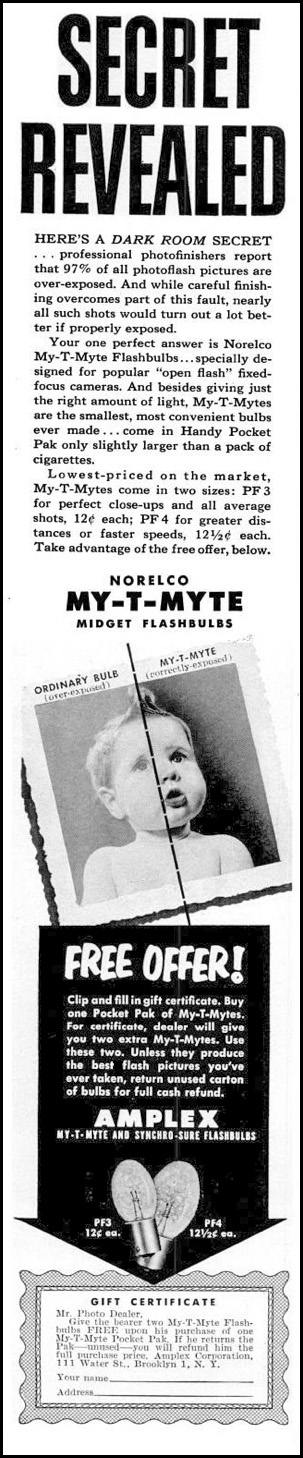
MY-T-MYTE flashbulb ad

Toronto. In the days when photographers used flash to create the light needed to take a shot indoors, prints with burned out highlights were common. One company promoted the solution to be the MY-T-MYTE flashbulb – a lower output bulb by Norelco which was less likely to over expose the photo. Everywhere else the company was known as Philips but Philco in the states managed to block the use of the name so Norelco was used in the States – of course up here Norelco meant Northern Electric Company…

Thanks to George Dunbar for bringing to light:-) this advertisement on page 66 of the November 23, 1953 issue of LIFE magazine (LIFE is a wonderful source for nostalgic photographic ads as are the various old issues of National Geographic magazine.)

Posted in photos | Tagged , , , , , | Comments Off on light where you need it

a new meaning to coated lenses

correcting chromatic aberrations

Toronto. Mid last century science perfected a lens coating that improved the contrast of lens designs allowing even more elements to further correct lenses,  paving the way for the complex zoom lenses commonplace today.

And now modern coating technology has evolved to allow chromatic aberrations to be corrected so that all colours focus at the same plane without resorting to additional elements.

My thanks to Russ Forfar who enjoys Science Daily and its research news. On November 20, 2018 in an article written by Harvard’s John A. Paulson School of Engineering and Applied Science (SEAS) researchers report how a single layer of nano structures can be used to correct chromatic aberrations. This has implications in the design of miniature lens systems for smartphones as well as designs for complex microscope objectives.

Posted in lens | Tagged , , | Comments Off on a new meaning to coated lenses

stoned on movies

Keystone ad in a late 1953 LIFE magazine

Toronto. When I went to Labrador to maintain a tropospheric scatter communications system that Bell selected to service communities in the far north of Quebec and Labrador, my dad said he would like to do movies, so I bought him a cheap GE tan light meter, some reels of Kodak colour film, a Eumig P8 projector and a Keystone Capri turret 8mm camera (the Boston company made a model K-8 in the 1930s).

I grew up in a small Ontario town and Keystone was a common name back then in consumer movie equipment. This was brought back to me when George Dunbar sent an email around touting a November 2, 1953 LIFE magazine ad on p122 for Keystone cameras.

Sadly, like the Polaroid camera of later years, tiny 8mm movies never caught on with my parents. Tiny, blurry, scenes projected in a darkened room just didn’t compare to B&W stills in print form that all could touch, view, and admire in bright daylight.  No special gear. No need to thread and start a special projector. No screen to set up.

I can still remember one movie of a wedding. My mom panned so fast that watching it made my head swim. The various outdoor scenes drifted from over to under exposure and back as the camera erratically moved around to capture the guests. Fortunately most shots were in focus and correctly exposed. At least I could recognize people I knew.


Posted in camera | Tagged , , , | Comments Off on stoned on movies

PHS of NE

Toronto. A year before our society was established, the PHSNE began operations and like us are a non profit organization. They are exchange members with us since the early years of our organization.

You can visit their new web site here. All members can enjoy the latest and earlier issues of their pdf newsletter “snapshots”.

The PHSNE has provided us with speakers like the late Jack Naylor as well as  many unique publications like Jack’s pre-Leica 35mm cameras booklet which came as an insert to a journal from one of our other exchange organizations, LHSA (Leica Historical Society of America)

Posted in miscellaneous | Tagged , , | Comments Off on PHS of NE

end of an era

Kominek’s

Toronto. Kominek Camera and Optical Instrument Sales and Service was just south of Wellesley on Yonge. It was opened in the 1950s and in 1960 I spent Saturdays driving to Toronto in search of books, camera gear and war surplus junk. I remember the Kominek sign on a door on the east side of Yonge.

Decades later, when I spent a summer working for Bell in St Catharines, I came across some old traffic register cameras. Each had a neat label stating it had been serviced and calibrated by Kominek of Toronto. When Kominek retired, he sold his business to two PHSC members – Russ Forfar and the late Hugh Cooley.

Russ carried on after Hugh died, but over time the mechanical gear Kominek specialized in repairing disappeared as newer digital technology took over leaving less and less components capable of skilled repair and adjustment. For the past few years the business has moved around, first to College Street and then to Russ’s home. And now it is closed.

Russ writes, “Hi Robert. It’s official.

” ‘Thank You‘ almost sounds trite compared to the 68 years of trust and support we received from our many loyal customers who followed us through our 3 moves.

“It is now time to wind down Kominek Camera and Optical Repair. Technicians have retired, died and now leave too many empty benches.

“Then there was the cynical direction that the industry took. My email and phone number will remain the same and I do try to answer them. I’m living on Hummingbird Hill now but, I’ll try to keep doing the 6 used camera shows which are great social events. I hope to see you there, Russ.”

Posted in camera | Tagged , , , | Comments Off on end of an era

another brick in the wall

Argus C3 (the Brick) ad in LIFE.

Toronto. After the war, in the late 1940s – 1950s, the USA tried to capture market share in cameras from the German industry. The result was print ads like you see here from the October 26, 1953 issue of LIFE magazine (p110). The ads touted American cameras as able to match German models for half the cost or less.

Then the Japanese onslaught hit offering cameras at cheap prices plus quality approaching the German industry. As a result, American cameras disappeared. Like the Leonard Cohen song says, “[they] sank beneath your wisdom like a stone”(the church called Our Lady of the Harbour in this song is real and I have been on its roof). A half century later, and print advertising began to suffer a similar fate, this time from the digital tsunami.

Meantime, enjoy this nostalgic ad for the Argus C3 and its auxiliary lenses. The C3 of course was fondly known as the Brick… A big thanks to George Dunbar for suggesting this ad in LIFE magazine.

Posted in miscellaneous | Tagged , , , , , , | Comments Off on another brick in the wall

a spark of light

Worthington’s spark photo c 1900

Toronto. We all (almost all) can remember Dr Harold Edgerton of M.I.T. and his famous speed light shots in the early days of electronic flash. These shots allowed us to see phenomenon that was too brief for the human eye to observe. One famous photo was his 1957 record of the milk drop coronet.

Few of us however, have heard of  Arthur Mason Worthington, FRS. He was a British Physicist who pioneered high speed photography decades before Edgerton’s remarkable work in Boston. Worthington, a professor in fluid mechanics used an electric spark to create short duration illumination to record splashes photographically.

A tip of the hat to member George Dunbar for this reminder of the century plus experiment in speed light in Britain.

Posted in history | Tagged , , , , , | Comments Off on a spark of light