all that’s fit to print

Lens from Traffic Camera

Toronto. I received an email Tuesday from Brad down in Florida. Brad came across an unusual camera there with a label by Kominek in Toronto. He has it up on Ebay at the moment.

Brad explained the camera had been used by a bank to allow the teller to photograph customers. I replied that it looked like a telephone company traffic camera but I would discuss it with Russ, the current owner of Kominek Camera Repair (when Mike retired, he sold his business to Russ Forfar and the late Hugh Cooley, both PHSC members).

Russ identified it as a custom made camera tested and maintained, not made, by Kominek.  The cameras use a Wallensak lens and shutter on a half frame 35mm camera. The shutter is triggered by a solenoid and a small motor winds the film on. Mostly used to record traffic registers for telephone companies, the cameras could also be triggered remotely by bank tellers and manufacturing assembly lines. Continue reading

Posted in camera | Tagged , , , , , , , , | Comments Off on all that’s fit to print

stereo goes to war

George Hunter’s Aerial Camera cWW2

Toronto. During the war, aircraft would routinely pass over enemy territory using cameras such as this beast (used by the late George Hunter long after the war) to take long runs of photographs.

Stereo uses two images at slightly different angles. If each image is restricted to one eye, the two images are fused in the brain to create a stereo image. If the angle is exaggerated,  the images still merge but as hyper stereo images.

War time, selected photographs from the long run became stereo pairs. This pair of photos were viewed with a tall dual lens viewer and translated as topographical outlines on a map.

In hyper-stereo, what looked like flat lands suddenly became hilly or even mountainous. Things hidden under a camouflage cover suddenly became outlined and dimensional, no longer part of a forest or field.

Posted in camera | Tagged , , , , , , | Comments Off on stereo goes to war

seeing double – again

Realist Camera from 1955 LIFE ad

Toronto. Stereo seems to wax and wan in popularity. Around the end of the 19th and beginning of the 20th century, stereo was very popular – the television and movies of the day. It disappeared and shot to popularity once again in the 1950s with books, movies, kids toys (like the View-Master), cameras, projectors and slides.

The stereo of the 1950s made use of special cameras like the Realist and dual lens projectors to simplify creation and projection of colour stereo slides. In house, we had both Stan White and Bob Wilson as enthusiastic experts. In fact Stan held special stereo evenings for our  September meeting over a number of years.

In 1955, the special stereo cameras were promoted in advertisements like the one above from the April 18th, 1955 edition of LIFE magazine (page 65). Not to be left out, major camera makers offered elegant accessories to convert their cameras temporarily to stereo instruments using prisms, mirrors, and tiny dual lens assemblies.

As in times past, the fad slowly died out. People were reluctant to wear special glasses needed to see the stereo effect – or to limit shooting to “normal” focal length lenses. In this century we have seen lenticular technology used to allow stereo viewing without special glasses. Special four lens cameras were necessary to create the lenticular prints and special handling of the resulting prints. Even televisions were offered with stereo capability – and rather pricy viewing glasses. Both faded into history quickly.

The ad that brought out this story was suggested by my friend and fellow PHSC member,  George Dunbar.

Posted in camera | Tagged , , , , , , | Comments Off on seeing double – again

seeing red

Ansco Panchromatic film advertisement in 1955

Toronto. Nope, this isn’t about anger issues – or bulls – but good old films and emulsions. All emulsions and sensors are sensitive to light. The energy of light varies with blue and shorter wave lengths having proportionally more energy.

The light energy falls as light goes from blue to yellow to green to orange to red and below. Early emulsions were blue light sensitive. Some times a chemical sensitizer was used to make the emulsion sensitive to some lower wavelengths. For example, Orthochromatic film was sensitive to blues through yellows in the visible spectrum. Continue reading

Posted in film | Tagged , , , , , | Comments Off on seeing red

“… you must have a fantastic camera …”

First Born – Robert Carter

Toronto. This quote, attributed to Sam Haskins, must be one of the worst compliments ever given to a photographer!

Stripped of its bells and whistles, a camera is just a black box that holds the sensitive media (film, sensor) the right distance from the lens. And the lens allows the photographer to focus and set the aperture to control the amount of light entering the camera and the image’s depth of field/focus. The film determines the light sensitivity and contrast. The bells and whistles just simplify things.

Wedding – Robert Lansdale

The vital part of the photograph is the subject, framing and location – all dependant on the experience and judgment of the photographer, not his camera.  The First Born, above was taken in a gloomy corridor of Montreal General near midnight the summer of 1969. Tri-X ASA 400 allowed a hand held shot. A wide aperture put the background out of focus to add to the drama while providing enough light for the film.

36 years later, film was passé and this wedding was shot on a digital sensor by Bob Lansdale. Like my older B&W shot above, his photographer’s eye chose the pose and the venue to make the picture a work of art.

Churchill 1941 by Karsh

In the studio, the photographer can also  choose the posing and the lighting to give his photographs his trade mark touch. In 1941, Karsh of Ottawa took this very famous portrait of a war-time Churchill. Snatching the great man’s cigar was said to prompt the iconic bulldog scowl!

Journalists and news-photographers have a more limited choice in lighting and subject but they too determine the setting and lighting. These often change what would be a pedestrian snapshot into a chilling or historic work of art.

Oh yes, the quote(s) were suggested by my friend George Dunbar – a retired industrial photographer and videographer – the first quote of which prompted me to reminisce a bit.


Posted in people | Tagged , , , , , | Comments Off on “… you must have a fantastic camera …”

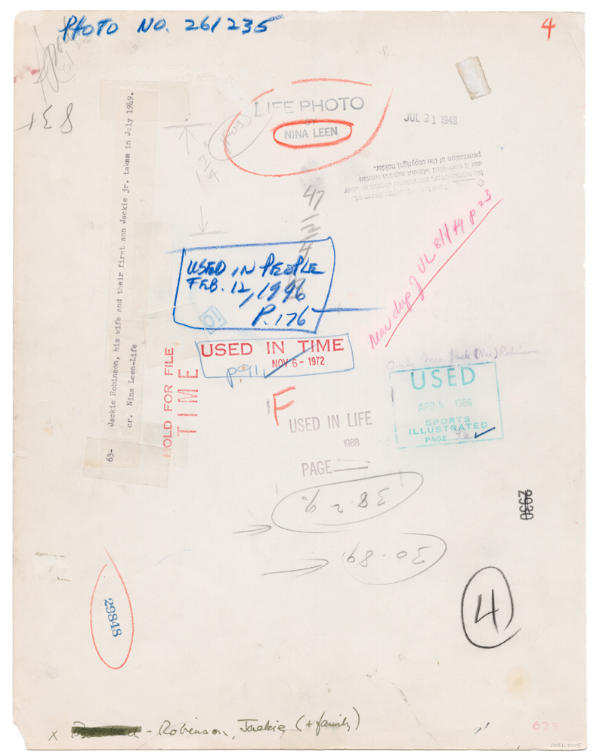
Jackie and family July 1949

Jackie Robinson and his family in 1949 – by Nina Leen

Toronto. Our speaker last month, Erin Levitsky, spoke on LIFE photographer Nina Leen. Growing up in Canada, I often heard of Jackie Robinson and how he broke baseball’s colour barrier playing for a Montreal Royals team.

My apologies for celebrating Black History month a few days late with this post but it not only celebrates a special event in history but links to the topic of our speaker last month, the photographer Nina Leen.

This photo of Robinson and family was taken by Ms Leen in the summer of 1949. Details of the print are shown on the back (verso) as you see below.

My thanks to the site called “Fans in a Flashbulb” for this photograph and to George Dunbar for suggesting the site.

Posted in photos | Tagged , | Comments Off on Jackie and family July 1949

Goldchain at Tanenbaum Lectures – Ryerson

Rafael Goldchain, photographer

Toronto. If you were lucky enough to get tickets and  drop by Ryerson March 6th (Wednesday) at 7 pm, you can hear Rafael Goldchain at the Tanenbaum Lectures.

Click on the icon at left to see an overview of his talk. Rafael spoke with the PHSC  January 2008 on revolutionizing the Sheridan Photography department to bring it into the digital era.

Posted in people | Tagged , , , , , | Comments Off on Goldchain at Tanenbaum Lectures – Ryerson

56th Bièvres International Photo Fair

Toronto. Each year an international photo fair is held at Bièvres, France. This year the fair will be held on June 1, 2.

A couple of our members attended years ago in 2011. If you happen to find yourself in France this June, drop by the fair – you may find an item for your collection.

We mentioned this show in 2011 and again in 2017. Generally the items found in Europe are more unusual than in North America and much more costly.

Posted in fair | Tagged , , , | Comments Off on 56th Bièvres International Photo Fair

Hot-Docs! Hot-Docs! Get yur Hot-Docs here!

Garry Winogrand – Bio-Doc

Toronto. Toronto is hosting the Hot Docs festival once again and our friends at PhotoED invite you to see this bio-doc of the American street photographer Garry Winogand: “All Things Are Photographable“.

Screening is Saturday, March 16, 2019 at 506 Bloor St West (Ted Rogers Cinema). Note the linked photo is courtesy of Google Street View. Tickets are free for friends of PhotoED.

Photographs by Winogrand are some of my fondest memories. He is one of the many photographers who inspired me many years ago, especially when I moved back to the big smoke in the mid 1970s.

Posted in events | Tagged , , , , | Comments Off on Hot-Docs! Hot-Docs! Get yur Hot-Docs here!

Photographs of Minna Keene and her daughter Violet Perinchief

Pomegranates, circa 1906 © The Estate of Minna Keene

Toronto. The Stephen Bulger Gallery is holding an exhibition of early 20th century photographs by these two women called MINNA KEENE & VIOLET KEENE PERINCHIEF Two Generations of Photography.

The exhibition runs from March 9th to April 20th with the opening reception the afternoon of March 9th, including a guided tour with Stephen, Sophie Hackett of the AGO and Laura Jones, co-founder of the Baldwin Street gallery (all three are or have been PHSC members).

Click here  or above to see directions and times.

Posted in history | Tagged , , , , | Comments Off on Photographs of Minna Keene and her daughter Violet Perinchief