mom says screens are bad for your eyes

an evening in 1876 – from a book at the Toronto Public Library

Toronto. This copy of the frontispiece of an 1876 book at the TPL titled, “Shadows on the Screen; or, An Evening With The Children” reminds us that “screens” have been around for well over a century now.

As a kid and an enthusiastic reader, my mom told me books would, “ruin my eyes“. When we got TV in the 1950s my mom said, “don’t sit so close. You’ll ruin your eyes“. I wonder what she would say of computers and smartphones – especially smartphones – today?

As we know in photography, projectors have been around since well before 1839. The first use of the painfully slow/insensitive dry glass plate emulsion was to create magic lantern slides, often religious in nature. Slides became a means to project colour photographs last century – from Autochromes to Kodachromes, Ektachromes, and Anscochromes. Movies in black and white and later in sound and colour became a special treat, replaced by the convenience of television. Tommy, can you see me?

Posted in history | Tagged , , , , , | Comments Off on mom says screens are bad for your eyes

east side, west side

Old CNE postcard used by the Toronto Sun newspaper Saturday

Toronto. Fall is here. The last day of the CNE for this year is the air show today. The Toronto Sun ran an article by Mike Filey and this old postcard for the occasion last Saturday.

Mike was an early member and speaker when we were first established (journal issue 1-8). He spoke once again as a guest speaker at our November, 1989 meeting. And he has dropped into the PHSC meetings since then on occasion.

Speaking of fall, its time to drop your remote and check your collection list. It’s fair time once again! whether you visit us in the big smoke, or sashay out to the west coast to see Tonchi, or east to la belle province to visit Sol or even (plug your ears, gird your loins)  head south, visit a fair, or auction, or an image show and augment your collection of cameras, accessories, ephemera. and photographs.  Remember, it’s fair time once again!

The title of this post was taken from a song titled “The Sidewalks of New York“, written over a century ago.

Posted in fair | Tagged , , , , , | Comments Off on east side, west side

Bolex? Bollocks!

Bolex advertises in LIFE magazine to its American audience in late 1957

Toronto. Bolex from Paillard of Switzerland, was indeed the preeminent movie camera maker for 16mm and later 8mm cameras, but this spread (pp58-60) in the December 2, 1957 LIFE magazine sucks since it lists ONLY American dealers in spite of the magazine being distributed world wide. What chance did our camera shops have with Paillard touting ONLY American shops in this ad?

LIFE should have insisted on the ad listing ALL North American dealers and referencing other countries in less detail. Bollocks indeed!

I don’t mind LIFE ads in general especially since many of my ancestors and relatives lived/live in the states. At one time it was an easier border crossing than today with such a high level of paranoia (especially since 9/11 and the recent election of its current president). There are many things American to be admired. This camera ad is not one of them.

Regardless of my curmudgeonesque reaction, I do thank George Dunbar for telling me about his continuing finds in the historic pages of LIFE magazine.

Posted in camera | Tagged , , , | Comments Off on Bolex? Bollocks!

from Talbot to Stieglitz

Toronto. In March 1991, the PHSC presented me with this book in the hard cover version. The NY Public Library (or NYC Public Library as I have it listed) became a long time member of the PHSC and remains an institutional member today. In 1982, when the book was first published by Thames and Hudson, Inc., the author, Julia Van Haaften, had been a driving force in the library for a decade. She mixed a long term interest in photography with her work as a librarian in art history in the NYPL to rediscover and document their huge archive of photographic prints. This book was one of the results of her work.

Julia wrote and continued to write many books about famous photographers. This book is a slim 126 pages illustrating just a few of the truly historic photographs in the library’s collection. Track down a copy and enjoy the read.

Unfortunately, I don’t recall the occasion, but it may have been when Don Douglas and I did our dog and pony show on the History of Photography.  The inside label identifying the presentation of the book smacks of the wonderful marketing skills of Les Jones, programme convenor at the time, and himself a photographer and an eclectic collector of photographica.

Posted in book | Tagged , , | Comments Off on from Talbot to Stieglitz

a camera for the common man

Minolta A in 1957 Ad

Toronto. I first heard American composer Aaron Copland’s “fanfare for the common man” back in late 1957 when I picked up a Westminster LP titled “Copland“.

And like Copland’s well covered composition, the little Minolta was indeed made for the common man. In 1957, I had its slightly pricier brother, a Minolta Super A which looked much the same except for the faster f/1.8 Rokkor 50mm lens.

Minolta struggled for a foothold in North America, competing against the German marques, Japanese makers, and local (American) cameras with ads like this one in LIFE magazine’s November 11, 1957 issue.  A big thanks to George Dunbar for sharing this find with me and bringing back the pleasure the little camera gave me as I worked diligently to learn photography.

Posted in camera | Tagged , , , | Comments Off on a camera for the common man

I don’t believe it!

Argus C3 Ad c1957

Toronto. This was the catch phrase the old curmudgeon Mr. Meldrew used in  the decade long British  sitcom “One Foot in the Grave“. Meldrew was played by the Scottish actor Richard Wilson.

When I saw this page 9 ad from the September 16, 1957 issue of LIFE magazine courtesy of George Dunbar, I immediately thought of Richard Wilson’s famous catch phrase. The “brick” as the Argus C3 was fondly known, was indeed cheap, but to describe it like this, even six decades ago, is false advertising in all its glory. The marketeers went wild to describe its virtues while invisibly suggesting it was as good as pricier German cameras,

The ad suggests it is as simple to use as a box camera but has “advanced camera features …   to match your skills as you become more expert”. In his 1986 book, Ivor Matanle describes, “The unbeautiful Argus C3 [was] produced in vast quantities in the USA, and, with coupled rangefinder, an adequate quality f/3.5 coated lens and ruggedness akin to a builder’s wheelbarrow, performed tolerably well in its youth. … they rarely perform well now… as a doorstop or a paperweight they have much to recommend them.”

Years ago I read that the C3’s rangefinder was prone to misalignment making accurate focussing difficult. To adjust it, the camera had to be disassembled. To test it, the camera had to be reassembled. Not right? disassemble, adjust, reassemble, test. Still not right? Repeat steps … Hence the likely source of the paperweight comment as few would take a cheap camera to be repaired.

Posted in magazine | Tagged , , , | Comments Off on I don’t believe it!

brave new world

Editor Lansdale (centre) and new Versant 180 at Aries

Toronto. Aldous Huxley wrote his novel “Brave New World” in 1931. As a youth I read a paper back copy of the story. back in the time when a profusion of paper back titles offered a cheap education to everyone. In this book, originally published a year later in 1932, his tale envisioned a new and strange world.

And like the story, our editor discovered he was in a brave new world when he took the file for his 100th issue down to be printed. Bob Lansdale describes the event like this, “[I] was down to Aries to start the printing of our September issue. Their new machine turns out to be a Versant 180 Xerox machine… very compact and not what I expected it to be. The machine prints both sides of the page, then stacks them in a bin. When the individual book is ready the machine staples the pages together and spits it out the back of the machine.

“Seems to take about a minute to do our 64 page book and it will take a day and a half to do the whole batch. Needless to say I did not stay around for the whole printing. They say everything will be ready for packaging on Thursday but if it is possible for everyone we can do it on Friday.  No rush as we can’t mail it until [after] September 1st.

“There is no screen on the pictures. The image is toner on top of the page surface whereas our former litho printing is wet ink that sinks into the page. [The] Machine guy says that for photographs the litho system is best to get good blacks. I’ll have to work my self thru this again [i.e. how to set the darkest/lightest blacks for optimal printing. Check out any journal issue to see how fussy our editor is with print reproduction.].”

Posted in magazine | Tagged , , , , | Comments Off on brave new world

… blinding me with science …

B&H ad in LIFE Magazine September 16, 1957

Toronto. The second release of Thomas Dolby‘s CD “The Golden Age of Wireless” (after the song “She’s Blinding Me With Science” became a hit single in 1982 and was added to the CD) was the inspiration for this post.  In August of 1983, I was in Atlantic City, NJ on a week long security conference. As I wandered around one of the many casino’s, I heard a familiar tune – it was a small group covering Dolby’s famous song.

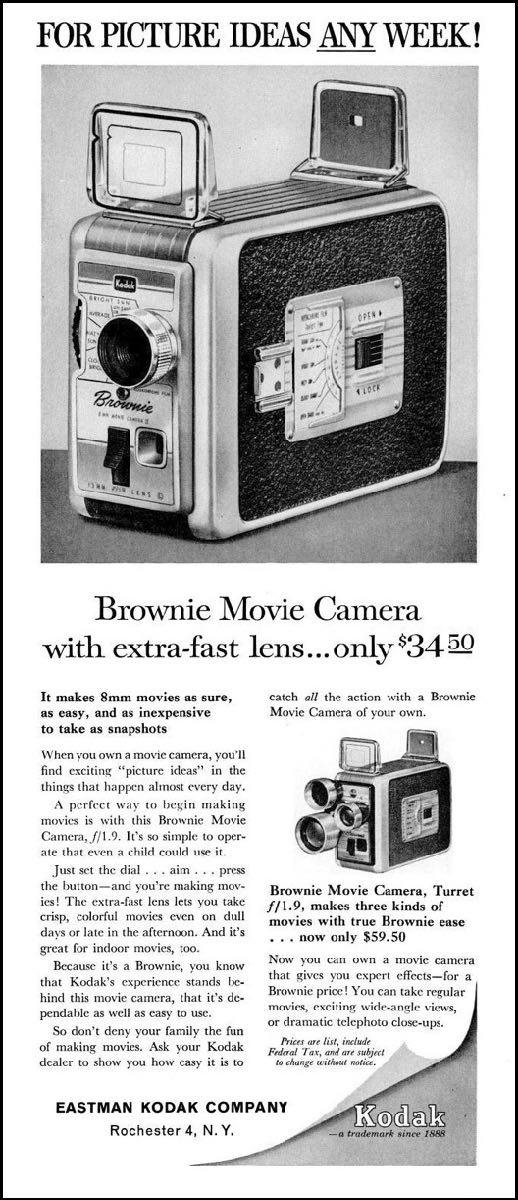
George Dunbar spotted this 1957 ad for a Bell & Howell 8mm movie camera (p145) using an electric eye mechanism to adjust exposure as the bright daylight shifted in intensity with the clouds and shadows.

The ad touted a “computer” that translated light into movement of the aperture. The tiny 8mm film demanded a short focal length lens which by the laws of physics has a wide depth of field regardless of the normal range of apertures. I don’t ever recall seeing a camera with coloured electric eye cells, but that may have been me since I tended to ignore 8mm movie cameras in those days.

Posted in magazine | Tagged , , , , | Comments Off on … blinding me with science …

collecting and using classic cameras

Ivor’s 1986 book on classic cameras

Toronto. When I joined the newly formed PHSC back in 1975, I was looking for good used lenses and accessories for my Leica M4 which I bought a few years earlier. In the late 1970s, I ordered Dr Neill Wright’s Collector’s Checklist of Leica Cameras. That helpful document introduced me to Ivor Matanle, who sold, collected, and used many of the fine old cameras.

In 1986, Ivor published a book on collecting and using classic cameras. That year, I wrote Ivor for a personal copy of his book which he sent on October 31 from his store.

Unlike the traditional histories and detailed models/years/serial numbers lists, Ivor’s book gave a brief history of the “golden years“of what Ivor calls “classic cameras” – the 1930s when film overtook glass plates for professional work into the 1960s when electronics and plastics began to replace mechanical and metal technology to lower manufacturing costs. In his book, he uses the classic cameras to take then modern photos and offers advice on which models to use and which to avoid.

Today, the digital era has annihilated film cameras as practical devices for artistic and personal records. This has created a tiny, loyal niche society that favours the old film technology. Ivor’s book would certainly attract those folk if only to see what can be accomplished with classic cameras of the golden era in photography. N.B. if you want to try the film technology, drop by our fall fair, or auction and get some bodies and lenses and darkroom gear to start this adventure!

Posted in book | Tagged , , | Comments Off on collecting and using classic cameras

isn’t it ironic

Jpg file from Huawei P30-Lite smartphone camera

Toronto. As Alanis Morissette sings on her 1993 album “Jagged Little Pill“. The irony is that the camera with the highest Mpx in the house is a P30-Lite smartphone by Huawei with a 27mm (equivalent) ASPH f/1.8 24 Mpx rating. The more expensive P30 and P30 Pro models have cameras boldly badged as “Leica” who collaborated with Huawei on this line. With a regular price of about $470 in Canada, it cost me zero dollars with a 2 year $40/month Canada wide voice and messaging service contract (before taxes and discounts). The camera has AI to determine the scene and many other options. Leica digital cameras and Leica lenses are of course in the many thousands of dollars prices these days.

I bought my first digital camera back when  they were pricy, awkward, and incredibly low resolution. My very first camera was a Chinon ES-3000 from the mid 1990s. Highest resolution was 758×504 pixels (about 0.3 Mpx). No preview screen. Windows only. And glacially slow downloads. My first shot was Larry Boccioletti as he stepped downstairs at our store in the Kingsway. Continue reading

Posted in camera | Tagged , , , , , | Comments Off on isn’t it ironic