those wonderful old Graflex cameras of yesteryear

portrait by a Graflex camera – Vanity Fair 1922

Toronto. what a great year! 1922. And Folmer and Schwing, a Kodak division at the time, advertised in Vanity Fair with this attractive portrait of a little girl.

Charming portrait. Charming camera. The Folmer & Schwing company had a complicated history, beginning in New York City as a bicycle compny.

The cameras became the standard tool of news  photographers and even have their own collector’s society and journal. My thanks to George Dunbar for discovering this 1922 portrait advertisement for such an historical camera.

Posted in camera | Tagged , , , , , , | Comments Off on those wonderful old Graflex cameras of yesteryear

movin’ out

Delivering PC 45-3 to CPC Gateway

Toronto. It was a miserable weekend, but Tuesday, December 3rd was clear so I joined editor Lansdale to sort and package the latest issue of Photographic Canadiana. We had one brief set back. CPC hardened their password protocol so we had to open a new account linked to our same control numbers.

Four boxes of issue 45-3 with domestic addresses hit the CPC Tuesday afternoon. The international (and USA) addresses will follow – President Clint arranges mailing from the USA, saving the society some postal expense.

Lots of great stories in this 24 page issue with no advertising. It should reach our members  this coming week. Not a member yet? Easy-peasy to fix. Just have your card ready and click the Paypal button at upper right after choosing Domestic or International and 1 or 3 years membership (you can renew this way as well… just sayin’).

And thanks to Billy Joel for the title…

Posted in journal | Tagged , | Comments Off on movin’ out

picture postcards

Allandale Ontario Railway Station c1906 or earlier. A slight crop of the original by The Valentine & Sons’ Publishing Co. 100942

Toronto. At left is a postcard of the Allandale Railway Station and restaurant on the edge of Kempenfeldt bay. My mother worked in the restaurant in the 1930s and enjoyed the excitement and rush to get passengers fed and on their way again.

This c1906 postcard shows the kind of historical item you will find at the Toronto Postcard Club show next  February 23rd at the Japanese Canadian Cultural Centre in Don Mills.

Click on the postcard icon to see a large poster advertising the TPC show next February 23, 2020. When Ed Warner and I last attended the show, you could find photographic postcards and actual photographs. Dealers had well organized wares for collectors.

Well worth a visit. You may just find a postcard or photograph that fills a blank in your collection!

Posted in events | Tagged , , , , , , | Comments Off on picture postcards

a phlock of photogs

LIFE magazine photographers in 1960 – 37 active and one retired.

Toronto. Nearly 60 years ago, LIFE gathered all its photographers, including one retired photographer in NYC for this group shot. It is the topic of the January 18, 1960 Speaking of Pictures column (pp 8, 9).

Of the group, only two are women – Bourke-White and Leen. Bourke-White photographed the very first cover of LIFE, Leen was the subject of a recent Ryerson thesis winner, Erin Levitsky,  whose thesis on Leen was featured in our journal (The big 45-2 issue – editor Lansdale’s 100th opus). I also see Alfred Eisenstaedt was in the group – famous for his 1930s photos of members of the nascent Nazi organization.

An equivalent group shot of famous Canadian photographers would be welcome as well as a magazine as famous as LIFE, but the heady days of photo essay magazines are long over. My thanks to good friend George Dunbar for sharing this memorable group photo with me.

Posted in miscellaneous, people | Tagged , , , , | Comments Off on a phlock of photogs

a different spin on things

Goerz Hypergon extreme wide angle lens

Toronto. One serious issue with extreme wide angle lenses in the days of big cameras and film or glass plates was light drop off in the film (or plate) corners. Expose for the centre, and there was serious vignetting. Expose for the edges, and the centre was burnt out.

In the beginning of the last century, Goerz found a solution. They mounted a tiny fan on the front of some of their  Hypergon lens as I wrote in this February 2003 article.

Like all extreme wide angle lenses, sharply curved meniscus glass was positioned around a central stop giving both the extreme wide angle of view and severe edge drop off of light. (see Kingslake – A History of the Photographic Lens, pp54, 55). To use the Hypergon, the tiny front fan was spun by air propulsion for part of the time and then flipped out of the way to expose the centre rays previously blocked. Ratio was critical. Aperture was tiny, lens was very slow. Awkward or what!

A tripod and long exposure were mandatory – no instantaneous shots here! Of course a smaller  plate could solve the problem of edge vignetting, but you would lose the extreme wide angle point of view you paid for with the Hypergon…

Posted in lens | Tagged , , , , | Comments Off on a different spin on things

ticka-tocka-not-a-clocka

Ticka camera (1905-1914)

Toronto. If you enjoy a mystery set in the 20s, Frankie Drake on CBC fills the bill. In some episodes, she or her team use a tiny spy camera called a Ticka. The Ticka was sold from about 1905 to 1914 – the eve of WW1. It is a British camera made by Houghton and is a licensed copy of the Expo Camera made in the Big Apple (NYC).

The tiny marvel takes 25 16x22mm shots on a small strip of film. The simple meniscus lens in the “winder” is about f/16 with a focal length of 30mm, or slightly telephoto in effect. The rudimentary shutter offers I (instantaneous – about 1/25 second) and T (time). It’s basically a box camera.

The camera was generally chrome-plated with a special solid silver version (expensive). A rare focal plane shutter model was made at one point (even more expensive). The tiny film demanded its own enlarger. Like any expensive collectible, Tickas were counterfeited and sold to gullible collectors.

Posted in camera | Tagged , , , , | Comments Off on ticka-tocka-not-a-clocka

points of view

A Rolleicord TLR

Toronto. Cameras of the last century tended to make a particular point of view easier. Cameras with rangefinders usually took an eye level view. Those with vertical viewfinders like some Kodaks and the famous TLRs took waist level shots – the belly button school of photography as Don Douglas used to call it. Massive ground glass backed cameras took either depending on their size and height – of course the image was upside down and reversed sideways on the ground glass (no big deal for a professional).

Some of the most popular Twin Lens Reflex cameras (TLRs) were made by a German firm mid last century. Their high end model was the expensive Rolleiflex with Zeiss lenses and Compur leaf shutters. The viewing lens was slightly faster to guarantee correct focus. A less expensive version (shown left) was a Rolleicord. Both were made by Franke & Heidecke of Braunschweig, Germany. Most TLRs took 6×6 cm photos on 120 roll film.

Some TLRs had Schneider lenses. Later versions used different shutters. Most had fixed 60 to 75 mm lenses or slightly wide angle normal lenses. Later models used bayonet mounts at the front of the lenses to add close up lenses and filters. Smaller models using 127 film took 4×4 cm images, ideal for super slides fitting a 2 inch square mount.

Some larger profession SLR cameras used 120 roll film and waist level viewers such as the Hasselblads. In time, Japanese TLRs took over the market. They too disappeared as digital cameras and smartphones evolved and crushed film down to a niche of enthusiasts.

Thanks to long time friend, Rollei collector, and master camera repairman, Ulrich Bartel, whose recent email on another matter prompted me to recall the heady days of Rollei and belly button photography.


Posted in camera | Tagged , , , , , , | Comments Off on points of view

flipping over movies

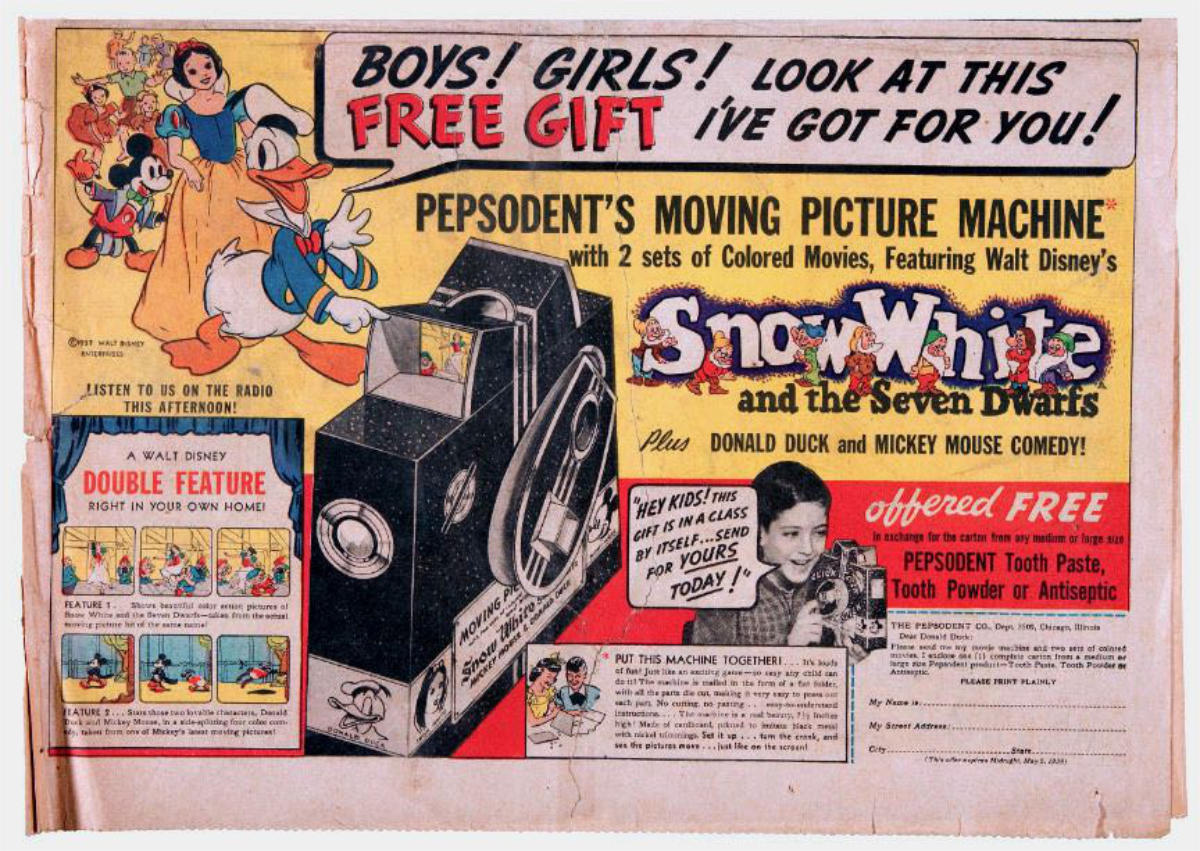
Flip Movie offer c 1938

Toronto. Pepsodent had a catchy jingle when I was a youth, “you’ll wonder where the yellow went when you brush your teeth with Pepsodent“. Around the same time, one of my favourite cartoons showed a perplexed artist (Van Gogh?) staring at a partially used tube of Pepsodent on his palette and thinking to himself, “I wonder where the yellow went?“.

George Dunbar tells me that Pepsodent also collaborated with Walt Disney to offer a card board machine you could assemble to view flip cards of Snow White (released in 1937) and other Disney characters plus a story line. George suspects his father helped him assemble the device.

Posted in film | Tagged , , , , , | Comments Off on flipping over movies

Lights! Action! Camera!

    LIFE Ad for the Argus M3 8mm movie camera (November 1959)

Toronto. Ahhh, amateur home movies. In the 1930s and 40s well heeled families could shoot 16mm movies of family life. Post war, 8mm  and Super 8mm became common allowing every family to capture family life in motion (my father-in-law used a Brownie movie camera to capture his holiday trips).

Home movies, indoor stills with flash and colour photos were pushed hard in the advertisements of the day. If a company had a popular still camera, the next step was movies. Argus had its popular C3 still camera, fondly called the brick, so it was logical to move on to… movies. In 1959, Argus advertised the M3 movie camera. The choice of M3 for its name may have been to imitate the fabulously popular Leica M3 of the day (and by far the most successful Leica ever) or M for movie and 3 for the 3 lenses. The movie camera matched competitors with a lens turret, three viewfinders (fixed focal length lenses before inexpensive and quality zooms), and even a selenium cell light meter, all in a “pocket size” compact camera.

The differentiating concept was a palmed winder replacing the more traditional crank or winder key. Like most fads, people lost interest in the poor quality of 8mm and the demands of editing and home movies disappeared until the age of the modern home computers, smartphones and digital cameras with their high quality videos.  My thanks to George Dunbar and his dedicated research of photographic advertisements in popular magazines of the last century. LIFE magazine for November 23, 1959 features the Argus M3 on page 4.

Posted in camera | Tagged , , , , , , | Comments Off on Lights! Action! Camera!

when is a camera not a camera?

Komic Kamera (c1930s 2D film strip viewer)

Toronto. When it’s a Komic Kamera – a toy handheld  2D viewer for film strips! The size of this viewer suggests 35mm strips. I saw a couple of sites on Google that suggested the little toy was made by different companies – Allied in Chicago, and Russakov also in Chicago.

The “camera” was made in both tin and bakelite versions. It was actually a toy made to view short film strips frame by frame as you turned the knob to bring the next frame into view. The strips told a short story in 2D, usually featuring American newspaper comic characters of the day (some movie plots were used too, apparently).

The “Made in Chicago Museum” page gives background on Allied while the “Kleefeld on Comics” page credits Russakov. Kleefeld also suggests somewhat lewd/adult strips were offered for the tiny viewers.

As a kid, I once had a smaller bakelite viewer, black with art-deco sides. The strips were a smaller 16mm width to my memory. A ground glass window illuminated a frame while a simple eye-piece focused the frame on the retina. The bakelite case could be carefully pulled opened and the film strip exchanged for another. I think it came was some old cartoons.

It appeared in my life suddenly and then disappeared for ever – my mother liked to trash toys once my interest was lost – or pass them on to others. My thanks to good friend George Dunbar for this trip back along memory lane,

Posted in camera | Tagged , , , | Comments Off on when is a camera not a camera?