zombie jamboree

Sarah Francis Whiting views her hand bones by X-rays in 1896

Toronto. Early photographic media were unable to record the much weaker lower end of the visible spectrum (reds, some oranges) but what about the spectrum above the visible blues and violets? In 1896, just weeks after Germany’s Wilhelm Röntgen publicly announced his discovery of what are now called x-rays Sarah Francis Whiting of Wellesley College in the States replicated his experiment and achieved identical results.

Whiting is shown in this image viewing the bones of her hand in a fluoroscope. Behind it and her hand can be seen the naked bulb of a Crookes tube excited to a high voltage by an induction coil. These were the days before x-rays were found to be deadly after steady use over time and lead shielding be came mandatory.

In another photograph at Wellesley, Whiting’s colleague Mabel Chase is shown in the same laboratory using the Crookes tube to record her hand bones on a photographic plate – no camera needed!

Thanks to Russ Forfar in the wilds of Southern Ontario for this bit of history. For decades film was used to capture bone tissue by x-rays. Lead vests and lead sheets were used to protect sensitive body areas from the energy of the rays. Today care is still taken but the x-rays are used digitally and pop up on a computer screen. Far less energy is required to get a good record.

NB. The title is that of the song “Zombie Jamboree” written in about 1953 by Winston O’Connor and sang here by the Kingston Trio who included it in an album a few years later (one of my favourite songs over the decades).

Posted in history | Tagged , , | Comments Off on zombie jamboree

a hint to the future of colour photography

Karsh on Kodachrome c1944 by J C A Redhead, FRPS

Toronto. In February 1931, the magazine Science and Invention had this brief note on the status of a new colour process taken on by Kodak. It modestly states, “These processes are said to be as simple as those involved in taking of monochrome pictures”.

A few years later Kodachrome was formally announced. Taking was indeed simple. Processing was a totally different matter. It was so complex exposed rolls had to be returned to Kodak and later after government intervention, optionally to major independent processing labs.

The photo at left is from the excellent 1978 Brian Coe book titled “Colour Photography“. The Karsh print appears on page 119 of my soft cover edition. The horizontal marks in the enlarged view of the Karsh print are due to the book printing process at the time.Once again, I would be remiss if I did not credit this post to George Dunbar and his generosity in sharing his photographic research with me.

Posted in history | Tagged , , , , | Comments Off on a hint to the future of colour photography

the world’s largest camera

World’s Largest Camera in 1931

Toronto. In 1931, the USA – never one to boast – announces that it has the “World’s Largest Camera” via the magazine “Science and Invention” in its January 1931 edition.  J G Barry of the American government’s “US Geological Survey” department in Washington DC is shown beside just part of the huge structure.

Thanks to George Dunbar for sharing this tidbit of history with me. Check out the earlier post “electric avenue” to track down this magazine – a retitled version of Electric Experimenter. Like today’s TV networks, the modest amount of editorial content attracted readers and subscribers, so important to its primary audience – the advertisers. Our own journal and newsletter, however DO NOT CARRY COMMERCIAL ADS and as such are 100% editorial content, fully devoted to their subscribers!

Posted in history | Tagged , | Comments Off on the world’s largest camera

What Camera Settings Should I Use for Nighttime Photos?

Night Shot by Harry Guinness to illustrate his article

Toronto. Remember Life Savvy and How-to Geek in a post the other day? Well, here’s another article by Harry Guinness, from April 10 of last year (2019), this time on ideas to use with the more traditional style of digital cameras with interchangeable lenses.

In film days, nighttime shots demanded a tripod and slow speeds (a fast lens would help). Media of the time was super fast at ISO 800, and usually ISO 400 tops unless “pushed” in development. I remember doing hand held indoor photos under florescent lighting using ASA 400 Tri-X at 1/25th of a second with a lens setting of f/2.

Right into the mid last century you had to use black and white film for any speed at all – colour films were less than ISO 100 for the most part. My last venture using film and my Leica was in 2002 and by then colour print film was offered at a fast ISO 800.  Nevertheless, it would be considered a very modest ISO rating today – even my now old Sony NEX-6 takes decent colour shots with acceptable noise levels at ISO 3200.

Posted in history | Tagged , , , | Comments Off on What Camera Settings Should I Use for Nighttime Photos?

get great photo information

Share your email with your society

Toronto. We have seen a seismic shift in photography these past years as the art moved from film to digital. And within digital from discrete cameras to those built into smartphones.

On top of this in 2020, we have seen a pandemic so awful it has fundamentally changed our world. To compensate the lack of contact with our members, our editor and treasurer have gone out of their way to produce specials that are members only. (We will continue to issue our PHSC News which is open to all.)

Sadly, even in this year of 2020, with email now available for over TWENTY years, we still have a few members who do not or choose not to have emails that are shared with the society. We urge all – especially members – to get an email address and tell us what it is. Feel an email is a luxury? Then go for a free email from Google (gmail) or Microsoft (hotmail) or their competitors and use a computer at a friend’s home, or a local library, or a child/grandchild’s home.

If you ARE a member and haven’t seen the emailed pdf files, then email me at info@phsc.ca and I will make sure you are registered both in your membership record and on MailChimp.

Posted in activities | Tagged , , , | Comments Off on get great photo information

electric avenue

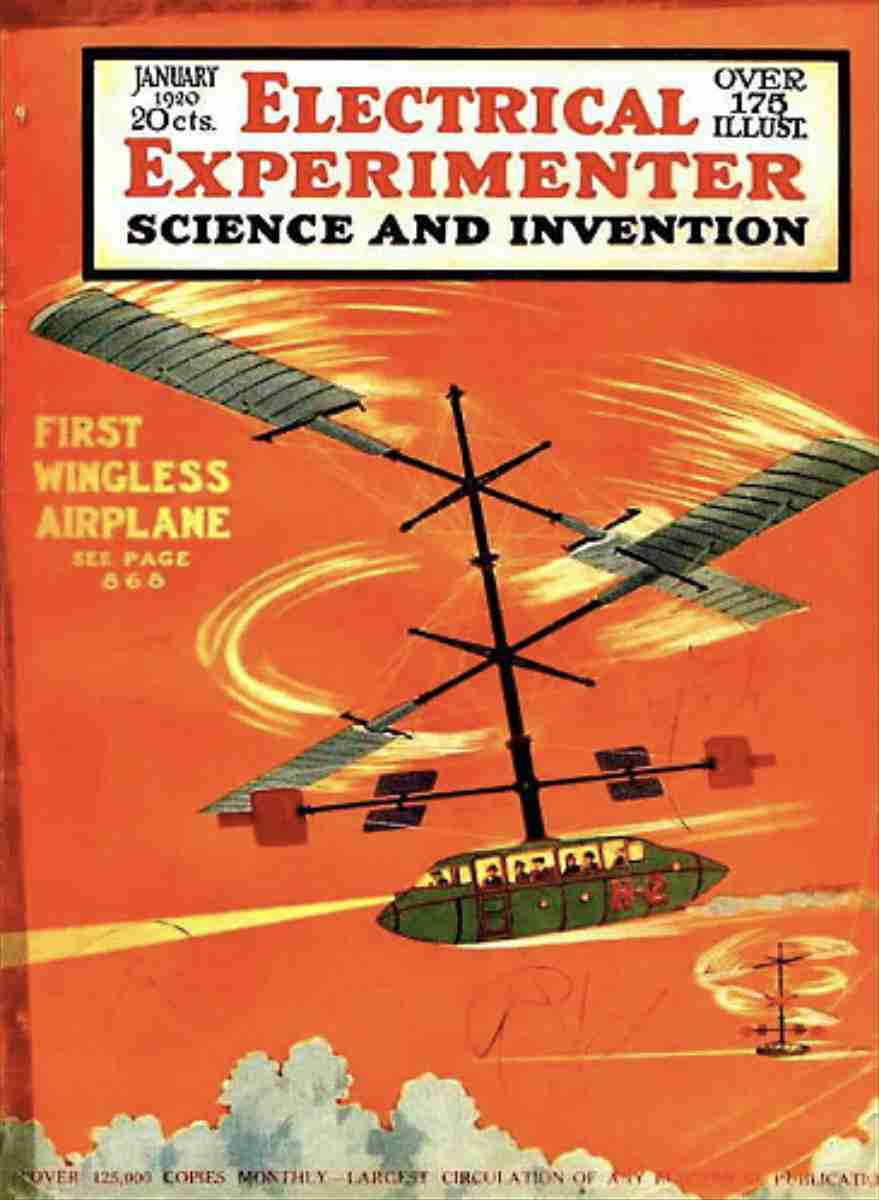
EE January 1920 issue cover

Toronto. Over the years, any significant scientific discovery was soon promoted as a nostrum for curing any long-term illness without recourse to the nasty demands of scientific proof. Electricity, Radiation, Atomic Energy, etc. The list goes on including most recently “cures” for Covid-19 from the US President down. But other non-medical uses were touted, often ones very innovative for the time.

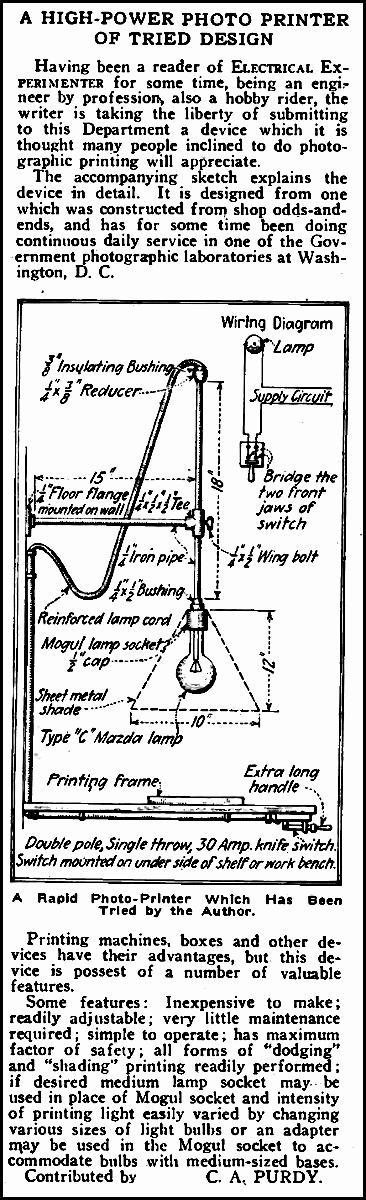
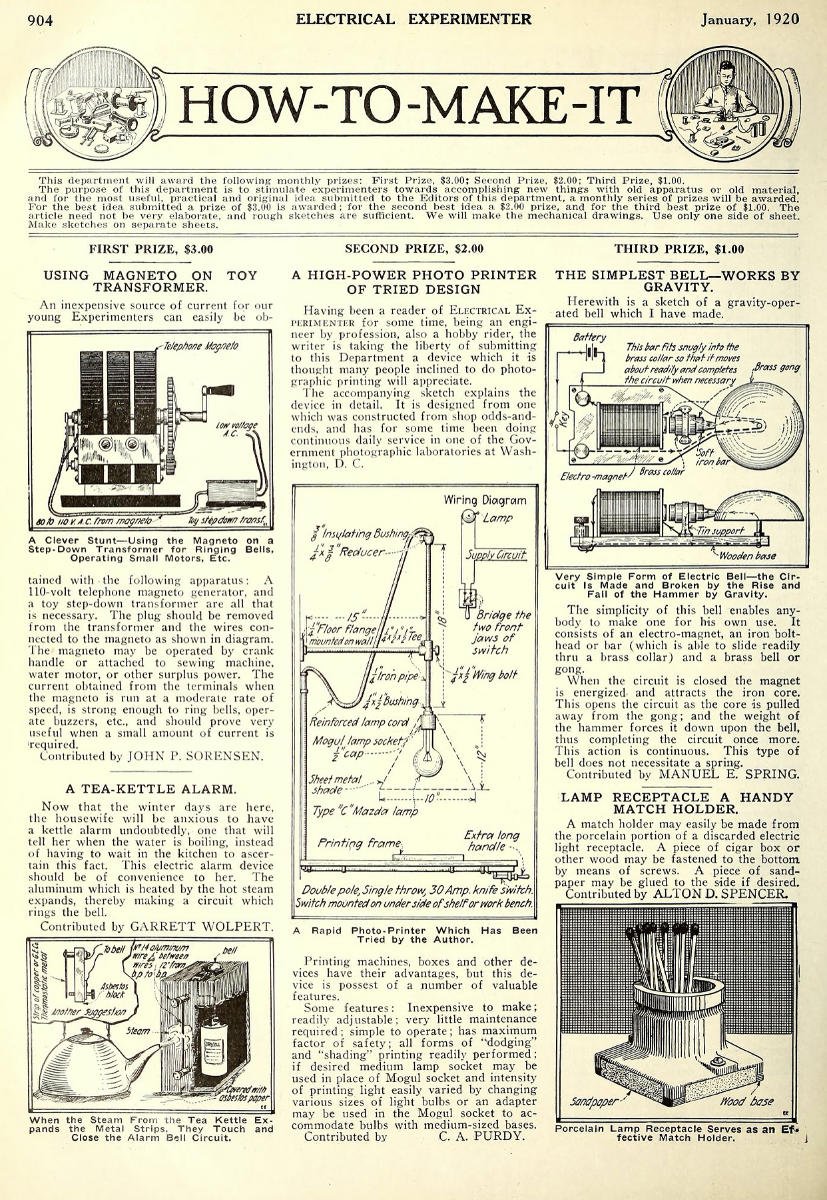
In 1920, a popular American magazine was called “Electrical Experimenter“. Its editor was Hugo Gernsback. While mainly devoted to radio (wireless) and electricity, amongst the January 1920 articles was a photographic piece on page 904 showing how the relatively new electric lighting could be used to contact print indoors. Space between the light bulb and printing frame could allow a degree of dodging and burning if needed. I am surprised that the DPST (double-pole, single throw) knife switch under the shelf didn’t accidentally electrocute the photographer!

NB. The post title comes from Eddie Grant’s 1982 protest song of the same name sang by him in this 2006 upload to YouTube (this tune has a very low res video). As a youth, I read Gernsback’s Radio News and occasionally Science and Mechanics for many years. A tip of the hat and a big thanks to good friend George Dunbar for sharing his research with me.

Posted in history | Tagged , , | Comments Off on electric avenue

Get Me to the Church on Time (Trunk Sale)

Same Place, New date (this Sunday)!

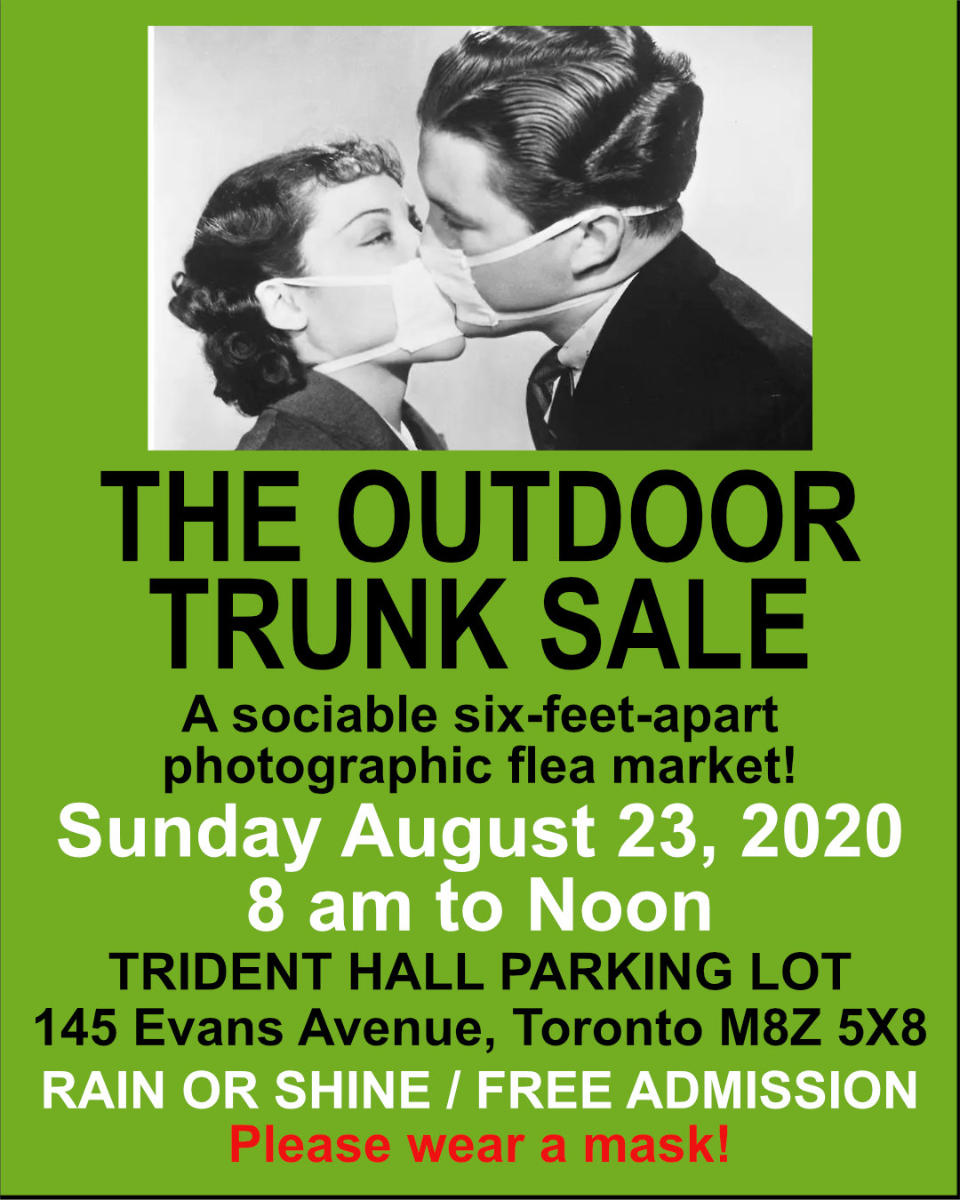
Toronto. After months of COVID-19 restrictions, we can finally host an outdoor event at the Trident Centre. Our first camera show this year is the Trunk Sale delayed from last month and now ready to go August 23rd!

Click on John and  Sonja’s poster icon at left for a larger poster filled with the pertinent details! Or drop down to this link for an alternative poster.

Cameras, accessories, film, darkroom, images etc. have all been available at past sales. One of the first shows in the area this year!

And there really is a church at Trident Hall each Sunday!

NB. This post title is from 1956’s “My Fair Lady”, and the tune of the same name as sung by Stanley Holloway playing Eliza’s Father, Alfred P Doolittle. The play is an adaptation of George Bernard Shaw’s Pygmalion.

Posted in fair | Tagged , , , , , | Comments Off on Get Me to the Church on Time (Trunk Sale)

why everyone should learn photography

smartphone photo
by Harry Guinness

Toronto. Life Savvy posits “why everyone should learn photography” in its post by Harry Guinness back on May 12th. This article is in the “if you can’t beat them, then join them camp” as Harry sets out to teach smartphone owners and users the basics of taking good photos with their smartphone.

Harry writes about photography on How-to Geek, one of the blogs I follow regularly. You might enjoy some other articles on either blog (Life Savvy or How-to Geek) – have a look.

Posted in history | Tagged , , , , | Comments Off on why everyone should learn photography

brave new world

Slide courtesy of Gordon Brown’s talk January 2003

Toronto. Today, almost everyone has a smartphone that includes a sophisticated digital camera and editing apps. Stills, selfies, and videos are taken incessantly.

With some care, and little or no photographic skill, people capture a decent image. In fact, they don’t think twice about snapping off dozens of images – no cost and no delay to see the results. Bad shot? Trash it! Good shot? Email it!

It was nearly 90 years ago in 1931 (when Aldous Huxley wrote his book of the same title) that a roll of film often lasted amateurs – casual or serious – weeks. Cameras were mostly bulky affairs, films or plates were black and white (with the rare colour film/plate for the adventurous). Skill was needed to correctly select, frame, and expose a subject. Tripods were a necessity, not an add-on to show you were a serious photographer.

NB. I discovered Huxley’s works in the early 1960s reading “Brave New World” and a couple of his other novels. “Brave New World” seemed to be a fitting title for this post given the Herculean photographic transition from film to digital this century.

In the 1970s, Kodak experimented with digital cameras but the research was just that. Kodak made most of its profit from the sale of film and paper at the time. However; Kodak’s research into digital technology continued and for a time “Great Yellow Father” was a major factor in digital photographic technology.

By January 2003, when George Hunter first spoke to us on the topic of  “Tales of a Photographer“, professionals were beginning to scan and print. Digital cameras were still too low resolution and too expensive so many pros would shoot film and scan it allowing Photoshop technology to clean up the image and digital printers to create longer lasting prints.

On September 19th, 2007 we had the pleasure of hosting a talk by Gordon Brown called “Photography before computers and after digital“. Gordon was both a scientist and a photographer. He researched subjects for Kodak (like the T-Max name) and taught the ZONE System at the Ansel Adams school. His talk covered the history of digital photography from its beginnings in the laboratories of Kodak to the mid 2000s – spanning some thirty years. The above slide image is from his talk.

By March 2008, when Rob Skeoch (pronounced skew) spoke to us calling his talk  “Observations of a Large Format Photographer“, digital technology had made serious inroads over film. Sports photos, once worth hundreds of dollars a shot had fallen to $25 at most. Instead of a publication paying for a single slide chosen by the photographer to be mailed in; literally hundreds could be emailed to the editor and the editor, not the photographer, could and did pick and choose! Continue reading

Posted in history | Tagged , , , , | Comments Off on brave new world

boxes, bellows, and beyond

Adjustment scale for the Poco camera which uses a bellows and brass rail mechanism

Toronto. Most of the early cameras were big boxy things with relatively small diameter lenses. Early on you changed lenses to change angles of view (wide angle, telephoto) always mindful of the diameter of the circle of confusion – or how much of the plate could be covered without vignetting. Stopping down a lens would improve its coverage

To focus on both near objects and infinity, the awkward old cameras had to be adjusted. The two most common approaches were the box-in-a-box and the  bellows. As cameras shrunk in size, the so called normal lens became shorter. For a brief time both bellows and threaded metal focussing mounts were used. As the minicam revolution in the 1930s took off, threaded metal focussing mounts took over the market. Extension rings, bellows, and auxiliary lenses were used to allow close-ups closer than about one metre – the common near focus distance of a minicam such as the Leica.

In the above photo, you see the distance scale for a Poco camera allowing the lens to be focussed at distances shorter than infinity.

Modern day smart phone cameras are automatically focussed internally leaving most users   with little if any interest in how the technically sophisticated little wonders accomplish such focussing from infinity to a few inches. They are marvels with about a 3mm focal length lens (equal to a 35mm lens or even shorter today) and auto focussed using a square box outline and finger tap on the gorilla glass screen.

Posted in camera | Tagged , , , , , | Comments Off on boxes, bellows, and beyond