which twin has the Toni …

Amphoto 1973 facsimile

Toronto. Late last century was the hey-day for camera and image collecting. Bargains abounded. New books were published. Old books once destined for garbage became valuable items. Advertisements and other ephemera took on a pricier existence. Old, dusty publications were worthy of reprinting as ‘facsimile’ editions promising a return well beyond the cost of printing and augmenting the original.

This particular facsimile (shown here) is one of many reprinted by Amphoto late last century. “Photographic Pleasures” is a comical look at the new fad of photography back in 1855. The original is written by Edward Bradley under the pen name “Cuthbert Bede”. This 1973 reprint includes a modern (now nearly 50 years old …) introduction by the then editor of Amphoto facsimile editions, Peter Pollack.

Note: The post title was a catch phrase for a well advertised home hair ‘perm’ treatment in the 1940s/50s. I can remember hearing their jingle on the radio and later on our then new television set. Like so many things back then, Toni was an American product.

Posted in history | Tagged , , , , , , | Comments Off on which twin has the Toni …

look, ma – no hands …

Toronto. Wouldn’t it be wonderful if a zoom lens was invented with the zoom controlled by electricity? Smartphone could off these tiny marvels and a light finger motion could shift the tiny zoom lens’s focal length.

PHSC member and friend Russ Forfar sent me this intriguing article from Science Daily from Cornell and published June 10th, 2021, “Novel liquid crystal metalens offers electric zoom“. Cornell researchers collaborated with Samsung on this project. The technique was initially seen as a design for “augmented reality glasses” where saving space and weight is a priority.

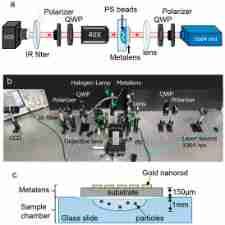
The above thumbnail is from an article on the MDPI website title “Miniaturized Metalens Based Optical Tweezers on Liquid Crystal Droplets for Lab-on-a-Chip Optical Motors“.

While these articles discuss experimental ideas, the result may well be common place articles in a decade or two and history in another half century. Even forty years ago, the late Douglas Adams in his “The Hitchhikers Guide to the Galaxy” predicted a pocket sized electronic encyclopedia. Today, such ereaders  are common place containing hundreds of books (my iPod Touch is an example).

Posted in history | Tagged , , , , , | Comments Off on look, ma – no hands …

the summer of ’44

Graflex ad in June 1944 issue of Popular Photogaphy

Toronto. WW2 was winding down the summer of 1944 and would end in Allied victory the following spring/summer.

Graflex gave a novel twist to the war effort and the American fighting men suggesting the average American was Part-Owner of cameras his government purchased for use in the war.

Further, that the average American could become a sole owner of a Graflex after the end of the war, buying it with the proceeds of no longer needed war bonds!

Once again, please give a big thank you to my friend and fellow photography historian for sharing this find with us.

Note: the title of this post is a riff on a 1970s book I enjoyed many years ago called, “Summer of ’42

Posted in history | Tagged , , , | Comments Off on the summer of ’44

a boatload of testosterone

American troops reach the States after WW2 ends in Europe

Toronto.  Our past president and friend Les Jones sent me this interesting photograph from the Rare Historical Photos website showing American troops arriving home on the Queen Elizabeth. Les is both a sports photographer and an author.

I had an uncle in WW2. He landed in Canada by boat. The journey home continued by train to the CNE grounds in Toronto where we picked him up for the final ride home. He said he was sea sick going to the war and coming back home.

Visit this site to see other photos and read about the troops arriving back in the States. I just finished Erik Larson’s book “The Splendid and the Vile”. Larson makes use of copious quotes from the early war years to follow Churchill and his family from pre war 1939 to Pearl Harbor with an epilogue to carry the tale to post war. The book hits home on just how much was owed to the American participation, albeit a bit late.

Posted in history | Tagged , , , , , , | Comments Off on a boatload of testosterone

PHSC News newsletter for June 2021

Mamiya Super-16 subminiature camera

Toronto. At right top of page 1 in the latest PHSC News newsletter is a subminiature film camera made by Mamiya in Japan for all you die-hard film fans.

June of 2021 is well underway, and our editor, Sonja and her team, have produced this thought-provoking   edition to distract you from the current pandemic. Speaking of which, COVID-19 vaccinations are accelerating in spite of the virus variations world-wide. According to the TV news, our percentage vaccinations per capita have catapulted us to the top of the G7 countries after a very sluggish start. Vaccines and close adherence to common sense guidelines seem to be affecting new cases in a very good way.

This latest issue of PHSC News (21-02) has many delightful articles – short, crisp, and provocative. Take a few moments and read them to ease your personal cares (and boredom)!

The page 1 article, ‘Bearly Lucky‘ shows how NOT to chase a bear, in spite of the success this time.  Page 2, under PHSC Presents is, “Honey, I Shrunk the Lighting Equipment)“,  highlighting the various ways slides were viewed under a light microscope . On page 3, in the column “STREAMABLES“ we meet American photographer, the late Elsa Dorfman,  and Polaroid’s massive 20×24 inch studio view camera (few were ever made); while page 4 features a whimsical look at “The Pun-gent Photography of Bruce A. McMillan” in the column called “PHOTO BOOK 101“.

Page 5 discusses “Will an Election Win be Cummings for Erin O’Toole?” in the “MEDIA-ROLOGY” column’s tongue-in-cheek take on a possible O’Toole campaign. And David does his usual saucy Equipment Review, and the “Why it was Tough Going for Silent Film Stars with Acne“ article about ortho and pan film; while page 7 has a trio of WEB LINKS of interest to us all.

And of course, Page 8 features a poster on our forth-coming ZOOM event  “Paulette Michayluk: On Inspiration. You may find this page very familiar since I used it in a recent post :-)! On page 9, Ivy & Izzy trade quips on “The Hallmark of a Drugstore Collection” quietly followed by John’s compilation page of classifieds covering many events of interest to photographers and our members.

P.S. As usual, every link shown in the newsletter is a hot link just waiting for your click!

P.P.S. You can visit this issue by clicking here, or by g0ing to the menu item NEWSLETTER at the top of the page. There is a drop down menu that takes you to older issues dating back a couple of decades to the very beginning.

Posted in newsletter | Tagged , , , , , , , , , , , , , , , , | Comments Off on PHSC News newsletter for June 2021

one man’s trash …

Ms Jordana Lee takes a rest with a 1950s DeSoto, as photographed by Garry Black

Toronto. … is another’s treasure, or so they say. On June the 7th, 2021, Stu Mills of CBC News posted the article, “All makes and models: Auto scrapyard a mecca for photographers“. This article  and photos show how innovative photographers have taken to the “Eastern Ontario Boneyard [that] has been setting aside classic cars since the 1960s”.

The ‘boneyard’ relics are used as props for models in eye-catching garb. Our PHSC president, Clint Hryhorijiw. himself a professional photographer. noticed this interesting article and passed it along. A big thanks to Clint for sharing this tidbit of ‘future’ history.

Posted in events | Tagged , , , , , , , | Comments Off on one man’s trash …

Paulette Michayluk: On Inspiration – June PHSC Presentation

Toronto.  Paulette Michaluk: On Inspiration. Ms Michayluk is a photographer and podcaster. Join us on June 16, 2021 at 8 pm (we begin around 7:30 with a social get together – all welcome). Read the poster below for more information. Poster taken from the coming PHSC News for June 2021 with thanks to editor Sonja Pushchak.

Go to Eventbrite for free tickets or to program@phsc.ca with any questions.

Zoom audience questions are welcome.

Our June Presentation via ZOOM

Posted in program | Tagged , | Comments Off on Paulette Michayluk: On Inspiration – June PHSC Presentation

mille feuille

April 1944 Popular Photography ads

Toronto. In the spring of 1944, it seemed as if everyone wanted to make photographic paper, especially the fast variety suitable for enlarging (slower contact paper worked but took minutes of exposure, not seconds). In the 1950s, only the larger establishments could sell Kodak papers, all smaller studios and shops sold ‘off brands’. This included Ilford at the time. I tried Ilford back then, but sample photos were hard to find so it was a bit of a pig-in-a-poke situation. I stuck with Kodak.

Papers varied in sensitivity, weight, surface, contrast (grade), etc. Some makers, like the mighty Eastman-Kodak had readily available sample sheets to help the professional or enthusiastic amateur choose a paper. Years later, Ilford pushed black and white material and had a gorgeous sample book for their two paper product lines (Ilfobrom and Ilfomar). Ilford films, paper  filters, and chemistry, all for black and white exposures took off due to their well thought out and systematic approaches. For example, instead of storing a number of different paper grades for any given product, you needed just ONE Ilford paper. Every paper had the full gamut of grades so a simple filter change in the enlarger was used instead.

A tip of the hat to George Dunbar for suggesting these ads for alternatives to enlarging paper from the Great Yellow Father. In the end, It came down to mostly Kodak or Agfa for colour paper and mostly Ilford for black and white paper.

NB. The post title means ‘thousand sheets’ and comes from a delightful French pastry. I first enjoyed mille feuille over sixty years ago in Montreal with my morning coffee. You can make a modern version with this preppy kitchen recipe.

Posted in history | Tagged , , , , , , | Comments Off on mille feuille

the woman and the car

Off to Winterport, Maine c1910 in a flivver

Toronto. Even as a youth, I looked to my father as the car driver, owner, and mechanic. Mom never learned how to drive – it was considered unladylike.  It was a male oriented world. A woman who drove a car even mid last century was a rarity – and one who repaired an automobile even more so!

In 1909, a company in London England (and New York, USA) called the John Lane Company, published the ‘motoring’ text you see below, especially written for women. The little volume is “illustrated by photographs specially taken … by Mr. Horace W. Nicholls”. Amongst my stuff was a wallet-sized paper print as shown above. A quartet was on their way by automobile to Winterport when one stepped out to photograph the event. Two things struck me: the driver shown was a woman; and my print was reversed (I corrected this electronically as well as adding some contrast).

The illustration below is from the book (including the photograph by Foulsham & Banfield, Ltd.). The bool was discovered and shared with me by my good friend George Dunbar. The photo was chosen by the author, Ms Dorothy Levitt who lived her life in the UK and often went to Europe. In her book, she recommends a one cylinder, 8 horse power, De Dion motor car and explains why. I was surprised at how many things were considered accessories back then and not sold as part of the vehicle.

You can read the book here or even download it for free, but please note the following statement – “This eBook is for the use of anyone anywhere at no cost and with almost no restrictions whatsoever. You may copy it, give it away or re-use it under the terms of the Project Gutenberg License included with this eBook or online at www.gutenberg.org/license.

A century ago automobiles were an adventure. You didn’t just hop in and drive away, you had to learn how to start, maintain and drive the beastly machines. Not for the faint of heart!

Posted in Uncategorized | Tagged , , , , , , | Comments Off on the woman and the car

a sharper kind of light

Tiny Red Bud seeds – some infected with weevils.

Toronto. Photography demands light, but so do other optical devices such as light microscopes. The resolution limit of light microscopes has usually been the light itself, forcing a transition to other devices such as an electron microscope if increased resolution is needed. However, the higher resolution can only take place if the subject matter is in a vacuum – not so good for living things.

Down at the U of C in San Diego, Science Daily states, “Engineers have developed a technology that turns a conventional light microscope into what’s called a super-resolution microscope.

“It improves the microscope’s resolution (from 200 nm to 40 nm) so that it can be used to directly observe finer structures and details in living cells.”

I took the photograph at left. It shows tiny seeds from the Red Bud tree. Some of the seeds are infected with weevils. Perhaps some day such a technique will allow ordinary close-up photographs like this one to benefit from much higher resolution too…

My thanks to PHSC member Russ Forfar, a long time fan of science, for the suggestion and link. N.B. At one time I collected light microscopes and related books as well as cameras, photographs and ephemera.

Posted in history | Tagged , , , , | Comments Off on a sharper kind of light