it’s coming, it’s coming!

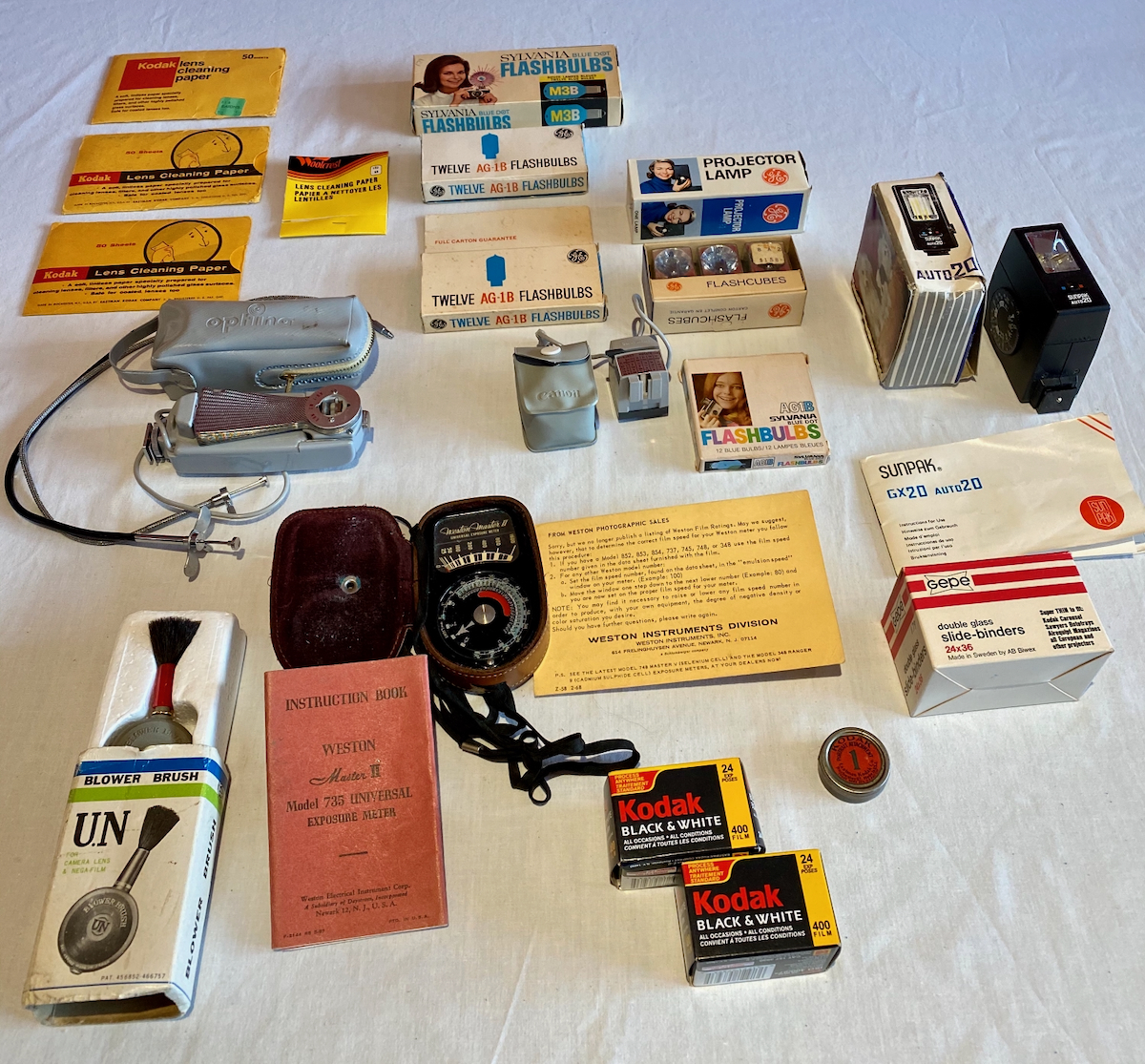
lot from the 2019 Fall auction

Toronto. … and just what is coming, you may ask? THE PHSC SPRING AUCTION, that’s what. Keep an eye out for it.

On Sunday, April 30th. Same place, slightly later time.

We are back in person with a wide selection of lots for your consideration. Sellers – we can post any selected lots on line. Just send the images to Clint. He will verify their eligibility for this auction and send me the photos to upload for our April 30, 2023 auction.

Check out the sample lots to be posted later this month. Here is great chance to add to your collection, or get that user thingy you just have to have for better photos.


Posted in auction | Tagged , , , , , , , | Comments Off on it’s coming, it’s coming!

before the old city hall …

The Globe Foundry at Queen and Bay were the old City Hall now resides

Toronto. George Dunbar sends this remarkable photograph from the archives of the Toronto Public Library. The photo shows the old Globe Foundry on Queen Street West at about the address of the old Toronto City Hall (the only City Hall when I was a kid).

George writes, “A wonderful street scene in Toronto. This address must be the present location of The Old City Hall, built 1888/1889.

“Globe Foundry, Queen Street West, north side, between James & Bay Streets 1882 – TPL”

Just another reminder that libraries and archives have a wealth of photographic history. Take a look at your local library and archives.


Posted in history | Tagged , , , , , | Comments Off on before the old city hall …

the Barretts of Whitby

Portrait of Sarah and Augustus Barrett – from Whitby Library archives

Toronto. I seldom see write-ups on older Canadian photographers. George Dunbar was browsing ‘ourOntario.ca‘ and happened upon the Whitby Library Archives. There he found material on a photographer, Augustus Barrett, who once operated a studio in Whitby and later a bit further west in Toronto.

George sent me these notes he gleaned from the archives, “Augustus Barrett was born in Germany in 1830. He married Sarah Ann Edwards and they had two children. Augustus opened his photography studio in Whitby in 1872 and operated a studio and gallery until 1884.

“Barrett’s studio in Whitby was located at 121 Brock Street North. He later opened a studio in Toronto and died in 1902. Sarah died in 1919. They are buried in Mount Pleasant Cemetery.”

Note. I used a riff on a popular 1930 English play, “The Barretts of Wimpole Street” about the romance of Robert and Elizabeth (Barrett) Browning.

Posted in history | Tagged , , , , , , , | Comments Off on the Barretts of Whitby

now a b-i-i-i-i-i-i-g smile

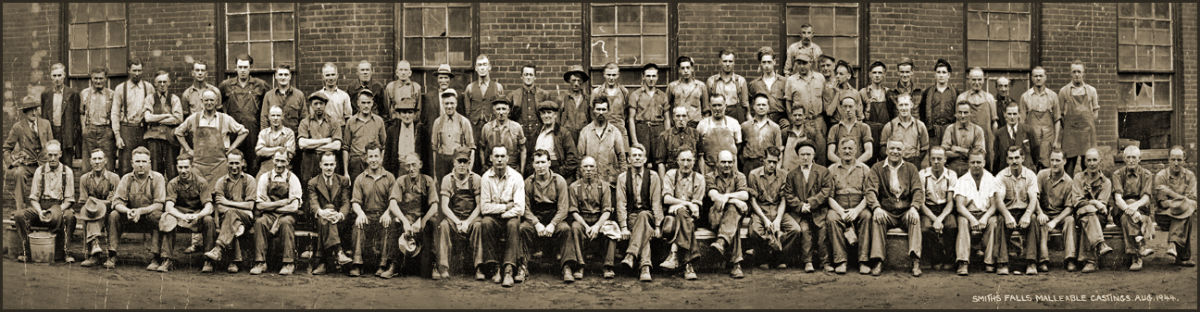
Some of the boys at the Smiths Falls Malleable Casting Company. Click to see the full panoramic photo/

Toronto. Group photos were often taken over the years to show the team players in a school, plant, or factory for a given year. Smiths Falls pre-WW2 was a very active Canadian factory town with  a number of impressive industries. Here are the boys at the “Smiths Falls Malleable Castings Company” in 1944.

It was popular to use a panoramic photograph like the one here. Such extra wide photos were taken by a special camera like the Cirkut. The patent was taken out by William Johnston, buried here in Toronto. NB. Parks Canada have a brief story about ‘Malleable’; its founding and its demise (see pages 313/4 and look at the index near the beginning for other notes and pictures).

The PHSC journal, Photographic Canadiana, has many articles on panoramic photos such as this one titled, “Monster Panoramic Photographs Found Beneath (Ontario) Legislature Floor” found in issue 31-1 on page 20 (members get/can request a free searchable CD index of the first FORTY issues of the Journal and copies of those issues as well). The index is also available on Google.

George Dunbar spotted this interesting photo in the Smiths Falls Public Library and sent it along for all of us to enjoy. Photographs by Cirkut camera were in vogue for a few decades. And yes, there is NO apostrophe in Smiths Falls as far as I can tell.

My mother and her sister are in a c1930 school photo by Cirkut, while years later I was in a non-panoramic (group was small) plant photo (late 1950s). Our late editor Bob Lansdale often took group photos with a regular camera. I saw one case where he used a stairway to good advantage.

Long forgotten, these extra wide group photos are often collected by members and a few have popped up on our show and tell sessions.

Posted in history | Tagged , , , | Comments Off on now a b-i-i-i-i-i-i-g smile

PHSC ZOOM Event TUESDAY April 18, 2023

Toronto. Our monthly meeting for April will be a talk by Cindy Motzenbecker on “Vintage Occupational Photography“. Cindy was editor for many years at MiPHS, a long time member of the Daguerreian Society, occasional visitor at our meetings, and part of the late Bob Lansdale’s network when he was editor of our journal,  “Photographic Canadiana“.

Sign up for this free talk via Eventbrite. Any questions? Drop our programme director, Celio Barreto at program@phsc.ca a note. Please note that the image below is a jpeg and as such does not have active links.

Posted in program | Tagged , , , | Comments Off on PHSC ZOOM Event TUESDAY April 18, 2023

a KODAK moment

newly weds in Surry, England in WW1 (1917)

Toronto.  From the very beginning, the sine qua non of any portrait photographer or artist was capturing the very essence of his subject. Some images succeeded and some did not. The successes, such as the famous Karsh portrait of  Churchill, are recognized by all. The Karsh portrait shows clearly the English bulldog who refused to back down in WW2.

Here are newly weds in Cheam, Surry c1917 during the Great War (WW1). She was about 17; he was about 20. Have a look carefully and see if the photographer captured the ‘essence’s the young couple. While the portrait is lacking in many ways, it is meaningful to the future families of the couple. It was one of the very few of their personal photographs to survive the hectic world of the Great War.

The title above is a famous catch phrase in its own right. Kodak used the phrase in many advertisements to describe a photo taken with their products showing the excitement in the subject(s). I have no idea if the above portrait used any Kodak products.


Posted in history | Tagged , , , , , , , | Comments Off on a KODAK moment

marble nursery

On the Job: How Metro Works – Smith Monument – courtesy of George Dunbar

Toronto. Like all youths, we were very incorrect. When we passed a cemetery for example, it was called a ‘marble orchard’!

In response to a recent post on work photographs (workin’), my friend George Dunbar replied that he sent photographs over a period of time to the Star for articles about work in Toronto, ‘Your “workin’ ” column reminded me of a series (94 photos) I did for the Toronto Star 30 years ago. It was titled. “On the Job: How Metro Works.”‘

Contributions to a newspaper of the day is just one example of how photographers and photography contributed to local history. Years from now, newspaper archives will proudly display the photographs of the time alongside text.

To his email, George added a single photo. By chance the photo was about a cousin of ours and his family business! The business, Smith Monument Co Ltd, was illustrated by the massive inventory of marble ready for monuments or grave boundary markers. Many of the stones Smith used were from a quarry in Quebec. At Smith, the stones were selected, shaped, polished, and engraved as specified before being placed in the cemetery. Small world.

Posted in history | Tagged , , , | Comments Off on marble nursery

educating photographers

one of the first Exakta books I bought in 1958 (printed in 1955)

Toronto. In the days of film, many cameras came from Europe or Japan. Photographers used the information booklet that came with the camera – often written by folks definitely not use to English – for education. Photographers resorted to books for further education about their choice of camera, or for history, or for learning (development, enlarging, lighting, etc.), or for inspiration (photos or techniques by recognized professionals).

In time, books increased in cost – I took a course a decade ago at Humber. One text book alone cost me  $100 and was obsolete within a few years. I was shocked. Back in the 1960s at university we were up in arms over a small soft cover book deemed mandatory – it cost every student in that class $15.

Books on computers and applications hastened the fall. In a few years newer machines and software updates made those barely used books obsolete. Bookshops and aisles addressing computers and software rose up briefly, then disappeared into the past.

Old books and magazines give us insight into the processes and equipment our ancestors once used. As printed material disappears, we are losing a big  source of history. On the plus side, the internet gives us an ease of searches and an education by short videos – reading and comprehension of complex writing is not really needed.

Another interest I have is microscopes – mostly self-taught by reading very old books purchased at used bookshops both here and abroad (plus a few more recent books put together by other enthusiasts and collectors) … Books on microscopy are hard to find these days.

While books and magazines are still being written and printed, there is less and less choice as the digital era unfolds. Today, rather than buying numerous books and searching their indicies, photographers use the internet for information – both text and videos. But what about history??

Meantime, PHSC events (auctions, fairs, sales) often turn up photography books of historical interest. Drop in on our April 30th auction – you just may be able to give an old book a new home!

 

Posted in history | Tagged , , , , , , | Comments Off on educating photographers

through a computer darkly

the Abbott family – courtesy of the OGS

Toronto. Another past-time of mine is family genealogy. For over forty years now I have traced ancestors diligently. The other day the society received an email from the Ontario Genealogical Society (OGS) announcing its free online series for this month will focus on Black History in Ontario. Three separate dates and sessions are noted (free but with mandatory registration).

Please join in, especially if you have ancestors with black roots. Dr Julie Crooks was our guest speaker at the February 2018 Toronto meeting. Although the Wikipedia page above says she was born in London, England; she mentioned to me that she is from Ghana in Africa and was educated in England before emigrating here.

Once again, it is photography that lets us see how our ancestors looked and lived. Food for thought!

Note. This post title is a riff on the biblical phrase “Through a glass, darkly” from 1 Corinthians 13:12.

Posted in history | Tagged , , , | Comments Off on through a computer darkly

O to be in Long Branch …

items from a previous auction (spring 2020)

Toronto. … now that April is there. Okay, enough Browning. We are fast approaching this spring’s PHSC Auction. The date is April 30th (Sunday), 2023 at the usual Legion Hall in Long Branch but at a slightly later time.

A poster went out some days back to all with active emails on our newsletter list at MailChimp. Send me a note at info@phsc.ca if you aren’t on the list but would like a copy of the poster and its more complete information.

I will do a post here with the details later this month. The event is noted on the right hand sidebar of this site.

Note. The title is a riff on a line in Robert Browning’s home sick poem, “Home Thoughts, from Abroad“. At the time Browning had left his native England and missed it as spring came along.

Posted in auction | Tagged , , , , , , | Comments Off on O to be in Long Branch …