Ian P Archer 1958 – 2023

Ian Archer and a field camera acquired for his collection.

Toronto. We were sad to learn of the death of Ian on Wednesday, April 19, 2023. Ian was a long time member of the PHSC and a frequent contributor to our monthly ZOOM meetings. He would have reached 65 later this year.

Ian joined the PHSC back in 1983 while he was at Eddie Black’s. The photo at left is from his Facebook page showing Ian with an addition to his collection from one of our more recent auctions.

Ian is survived by his wife of over 42 years, Joyce Allison Archer ( née Major) and son Devon Paul Archer.

Ian was born in Ottawa, after his parents immigrated to our capital city from the UK. In addition to Joyce and Devon, he is survived by his brother, Andrew, and sister, Norine, along with their spouses, two brother’s-in- law, five nieces, four nephews, five great nieces and a great nephew.

A formal obituary will appear in the Toronto Star early next month.

Ian and our late editor, Bob Lansdale with two Graflex cameras from one of our auctions
Posted in people | Tagged , , | Comments Off on Ian P Archer 1958 – 2023

I swan …

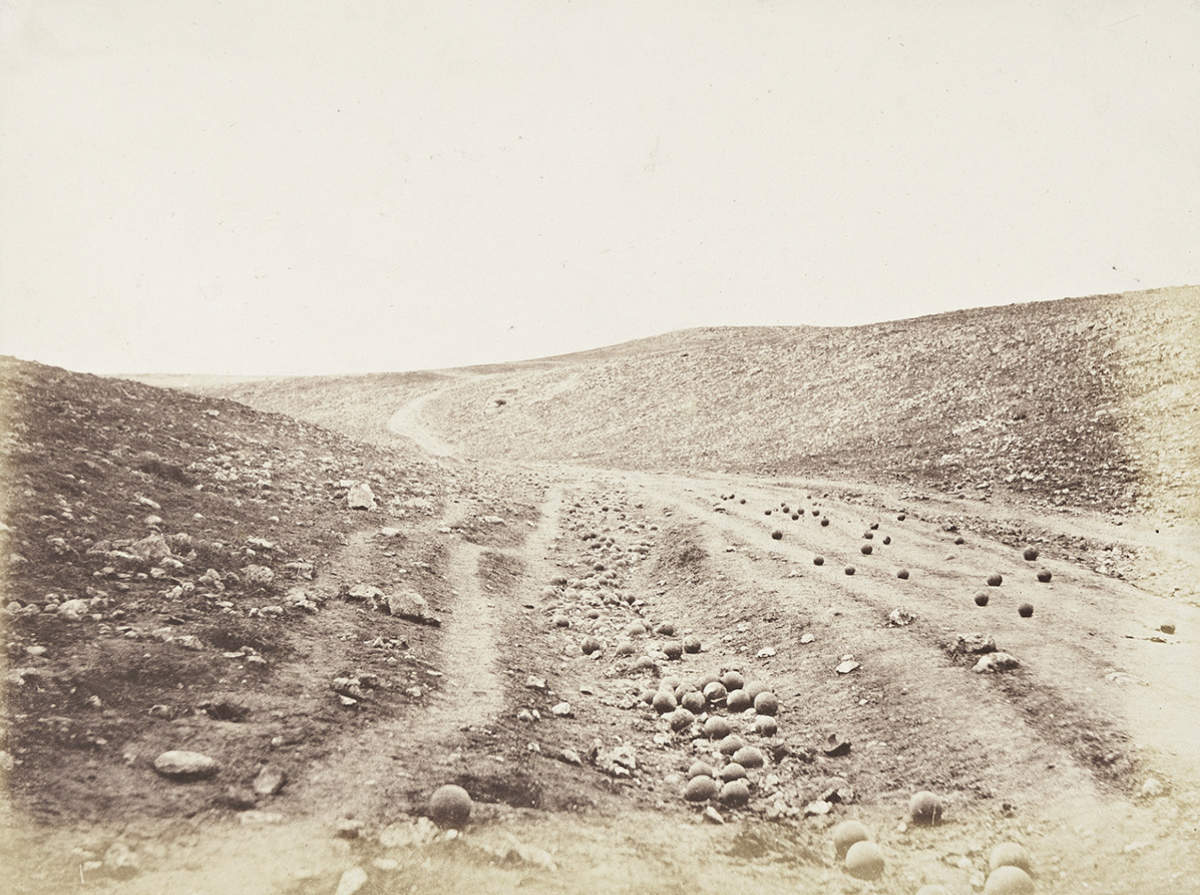
original salt print by Roger Fenton, “Valley of the Shadow of Death”

Toronto. Okay all you photo print collectors! Here is your chance to add some authentically historic prints to your collection.

Under the auspices of sister organization, The Daguerreian Society, Swann Auction Galleries in NYC are auctioning 100 works from the Stephen White Collection in today’s (Thursday the 27th) auction.

The gallery says  in part, “Photography’s immediate importance in documenting and sharing information serves as an early theme, including Roger Fenton’s pioneering image from the Crimean War Valley of the Shadow of Death, and an exceptionally rare view that documents the vicinity of the execution of Emperor Maximilian in Mexico.

“The idea that photography possesses a dual or hybrid identity as both an art form and documentarian tool is ever-present, and continues throughout, including an astonishing large-format example of Tom Howard’s surreptitious and immediately iconic image made at the execution of Ruth Snyder, an early print showing the Wright Brothers’ first flight in the Kitty Hawk in 1903, and Garry Winogrand’s noir portrait of Victor Riesel, a syndicated journalist blinded after an acid attack.”

Visit the gallery link above and swap some $$$ for a piece of history.

Posted in activities-other | Tagged , , , | Comments Off on I swan …

dying, dying, dying

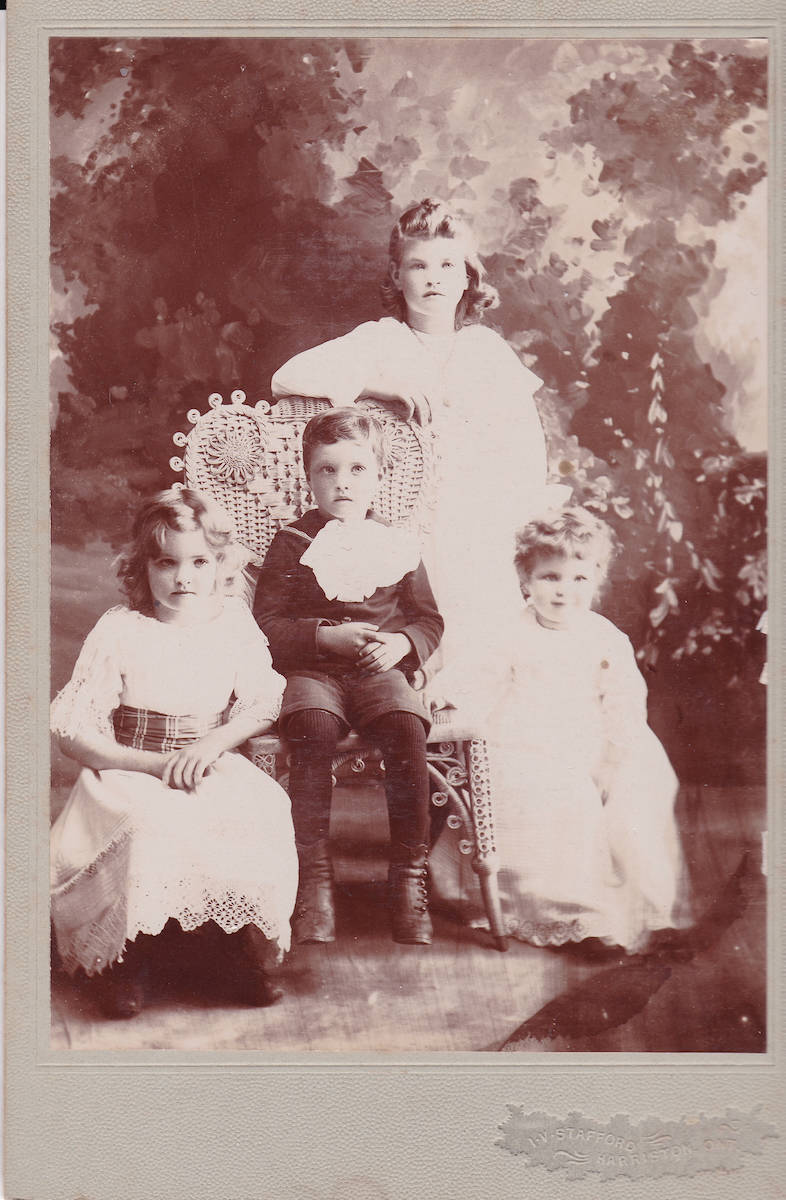
1880s or 1890s cabinet card of four children. Highlights are washed out now.

Toronto. Members of the PHSC (and most other readers of this site) collect cameras and/or photos. A few collectors even specialize in photographs. Some are eclectic, some collect by kind, some collect by subject, some collect by process, etc. Our late editor Bob Lansdale was partial to CdVs and other cards where the photograph was made with the carbon process. Carbon process prints do not fade over time.

The cabinet card shown here was printed c1885 in Harriston, Ontario (about an hour north-west of Toronto). While the glass plate in the studio may have been correctly exposed, developed,  and printed, today it shows washed-out highlights. If the subjects survived the vicissitudes of childhood and early youth and married, they could be the great- or great-great-grandparents of today’s people.

Visit one of our events and you just may find a photo – cased, carded, mounted or bare – to add to your collection. PS. Visit the auction at the end of this month, and our spring photographica-fair next month (May 28th – see our website’s right hand side bar).

Note: The title of this post is part of a line from Tennyson’s poem, “Blow, Bugle, Blow“. This is a favourite poem of mine, along with his poem “The Lady of Shallot”. Both were memorized about 75 years ago in grade school. As children, we memorized poems but were too young to do any proper analysis.

Posted in history | Tagged , , , | Comments Off on dying, dying, dying

what a bargain!

1952 ad for the Graflex Ciro 35 camera

Toronto. I’ve noticed over the years that in every industry larger companies buy up smaller ones for a variety of reasons – features, expanded territory, potential, etc. The photographic industry was/is no different as attested by the early years of Kodak.

My good friend and fellow PHSC member, George Dunbar, sent me this interesting link to a Graflex ad in Popular Mechanics (May 1952 issue).

Post war, Graflex added the Ciro camera line to attract ‘modern’ customers who viewed the large traditional Graflex cameras as old fashioned vs the  more modern designs that used 120 or 135 roll film.

The Ciro 35 line was touted as a bargain at ‘under $50’.  In this way Graflex was suggesting an aspiring amateur could get a better deal by buying a home grown camera. All too soon, the more serious amateur would turn to interchangeable lenses or add-on lens elements to make his camera more flexible – features not offered in 1952 by the Ciro line.


Posted in history | Tagged , , | Comments Off on what a bargain!

fuzzy girl

portrait taken with a Thambar 9cm lens and screw-mount Leica

Toronto. Like all hobbies and professions, photography had fads from time to time. The late part of the 18oos and earlier part of last century, pictorialism took over for a time. Proponents of pictorialism used photography as a basis for art, including using a soft focus approach.

By the time Leitz retailed its Thambar lens, the fad was almost over. A few of the lens were made during and after WW2, but the total Thambars made was less than 3,000. The lens used uncorrected peripheral rays to create the out of focus look. Stopping down sharpened the image. A special silver central spot filter blocked out the sharper central rays. Unfortunately, use demanded varying the aperture, the scene, and the special filter making it difficult to take a great shot.

I bought my lens used at Downtown camera who sell one today (by special order and with a bayonet mount rather than the old screw mount).

While the Thambar was a failure in sales, it is in high demand by collectors of Leica lenses. You can see in my photograph that the lens focussed on the edge of the chair, not the child’s face as intended. An interesting lens, but hard to use. It was brought back briefly in a bayonet mount and very high price.

Note: The post title is a riff on “Funny Girl“, a story about Fanny Brice that was offered in various ways (stage, movie, musical, etc.). Here is Barbra Streisand singing the namesake title song, “Funny Girl“.

Posted in history | Tagged , , , | Comments Off on fuzzy girl

come a little bit closer

Mallard duck taken with a Tele-Arton lens and SONY NEX-5

Toronto. Sometimes when we see a shot, a closer view crops out extraneous stuff while keeping the subject still and in focus. Instead of moving closer (possibly frightening the subject), we can use a zoom lens at the tele end to mimic a closer shot.

While today we are accustomed to using zooms rather than prime lenses, it wasn’t always the case. For many years after their introduction zooms suffered from short variations in focal lengths, high cost and geometric distortion. As a result prime lenses of long focus or telephoto design were quite common.

Around 1985, I bought a Tele-Arton  f/5.6 240mm Schneider lens. The screw mount lens (mis-engraved as ‘Arlon’) attaches to a Leitz Bellow II. The previous owner, Jim McKeen sold it to me at one of our Photographica Fairs. Jim was from Hamilton and had a hardware store in that city. His passion was birding and he once used the lightweight lens to capture images of birds in the area.

I took this shot years later with a mirrorless digital camera and conversion ring. The equivalent focal length is about 360mm. The original  image is very crisp, and in good focus and contrast (coated lens elements). Compared to a standard lens of 50mm, I can get an image that appears to be about seven times closer.

If you would like a Tele-Arton  or another tele-lens for use or your collection, you may find it at one of our events this year – dates and places are shown in the right hand side bar. The most current coming event is our April 30th Spring Auction.

Note: the title of this post is a 1964 song made popular by Jay and the Americans who sing it here.

Posted in history | Tagged , , , , | Comments Off on come a little bit closer

feeling blue

Arthur Dow’s cyanotype of the Ipswich, Mass. river curtesy of ‘The Local News (Ipswich)

Toronto. There are a number of 1800s photographic print processes. One is obvious even to the uninitiated. Cyanotypes can be recognized by their tell-tale blue shades. A more modern equivalent is last century’s ‘blue prints’ offering electrical, architectural, etc. data for the many workers on a project. Blue prints are also easy to spot with their white lines on a blue background.

My good friend George Dunbar writes, “For anyone interested in American art, especially cyanotypes … Three cyanotypes are displayed in this art review by my writer friend, Bob Waite.” With this message is a column in Massachusetts area’s ‘The Local News‘ by Bob Waite called, “ARTHUR WESLEY DOW WOWS THEM IN ST. PETE“.

Read the column ands learn more about the late Art Dow of Ipswich and his work as an artist, and photographer, etc.

Posted in history | Tagged , , , , | Comments Off on feeling blue

Chiyoda edition film camera announced

Lomography’s latest camera (film)

Toronto. Lomography is a familiar name to all film buffs in this time of digital technology. Birgit Bucharest sent the PHSC a note the other day announcing Lomography’s latest film camera, the ‘LomoApparat Chiyoda Edition’ shown here.

To reserve your camera (out in June/July) visit the Canadian Lomography store here. If you are in the States, the site will offer to switch you down there in the land of US Dollars.

Notice the background? Japanese Cherry Blossom trees in full bloom. My neighbour has had one for years and I noticed it is blossoming. In fact, Toronto’s High Park is well known for its many Cherry Blossom trees – all beginning to show their splendour with the beautiful pink blossoms that announce spring!


Posted in activities-other | Tagged , , , | Comments Off on Chiyoda edition film camera announced

sky high

Six Glaciers in Alberta behind Lake Louise. Taken about two decades ago with a Leica M4

Toronto. In the early days of minicam photography, mountain scenery was thought to be popular with travellers. Companies like Leitz made special lenses to use in the mountains with their cameras.

The lens designs put lighter weight over aperture (usually a smaller maximum aperture  as mountains had an abundance of light). Focal lengths were likely medium telephoto.

Slower and shorter focal length lenses were already available and relatively light. For example, the 5cm Elmar (joined a few years later (1935) by the 3.5cm Elmar and 2.8cm Hektor).

A typical special design for travellers was the 105mm f/6.3 ‘Mountain Elmar’.  While not especially successful when first offered (only about 4,000 ever made – 1932 to 1937), it is now desirable to collectors.

In the haze of the above photograph is Abbott pass – location of the first recorded fatality from mountain climbing in Canada. On the climb down, my daughter and I dropped in at the nearby Tea House for refreshments.

I took the photo  twenty years ago probably with a Canadian designed and manufactured 35mm Summicron lens. I used ASA 800 Kodak negative colour film.


Posted in history | Tagged , , , , | Comments Off on sky high

faking it

THE ELECTRICIAN by eldagsen (Berlin) courtesy of PetaPixel.

Toronto. Les Jones sent me an email the other day about Berlin-based “photomedia artist” Boris Eldagsen. Boris won one of the prestigious World Photography Organization’s Sony World Photography Awards with his photograph called “THE ELECTRICIAN” from his series “PSEUDOMNESIA Fake Memories“.

Boris DECLINED the prize. He explained that while the photograph appears to use an old photography technique, it was actually ‘co-produced’ with the aid of AI (artificial intelligence) image generators.

We once said ‘a camera doesn’t lie’ – not any more! The more tech-savvy folk amongst us realize that ‘AI image generators’ are the buzz words of today. About 40 years ago, computers were just too slow and memory too small to run any serious AI app. Today, this is simply not the case. Even my desktop setup has more capacity than an entire data centre back in the 1980s!

You can read the full article titled,”Artist Refuses Prize After His AI Image Wins at Top Photo Contest” here or on PetaPixel.

Posted in history | Tagged , , | Comments Off on faking it
