an ambrotype self portrait

Stan White – self portrait c1996

Toronto. Over the years, photographic processes continuously evolved. For example, some effort was made to deliver less expensive cased images (Daguerreotype look-a-likes). One solution was to take a negative using the then new wet-plate technology and treat it to reverse the tonal range, bleaching the black areas white and using a black background in the case to simulate the blacks in the clear areas of the ‘negative’.

More recently [mid 1990s] courses and workshops demonstrated the old technique to a new contingent of photographers. Stan White had a column in the journal called simply “Stan White’s Corner”. For issue 22-1 Stan wrote of his experiences with a workshop across the lake at GEH.

The self portrait at left comes with this paragraph: Note the rubber glove; the photograph was taken during a processing session. Thblue-only sensitive emulsions were tricky on even the most perfect complexion. The writer finds this picture most useful when applying for a senior-citizen discount, not too many people will argue your age when your photograph is an ambrotype.

Stan begins this column, “I am now back from my second one-day workshop sponsored by Eastman House, the first being the Daguerreotype Workshop the subsequent results from which were featured in a previous issue.

“This latest offering was on wet-plate collodion ambrotypes, tintypes and other wet-plate applications. The work of the principal instructors Mark Osterman, and his wife France Scully Osterman [June 1998 speakers at the PHSC], was superb and showed a wide range of ambrotypes and tintypes, treated in variety of different ways, as well as wet-plate negatives printed on modern papers.

“One 8 x 10 inch contact print of a full-length portrait printed on modern Ilford double-matt paper had a tonal range the like of which I have never seen bettered. There is a tolerance to the combination of plates of purblind sensitivity coupled to simple Petzvaglasses for neither takes advantage of the others shortcomings and the result is pleasingly familiar to the eye like the simple taste of honest bread and cheese.

“Modernity has paid a heavy price in quality, for the convenience of all-encompassing photographic utility. …”

The column is available on the members-only DVD as the issue 22-1 pdf file. Instructions on joining/renewing are shown above (MEMBERSHIP) and to the Right depending on the choice of payment type (Cheque, Credit Card, PayPal Account, etc.). Any questions, email Lilianne at member@phsc.ca.

Posted in history | Tagged , , , | Comments Off on an ambrotype self portrait

AI and photo history

Girl at work on (telephone ?) cabling (date unknown)

Toronto. Some of us are bombarded by announcements about the marvellous results attained by artificial intelligence (AI).

Here at the PHSC we use some apps touted as AI, especially Topaz Photo AI (with each update this program has shown improvement). The image at left was sharpened using Focus Magic rather than the Topaz program and resized with Affinity Photo. Many digital images are slightly soft and benefit from a touch of sharpening.

Images, especially those from old journal issues are often enlarged, de-noised and sharpened before use. This often has a trade-off between the authenticity of the original image and clarity on the web.

We tend to avoid the nastier uses of AI (creating fake works of art for example). Any app that modifies an image etc seems to tout its AI aspect. The latest releases of various OS software, including macOS,  have some AI elements embedded in them to offer ‘suggested wording’, etc.

But what about the effect it will have on photographic history? This aspect is the subject of a coming symposium announced by TMU’s (ex-Ryerson U) Image Centre:

“From March 31 to April 2Encoding the Image: How does AI affect the Future of Photo History? will bring together historians, curators, and computer scientists to examine AI’s role in photography research and collection management. Organized by Dr. Thierry Gervais, the forum fosters dialogue among scholars and professionals. Registration is required—learn more about the sessions, speakers, and how to attend on our website.”

Although we look at historical photographic equipment, photographs, and history, not the future, this coming symposium will be of considerable interest!

Posted in activities-other | Tagged , , | Comments Off on AI and photo history

a better mouse trap

Some of Talbot’s ‘mousetraps’ by Catherine Weed-Ward (detail from her 1905 negative)

Toronto. Past president, author, and sports photographer Les Jones sent me a note the other day on an interesting article about Henry’s lost cameras.

In January of 1839, Two unique means to capture images created by sunlight were announced. One, by Daguerre of France  showed how a silver-coated copper plate could  be used to create a permanent image called a daguerreotype.

The astonishing news caused an urgent reaction in one Englishman who already had a similar ‘permanent’ process for his personal use. Henry Fox Talbot immediately had his process announced from England. His process created a ‘negative’ image that could be used to ‘print’ any number of positive prints.

The one-off daguerreotype was initially the chosen process and rapidly spread around the civilized world. After all, it was free (except in the UK). Ultimately with numerous improvements, Talbot’s process took over and the negative/positive technique became the world-wide standard for glass plates and film.

Recently a search was initiated in the UK to track down Talbot’s cameras or ‘mousetraps’ as some called them. Larry Schaaf introduces an article titled, “The Hunt for Talbot’s Cameras” by  guest writer Roger Watson. The article describes Talbot’s cameras complete with photographs of a few of these hand made instruments as well as offering an opinion about why so few exist today.

At the right under ‘PHSC EVENTS’ are the confirmed events so far for this year. You may not find a Talbot ‘mousetrap’ but there will be lots of goodies to add to you user gear or collection!

Posted in history | Tagged , , , , | Comments Off on a better mouse trap

from mother Russia (with love??)

c1935 Russian Sport SLR minicam using 35mm film in a special cassette.

Toronto. Issue 22-1 features a selection of cameras from our 1996 spring fair as photographed by Bob Lansdale and assisted by Tiit Kodar. Among the offered goodies was this rare Russian camera, the USSR Sport from 1935.

The photo for this post is the smallish image in issue 22-1 ably enlarged by Topaz Photo AI, and enhanced by Focus Magic, and Affinity Photo.

The Sport was possibly the first minicam SLR design (a debate ensued with the Kine Exakta maker – it was marketed in 1936) The Sport takes 50 shots (24 mm x 36 mm) using a special cassette (cassettes were not yet standardized).

It has an optical finder for direct eye-level shots. You can see a large awkward box on top of the camera – it serves as a hood for the SLR viewing magnifier. The beast uses an Industar 10 lens with a top aperture of f/3.5 and a fixed 50mm focal length.

The camera uses a focal plane shutter rated at B, plus a range of 1/25 – 1/500 speeds.

The dealer who owned the camera had an asking price of $450 back about 30 years ago.   By the way, see the location and dates for our confirmed events this year to the right under ‘PHSC EVENTS’. We can’t promise a USSR Sport camera will show up, but you will find lots of intriguing goodies to expand your collection!  

Posted in history | Tagged , , , , | Comments Off on from mother Russia (with love??)

aptly chosen words …

Preston Springs Hotel by Stan White, c1996

Toronto. Various photographers have chosen to pick popular city locations which were photographed many decades ago, and show what they look like today given roughly the same field of view, etc.

In our journal issue 22-1, the late Stan White chose to compare stereo views “then and now”. The example here is the “Preston Springs Hotel”, just a bit west of the city. In his article titled, “Then and Now”, Stan begins, “Many people think that history finished the day they were born. It comes as surprise to an old man to find that the young consider him history. Many of us see our short sojourn through life as though from a railway station looking back down the tracks of time.

“We should be thinking of ourselves as passengers on a train speeding into the future at the same speed it is leaving the past behind – a train whose passengers are feverishly making history.

“It behooves all historical societies not to become s0 involved in the past that they have no time for the present, for the present is the history of the future. We live in a young society. In Ontario, even if we include the aboriginal tapestry, there is little tangible pictorialhistorical evidence that goes back more than 250 years. Perhaps a little more or little less in other parts of Canada.”

Members can read Stan’s thought provoking article in the issue 22-1 pdf file on the members-only free DVD which contains the first 40 volumes of “Photographic Canadiana” including an index of all articles (the index is in various formats). Those not a member at present can follow the instructions above (paying by cheque, etc.) or at right (paying by credit card or PayPal account). Questions? Email Lilianne at member@phsc.ca.  PS: Help us out, please indicate whether your membership is NEW or a RENEWAL. Enjoy!
Posted in history | Tagged , , , | Comments Off on aptly chosen words …

mr Garrett continues …

Helena Burroughs by Halsey and Sadd (?), 1840 – McCord Museum collection, Montreal, QC

Toronto. The late Graham Garrett was our guest speaker at the 20th anniversary supper. One one hand he could be downright prickly to deal with but on the other hand, he was the epitome of  a photographic researcher: determined, thorough, fussy, and very, very detailed as shown by his CD of Canadian Daguerreotype photographers (1839 – 1841).

Part one of his article titled, “Photography in Canada 1839-1841 – A historical and biographical outline” appears in issue 21-5. Part two in issue 22-1 begins, ” As to the first attempt at commerciaportraiture with the daguerreotype process in Canada, it seems to have begun in the province of Quebec by newlyestablished partnership of Halsey and Sadd who arrived in Montreal during the middle of September 1840 from New York.

“Little is known of their activity while in Montreal, however they may not have been entirely successful because of bad weather and by the end of the month they had departed for Quebec City

“Despite overcast conditions that followed them to the provincial capital, thfirst week the skies were clear and they appear to have made the most of thopportunity. The editor of the Quebec Mercury stated on October 10th that they had been ‘extremely fortunate in being favored with the clear weather and bright sun since their arrival here. They have been enabled, every day, to take a number of miniatures by this process, by which the likenesses are wonderfullaccurate.’ … “

Members can read BOTH articles in the respective pdf issue files on the free members-only DVD. To join, see MEMBERSHIP above (cheque, etc.) or at right (credit card, PayPal account). Questions? Email Lilianne member@phsc.ca. To help us, please indicate if this is a new or renewal membership. Thank you!

Posted in history | Tagged , , , , | Comments Off on mr Garrett continues …

in the beginning …

Matthew Isenburg – a modern daguerreotype by Mike Robinson – courtesy of NGC

Toronto. The National Gallery of Canada [NGC]  houses one of the most auspicious photographic collections. This month, writer Nathan Mandigo wrote a detailed article on the collection, its original collector, and their background in the magazine of the NGC titled, “THE ISENBURG COLLECTION: THE BEGINNINGS OF PHOTOGRAPHY“.

The late Matt Isenburg spoke to us back in April, 2000 on “Evolution of the Camera”   and again in September, 2005 on modern day collecting (Ramblings and Recollections).

Matt amassed an eclectic collection photographica. Both he and Mike Robinson of this city were elected as president of the Daguerreian Society. He was well known to Mike and our late editor, Bob Lansdale. Mike catalogued the collection when it was sold and housed in Toronto before moving on to the NGC.

The above article is well worth the read, especially if you are a bit foggy on history of photography.

Posted in history | Tagged , , , , | Comments Off on in the beginning …

Newsletter 25-2 issued

PHSC News – issue 25-2

Toronto. Editor Patrick Gunn has put together an impressive issue for February. A fine example of his artistic and writing talent – the issues just keep getting better!

Patrick tells us the basic framework including non time-sensitive articles are already created.

Click here for a copy of this issue or visit NEWSLETTER above for this and other issues. Want a personal copy with notice sent directly to your in box? Then just email news@phsc.ca and I will add you to our MailChimp list.

This issue contains many news items and announcements in its 16+1 pages. Have a gander at the striking layout and articles. Remember, drop Patrick or me a line if you have/want photo gear.

Posted in newsletter | Tagged , , , | Comments Off on Newsletter 25-2 issued

a visit to the great yellow father (north)

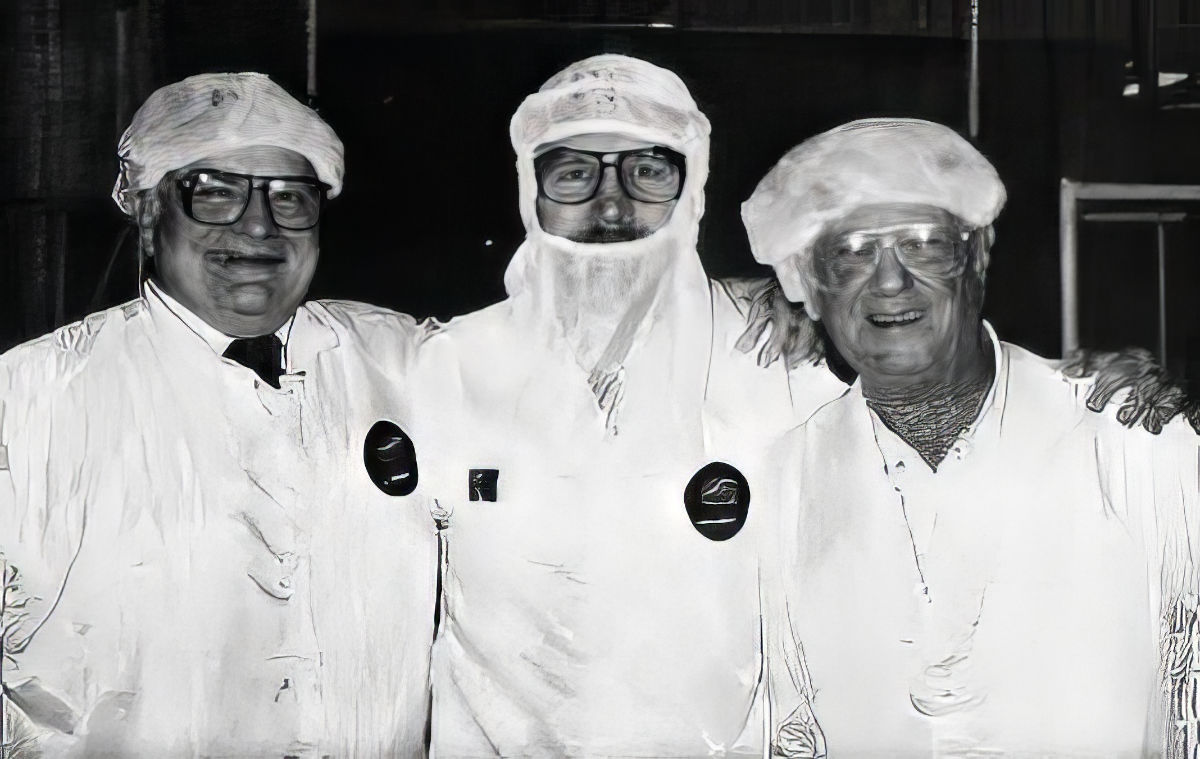
a trio of Amigos – Bill Kantymir, Les Jones, and Larry Boccioletti visit Kodak Canada

Toronto. In March of 1996 (same year as this site was launched), president Les Jones and two side-kicks, Bill Kantymir and Larry Boccioletti visited the facilities of Canadian Kodak. The photo at right is from the issue 22-1 enhanced by Topaz Photo AI and Affinity Photo.

Ev Roseborough recorded this event in issue 22-1 of our journal with the article, “PHSC Guests of Kodak Canada”, written by Larry Boccioletti. Larry’s article begins, “In March, President Les Jones, Bill Kantymir and myself were guests of Bonnie Chapman, Kodak Canada ‘s Director of Corporate Sponsorships.

“We were privileged to be given short tour of the Kodak plant. Because of the need to prevent contamination, meticulous attention to cleanliness is evident, and we donned white coveralls and hair coverings. Every door we went through had sticky pads on the floor so that any dirt on our shoe soles would be removed.

“We watched rolls of support materia(uncoated film base) being unwound inta coating machine by robotic vehicles running on magnetic tracks in the floor. After coating, the rolls, 39 inches wide and weighing hundreds of pounds, wersent to the next building, for either export to other Kodak facilities worldwide, or for slitting and spooling for the Canadian market.

“In the manufacturing area we enterean elevator, and as the doors closed, the lights went out and our escort produced a flashlight throwing very dim green illumination. The elevator too, had dim green lights along the baseboards but it was still impossible for me to distinguish any images. Im sure it would take a long time for my eyes to become accustomed to the darkness.

“Our escort, Gord Morse, guided uinto what seemed like a very large hall way which lead to the control room. It too, was lined with green dim lights alonthe baseboards. He call ed to a persositting in the dark and they had conversation. It was strange knowing thathese persons spent the better part of day in total darkness.”

Like all good things the film and phot paper industries were decimated by the influx of digital technology. Kodak’s mighty presence here and in Rochester was similarly decimated – building were destroyed, and her a remaining building was to become a subway station.

Members can always see the rest of Larry’s article in the pdf version of issue 22-1 on the free members-only DVD. Join now – the MEMBERSHIP menu above for paying by cheque or the PayPal paragraph at right to use  a credit card or a PayPal account. Questions? See Lilianne at member@phsc.ca.

Posted in activities | Tagged , , | Comments Off on a visit to the great yellow father (north)

where oh where has my …

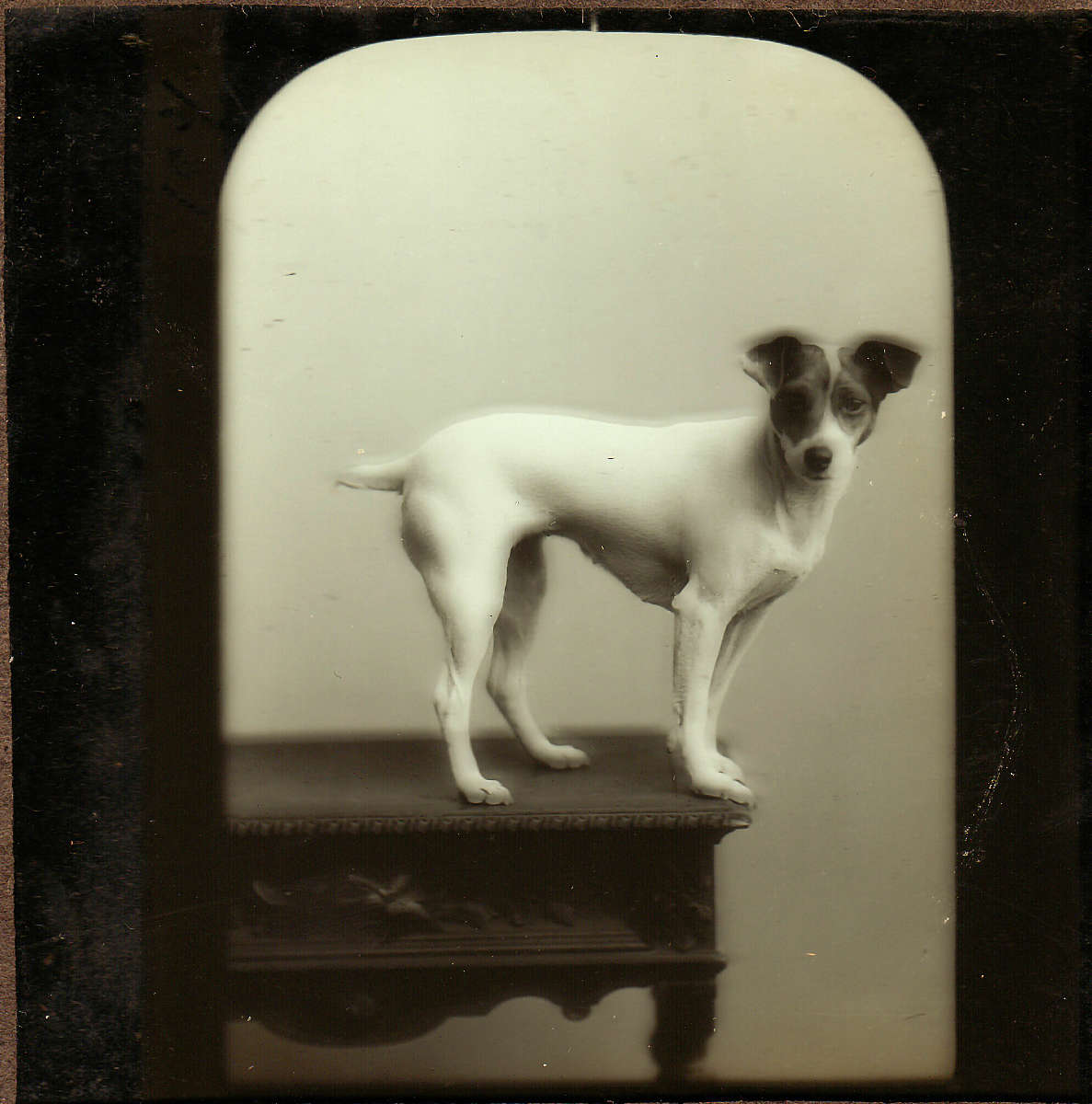
a glass slide of a dog (terrier) taken in Bath, England by a George Bath c1920s or 1930s

Toronto. … little dog gone? As the singer sang so sadly. At left is one of two glass slides of terriers with no date, purpose, etc.

Photo collectors often group their collection by kind and search shows, fairs, auctions, antique shops, junk shops, etc, for a specific type of photo to add.

The photo shown here could be categorized as glass slide, positive, animal, dog, pet, etc. by various collectors. The original is well exposed and sharper than shown here.

Be sure to attend our events this year for items that complement your own collection. Date and location, once confirmed are shown to the right. A post is pinned to the top of the front page as the event date draws closer.

PS. If you live in Ontario, be sure to vote today!

Posted in activities | Tagged , , , , , | Comments Off on where oh where has my …