AGO photography prize – public opening Sep 6, 2017

AGO AIMIA Opening Sep 6 2017

Toronto. Join the Art Gallery of Ontario (AGO) on September 6th at its AIMIA opening. The event is open from 6 – 9 pm at the AGO downtown (317 Dundas West in Toronto at Beverley).

The public can vote on the four runners-up (Liz Johnson Artur, Raymond Boisjoly, Taisuke Koyama, Hank Willis Thomas) to this year’s award either in person or on line this fall.

Posted in activities-other, events, people, photos | Tagged , , , | Comments Off on AGO photography prize – public opening Sep 6, 2017

Daguerreian Symposium Oct 26-29, 2017

Dr Mike Robinson

Toronto. Need an excuse to visit The Donald in Washington? How about taking in the world famous Daguerreian Society’s symposium as well? The symposium will be back in Washington D.C. this year.

The prestigious agenda of speakers includes our own Dr Mike Robinson.

“Dr. Mike Robinson is a artist-practitioner, teacher, conservator, and historian of the daguerreotype.  In June 2017 he earned his PhD in Photographic History with the dissertation titled ‘The Techniques and Material Aesthetics of the Daguerreotype‘. The paper is available here on Mike’s website, centurydarkroom.com.

“He has researched and written on the studio practice of Southworth and Hawes for the Young America [the book by Grant Romer on Southworth and Hawes] catalogue and for the Daguerreian Society annual.

“Mike taught graduate and undergraduate courses in 19th Century Photographic Processes at Ryerson University in Toronto, and has lectured and taught daguerreotype workshops in Toronto, Rochester, New York City, Lacock Abbey UK, Bry-sur-Marne France, and Kolomna Russia.”

Posted in activities-other | Tagged , , , , | Comments Off on Daguerreian Symposium Oct 26-29, 2017

The Leica Manual 1935 – 1973

The 15th and last edition of the Leica Manual 1973

Toronto. As my eyes began to struggle with focussing my Exakta, I sought out an alternative design. On March 21, 1970 I bought Andrew Matheson’s “The Leica and Leicaflex Way” 9th revised edition at Mitchell Photo Supply on Dominion square in Montreal. It was one of the many Focal Press books from England available at that time. It was an eye opener to me and two years later in July 1972 I bought my first Leica – a model M4.

It served me well over the years and I still have it although it has sat unused now for 15 years as digital has overtaken film. On August 2nd, 1973, while visiting Mitchell’s again I spotted a stack of oversized books  by the doorway titled “Leica Manual” 15th edition by Douglas Morgan, David Vestal, and William Broecker.

There were 15 editions of the Leica Manual from 1935 to 1973. If you would like to see one, you can download the 2nd edition, released in 1936 and dated as 1937 here, or visit the Archive web site for the revised 3rd edition noted as 1938-9 here. The earlier editions featured chapters by specialists in various fields. The books were divided into sections: Basic Leica Technique; Leica in Science and Education; The Leica in Specialized Fields. The earlier manuals took great pains to show that tiny negatives could be enlarged to make big prints with little grain provided the negatives were correctly exposed, developed in fine grain developer and handled carefully.

I began collecting older editions of various Leica books including the Leica Manual. The earlier ones were half the size of the 15th edition, but all editions had 500 -600 pages printed on what appeared to be better quality clay paper, suitable for crisp photographs.
The 13th edition featured some colour photos, emphasized the M3 and the IIIf series, and dropped the number of pages to 456. It used cheaper wood pulp paper for the appendix on “Tables & Formulas”. Ads had disappeared. No specialists were mentioned as chapter writers. In the previous 11th and 12th editions ads were very slim.

Specialist writers appeared once again in the 15th edition, and rapidly changing “Tables and Formulas”  were moved to a new loose leaf book expected to be published in 1973 with annual supplements. I found a copy posted as published in 1975 and also “supplement 1” dated 1977. I believe the concept did not take hold like its predecessor, the Photo-Lab Index did (at one time I owned two copies of the P-LI which was also loose leaf and offered annual supplements). A modern take on the Leica is covered here by Eric Kim.


Posted in Uncategorized | Comments Off on The Leica Manual 1935 – 1973

…from one amateur to another

Miniature Photography 1937 by Richard L Simon

Toronto. The shift from large camera photography to miniature hit its stride in 1935 when Fortune magazine dubbed it the minicam revolution. Within a couple of years books were being published to teach the amateur how to embrace the new technology. One of these was called Miniature Photography – from one amateur to another. The amateur in this case was Richard L. Simon, a well-to-do New Yorker and half of the Simon and Schuster publishing house in NYC. The book was published the fall of 1937, a few months after I was born.

Like most books of the period, the paper used doesn’t accommodate clean crisp half tones so the photographs are limited to those printed on whiter clay paper and tipped in at the appropriate spot. The book is a hard cover about 5 x 8 inches and just under 170 pages. Footnotes are used on many pages, to clarify and amplify points, rather than gathered up and listed after each chapter. Appendices address the variation in controls of the Contax and the Rollei.

Simon speaks in the first party voice directly to the reader. He is candid about his advice and choices of camera (Leica), lenses, films, developers, papers, etc. He goes to great length to offer then current costs and ways to save money. He points out the pitfalls of owning a miniature camera and the more satisfying choices of scenes to shoot. Simon cautions that the cheapest processing and print houses are geared to large cameras so they often use ordinary film developer, not fine grain developer demanded by the tiny 35mm negatives. And enlargements are often made by indifferent staff used to the generally sharper large negatives needing less care in the focussing and developing of the print.

Reading it once again reminds me that the transition from a contact print size camera to a miniature camera demanding enlargement to make even a pocket size print viewable was a seismic shift in concept. Of course a decade or two later and 35mm was considered main stream for all but die-hard studio and news photographers.

Posted in book, camera, processes | Tagged , , , , | Comments Off on …from one amateur to another

Boris Spremo died yesterday at 81

Boris Spremo by Frank Lennon – Globe and Mail

Toronto. Thanks to Russ Forfar for notifying me that Boris died yesterday. His accomplishments are noted here by the Toronto Star and by his first employer in Canada, the Globe and Mail with a very brief bio here on Wikipedia.

Boris was a member of the PHSC. He was tagged to speak to us most recently this past April, but was too ill. He did speak to the PHSC of his adventures in March of 2001.

Posted in people | Tagged | Comments Off on Boris Spremo died yesterday at 81

What the heck is a Perfex?

c1938 Perfex camera made in Chicago from bakelite and metal. Courtesy of Richard Berbier, PHSNE

Toronto. In the most recent issue of snap shots (23-1), the newsletter of the Photographic Historical Society of New England (PHSNE), collector Richard Berbiar writes in the Vintage Camera Corner about his Perfex Speed Candid camera which was the first American made 35mm camera to boast a focal plane shutter.

He describes this odd looking bakelite and metal camera in some detail. This camera was the very first model made by  Candid Camera Corp. of America. It was made from 1938-9 as a cheap alternative to the German Leica. While issue 23-1 of snap shots won’t be posted on the PHSNE site for a few months, many other sites offer details on this rather ugly ducking. Most detailed is Vanguard Real Estate’s site called web4homes.com. Marcy Merrill out in Washington State on the west coast runs a studio and collects cameras. Her site discusses a badly treated Perfex 55. And the Historic Camera site which links to us discusses the Perfex camera as well.

The struggling Candid Camera Corp. continued on past the end of WW2 to around 1950. It was then sold to Ciro. Ciro too was eventually sold to Graflex who discontinued US production of 35mm cameras in 1957 and began importing Japanese models made by Kowa.

Posted in camera | Tagged , , , , , , , , , | Comments Off on What the heck is a Perfex?

a 1913(ish) Graflex makes great shots and great friends

Using a 1913 Graflex at F1 Races

Toronto. Using an old 1913 Graflex camera. My friend and fellow PHSC fan Russ Forfar sent me this link about using an old Graflex which had only two working speeds – slow and slower – to shoot high speed F1 races.

The photographer used a century old film based reflex beast while all others used modern digital cameras. 10 film holders allow for at most 20 shots per event. The lens appears to be back of the lens board in the shot that shows the camera front.

Have a look at his work and think back to the need for serious thought and planning when you only had a few shots in the camera.

Posted in camera, people | Tagged , , | Comments Off on a 1913(ish) Graflex makes great shots and great friends

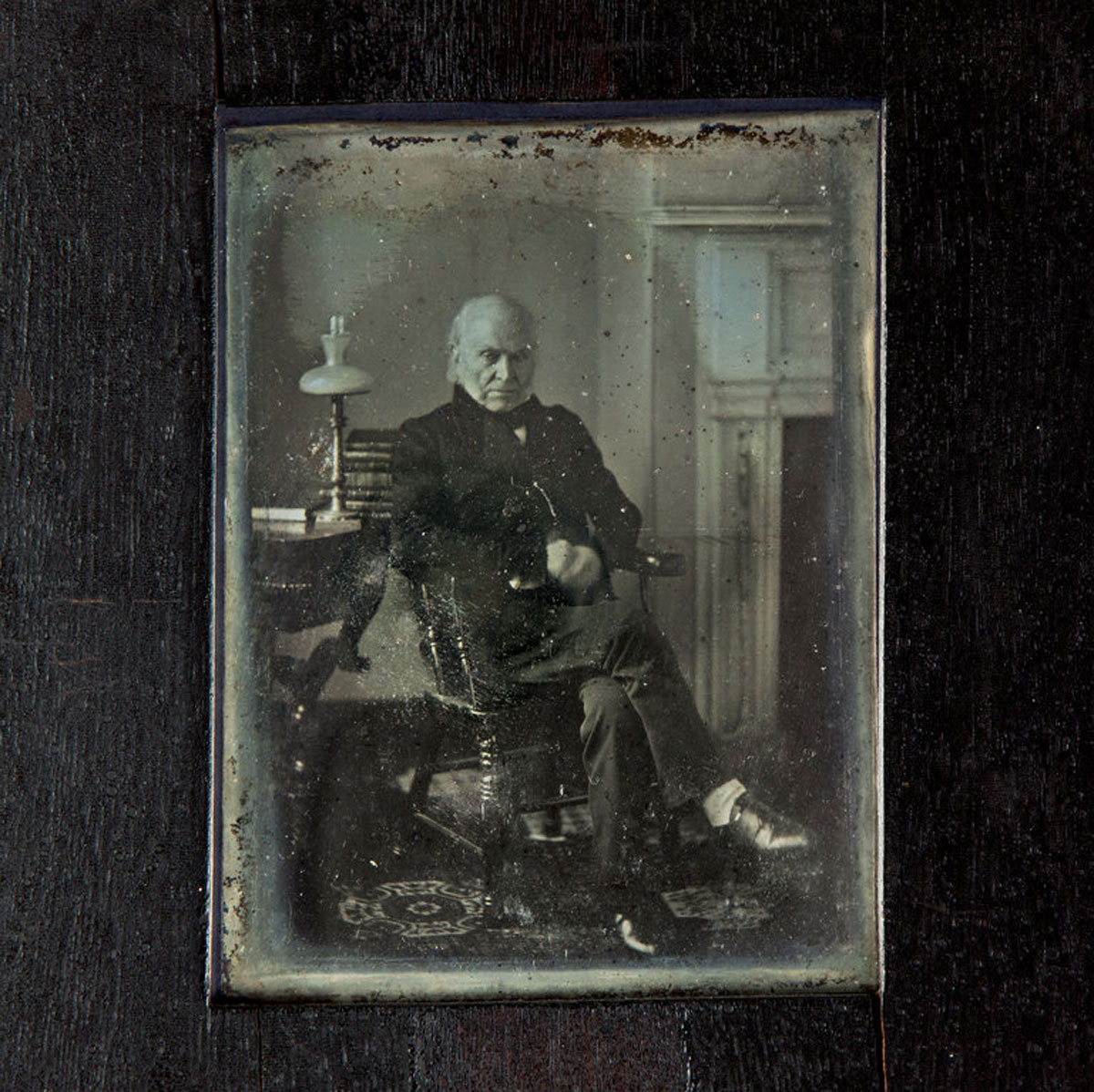
A March 1843 Daguerreotype portrait

John Quincy Adams, March 1843

Toronto. Where would we be without the thoughtful benefit of George Dunbar? Once again George found a photographically interesting item and sent me a quick note. Sotheby’s, the famous auction house, will auction off a daguerreotype of the 6th president of the United States, John Quincy Adams, taken in a Washington DC studio in March 1843, just short of five years before his death. The 76 year old senior politician sat for his portrait just four years after photography was invented.

Sotheby’s estimate the portrait is worth an eighth to a quarter of a million US dollars.

The link George included in his note is for the NY Times article covering the forthcoming auction. Before this portrait, one taken a few months later in August 1843 was considered the oldest known photograph of an American president.

Posted in auction, photos | Tagged , , , , | Comments Off on A March 1843 Daguerreotype portrait

Canada 1867 – 2017

Happy 150th Canada!

Toronto. The celebration of our 150th anniversary (on July 1, 2017) (come out this September 20th to our next presentation) was celebrated with a quintet of speakers, specially made cakes, a beaver poster, and two group photographs; one “traditional” style format by our journal editor Bob Lansdale, and one in stereo by Bob Wilson.

Both photographs were taken in digital format, the technology that has relegated film and darkroom chemicals to the dust bins of time.


Our quintet of speakers covered the past century and a half plus of photography as follows:

Yvette Bessels on modern wet-plate photography

Yvette Bessels on modern wet-plate photography. Yvette did a very professional slide show documenting her experiences and technique in the modern art of creating wet plates and albumen prints. I made a post about Yvette and Modern Wet-Plate Photography on June 27th. The post links to Yvette’s site and her instructions for anyone wishing to try the century old process. There is a growing niche of people who are embracing the old chemical based processes. Our fairs and auctions are a great source of such materials.


Jeff Ward on the Maritimes photographers

Jeff Ward on documenting Maritime photographers. Jeff flew up from Halifax to visit family and was delighted to review his progress in documenting the activities of Maritime photographers, principally members of the Rice family. PHSC members have helped Jeff in his research efforts using resources at hand including the databases indexed by Ancestry.ca

The Rice family consists of many documented photographers in our eastern provinces. Jeff gave fully illustrated slide show linking the various members of the family.


Baldwin Street Gallery

Laura Jones on Baldwin Street Gallery. Laura joined the PHSC when it first began and has spoken to the organization many times. Tonight she presented another facet of the Baldwin Street Gallery.

The gallery was the first photographic gallery in Canada. Laura noted that the neighbourhood surrounding Baldwin Street was like family. Many people, including our next speaker, dropped in at Baldwin when the gallery was a destination for Toronto area artists.


Vincenzo Pietropaolo – photographer and author

Vincenzo Pietropaolo on modern day publishing of photographic books. Vince has spoken to us a few times. Tonight’s talk was affected by technical issues prompting him to speak without slides. And he chose to speak at length on his latest book, Ritual, based on photographs spanning 46 years for which he used various b&w and colour negative films, Ektachrome and Kodachrome slides, and digital photography and the difficulties facing modern-day photographers wishing to publish books of their photographs. Vince explained the need to self-publish which means handling the funding, finding a publisher, and doing entire sales and marketing all on your own.


Nick Chomps on the downright scary art of Roof Top photography

Nick Chomps on Rooftop photography. In a nod to modern day photography, our last speaker was the young Torontonian Nick Chomps  speaking on the latest youth-oriented fad of shooting breath-catching photographs on the roof tops high above unaware passersby as they scurry about their business. Nick related how rooftop photography works with his primary photographic business of architecture photography. Nick noted that roof toppers prefer the high end digital full frame cameras (Canon, Nikon, Sony)  and ultra wide-angle lenses. Telephotos are reserved for the times when a tighter frame is more appropriate, while drones are used to give an overview of the shooting area. Nick said most security people were polite and helpful once they realized the photographer had no intention to damage the building or disrupt its inhabitants. (Note that various government officials decry the risky art of Roof Top photography.)

We finished this delightful evening with the two photographs taken of those audience members who remained available after the evening’s very interesting lectures.

Posted in Uncategorized | Comments Off on Canada 1867 – 2017

huge and SHARP

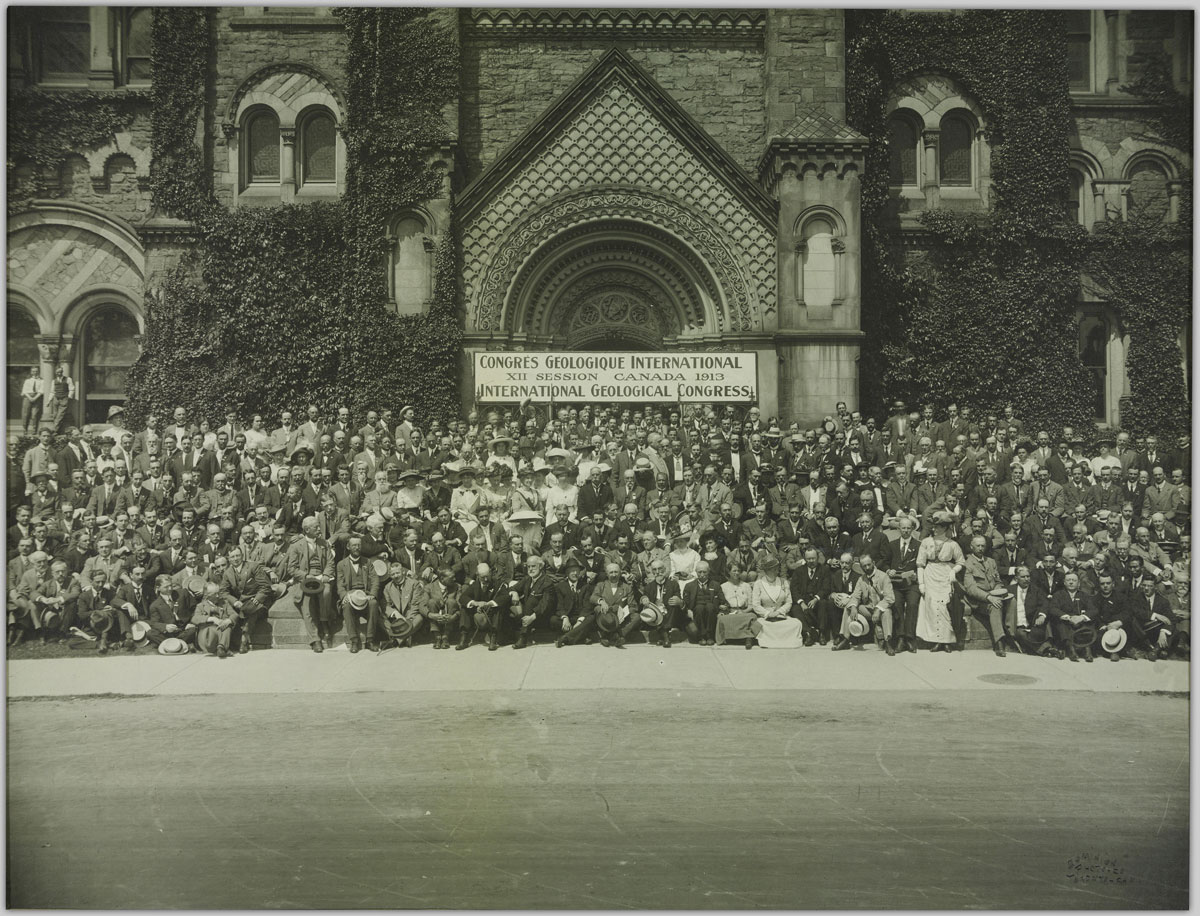
International Geological Congress at U of T Toronto in 1913

Toronto. My friend George Dunbar sent me an email recently with this massive image of a group photo taken here at the University of Toronto in 1913 of attendees to the International Geological Congress by the Dominion Photo Co., Toronto Can.

I wondered why  the conference was held in Toronto and why it was put online at the UBC Library Archives in Vancouver BC. This lead me to do a bit of research.

Firstly, the Dominion Photo Co is not a Toronto firm. According to Memory BC, a website associated with the Vancouver Public Library (VPL), “The Dominion Photo Company was a commercial photography firm established in Vancouver in 1914 by Percy Bentley. The company was involved in photojournalism, theatre slides, timber surveying photographs, police photography, postcards, amateur developing and printing, commercial/industrial work, and portraiture.

Interesting note, but just above it the site shows, “Dominion Photo Company (1871-1944)”. Continue reading

Posted in photos | Tagged , , , , | Comments Off on huge and SHARP