enjoy Photo News 26-4

Photo News 26-4

Toronto. A few weeks back, I had the pleasure of bumping into Norm Rosen at our fall fair. Norm is the editor of the magazine PHOTO NEWS. Then just last week, I enjoyed Norm’s latest opus at breakfast – the magazine was a free insert in my Globe newspaper for that morning.

The focus of the latest issue was Snow – a common Canadian commodity at this time of year. Previous issues are now online at the Photo News website. This issue should be up as well in a few weeks.

Check this and all issues for timely tips, and arresting articles and photographs by leading photographers. This is a rare magazine giving precedence to Canadians – even the ads, all of which I found interesting to me.

Posted in book | Tagged , , , , , , , , , | Comments Off on enjoy Photo News 26-4

Let George do it

Mr George Eastman
of Rochester NY

Toronto. The dry plate process as described by Dr Maddox quickly reached North America and served as the basis for George Eastman to quit his bank job and establish the Eastman Plate Company in 1881. He had experimented with dry plates even before the pivotal paper by Dr Maddox in the BJP. A few years later, he began making and improving the roll film on a flexible backing. The earliest versions were called stripping films since the developed emulsion had to be stripped off its backing and placed on glass to be contact printed since the film first used was optically impure.

In 1888, Eastman came up with the ubiquitous Kodak roll film camera and his famous slogan you press the button and we do the rest. Quick improvements in camera and roll film finally made photography a universal hobby. Finally, anyone could snap a decent photo. Almost all photography was black and white, but reasonably fast – and very easy!

Posted in Uncategorized | Comments Off on Let George do it

Getting closer to a universal hobby

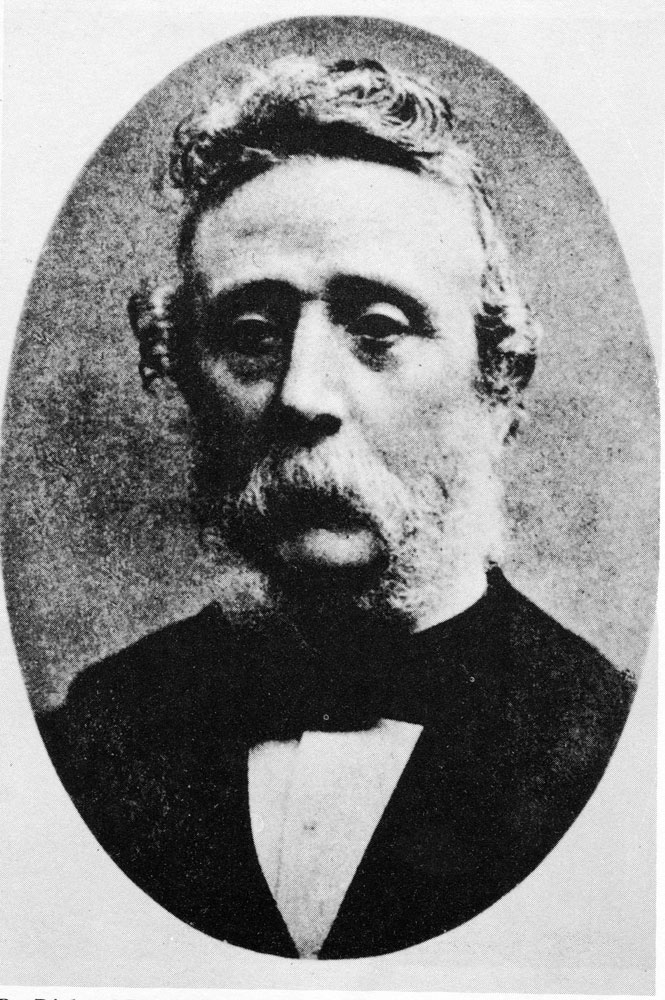
Dr Richard Maddox

Toronto. In 1871, photography crept another step closer to simplicity.  Using gelatin instead of collodion, Dr Maddox was able to create dry plates that were even faster than wet plate technology and for the first time instantaneous pictures (about1/15th of a second in bright sun) could be captured. In fact dry plates were consistent enough in speed to let amateurs buy plates, capture images, and take the plates home or to others for development, all at their leisure.

A tripod was still needed and now, since the capture of an image and its printing were separated by time, a means to calculate exposure, and a shutter mechanism too. The dry plate process Dr Maddox created quickly went world wide, setting the stage for the next big thing to come from North America.

Posted in processes | Tagged , , , , , | Comments Off on Getting closer to a universal hobby

Sloppy, but it works

Frederick Scott Archer, sculpter, artist, and photographer

Toronto. When Scott Archer announced his invention, most photographs were studio portraits by Daguerreotypists; while some people used Fox Talbot’s salted paper negatives and prints. Both processes were slow in camera and very technical requiring care and precision to obtain a reasonable result.

From the earliest days experimenters attempted to use glass plates and remove the low resolution caused by paper fibres. Sadly the emulsion adhering to glass was far too slow to use the plate in any camera of the 1840s.

In 1851 this changed with a new process perfected by Scott Archer, a Calotype photographer. He used collodion as a glue to adhere the silver nitrate to the glass plate, making the plate sensitive enough to use in a camera. One big problem: the plate had to be exposed and developed while still wet. If the plate were to dry, the sensitivity would plummet and render it useless to capture or retain an image. One had to have a darkroom adjacent to the scene to sensitize the plate, take the photograph, and develop the image before the plate dried. The era of wet plate photography and albumen prints began.  NOTE: Our program director, Ms Yvette Bessels, is a practising wet plate photographer! Continue reading

Posted in processes | Tagged , , , , , , , , | Comments Off on Sloppy, but it works

Mike Carmichael 1932 – 2017

Toronto. The Globe and Mail has a good article by Susan Ferrier MacKay yesterday on the late Mike Carmichael, a journalist who worked for the Globe, Telly and Sun newspapers in Toronto and the Canadian Magazine.

Mike is pictured at right with a press camera, courtesy of the Carmichael Family

Read Susan’s article to learn more about this Canadian journalist who covered stories in Europe, Canada, and the States.

Posted in people | Tagged , , , , | Comments Off on Mike Carmichael 1932 – 2017

A fox in the hen house

Toronto. Talbot was a well off Englishman who painted landscapes in watercolour. On a European trip in 1834, He chose Lake Como in Italy for one painting. Using a Camera Lucida, he dreamed about being able to capture the scene on his sketch pad, not just project it via the Camera Lucida.

Coming home to England he experimented with Wedgwood’s silver nitrate solution and paper and quickly realized a salt solution would make the images from  his tiny cameras (he called them his mouse traps) insensitive to light once again. Only the images were negative! Using the developed paper negative on top of a second sensitized paper in sunlight created a positive and a salt bath “fixed” its permanence.

When he first heard Daguerre’s announcement, he was dumbfounded. Unlike Niepce or Daguerre who experimented to find commercial solutions, Talbot served only himself. Shocked into action, he rushed to announce his system of photography by the end of January 1839. While grainy due to the use of a paper negative, the principal of a negative and a positive print became the standard. The Daguerreotype was a one-off positive whereas the salt negative of Talbot could have many positive Calotypes as he later called them.

What a month was January 1839 – not one but two viable processes. The world would never be the same!


Posted in photos, processes | Tagged , , , , | Comments Off on A fox in the hen house

A French man with a plan

Louis Jacques Daguerre

Toronto. Daguerre was a scenic painter and creator of dioramas. He wanted to find a way to capture scenes and have a record from which to paint the scene for a diorama much later. When he learned Niepce was also trying to capture scenes, he joined forces.

After Niepce died, Daguerre through many experiments settled on using sensitized silver plates. He finally realized the virtue of the latent image and a means to develop it. He discovered that mercury fumes would bring out the latent image and a salt bath would render the resulting image impervious to light.

He arranged for his process (the Daguerreotype), which took just minutes to record a subject in the camera, to be announced on January 7, 1839 by French scientist François Arago. And in return for a pension of 6,000 francs for him and a pension of 4,000 francs for his late partner’s nephew, Isidore Niepce, from France, he published his process for free use world wide – except England where its use required a licence.

NOTE: Over a century and a half later Daguerre’s mirror with a memory is still crisp, clear, and high resolution – drop in to our Image Show this Sunday and pick up one or a few!


Posted in processes | Tagged , , , , , | Comments Off on A French man with a plan

A Frenchman succeeds in fixing a sun drawing

Toronto. Niepce was a lithographer with a poor skill in drawing. To overcome this impediment, he tried various means to capture an image on a metal plate. He had initially tried paper and a silver-chloride solution a la Wedgwood, but he too could not keep the paper from going black.

His fresh egg was a solution of bitumen of Judea (asphalt) and solvent to make a varnish coating on a metal plate.The varnish was light sensitive. After a long exposure to sunlight hardened the varnish not shaded, a wash of petroleum and lavender oil removed the softer unexposed parts leaving a negative representation of the subject on the metal plate.

The first successful heliograph image was announced in 1822 and later commemorated in his home town of Saint-Loup-de-Varennes with a stone monument. The earliest photograph or heliograph created in a camera obscura was a scene of his back yard taken in 1826/7  from an upstairs window in his house. The plate is now in the Gernsheim collection at the University of Texas.

Sadly, his process was faint, contrasty, and extremely slow (hours in bright sunlight). He later collaborated with another Frenchman to make the process practical but died before success was achieved.

Posted in processes | Tagged , , , , | Comments Off on A Frenchman succeeds in fixing a sun drawing

A different kind of plate

Toronto. No technology ever arrives on the market already in its final form, including photography. The art of the picture is based on many earlier ideas that cumulated in the invention of photography; first as film and now as a digital image.

Tom’s father was a potter – you may be lucky enough to have some of the famous Wedgwood dinnerware today. Tom may have used his dad’s camera obscura in his experiments – we don’t know today. Building on earlier experiments, Tom used silver salts to sensitize paper, leather, etc.

Using the camera obscura, (or simply contact printing) he could capture a silhouette of leaves. He noted his experiments in 1802, just a few years before his death. A friend and famous chemist, sir Humphry Davy, expanded upon and presented his work in 1809 to the Royal Institution. Ironically, while Wedgwood found a way to sensitize material and capture an image, he  was unable to desensitize the unexposed portions – they slowly but surely faded to black eventually making the entire sensitized material black.

Posted in processes | Tagged , , , | Comments Off on A different kind of plate

A book to remember

The Birth of Photography (1800-1900) by Brian Coe 1976

Toronto. In A Night to Remember, author Walter Lord wrote a thrilling story about the sinking of the Titanic back in  April 1912. In 1976, the late Brian Coe then Curator of the Kodak Museum in England. wrote this book. It was just one of many books on the history of photography that he wrote.

I used my personal copy as a reference for a series of presentations I gave for the PHSC in the 1980s and 90s. Don Douglas was my partner in crime, using his collection of Ansco cameras to demonstrate the progress in cameras while I covered the evolution of photographic processes.  Coe’s book was ideal for me. He covered each milestone in photographic history, devoting a few pages to each event to describe its significance.

If you come across a copy of this inexpensive book today, buy it and read the exciting stories of the people and challenges facing our favourite pastime as it evolved from concept to the age of black and white roll film. A book to remember indeed!

Posted in book | Tagged , , , | Comments Off on A book to remember