and then there was the smartphone…

comparing light for
iPhone 7 Plus and iPhone X
telephoto lens

Toronto. When I first bought a Sony F-828 camera at the end of its production and marketing, I bought my wife a thin, pocket sized Sony point and shoot T7 with a 3:1 Zeiss zoom lens and a 3.3 megapixel sensor. The F-828 had an 8 megapixel sensor and a beautiful Zeiss zoom lens. The camera was massive and heavy. Both took jpeg files and used different batteries and chargers.

The recently announced Apple smartphones (caution: the linked   Macworld site has a ton of annoying ads) have a higher pixel rating, two lenses and stabilizing circuitry, plus automatic colour balance, exposure, aperture and speed settings. The camera in the iPhone X is 12 megapixel – twice the size of my decade-plus old F-828 and nearly 4x that in my wife’s T7, The two lenses are about equivalent to a 28mm and 56mm camera lens.

The clever aspect is this: The wide-angle has a larger aperture so if the light is dim and the telephoto is selected, the camera uses a cropped version of an image taken with the wide-angle lens instead!

And anyone who owns a smartphone usually has it with him, ready to snap a family or even a news-worthy photo. So the question is, with smartphones, “who needs a camera today”?

You can learn more on family photos by hearing our December speaker, Dr Jennifer Orpana of the ROM who will speak on Family Photo Archives!


Posted in camera | Tagged , , , , | Comments Off on and then there was the smartphone…

the era of digital cameras

Two simultaneous injections are easier on the tiny patient

Toronto. The trend from the beginning of photography in 1839 was improved simplicity and accuracy. Today, with the era of digital photography, the making of a photograph is simplicity beyond belief: Focus, exposure, light balance, speed, and aperture are set automatically on the fly.  Images appear on the camera back instantaneously. Shaky? Blurry? Poorly framed? Shoot again!

No need to print – send to friends by email or internet. Just store it on a computer and for the truly old fashioned, a few quick presses of computer keys (and a few seconds), then the computer’s inkjet printer shoots out a copy – even on a print-like 4×6 inch piece of glossy or matt paper if you so choose.

The above image was taken by me back in 2012 with a Sony digital camera. The subject was my baby granddaughter being immunized in her doctor’s office. A Kodak moment indeed!

To learn more, come and hear our December speaker, Dr Jennifer Orpana of the ROM who will speak on Family Photo Archives!

Posted in camera | Tagged , , , | Comments Off on the era of digital cameras

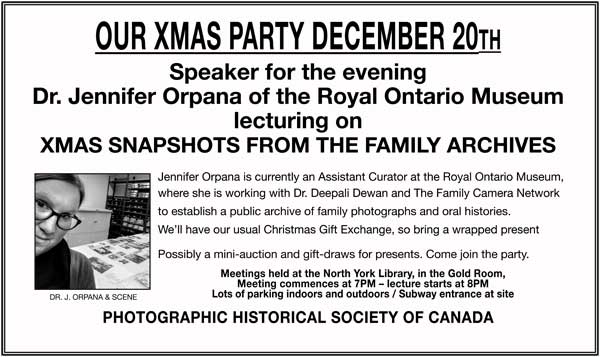
Dr Orpana of ROM on Family Photo Archives

Dr Jennifer Orpana of the ROM

Toronto. PHSC Meeting, Wednesday, Dec 20, 2017
Christmas Snapshots from the Family Archives
Dr Jennifer Orpana of the ROM

Come out and listen to Dr Orpana speak on the Christmas snapshots in the family archives held by the ROM. Bring along your own Christmas Snapshot to share with the group. And enjoy the annual gift exchange (my thanks to Bob Lansdale for producing the announcement posted below).

The public is always welcome. Go to our Programs page for directions.


Posted in program | Tagged , , , , | Comments Off on Dr Orpana of ROM on Family Photo Archives

snap-shots for the common man

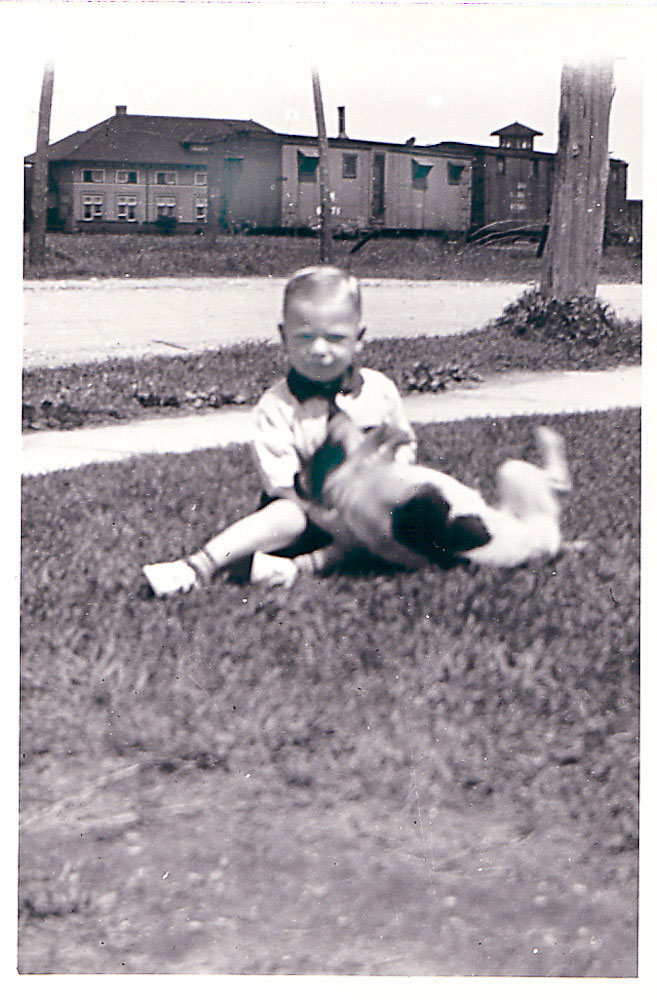
Me and my pooch
Allandale Station in background

Toronto. in the 1900s photography took off. Almost everyone could afford a Kodak and shoot family photographs. My dad took this snap c1940 with his trusty Kodak Jr Brownie Six-20 folder.

Like millions of families world-wide, my father photographed every day life so we would have a record years later. These family oriented snap-shots demanded the use of Kodak roll film and a Kodak camera – folder or box. While some alternative cameras and films existed, the vast majority of families used Kodak products. We are all familiar with that old bromide, A Kodak moment…   

See if you can find an old shoe-box of black and white prints showing special family events and relatives over a half century ago. And for more on the topic, join us in December when Dr Jennifer Orpana of the ROM will speak on Family Photo Archives!
Posted in processes | Tagged , , , | Comments Off on snap-shots for the common man

enjoy Photo News 26-4

Photo News 26-4

Toronto. A few weeks back, I had the pleasure of bumping into Norm Rosen at our fall fair. Norm is the editor of the magazine PHOTO NEWS. Then just last week, I enjoyed Norm’s latest opus at breakfast – the magazine was a free insert in my Globe newspaper for that morning.

The focus of the latest issue was Snow – a common Canadian commodity at this time of year. Previous issues are now online at the Photo News website. This issue should be up as well in a few weeks.

Check this and all issues for timely tips, and arresting articles and photographs by leading photographers. This is a rare magazine giving precedence to Canadians – even the ads, all of which I found interesting to me.

Posted in book | Tagged , , , , , , , , , | Comments Off on enjoy Photo News 26-4

Let George do it

Mr George Eastman
of Rochester NY

Toronto. The dry plate process as described by Dr Maddox quickly reached North America and served as the basis for George Eastman to quit his bank job and establish the Eastman Plate Company in 1881. He had experimented with dry plates even before the pivotal paper by Dr Maddox in the BJP. A few years later, he began making and improving the roll film on a flexible backing. The earliest versions were called stripping films since the developed emulsion had to be stripped off its backing and placed on glass to be contact printed since the film first used was optically impure.

In 1888, Eastman came up with the ubiquitous Kodak roll film camera and his famous slogan you press the button and we do the rest. Quick improvements in camera and roll film finally made photography a universal hobby. Finally, anyone could snap a decent photo. Almost all photography was black and white, but reasonably fast – and very easy!

Posted in Uncategorized | Comments Off on Let George do it

Getting closer to a universal hobby

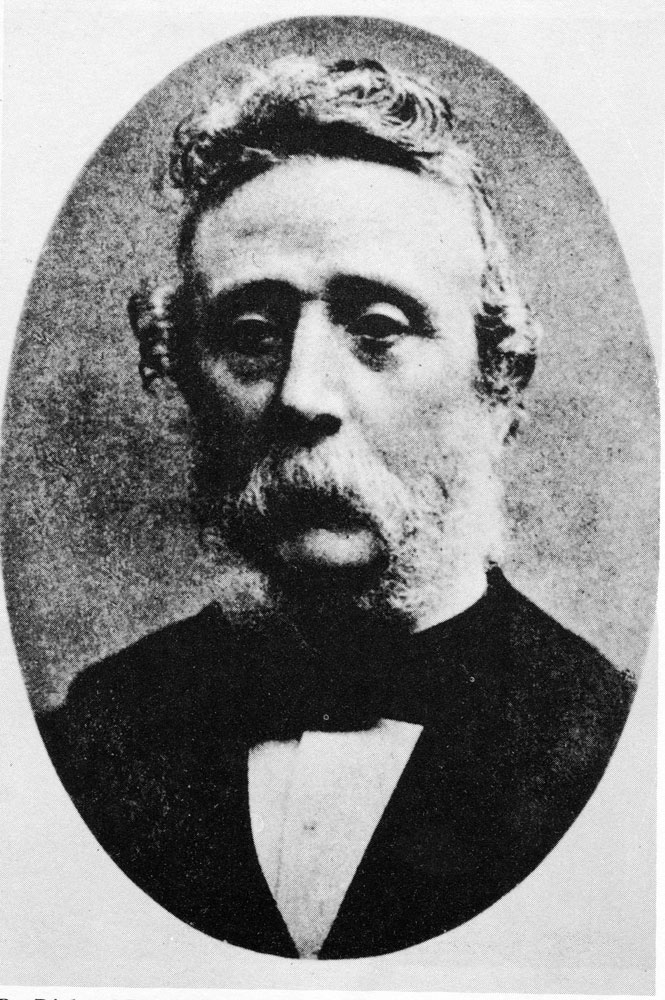
Dr Richard Maddox

Toronto. In 1871, photography crept another step closer to simplicity.  Using gelatin instead of collodion, Dr Maddox was able to create dry plates that were even faster than wet plate technology and for the first time instantaneous pictures (about1/15th of a second in bright sun) could be captured. In fact dry plates were consistent enough in speed to let amateurs buy plates, capture images, and take the plates home or to others for development, all at their leisure.

A tripod was still needed and now, since the capture of an image and its printing were separated by time, a means to calculate exposure, and a shutter mechanism too. The dry plate process Dr Maddox created quickly went world wide, setting the stage for the next big thing to come from North America.

Posted in processes | Tagged , , , , , | Comments Off on Getting closer to a universal hobby

Sloppy, but it works

Frederick Scott Archer, sculpter, artist, and photographer

Toronto. When Scott Archer announced his invention, most photographs were studio portraits by Daguerreotypists; while some people used Fox Talbot’s salted paper negatives and prints. Both processes were slow in camera and very technical requiring care and precision to obtain a reasonable result.

From the earliest days experimenters attempted to use glass plates and remove the low resolution caused by paper fibres. Sadly the emulsion adhering to glass was far too slow to use the plate in any camera of the 1840s.

In 1851 this changed with a new process perfected by Scott Archer, a Calotype photographer. He used collodion as a glue to adhere the silver nitrate to the glass plate, making the plate sensitive enough to use in a camera. One big problem: the plate had to be exposed and developed while still wet. If the plate were to dry, the sensitivity would plummet and render it useless to capture or retain an image. One had to have a darkroom adjacent to the scene to sensitize the plate, take the photograph, and develop the image before the plate dried. The era of wet plate photography and albumen prints began.  NOTE: Our program director, Ms Yvette Bessels, is a practising wet plate photographer! Continue reading

Posted in processes | Tagged , , , , , , , , | Comments Off on Sloppy, but it works

Mike Carmichael 1932 – 2017

Toronto. The Globe and Mail has a good article by Susan Ferrier MacKay yesterday on the late Mike Carmichael, a journalist who worked for the Globe, Telly and Sun newspapers in Toronto and the Canadian Magazine.

Mike is pictured at right with a press camera, courtesy of the Carmichael Family

Read Susan’s article to learn more about this Canadian journalist who covered stories in Europe, Canada, and the States.

Posted in people | Tagged , , , , | Comments Off on Mike Carmichael 1932 – 2017

A fox in the hen house

Toronto. Talbot was a well off Englishman who painted landscapes in watercolour. On a European trip in 1834, He chose Lake Como in Italy for one painting. Using a Camera Lucida, he dreamed about being able to capture the scene on his sketch pad, not just project it via the Camera Lucida.

Coming home to England he experimented with Wedgwood’s silver nitrate solution and paper and quickly realized a salt solution would make the images from  his tiny cameras (he called them his mouse traps) insensitive to light once again. Only the images were negative! Using the developed paper negative on top of a second sensitized paper in sunlight created a positive and a salt bath “fixed” its permanence.

When he first heard Daguerre’s announcement, he was dumbfounded. Unlike Niepce or Daguerre who experimented to find commercial solutions, Talbot served only himself. Shocked into action, he rushed to announce his system of photography by the end of January 1839. While grainy due to the use of a paper negative, the principal of a negative and a positive print became the standard. The Daguerreotype was a one-off positive whereas the salt negative of Talbot could have many positive Calotypes as he later called them.

What a month was January 1839 – not one but two viable processes. The world would never be the same!


Posted in photos, processes | Tagged , , , , | Comments Off on A fox in the hen house