a tip of the hat to professionals

A 1950s photographer with an old pre-war studio camera.

Toronto. LIFE magazine back on May 21, 1951 published an advertisement by Ansco on page 95 encouraging families to get a professional portrait taken – using Ansco products, of course.

For reasons best known by the Ansco advertising agency, the professional photographer was shown with a massive wooden studio camera. The camera and lens were very pre-war or even earlier while the professional appeared like a 1950s businessman.

Perhaps the company missed learning about the mid 1930’s minicam revolution, or the 4×5 cameras used by other professionals like news photographers, or colour, or flash, or any of the other revolutions in photography that took place since the early 1930s.

Posted in processes | Tagged , , , , , , | Comments Off on a tip of the hat to professionals

a beacon in the night …

Beacon Flash Camera Ad
LIFE May 14, 1951

Toronto. Happy Canada Day, everyone!

As I mentioned in an earlier post, the 1950s saw a burst of inspiration in selling flash guns to the general public as a means to counter the rather anemic speed of the films of the day (an ASA/ISO rating of 200 was REALLY fast)!

The Whitehouse Products factory in NYC made a line of box cameras that was quickly modified to have the by then ubiquitous flash gun added directly to the camera. Like all box cameras, they were touted as easy to use, not of limited focus, slow shutter speed, and high aperture.

We saw many of the various Beacon models at our various fairs and auctions. Thanks to my good friend George Dunbar for spotting this typical ad in the May 14, 1951 LIFE magazine. Here is a video on the Beacon II without the flashgun.

Posted in camera | Tagged , , , , , | Comments Off on a beacon in the night …

Ektachrome Redux

Anscochrome c1958
building a Heathkit Apache
Transmitter in Labrador

Toronto. John Linsky sent me an email the other day announcing the rebirth of Ektachrome by Kodak. I replied in part, that Ektachrome is based on Agfa’s processes. Much larger colour-coupler molecules are used so they don’t drift from layer to layer making processing far simpler. The down side is a limit to accurate colour rendering and stability compared to Kodachrome (ASA 10) which used smaller molecules giving a wider choice of dyes and better colour accuracy and life.

I mentioned to John that I had processed the Anscochrome version of the film many years ago in Labrador (like the sample shot shown of me building a Heathkit Apache Ham Transmitter in Labrador in the late 1950s) using the film and processing kit supplied by Ansco plus the heat sealed cardboard slide mounts provided by Kodak. (John called later to say he too developed Anscochrome slides at home.)

Ansco was one of the first companies to offer bulk loads of their slide film (ASA 32:  modern camera sensors only go down to ASA/ISO 64 or 100) and do it yourself home reversal processing kits. The total process took me about an hour per roll once the chemistry was mixed for all the various baths. There was a first development in a b&w developer, stop, fix and wash before the colour reversal steps.

Exposure to light once the film was developed turned all the remaining silver halides to metallic silver allowing all subsequent processing to be done in daylight. The colour processing developed all colour layers at once (vs. Kodachrome which used a colour development process for each layer with narrow tolerances for the time/temperature of each step of each layer process).

A fixer bath removed the remaining silver and a final wash gave a beautiful film strip of slides with all right-way around colours (positive).

I sent many strips home for my mother to cut and iron into cardboard mounts like above. Other strips I cut myself and slipped each positive into a special cardboard mount fatter than the Kodak heat sealed mounts but faster allowing projection as soon as the frames dried and were slipped into the mounts.

Posted in processes | Tagged , , , , | Comments Off on Ektachrome Redux

first photograph taken in what became Canada after confederation July 1, 1867

Niagara Falls in 1840
Daguerreotype by H L Pattinson

Toronto. In 1840, an English businessman  called Hugh Lee Pattinson in a trip around the known parts of North America, used the the new daguerreotype technology to record spectacular areas of the world.  In British North America, he recorded the world famous falls at Niagara. The originals were thought to have been lost to history when they suddenly emerged in holdings at Newcastle University in northern England. The event was noted back in 2013/4 by the Huffington Post (Canada).

George Eastman House in Rochester offered to clean, copy and return the originals to Newcastle. Our May speaker, Dr Anthony Bannon raised the topic in his presentation on The Taking of Niagara, his tongue in cheek name for early drawings and photographs of the awesome and noisy falls.

Posted in photos | Tagged , , , , | Comments Off on first photograph taken in what became Canada after confederation July 1, 1867

all the news that’s FAKE to print …

Real or Fake? Communist Browder
and Democrat Tydings

Toronto. It is often thought that manipulation of photographs only happened after Photoshop and its ilk arrived on the scene. However, decades before Photoshop, a savvy darkroom expert could seamlessly blend or otherwise manipulate two or more negatives or prints to appear as a single print.

Those of you who follow American political history will recognize the names Butler (R) and Tydings (D) who fought in the fall 1950 elections to be Senator of Maryland. Butler, the Republican won, in part due to this fake photo implying that Tydings is getting advice from the communist leader, Earl Browder. The doctored photo was circulated in a newspaper funded by the Republican winner, Mr Butler, just before the fall election.

The USA was founded by conservative religious folk called Pilgrims, banished from England. In the states, Republicans are like Conservatives here, devoted to right wing beliefs while Democrats are like Liberals here, big government and more left wing ideas. American communists were far, far left in their beliefs. Lately, the Republicans have been taken over by the Tea Party folk: those with far right wing conservative ideals as espoused by the current President.

Research by LIFE magazine turned up the Tydings part of the photo as a 1938 print of him listening to a radio broadcast (of election returns) while the Browder shot was a reversed image of the gentleman answering questions at a US Senate investigation …  Who says cameras never lie?


Posted in miscellaneous | Tagged , , , , , | Comments Off on all the news that’s FAKE to print …

more information on the recovered daguerreotype images

Daguerreotype image
by x-ray – Science Daily

Toronto. Two days ago I posted a note on using x-rays to bring out daguerreotype images long thought lost in damage and tarnish. The earlier article was printed in the Globe and called to my attention by John Linsky. This time Russ Forfar sent an email about an article on the same process in the Science Daily.

The Science Daily article dated June 22nd gives different details on the process and covers the work of scientists at the University of Western Ontario. over in London, Ontario, about a two hour drive from here.

Posted in processes | Tagged , , , , | Comments Off on more information on the recovered daguerreotype images

a flash in the pan

LiFE Feb 19, 1951

Toronto. For Christmas 1951 I received the gift of a Brownie Hawk-eye kit with a camera (box), a roll of 620  film, flash  bulbs, flash-gun, dry cells for the gun and a plastic protector to hang over the flash-gun in case a bulb exploded. There was a wave of amateur cameras with synchronization for flash bulbs in the late 1940s and 1950s and lots flash-guns to choose from like this Heiland model.

The built-in flash mentioned in the ad is the synchronization to shoot a flash bulb at the right time as the shutter opened. This was before the days of built-in flash that we see today, even in smart phones. The flash bulb was the obvious solution to indoor photos with the abysmally slow media of the day. Flash bulb popularity lasted about two decades before cheap electronic flash-guns were offered and  later built in flash (first bulbs, then electronic) Most modern day digital cameras and smart phones have built-in electronic flash and many high end cameras can take external electronic flash too.

Thanks to George Dunbar for mentioning this wonderful LIFE magazine ad for a Heiland flash-gun accessory (LIFE February 19,  1951 issue).


Posted in camera | Tagged , , , , | Comments Off on a flash in the pan

x-rays reveal an image hidden by damage

Daguerreotype image
by x-ray – Globe & Mail

Toronto. I had a call from John Linsky Friday morning as I was making breakfast. John had read an article in the Globe that morning regarding the discovery of images on a daguerreotype thought to be long lost.

The scientists in Saskatchewan used x-rays to excite the mercury atoms (daguerreotypes are developed with mercury fumes as you likely know).

Past PHSC president Dr Mike Robinson of Toronto is a modern day daguerreotypist. If you enter the word daguerreotype in the search bar at the upper right, on our web site, you will see our many posts on the topic.

The strategy would help if daguerreotypes are found in the wrecks of the Franklin expedition and have been damaged by sea water. You can read the Globe article here.

Posted in processes | Tagged , , , , | Comments Off on x-rays reveal an image hidden by damage

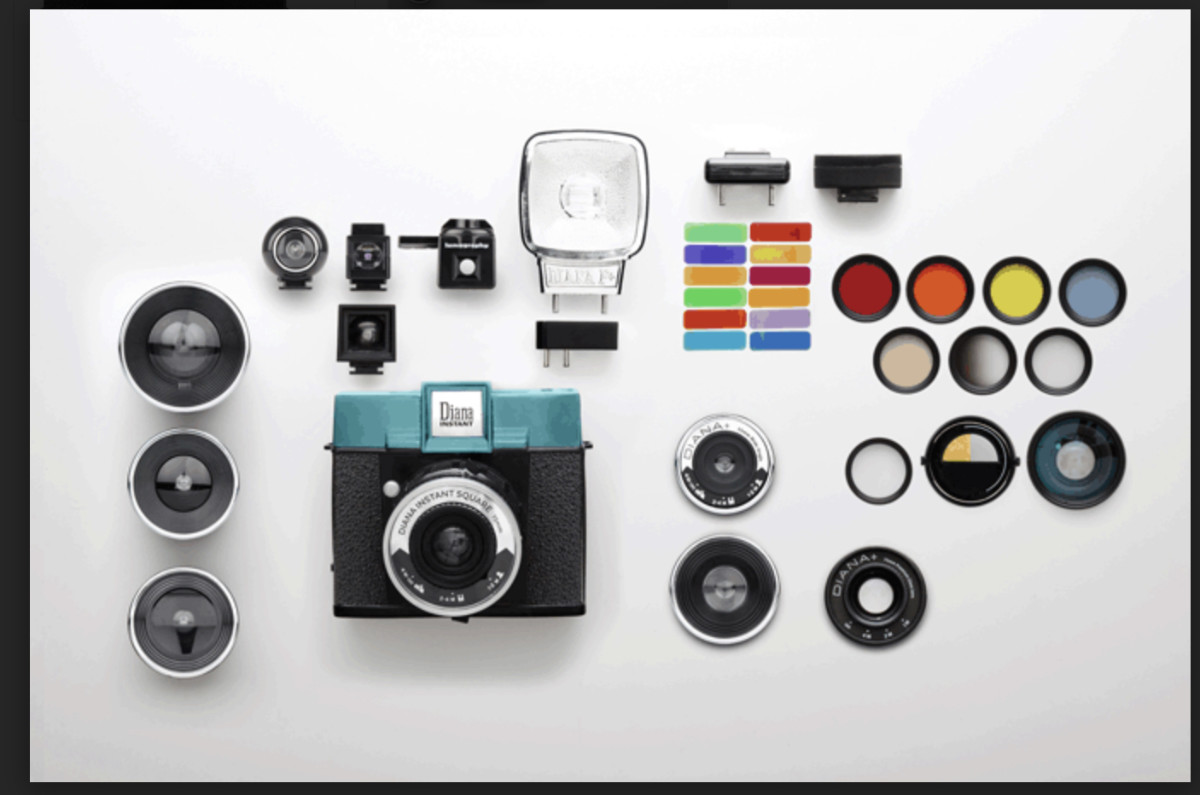
The Diana Instant Square

Diana Instant Square
Click for accessories

Toronto. Those of you who have frequented our fairs have seen many versions of the 1960s Diana camera over the years. It was a cheap little film camera taking 120 film. The folks at Lomography USA have embraced the little camera and released it June 20th via Kick Starter as a modern instant film camera taking the readily available Fujifilm  Instax square “Polaroid” style film and print combined.

Read this press release to learn about the many attachments and special look imparted by this camera on your photos. The accessories are the same ones made for the Diana F+ Roll film camera.

Posted in camera | Tagged , , , , , | Comments Off on The Diana Instant Square

a free lesson in optics

Leitz New York booklet
7427a dated July 1936

Toronto. In July, 1936 Ernst Leitz in Wetzlar published a free booklet called Lens Tables for use with the Leica Camera. The version I have was produced for and made available from the New York distributor for Leitz products.  It explains the optical theory behind depth of focus and its relation to focal length. It also instructed the reader on the concept of hyperfocal distance.

I often used the hyperfocal distance on my Leica M4 lenses to get a maximum range of in focus distance without need to fiddle with settings before shooting.

The little booklet used many tables to simplify the task. Knowing the lens focal length and f/stop, the correct table immediately indicated the sharpest near distance and far distance in feet. The booklet was especially important when using the supplementary lenses alone on the camera or in conjunction with the 1935 BEEOY spider legs accessory which set the closeup framing.


Posted in book | Tagged , , , , , , | Comments Off on a free lesson in optics