the end of summer …

Octopus ride on the CNE Midway in the summer of 1979

Toronto. When I was a kid mid last century, the start of the last two weeks of August signalled the end of summer and start of CNE time, an annual event that ended each September on Labour Day with an air show.

As a youngster, my wife and her parents went on soldier’s day to see her grandfather march in the parade.

When I was a tiny child, my mother and aunt took me to the CNE Midway. One ride stuck in my mind – the Caterpillar. A cover came over us once the ride started leaving us to soar slightly up and down in darkness as we spun around. Years later, I saw a photograph in a Focal Press text and recognized the unique seats and cover of the Caterpillar ride I once rode at the CNE Midway.

The PHSC has a connection to the CNE too. For a brief period in the 1970s, the society had a booth in the Arts and Crafts building (now the Medieval Times Restaurant). It was always a challenge to fill the schedule with members. Near the end of the CNE participation, Allan Barnes set up a free standing display that worked with no member in attendance. Our participation ended when the building went commercial and you paid a stiff fee for booth space to SELL goods (around the same time the news papers stopped reporting CNE daily attendance).

The excitement of the CNE came rushing back when journal co-editor Louise Freyburger sent me a link to a news video on CNE photographer Scooter Korek who has photographed the annual event for nearly 50 years now (be sure you turn up the video’s sound).

The photo at left is one I took about 46 years ago on the CNE Midway when there was barely enough light to properly focus and expose a colour negative. Enjoy the news clip on the work of Scooter.

Our 2025 events have many interesting items to add to your collection. Our next event is the famous fall fair on October 19th at the Trident Hall in the west end. See  PHSC News 25-7 for details. The poster etc. goes up here in later September/early October. Meantime, enjoy the PHSC News and the CTV news clip!

Posted in activities-other | Tagged , , , | Comments Off on the end of summer …

when night falls …

winter’s night in early 2014

Toronto. For many decades after the invention of photography, it was a daylight – bright daylight – pursuit unless one resorted to bright artificial lighting – flash powder, flood lights, flash bulbs, electronic flash, etc.

Sensitive media of the day was painfully slow. Initially even street scenes demanded a tripod while studio subjects also needed a means of subject support – hidden (sort of) or obvious.

When film began to die out and digital took over, the sensors slowly increased in both sensitivity and resolution. In this example, a winter scene was taken in early February, 2014 around 11 pm as graders fought a snow storm softly trying to fill the streets.

Early night scenes on film demanded the use of a tripod or other means to steady the camera. Long exposure times meant only stationary objects were recorded (or streams of head/tail lights) moving people and vehicles were not recorded. Night shots were usually street scenes or sky scenes (moon, stars) when  glass-plates and film were king.

Our 2025 events offered many photographs, not necessarily night scenes. Come out to our 2025 events and augment your collection! The next event is our fabulous fall fair on October 19th at the Trident Hall (Evans/Islington) in the west end of the city. Details appear in the issue 25-7 of PHSC News. The details will be posted here closer to the event.

Posted in history | Tagged , , , | Comments Off on when night falls …

Autochrome and fashion.

Autochrome c1908-10 – see Cally Blackman’s video

Toronto. From the beginnings of photography until the early 1900s, photographic processes were all monochrome – unless the image was hand coloured!

Around the turn of the 20th century, a variety of additive colour processes were invented, the best of the bunch appears to have been Autochrome. First marketed around 1907, it continued to be a glass-plate-only product until 1930 when it moved to film, only to disappear a few years later when it was replaced  in the market by newer (and faster) subtractive processes such as Kodachrome.

During its reign, Autochrome portraits displayed the latest in fashionably attractive clothes. Recently Cynthia Motzenbecker sent me  a Youtube link to a short British video by Cally Blackman, part of the Royal Photographic Society (RPS) materials. The Blackman video covers Autochrome and fashion from 1907-1930.

The image at upper left, “C1908-10 La broche de pâquerettes:© Collection AN, Paris”, is from Cally’s video. Please note that Autochromes are naturally soft and low contrast. This image was slightly electronically sharpened and increased in contrast.

While you may find an Autochrome at one of our 2025 events, we can’t say for sure, BUT we can say you will find an item to complement your collection! Our next event is the famous fall fair initiated by the late Larry Boccioletti. It will be held October 19th at Trident Hall. PHSC News 25-7 carries the poster and details. Don’t miss it!

Posted in history | Tagged , , | Comments Off on Autochrome and fashion.

Mr Goss, You make great pictures …

Building the Bloor St Viaduct – looking west in 1917

Toronto. …. with  a nod to Christie’s tag line for the idea.

If you have ever crossed the Don Valley on Bloor or Danforth, you used the Bloor Viaduct shown here at left (July 18, 1917) while it was under construction. Forward thinking city officials added a passageway below the road level for future use as a subway (in use today). The photograph in 1917 was taken by city employee Arthur Goss on that sunny summer’s day.

Arthur Goss was the first city photographer, hired well over a century ago to record the works of  various city departments. Surprisingly, Mr Goss was not just a recorder, but a true photographer. He was City Photographer from 1911 to 1940 (when he died). His works are held in the City Archives (once the Records & Archives Division of the City Clerk’s Department at City Hall).

In early 1980, the City of Toronto Archives exhibited an overview of his work in the Market Gallery. The event included an illustrated brochure with a foreword by his friend, artist A J Casson of the ‘Group of Seven’.  The two met at the Arts and Letters club (downtown on Elm street these days).

Those readers who collect photo memorabilia should visit our 2025 events. While we can’t say you will find a Goss photo (many are available at the city archives …), you are sure to find items that complement your collection. Our coming event is the fabulous fall fair to be held October 19th this year. For full details, see PHSC News 25-7 or this web site (closer to the event).

Posted in history | Tagged , , , | Comments Off on Mr Goss, You make great pictures …

once upon a time in Toronto …

photographer Butchart and wife – photos courtesy the Jessie Stenberg collection

Toronto. In our journal, editor Bob Lansdale worked hard to present Canadian photographic history, often drowned out by the cacophony from across the border. While older Canadians learnt British history; younger ones through products, movies, magazines, TV, etc. learned about how great things American were.

Any Canadian business, once it grew to the point of being a potential threat, suddenly moved south to where vast markets and demand held forth.

In the times when we were a British colony; a British linked dominion, the influx of many people and ideas were from the UK. As an example, photographer David Coutts Butchart emigrated from Scotland to become an early Toronto photographer (first noted in 1859, before the Dominion was established). In issue 25-2 (over 60 pages) Walter J. Balfour ©1999 wrote an article titled, “DAVID COUTTS BUTCHART: An Early Toronto Photographer” about his great grandfather.

Walter begins, “In 1985, while visiting my mother in Scotland, our conversation turned to a discussion of my activities at the University of Victoria. I told her that part of my research involved photography which prompted her to remark that I might have come by that naturally since her maternal grandfather had been a photographer by profession. His name was David Coutts Butchart, with a studio in Toronto.

“I thought little more of this conversation until some years later while visiting the National Archives building in Ottawa I chanced to notice a drawer labeled Canadian Photographers.

“On checking its contents I discovered, much to my surprise, a file on my great-grandfather with references to some of his work preserved in the National Archives collection. This prompted me to talk to a staff member who then introduced me to a photo-archivist in Photography Acquisition and Research, Mr. Andrew Rodger.

“He knew of Butchart’s work but said he had no biographical information and would like to have some. I thus decided to see what I could discover… this sketch [see pdf file or journal] is the result.

“David Butchart was born in the Scottish parish of Barry in what was at the time Forfarshire, now Angus, on the last day of the year 1831. He emigrated with his parents to Canada in his twenties and became one of Toronto’s early portrait photographers.

“The Statistical Account of Scotland of 1791 describes Barry as principally a farming and weaving community of some twelve square-miles area, hosting a population of 796. The region remains agricultural today. David’s father, Alexander Butchart, was a farm laborer. We learn from the parish record that Alexander had married on 29 March 1829 a girl from the adjoining parish, Margaret Todd.

“David was their second child and eldest son in a family of eight children. There have been Butcharts recorded in the district from the middle of the 15th century. The surname is probably an anglicized form of the French Bouchard, brought across the English Channel by the Normans. Earlier spellings of the surname range through Bowchart, Bowchard, Bouchard, Bouchart and Buschart.” …

The entire article and its many illustrations were viewed by members in the issue 25-2 pdf file on the free members-only DVD/thumb drive. Joining the PHSC is easy and inexpensive – follow “Membership” above or at right. And email any membership questions to Lilianne at member@phsc.ca.

And while we can’t promise that you will spot a Butchart photo at one of our events, you will see lots of items that complement your collection. Our fall fair on October 19th is coming up fast. See the PHSC News 25-7 for details.

NB, The title idea came from Quentin Taratino’s 2019 movie, “Once Upon a Time in Hollywood“.

Posted in history | Tagged , , | Comments Off on once upon a time in Toronto …

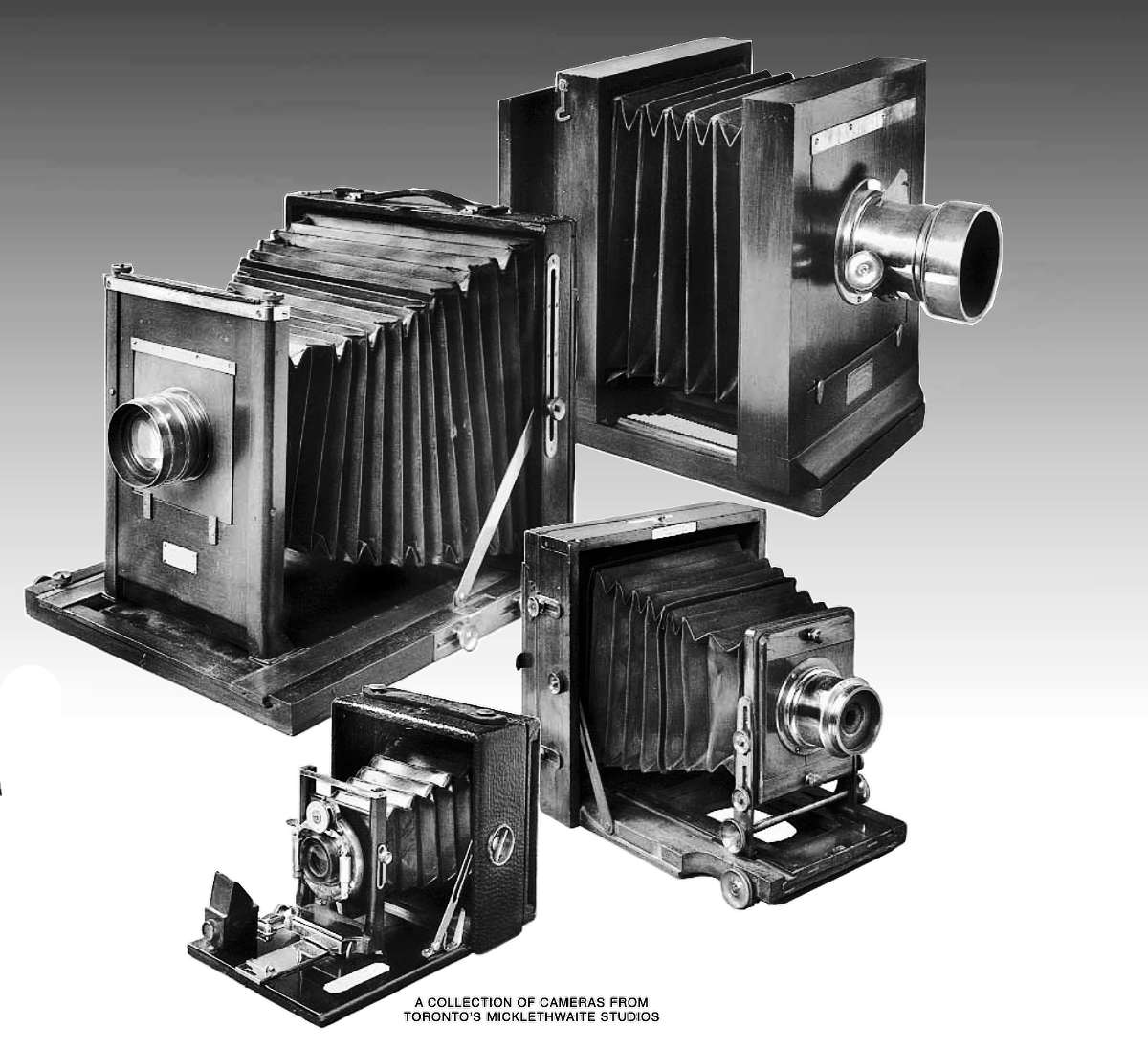
so what is a camera …really?

c1544 drawing of a camera obscura showing an eclipse

Toronto. At left is a c1544 drawing of a camera obscura showing a solar eclipse. In the image, the  left wall has a pin-hole to let in the light. The right wall acts as a screen to allow the image of the sun to be  projected and viewed. The construction between the two is a light tight box (one wall is removed in the drawing to show how it works). The image shown is courtesy of the Gernsheims’ book “The History of Photography“, long out of print (mine is the 1969 Thames and Hudson edition).

The most basic description of a camera is essentially the same: a light-tight box with the sensitive media at one end (instead of the wall) and a lens (instead of a pin-hole) and shutter mechanism at the other with the distance between them suitable to sharply focus a subject (about 10 feet away from the box) on the sensitive media.

In the days when media were crushingly slow, a hat, hand, lens cap, etc over the lens served as a shutter. Exposing the lens for a few seconds (or longer) allowed enough light to hit the sensitive media to record a latent image suitable for development.

Improvements at the media end of the light-tight box permitted rapid exchange of plates and later film without further unintended exposure to light.

Improvements at the lens end of the box were often more complex including a means to focus on a subject closer than 10 feet, a reduced ‘aperture’ to increase the amount of the foreground and background in focus (faster lenses used Waterhouse stops or variable aperture leaves to reduce or ‘stop down’ a lens and improve the depth of focus).  Different combinations of elements were used to flatten the image projected on the media and correct various imperfections. Some worked; some didn’t.

While today many cameras use variable focal length (zoom) lenses to vary focal length (and angle of view) others use interchangeable prime lenses or at least their front elements. Many zooms are also interchangeable to expand the focal length covered, or allow the use of prime lenses with special attributes.

Traditionally, lens elements were spherical (convex or concave) or plane and made of glasses with differing densities. Post WW2 special element coatings became common reducing inter-element reflections and improving contrast. A few decades later we began to see aspheric elements too. The goal was always to improve resolution, expand coverage, flatten the plane of focus and reduce or eliminate distortion – geometric, astigmatic, colour etc.

Digital technology brought with it a whole new science of photography. Quickly sensors had ISO ratings that began where the fastest film left off. Sophisticated computer chips reduced noise, sharpen images, changed saturation, auto focussed the camera, etc. Once shot, results could be displayed almost instantly. Thousands of shots could be taken on a sensor. No need to buy more film!

And lenses changed too. The smaller the size of the media (sensor), the shorter the focal length of the lens for the same angle of view. With smart phones, the sensor is so tiny a focal length of 2 or 3 mm has the same angle of view as a 35mm camera with a 35mm lens. With the strides in technology, some modern digital cameras can be bought with sensors of over 60mp allowing the use of electronic ‘zoom’ to create an image as if a zoom or longer focal length lens was used – just crop the 60mp size down!

So what is a camera … really! Visit our 2025 events to add to your collection – Next in line is our fall fair on October 19th. Details are in issue 25-7 of our PHSC News.

Posted in history | Tagged , , , , | Comments Off on so what is a camera …really?

a quest for collectibles

Sample images included in the MLAntiques fall auction lots

Toronto. Periodically I receive an email from USA based Michael Lehr Antiques (MLAntiques). The latest email announces their old photography images auction on September 6th. Details and offered lots are on their web site (see link here).

A great opportunity for photo collectors to check if  any offerings would complement their collection.

For 2025 we have at least two more events in October and November. Next we have our famous fall fair on October 19th, over a month after the MLAuction event. Drop by and see what can be added to your collection. Details will be posted here. Meantime, they appear in our PHSC News issue 25-7.

Posted in activities-other | Tagged , , | Comments Off on a quest for collectibles

wagon ho!

Mathew Brady, Civil War photographer, upon his return from the First Battle of Bull Run, wearing a saber given to him for defense by New York Fire Zouaves.

Toronto. Many old photo collectors have a ‘war’ category. One well known NYC photographer anticipated a demand  and decided he would photograph the American civil war. Sadly, interest in these war photos died with the end of the American civil war and the photographer died in poverty.

At the time of the war, the prevailing photographic process was the wet plate. It demanded the glass plates be sensitized, exposed, and developed before the emulsion dried. Worse, the process was too slow for action photos, only still shots would be sharp.

The photographer’s solution? Put all the darkroom gear, etc. in a wagon that could be pulled to each battle and the results recorded.

Well you may not spot one of Brady’s photographs at our 2025 events, you will have fun and perhaps spot items for your collection. Our next 2025 event will be the famous fall fair on October 19th. See PHSC News 25-7 for details.

NB. The title is a riff on the movie, “Westward Ho the Wagons!” produced in 1956 by Walt Disney.

Posted in history | Tagged , , | Comments Off on wagon ho!

remembering john vanderpant

John Vanderpant – courtesy the Vanderpant collection, Vancouver BC

Toronto. In issue 25-2, editor Bob Lansdale published Sheryl Salloum’s copyright 1999 article on the famous Vancouver based John Vanderpant titled, “John Vanderpant’s Vibrating “Voice” and Vision”.

Ms Salloum’s article begins with this prècis. “From 1919 to 1939, the Dutch-Canadian photographer John Vanderpant was a “voice… crying in the wilderness” of Canadian art.

“Isolated geographically from the larger metropolitan areas of Canada, he believed that western artists were too often forgotten, ignored, or misunderstood by both the local populace and the rest of the country. He urged BC’s artists to have ‘strong voices [and to] cry and cry and cry again.’

For this Dutch émigré, the desire to contribute to Canadian art by interpreting and recording the country’s beauty and spirit was paramount. A spiritual man, he also wanted to portray the cosmic energy that he believed united all things. An energetic and highly motivated individual with interests in mysticism, poetry, music, and art, Vanderpant became a significant influence on Canadian photography during the 1920s and 1930s.

“Through his ‘strong voice’ he also became a catalyst to Vancouver’s arts community; the painter Jock Macdonald called Vanderpant ‘the only “living” being’ in Vancouver.”

Her entire article, illustrated with Vanderpant’s photographs, can be viewed in the issue 25-2 pdf file on the free members-only DVD/memory stick. To join, follow the Membership instructions above (cheques), or at right (credit cards or PayPal). Any membership questions may be sent to Lilianne at member@phsc.ca.

You may spot a Vanderpant photo or other item of interest at one of our 2025 events. The next event is our famous fall fair this October 19th. See PHSC News 25-7 for fair details. As we get closer to the date, the poster and details will be pinned this website.

Posted in history | Tagged , , , | Comments Off on remembering john vanderpant

of mouse traps and man

Talbot – Daguerreotype by Claudet c1844

Toronto. Have you ever thought about how photography came about? In early January of 1839, Daguerre felt he had perfected his process enough to have it noted in the French newspapers of the day. Some more modern articles consider the process the ‘Polaroid’ of its time – a one-off monochrome image while you wait.

Most of the world were thrilled at the news. One Englishman was definitely not. William Henry Fox Talbot felt he had invented the photographic process (i.e. scenes captured by the sun and processed for permanence). He used his process personally but saw no reason to rush it to public announcement.

After Talbot saw Daguerre’s news, he presented his process, sample prints, negatives, etc.  to the Royal Institute and shortly thereafter to the Royal Society. With hindsight we see that Daguerre recognized the concept of the latent image while Talbot developed  the concept of the negative/positive process.

Both processes used silver halides  but differed – the end result was the same: an image captured by the effect of a sunlit scene on sensitive material. Daguerre offered a higher resolution one-off positive while Talbot offered a lower resolution negative that was contact printed to create as many positives as desired. The fibres of his paper causing the lower resolution.

To conduct his experiments, he chose to use small boxes  with a cork up front to check progress of the exposure. His wife dubbed these small devices “mouse traps“.  Her home was cluttered with these boxes as Talbot pursued his experiments (exposures being very long at the time).

NB. The post title is a riff on the book “Of Mice and Men” by John Steinbeck, a favourite author of mine years ago.

Posted in history | Tagged , , | Comments Off on of mouse traps and man