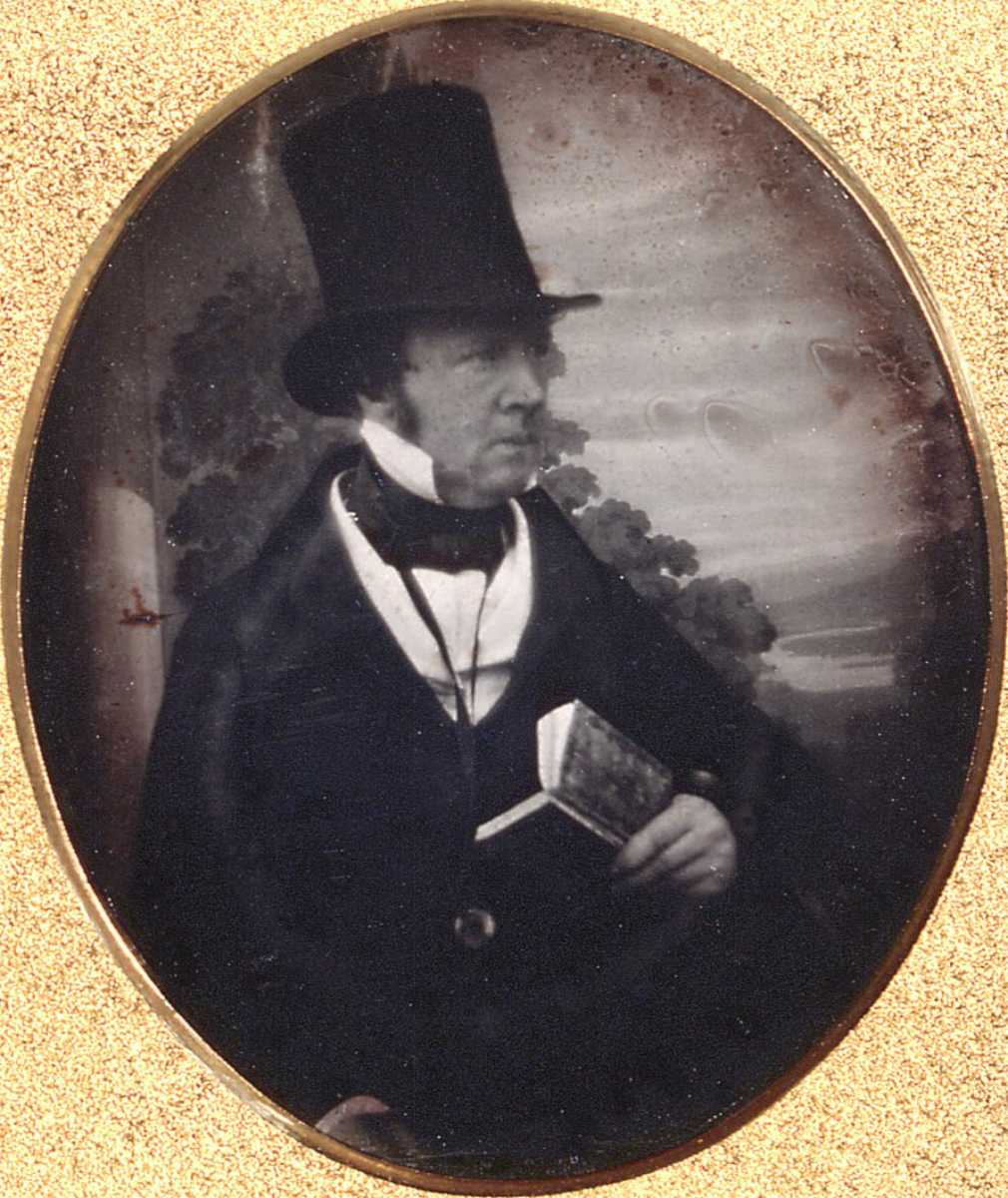
Talbot – Daguerreotype by Claudet c1844
Toronto. Have you ever thought about how photography came about? In early January of 1839, Daguerre felt he had perfected his process enough to have it noted in the French newspapers of the day. Some more modern articles consider the process the ‘Polaroid’ of its time – a one-off monochrome image while you wait.
Most of the world were thrilled at the news. One Englishman was definitely not. William Henry Fox Talbot felt he had invented the photographic process (i.e. scenes captured by the sun and processed for permanence). He used his process personally but saw no reason to rush it to public announcement.
After Talbot saw Daguerre’s news, he presented his process, sample prints, negatives, etc. to the Royal Institute and shortly thereafter to the Royal Society. With hindsight we see that Daguerre recognized the concept of the latent image while Talbot developed the concept of the negative/positive process.
Both processes used silver halides but differed – the end result was the same: an image captured by the effect of a sunlit scene on sensitive material. Daguerre offered a higher resolution one-off positive while Talbot offered a lower resolution negative that was contact printed to create as many positives as desired. The fibres of his paper causing the lower resolution.
To conduct his experiments, he chose to use small boxes with a cork up front to check progress of the exposure. His wife dubbed these small devices “mouse traps“. Her home was cluttered with these boxes as Talbot pursued his experiments (exposures being very long at the time).
NB. The post title is a riff on the book “Of Mice and Men” by John Steinbeck, a favourite author of mine years ago.