digging in

Sod turning ceremony for Convocation Hall, U. of T. 1904 by Galbraith Photo Co., Toronto

Toronto. Photo historians are blessed with a rich source of photographic history – a community archive of photographs from long ago local studios. The names and often addresses paint a picture of the community as it grew. Verification can often be accomplished with the city directories of the time (they were usually printed once a year replete with advertisements).

The photograph here is from the University of Toronto archives and shows the, “Sod turning ceremony for Convocation Hall“. This photo was taken in 1904 by, “Galbraith Photo Co., Toronto”. The description reads, “John Hoskin, chairman of the board, turns the sod. R.A. Reeve, president of the Alumni Association and dean of the faculty of medicine holds the wheelbarrow.”. George spotted  the fellow to the left side of the enlarged photo with a shovel ready to take over once the photo-op of the dignitaries ended.

Our late editor, Bob Lansdale, has photographs in the U of T archives. Bob once discovered a cluster of studios in the Yonge Street and King Street area in the mid to late 1800s.

My thanks to good friend George Dunbar, for his diligent search of local archives and his generosity in sharing his finds with us. So dig into your local archive fonds and learn about your community’s history! Enjoy.

Posted in history | Tagged , , , | Comments Off on digging in

entertainment in the late 1800s

a photograph of the Milan Cathedral c1875 attributed to Ponti and his Megalethoscope technique

Toronto. Did you ever wonder how people amused themselves before movies, radio, television, etc? Books, newspapers, and stereo cards?

Well thanks to the Megalethoscope, patented in 1862 by Swiss born Carlo Ponti, people could also be entertained (and educated) by photographs that slowly turned to night and even colour.

In the late 1800s, slow media meant night scenes were very rare and colour captured from nature (not hand painted) was deemed impractical by existing photographic means in regular use.

However, the sense of motion by the concept of front and then back illumination to vary a scene was common even in Daguerre’s day (before photography) when it was used with the massive dioramas.

A post on ICP’s, Fans in a Flashbulb website on by Christopher George shows this (left/top) General view of the Cathedral, Milan, ca. 1875 attributed to Mr Ponti and his Megalethoscope idea. Have a read and view.

My thanks to good friend and fellow photo historian, George Dunbar, for discovering this odd bit of photo history and sharing it with us.

Posted in history | Tagged , , , , | Comments Off on entertainment in the late 1800s

tribute to a couple of Ws

Keystone View Coy Photographer’s Car courtesy of Calisphere

Toronto. Keystone is a familiar name to members of the PHSC. As publishers of stereo view cards and sets (at one time), their wares are seen at many PHSC fairs. At left is a shot of one of the Keystone photographers’ cars (Meadville, PA).

In the PHSC, a small group of collectors were heavily involved with the magic of stereo. The standouts in our society were the late Dr Robert (Bob) Wilson, and the late Stan White.

Both were presidents of the PHSC organizations and deeply involved with the society over the years. Bob wrote a column on stereo in the Photographic Canadiana journal and frequently had a table at our fairs. Stan spoke to the society many times accompanied by stereo shows. Stan also was instrumental in establishing and filling the Canadian Stereoscopic Collection (CSC) housed for many years at Sheridan College and later the AGO before it was returned to the society.

As a tribute to Bob and Stan, please enjoy this fine collection of stereo views on the Calisphere website. Calisphere is part of the University of California. Many organizations have provided the images displayed. The scenes are not only in California, but world wide.

Thanks to my good friend and PHSC member, George Dunbar, for finding and sharing Calisphere and its online archive of stereo images with us.

Posted in history | Tagged , , , , , , , | Comments Off on tribute to a couple of Ws

hurry up and slow down

a real time, ultrahigh-speed mapping (DRUM) camera. Pictured are researchers Xianglei Liu and Jinyang Liang working on the optical setup at INRS, Quebec

Toronto.We usually cover old still photographic items in these posts, but today I take a look at movies (motion using the brain’s persistence and a rapidly projected series of frames).

Frame rate can noticeably affect a movie. When a movie is projected at the regular speed each frame is held briefly and projected giving what appears to be a natural motion on screen. If the movie camera records many frames in a given period, they appear to be projected in slow motion. And contrarily, if there are too few frames recorded, projection makes the action appear in fast motion – ie. a person walking is recorded and then seems to run when projected. Or a slow process (i.e. multi day) can be speeded up on projection (time lapse).

These events, are often used for entertainment or education (time lapse). However; some short term events (sub second) are of scientific interest. How can they be recorded and slowed down for projection? By using a special high speed camera! Unfortunately, physical limitations and media sensitivity set a boundary for the camera’s success.

Now Payal Dhar writes for the IEEE journal about a Quebec team’s success using optics to extend that boundary in, “A Cheaper Ultrafast Camera Required Looking to Optics The new “DRUM camera” can capture up to 4.8 million frames per second“.

Take a few minutes to read Payal’s article and see one direction scientific photography is going in the future (it will be history – in about 50-100 years – we are just a bit early here …).  Another tip of the hat to my good friend, George Dunbar, for spotting and sharing this unusual article in the IEEE Journal (the Journal is a free PDF download to IEEE members).

Posted in activities-other | Tagged , , , , | Comments Off on hurry up and slow down

an innovator called Karl

camera designer Karl Nüchterlein, courtesy of Theme (photography daily)

Toronto. You have likely used his designs or innovations, especially if you took photographs last century with smaller roll film cameras (127 and 35mm) or used an SLR.

A young Dutchman, Johan Steenbergen, moved to Dresden in 1912 where he established a camera factory which he named Ihagee (IHG), the abbreviation for the German expression, “Industrie- und Handelsgesellschaft”.

In 1923, a talented camera designer of the name Karl Nüchterlein joined Ihagee. Karl designed the VP Exakta using 127 roll film in 1933, followed three years later in 1936 by the Kine Exakta using 35mm film. These were the first small SLR designs. The  Exaktas were different in the fact they were designed for the left handed folk – key controls were on the top left, not top right!

While the cameras were of an interchangeable lens design, compromises had to be made to clear the necessary mirror mechanism. Normal lenses were 55-58mm, and any lens with a shorter focal length had to be specially designed to keep the rear lens elements clear of the mirror at infinity focus. A means to focus the lens at full aperture, then stop down for shooting was important.

Karl made other innovations at Ihagee, in addition to the first 127 and 35mm SLR cameras, including, the camera film winder lever, and a flash socket that was shutter activated.

WW2 was devastating for Ihagee with the deadly bombing of Dresden and the post war decision to put Dresden in the Russian zone. The Exakta survived for years after the war – my first interchangeable lens 35mm was an Exakta VXIIa, at the time more expensive than a Leica. When I bought the VXIIa around 1959, the shorter focal length lenses were often a ‘retro focus’ design with horrendous geometric distortion (both barrel and pin cushion).

Years later I realized the majority of my exposures were with a wide-angle lens, not the 50mm lens or a telephoto.

Posted in history | Tagged , , , , | Comments Off on an innovator called Karl

a field of reads

Alfred Stieglitz ca. 1904 or 1907 by Heinrich Kuhn

Toronto. Ken Metcalf sent along the issue 2 2023 of the Graflex  Journal devoted to, “SHARING INFORMATION ABOUT GRAFLEX AND THEIR CAMERAS”. You can see the back issues by visiting the journal web site here.

Issue 2 2023 has these major articles:
–  A Treasure From My Collection by David Bridge
–  Photographic Equipment of the U.S. Army Corps of Engineers in 1817
–  Cameras from the Smithsonian®
–  Dream Street – book review by George Dunbar
–  Attachment: Graflex Lensboards by Thomas Evans

Note: The title of this post is a riff on the 1989 movie, “Field of Dreams“. The movie is based on Canadian novelist W. P. Kinsella‘s 1982 novel Shoeless Joe.

Posted in activities-other | Tagged , , , , | Comments Off on a field of reads

help!

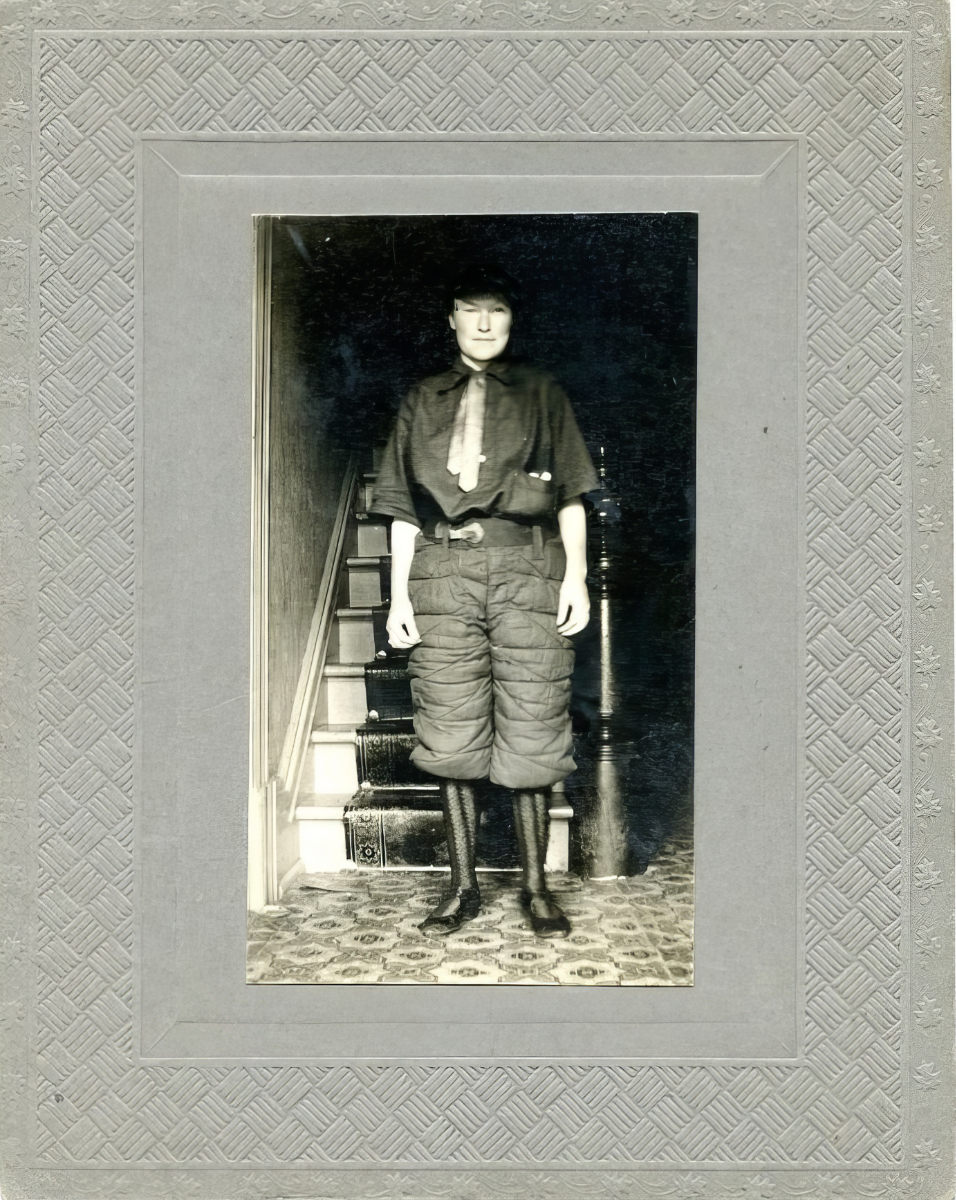
AEB August, 1906. What is the costume worn??

Toronto. At a recent PHSC auction, one lot of photographs included the photo at left. The lady seems to be wearing an unusual costume with what looks like padded bloomers. Also, the lady seems to have vaguely Oriental facial features. The photograph frame does not seem to have a photographer or studio identification.

Journal co-editor David Bridge writes in part, “Hope you are enjoying this warm late summer.  We found the attached lady in a bag of photos Louise bought … at the last auction.  The only inscription on the back [is] ‘AEB Aug 1906’.  Lorne Shields is unable to definitively say that this is a bicycling outfit – perhaps your multi-talented readers can come up with some further fashion opinion?  Skiing outfit? In August? What’s in the pocket?”

Okay folks, if you recognize the person or clothing, please let David know!. Write me at info@phsc.ca and I will pass the message on.

Note: The title is the same as the title of the popular Beatles song of  1965, “Help!“.

Posted in history | Tagged , , , | Comments Off on help!

a debt unpaid

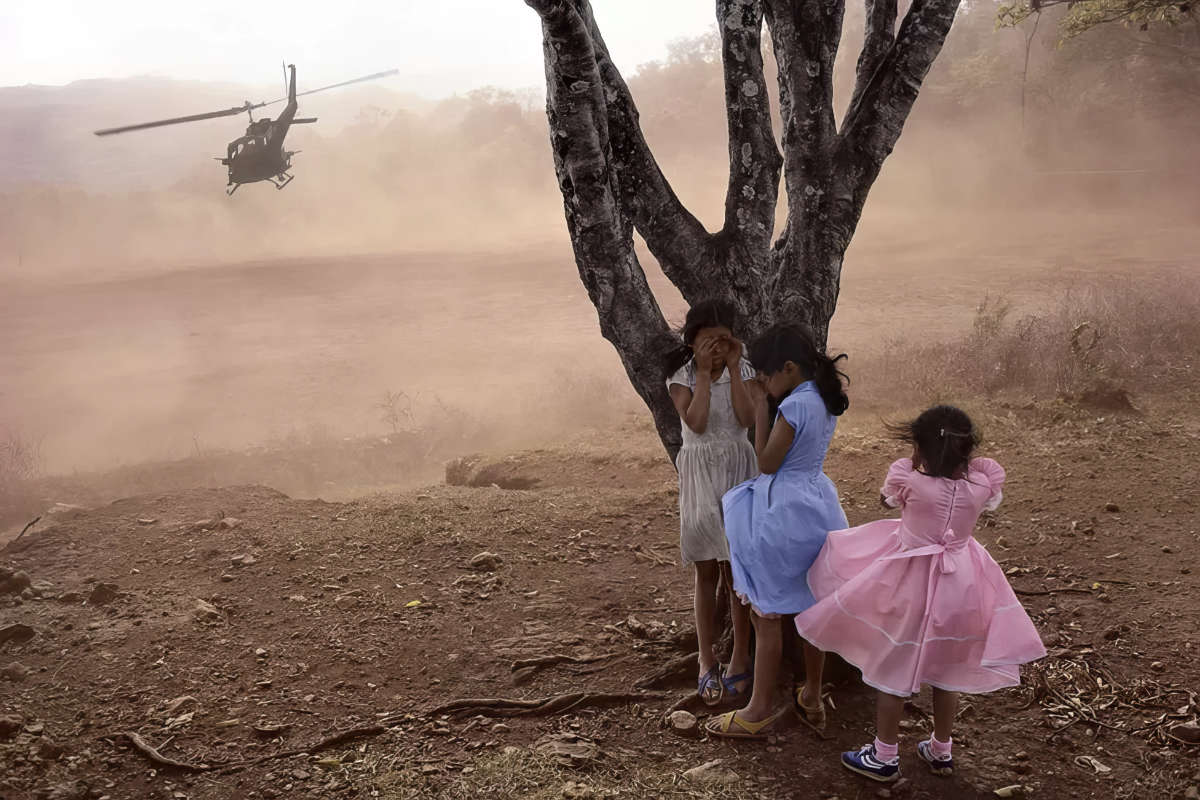
children and military helicopter in El Salvador, by James Nachtwey, courtesy of BBC News

Toronto. … promise made is a debt unpaid … as Robert Service wrote in his 1907 epic Yukon poem, “The Cremation of Sam McGee“. Service was born in England and lived in many places, including Canada (he once worked for the Toronto Star).

The ‘debt unpaid’ is by all of us to the photojournalists of the world who bravely burst into areas of natural disaster, human disaster, and  conflict  (war, civil insurrection, etc.) to bring us more timid souls the stories and photos of what is happening.

It should be noted that our society has had many Canadian photojournalists as guest speakers over the years, most recently Louis Palu in May of 2019.

Typical of photojournalism is the life and work of, “James Nachtwey: The last of the great photojournalists” as captured by Jonathan Head for the BBC News.

As to Nachtwey, who often worked in black and white film, Head writes in part. ” … In some images, though, the colour really stands out. An early photograph from the El Salvador civil war [top, left of this post] shows a military helicopter evacuating an injured soldier. But it is the three little girls crouching behind a tree in the foreground, their dresses of white, pink and pastel blue standing out in the orange dust cloud, who give the image its haunting loveliness.”

My thanks to my good friend, George Dunbar, who recently came across this BBC News article and shared it with me.

Posted in history | Tagged , , , , | Comments Off on a debt unpaid

expensive words

Sir John Franklin c1845 courtesy of Sotheby’s

Toronto. The old chestnut says a picture is worth a 1000 words. If so, the 14,000 words for these 14 daguerreotypes are worth nearly $39 USD each! Many Canadians remember the stories of Franklin and his two ill-fated vessels, the HMS Erebus and the HMS Terror which became locked in our ice while searching for the NorthWest Passage. The ship wrecks were discovered nearly a decade ago in this century.

Long unseen, the set of 14 portraits were auctioned off recently by Sotheby’s and realized about $545,580 USD on September 21, 2023. The daguerreotypes were taken on board the HMS Erebus in 1845 just days before it set sail on its last voyage. The portraits were taken using technology less than seven years old. Needless to say, they were the last portraits taken of the senior crew of the two vessels and the officers of the HMS Erebus.

My thanks to PHSC President, Clint Hryhorijiw, for alerting me to this sale.  You can read about the set and the last voyage of Franklin and his crew here on ArtNet News. Remember, it is the subject as well as age, photographer, and condition that determines a daguerreotype’s value. Expensive words, indeed!

Posted in camera, history | Tagged , , , , , , , , | Comments Off on expensive words

hot pix, it’s a phoney; hot pix it’s a phoney …

cover of latest Canada’s History Magazine

Toronto.  … with apologies to Karen Shopsowitz and her family. You couldn’t live here 60 years ago without hearing the jingle, “hotdog, it’s a Shopsy” or visit the city without buying one of those delicious hot dogs from her father’s delicatessen.

Karen spoke to the PHSC at the September 15, 2004 meeting recounting her father’s enthusiasm for home movies.

Any art item deemed rare, expensive, or famous is at risk of duplication. Paintings, cameras, photographs are typically copied and presented for sale.

For example, towards the closing of one of our shows, an old gentleman showed up and offered a dealer an old Leica with a brass nameplate across the back engraved with the name of an infamous Nazi officer who had died at the Nuremberg trials. The dealer bought the camera but I missed photographing it.

Calling the dealer later, he said the camera was a well preserved fake. The camera’s age, colour, engravings and serial number made the ownership plausible leading to his decision to buy. Once home, he carefully inspected his bargain only to discover a single glaring error: the name had a missing umlaut – just as bad as a spelling error in English! Nevertheless, the camera was in fine condition and he elected to keep it as an example of a fine fake.

The latest issue of Canada’s History magazine sparked this post. In notifying me of the magazine’s article on a famous military photograph that proved to be fake, George Dunbar writes, “Canadian photo historians will certainly be interested in this feature article, ‘Over the Top,’ in the latest issue of Canada’s History magazine (Oct/Nov 2023).

“This is a fascinating exposé of the creation of faked First World War photographs by Canadian officials and a British photographer.”.


Posted in history | Tagged , , , , , , , , , | Comments Off on hot pix, it’s a phoney; hot pix it’s a phoney …