half the size but twice the fun …

Lomophotography’s half-frame 35mm camera series ‘the Lomourette Family’

Toronto. Last century, when Oskar Barnack designed the first Leica, he chose to use cut off pieces of movie film but at double the frame size (1 x 1.5 inch) rather than movie frame size (1 x .75 inch) to obtain better resolution.

Over the years, both film speed and resolution improved allowing the industry to manufacture so-called half-frame cameras to double the exposures per roll (72 vs. 36) while maintaining sensitivity and resolution. The idea of half-frame isn’t terribly new (witness the old Ansco Memo for example).

Recently, the folks at Lomography announced a trio of simple half frame 35mm cameras (based on the Diana) to let you ‘test your mettle’ using the old film technology once again. Film niche fans up here in the big smoke can drop by Downtown Camera to see this latest from Lomography.

Posted in history | Tagged , , | Comments Off on half the size but twice the fun …

early darkroom days …

daguerreotype outfit courtesy of Matt Isenburg

Toronto. … really early days. When photography began, a photographer had to be not only an ‘artist’ but an all round ‘renaissance’ man. He had to create sensitized media, know how to expose same, and understand lighting. While cameras and lenses could be purchased, he definitely needed to at least understand camera and lens design.

A burgeoning offshoot of photographic history was the investigation and collection of the daguerreotype – the oldest documented photographic process. In the States, an entire historic society is devoted to that early art form. Some PHSC members were also Daguerreian Society members. The late Matt Isenburg both spoke to the PHSC and was at one point president of the Daguerreian Society.

The Daguerreian Society publishes periodicals throughout the year, plus a massive annual softcover publication. In addition the society holds an annual convention and image show.

In issue 19-1, the late Robert Wilson reviewed an issue of the Daguerreian Annual.  Bob begins, ” ‘The Annual of the Daguerreian Society is a forum for research, history, opinion and commentary on all matters related to the daguerreotype’ and the edition for 1993 has just been published. It is sent to each member of the Daguerreian Society and is available on a single issue basis as noted above. It meets its objectives by representing a combination of new articles written specifically for this Annual, items reproduced from earlier publications and portfolios of images.

” A number of essays are the result of new, original research into the lives of Daguerreotypists. Abel Alexander writes of the years that Robert H. Vance spent in Chile (1847-1850) after leaving Boston and before arriving in California.

” The noted researcher of photography in California and the Annual Editor, Peter Palmquist provides an essay on William Herman Rulofson, ‘The P.T. Barnum of American Photography’. Rulofson was a Canadian who worked as a photographer in Fredericton, New Brunswick, and St. John’s, Newfoundland, in 1847 and 1848 before moving to the gold fields of California. This article is illustrated with eight views of Stockton California, ca. 1850- 1852, mostly attributed to Rulofson.

” Laurie Baty summarizes the life of M.P. Simons, who began photography in Philadelphia in 1842. Dave Tinder outlines the life of a more modern photographer, Charles Tremear, who produced daguerreotypes in the 1930s in Greenfield Village, Michigan. Included in this article is a series of photographs showing Tremear demonstrating the various steps in the production of a daguerreotype. Also in this annual are several shorter essays on other photographers: Mathew Brady (by George Gilbert). … ”

Well, just follow the usual routine to read the rest of the article in paper copy or as a pdf on the free members-only DVD. Not a member? Follow the MEMBERSHIP stuff above and at right. Easy peasy. Questions? Email Lilianne at member@phsc.ca.

Posted in history | Tagged , , | Comments Off on early darkroom days …

disastrous 1904 fire

Looking south-west from the west side of Bay Street,April 1904
Photographer: W.J. Whittingham
City of Toronto Archives
Fonds 1408, Item 16
The tall fragment in the centre reads “Comfort Soap.” The tower to its right is that of the Union Station of the time, which was far enough west to escape the fire.

Toronto. In 1904, a disastrous fire consumed much of the business district in Toronto. The fire was visible as far away as other cities both here and in the States. Help arrived from places like Hamilton, and Buffalo.

The city archives have many photographs of the fire. Another example of how photography augments history. In issue 18-5 Ev wrote an article on the studio of Peake and Whittingham. One of the photographs illustrating Ev’s article is that shown at left taken by Whittingham during the 1904 fire.

The photo is just one of the photos of the fire housed in the Toronto Archives.

Ev describes the photo in this cut-line, “The sombre beauty of this scene, the ashes from which grew the phoenix Toronto, combine delicate tonal scale as a result of smoke, dust and haze with graphic composition. From a half-plate print.”

Collectors of images need to check for and include disaster images such as this. The collector can use archival fonds as necessary to identify the image content and its creator.

Here in Toronto, we are indeed fortunate to have a wealth of photographs in our archives. NB: The archives is a PHSC member via a resident archivist.

Posted in history | Tagged , , | Comments Off on disastrous 1904 fire

reeling

reels to develop many 35mm film strips at once speeding up the process.

Toronto. In the days of film, photographers developed the strip of film in a reel. Professionals could develop many reels of film at once using devices like that at left [photo courtesy of Patrick Gunn]. Once correctly developed, the best shots [frames] were enlarged in the darkroom and printed.

Mid last century, daylight tanks were marketed. Reels were loaded and dropped in the tank in darkness. A light trap mechanism allowed the various chemical solutions to be used in daylight for the traditional time-temperature development, stop, fix and wash before the strips were unwound and hung to dry.

Once dry, a contact print was made, select frames chosen, and those frames enlarged to create the final prints. During enlargement, cropping, and dodging and burning created the final image. professionals intending to replicate the final prints made notes of such cropping, dodging, and burning.

Today, with digital technology, software editors can make the relevant adjustments in very short time – if you understand the concepts and adjust the image with the correct software tools.

Artificial Intelligence [AI], while still in its infancy,  makes such corrections much easier. For example using Topaz Photo 3 AI to ‘sharpen’ the digital image above makes it appear crisper. Digital cameras by their very nature tend to make slightly soft images benefitting from a very minor bit of sharpening.

Proper experience is still necessary to make cropping decisions and adjustment of the image’s H-D curve [exposure, brightness, contrast, etc.].  And to see the future, sunglasses may be necessary …

Posted in history | Tagged , , | Comments Off on reeling

the importance of connections …

Bill Wittingham adjusted with Topaz Photo AI

Toronto. When Ev Roseborough took over as editor of Photographic Canadiana, we entered a new era. Ev’s vast network of fellow professional photographers  brought in many new members, some speakers, and a wealth of experience in the photographic industry.

This was aptly demonstrated in his article in issue 18-5 titled, “A Collection, and History, in a Basement”. which offers the tale of a Toronto studio run by Alexander Peake and William James Whittingham.

Ev begins, “Many years ago, 81 if you must be exact [written early in 1993], two gentlemen of English extraction set up a photographic studio on Adelaide St. West in the flourishing business district of Toronto.

“The two proprietors were Alexander Peake, a great tall man with very large hands and feet and, when I knew him, a trim gray moustache. He spoke in a low, raspy voice, as if it required great effort. Peake was a quiet careful worker of considerable ability. Strangely it has been impossible to find any details or a photograph of him.

“Of his partner, William James Whittingham (April 1887-Dec. 1941), more is known. Steve MacKinnon, archivist of the City of Toronto, located a reference in the City Directory of 1903 when Bill, as he was generally called, was employed by the Toronto Engraving company until 1912.

“That year finds Peake and Whittingham located at 26-28 Adelaide St. W. in Toronto. The studio then moved to number 50 and later number 64 Temperance St. …”

Well, good reader, you know the routine by now! PHSC members read the entire article either in hard copy or as a pdf file on the free ‘members-only’  DVD.  Above and/or to the right are MEMBERSHIP instructions. Join today if you haven’t yet. Questions? Email Lilianne at member@phsc.ca.

Posted in history | Tagged , , , | Comments Off on the importance of connections …

winging it …

Amateur’s Enlarging Camera No. 1 courtesy of Rob Niederman and the MiPHS Photogram

Toronto. The latest issue of the Photogram is now available to all members of the Michigan PHS (MiPHS).

Included in issue 52, 4 is this article on the “Amateur’s Enlarging Camera No. 1” by Rob Niederman. As Rob explains, until around 1900 enlarging was not straight forward. While the ‘camera’ is manufactured by Simon Wing, it is actually an enlarger of a fixed magnification.

You can read this article and others such as a history of Polaroid by joining MiPHS. By the way, in this issue are some photos of our president Clint Hryhorijiw who served as auctioneer at their recent fall show.

Posted in activities-other, photos | Tagged , , , , | Comments Off on winging it …

squaring a different circle …

a lens board and a brass Cooke Primoplan 4 inch, f/6.3 lens

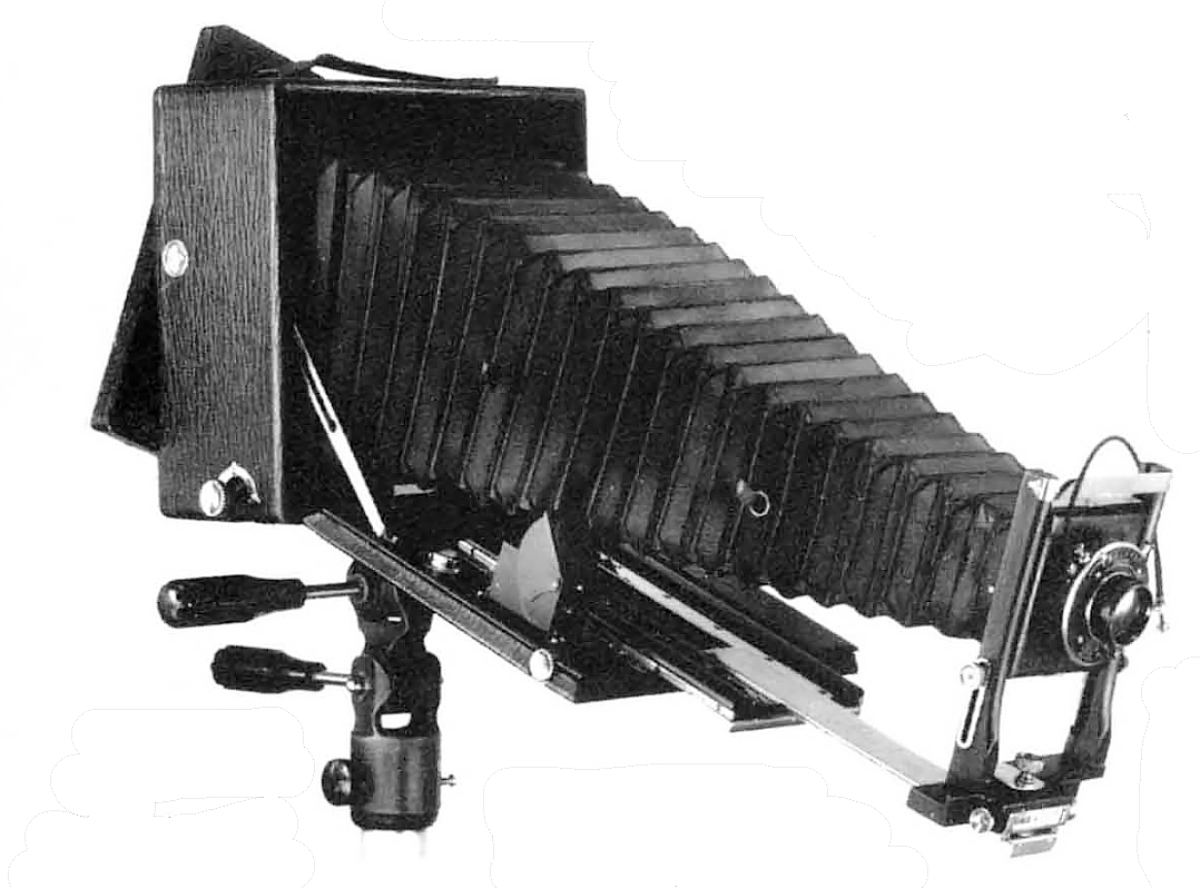
Toronto. From the beginnings of photography until well into the last century a common camera design was the field camera or its many variations. Basically the sensitive media was separated from the lens and (when needed) shutter mechanism by a sliding box affair, bellows, etc.

Early on it was determined that the lens board and its lens could be swapped out to vary the focus of the camera. A rack and pinion, sliding box, friction mechanism, etc allowed the lens-to-media distance to be changed to focus the subject on the media.

In yesterday’s auction was a Cooke Primoplane lens mounted on a Taylor, Taylor, Hobson (TT&H) lens mount and lens board. Someone won lot 391 and took home this gem. The brass lens is marked 4 inch (focal length), f/6.5, Series VIIA. As a lens name Cooke is still quite active while the name TT&H seems to have faded into history (Cooke was once a trade name for lenses designed by a different mr Taylor and manufactured by TT&H).

Kingslake in his book ,”A History of the Photographic Lens“, has an interesting section on Cooke triplets (chapter seven) and the relationship between the inventor of Cooke lenses and their  manufacturer, TT&H.

Posted in history | Tagged , , | Comments Off on squaring a different circle …

a book for November …

lot 606 – CAMERAS by Brian Coe

Toronto. .. to paraphrase the Walter Lord tale, “A Night to Remember” about the Titanic – I Read it about sixty or so years go. One of the books in today’s auction is CAMERAS by the late Brian Coe, curator of Kodak’s Museum in the UK at the time.

Other soft cover books by Brian were the principle basis for the talk I gave years ago during the infamous “dog and pony” shows I did with the late Don Douglas and his Ansco collection.

A copy of “CAMERAS” is lot 606 in today’s PHSC fall estate auction. It is a delightful book covering the history of cameras from the 1830s to the days of instant pictures. What adds to its appeal is the profuse use of line drawings and colour drawings of epic camera designs and how their features work.

Someone will take home a great book from 1978!

Posted in auction | Tagged , , , , , , , , , | Comments Off on a book for November …

by any other name …

A 35mm Kiev with case is lot 48 in Sunday’s auction.

Toronto. One of my co-workers commented years ago that a client (he was in the debt consolidation business at the time) had given him a new ‘Leica’ and the accessory lenses. Well, that sparked my interest.

My family visited his and after some chatter, Henry took me to the bedroom, bent down, and slid a cardboard box out from under the bed. Nestled inside with  a few lenses was a brand new … Kiev! Not a Leica but a Russian copy (sort of) of the famous German Contax. The Kiev was manufactured at the time in the Ukraine.

I have seen the odd one over the years, so imagine my surprise when this little beauty showed up as lot 48 in this Sunday’s auction! When the Kiev was manufactured, Germany having lost WW2 was thoughtfully ‘quartered’ by the victors – UK, USA, France and … Russia. Soon copies of high end cameras emerged from the USSR. Be they Leicas or Contaxes, they were made in the Ukraine.

Join us at the Sunday Estate auction – free parking, free admission and a very friendly crowd. A great way to pass a Sunday afternoon. A slide show of the lots and directions, times, etc are shown here.


Posted in auction | Tagged , , , , , , , , , | Comments Off on by any other name …

lots and lots to list

lot list fall 2024 auctin

Toronto. Our fall estate auction is coming up quickly (this coming Sunday, Nov 24, 2024).

In addition to the slide show of lots, Clint has provided a list of items in the auction. Both the photos and list are updated frequently on this post – be sure to check the post frequently as the auction approaches.

Free admission; free parking; friendly atmosphere. The above link to the post and poster give details. Come on out to augment your collection/user gear!

Posted in auction | Tagged , , , , , , , | Comments Off on lots and lots to list