Brodie’s Machine

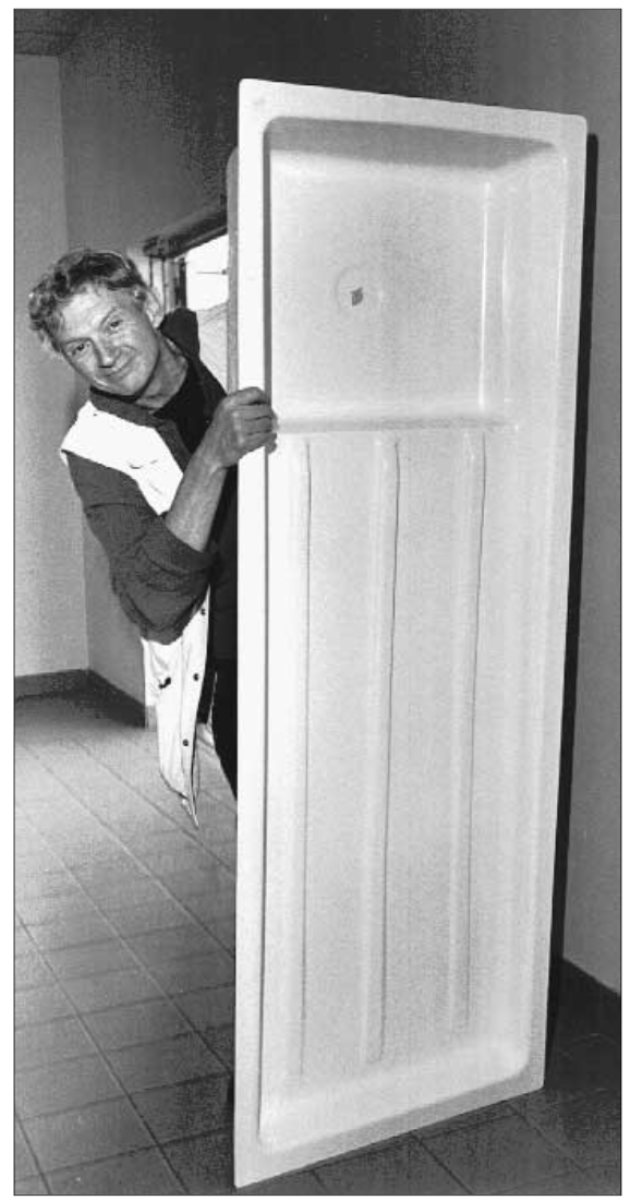
Brodie’s rear projector

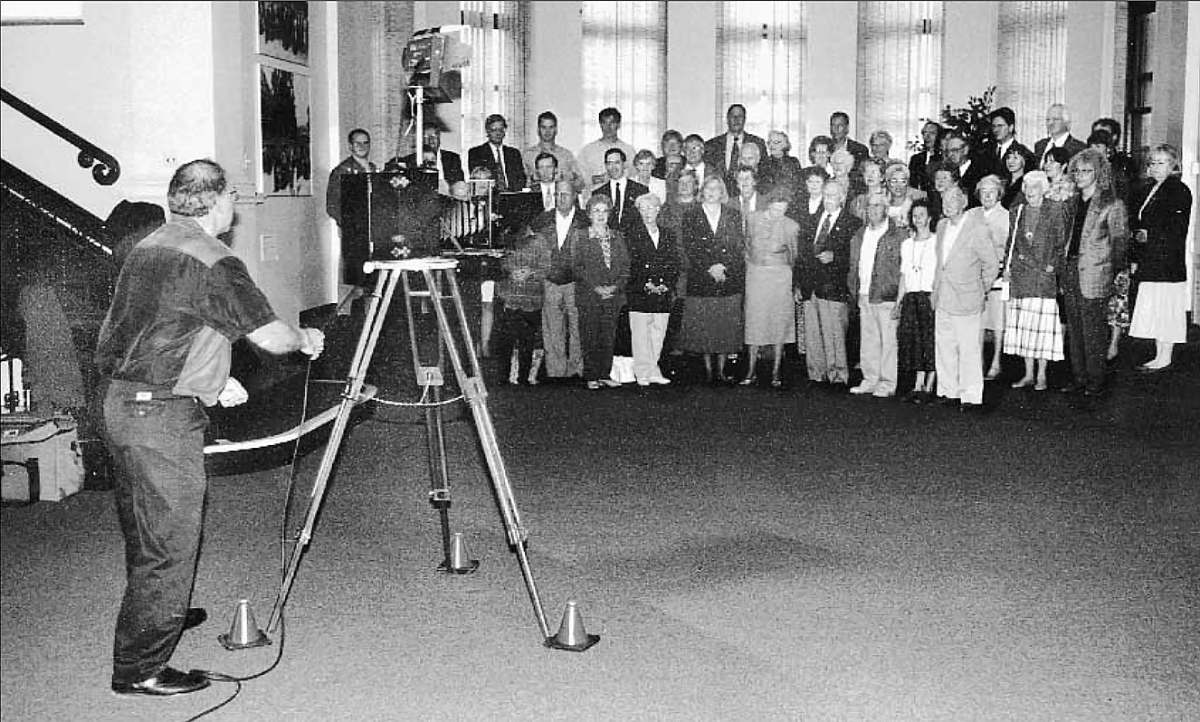
Toronto. Brodie Whitelaw (photographer) was well known to professional photographers in Ontario, especially past-editor Ev Roseborough. Brodie spoke at our May, 1989 meeting displaying a sampling of his skill via many beautiful prints. Born in 1910, Brodie died decades later in 1995.

In issue 22-3, Ev wrote a fine article called, “Brodie and his Wonderful Machine”. It was a tale partly of Brodie’s life, the growth of commercial photography,  and Brodie’s experimental machine that barely predated decent Macs with colour screens and software to retouch images.

I wrote the following on Ev’s article for the web site: “Brodie Whitelaw was one of Canada’s great commercial photographers and a contemporary of Ev Roseborough. In this article, Ev covers Brodie’s career, and at the same time gives an insight into the growth of commercial photography in Canada.

“Late in his career, Brodie spent a dozen years in a labour of love on his ultimate tool for commercial studio shots… a rear projector with incredible light power. I had an opportunity to see the instrument in Ev’s studio earlier this year — You can see it too at the fall fair this October [1996].

“Before Brodie completed the projector to his satisfaction, technology had moved on with front projection and beam splitters, and more recently, computerized image retouching.”

Ev’s story has far more details (and photos). He begins his story as follows, “This is a tale of a period. Some seventy years, 1925 to 1995 more or less. It represents the active lifetime, photographically, of Brodie Whitelaw. It also represents much of my own, with close parallels neither of us realised.

“Brodie discovered the lure of the lens and became a devotee of John Vanderpant, famous B.C. pictorialist, (see P.c. vol. 18 No.2). Much of his early soft-focus work resembles that of his mentor.

“Brodie’s parents, residents oMeaford, Ontario, died at an early age. The youngster, after receiving a fountain pen from his fellow students at MaplLeaf School on October 31, 1919, was put aboard the train bound for Vancouver where he was to live with an uncle.

“Graduating from U.B.C. in Arts in 1933, he determined to no longer impose on the resources of his uncle and set out for Toronto. He brought in addition to a portfolio of prints, a considerablknowledge of architecture and mechanicadesign.

“His ambition was to have studieaeronautical engineering but there werno courses in Canada and only one in the States with fees outof-reach. This interest became a major factor in determining his future.

You can read all of Ev’s story in the issue 22-3 pdf file on the free members-only DVD. To join or renew, see the appropriate paragraphs above and at right. Problems? Questions? Email Lilianne at member@phsc.ca. NB. Please help us by indicating whether your membership is new or renew.

Posted in history | Tagged , , , | Comments Off on Brodie’s Machine

the eye looker redux

c1929 ad for the tiny microscope. Note the amount of text used.

Toronto. I mentioned in earlier post that we camera collectors sometimes collect other oddball optical gadgets too. In the last issue (22-2) Ev wrote about a 1901 souvenir he discovered amongst Brodie Whitelaw’s gear and suggested it was a Stanhope viewer of sorts.

In the following issue (22-3) Ev reported on the messages he received in response to the article. His latest article, ‘“Mystery within Enigma” solved” covers some of the responses including ads submitted to him. 

Ev writes,”Generous readers from Michigan and California telephoned, wrote and faxedjoining local collectors with explanations about the device shown in the previouissue and I thank them all.

“Bill Carroll of La Entrada, CAphotographed his collection of six with new APS  [35mm film with a new kind of cassette] camera and explained that the glass block and small lens were one piece. There are slight size variations in the size of Bill‘s brass examples. One is stamped Japan and two have no apertures in thbody. Instructions on a box are iSpanish, French and English.

“The larger lens unit is a complete magnifier. Tube length and four apertures allow its use on opaque specimens. The smaller lens and glass block unit produces about 26X magnification of smears on the block face ([PHSC past president] Don Douglaused blood) or an insect or flower petaimpaled on the pin which can pass through the body tube.

“Bob Carters scope is also of brass. John Naslanics (MiPHS) catalog sheet [see large illustration at left] ialmost a treatise on its use, at half thprice, postpaid, of my 1901 model.

“According to definition it is still a ‘Stanhope’.”

Posted in history | Tagged , , | Comments Off on the eye looker redux

how bright is yonder light

A Weston 650 light meter (marketed 1935-1930)

Toronto. One element of a good photograph is correct illumination. Early days of the art saw a variety of charts, tables, and gadgets marketed or offered to aid the budding professional.

From dry plates on, this aspect of the art became critical – especially to the casual photographer. A nice, concise history of light meters can be found on James Ollinger’s website. Worth  a peek!

To better help determine the amount of illumination falling on the subject, some photographers used extinction meters. Their (extinction meters) down fall was the gradual  shift in the eye’s sensitivity to darkness.

In 1935, Weston made a beautiful art-deco meter (see above, left) that had a fancy scale on the left and meter coupled to a selenium cell on the right. The 650 was sold for only 4 years. It was superseded by other ‘improved’ Weston light meters. In the late 1950s, I bought a Weston Master III (looks like the Master II).

Like the 650, the Master III was helpful in daylight as time, clouds, location etc. affected  the amount of light falling on the subject. Unfortunately, at night or indoors, the selenium cell/meter combination lacked the necessary sensitivity –  it could no longer assist the photographer.

A decade later, cadmium sulfide cell (CdS) meters prevailed. The resistance of the CdS varied with the light intensity requiring a battery to function. It was far more sensitive – and much smaller than a selenium cell. Improvements in technology eliminated the lag in response, shifts in readings, etc, leading the way to built-in meters – a practice that continues to this day!

Issue 22-3 was a land mark issue for us in many ways. Bob Lansdale took over from Ev Roseborough and a shift began to revise the journal layout. In particular, Bob was much fussier, insisting on correct contrast of his photographic illustrations in print, detailed proof-reading by others, etc.  Above all, he kept the timeliness, detailed articles, Canadian focus, etc. introduced by Everett.

In issue 22-3 there are a few articles on Weston light meters including a reprint of the 1938 paper explaining the markings on meter’s left hand scale, science behind illumination, etc. In this issue, Ev has officially moved from editor to writer of articles. Members can easily read all the issue 22-3 articles by viewing the issue 22-3 pdf file on the free members-only DVD. Membership is a piece cake – and cheap to boot! See the info above or at right. Questions? Email Lilianne at member@phsc.ca.

And if you are interested in light meters – or any other bit of photographica – visit our 2025 events in the GTA. Date and location are shown at right under PHSC EVENTS for all confirmed events.

Posted in history | Tagged , , , | Comments Off on how bright is yonder light

billboard in the bog

A Tropo-Scatter Antenna in Labrador c1959 from the back

Toronto. Photo collectors often cherish  outdoor photos and work photos. This image hits both topics, but may be a bit too new for the collecting fraternity. Shown here is a billboard size Tropospheric Scatter antenna from the late 1950s. Microwave frequencies were bounced off the troposphere (about six miles up) and scattered to be received by a similar antenna a few hundred miles away.

The tropo-technology when installed was already too late as within decades it was superseded by satellites, fibre optics, internet, digital technology, etc. Although this equipment photo may be ‘new’ by collecting standards, photographs of the technology deserve to be collected since so few systems were installed (and photographed).

NB: The post title is based on the Ogden Nash parody of Joyce Kilmer’s poem. Nash wrote (more or less), “I never saw a billboard as lovely as a tree, in fact unless the billboards fall, I’ll never see a tree at all…”

Whether you collect images or cameras, or research photo history, be sure to visit our events. See PHSC EVENTS to the right for time and place. Of course a post will be pinned at the top of this page close to each event date,

Posted in history | Tagged , , | Comments Off on billboard in the bog

Emerald isle thoughts and a camera question

A c1910 Emerald camera – click name plate to see complete camera

Toronto. And a fine St Pattie’s day to you too! On this lovely Monday, we share a tale from our friend and past president, author, sports photographer, collector, etc., etc., Les Jones.

I received an email from Les asking if we had more goods on the old Eaton Emerald camera. Les says, “Knew Emerald roll film cameras existed as they feature in early catalogues and ads but had never seen one in 40 years of collecting.

“Available in various sizes, this one is similar to the #2 folding Teco [T Eaton Co] (original price $5) and possibly identical, apart from the nameplate. 2-1/4 x 3-1/4, f/11-f/45, I, B & T. Around 1910?

“Anyone know more details, production numbers etc.?”

If you can help Les out, drop him a note via info@phsc.ca.

Posted in activities | Tagged , , , , | Comments Off on Emerald isle thoughts and a camera question

crime and photography …

Churchill 1941 by Karsh of Ottawa (courtesy of Wikipedia)

Toronto. … the Karsh Caper. In 1941, Karsh captured the essence of Churchill and called the portrait the “Roaring Lion”. In 1988, he donated the signed print to Chateau Laurier hotel in Ottawa.

A different copy of the photograph was swapped for the signed print in late 2021 or early  2022.  By mid summer of 2022, the swap and theft were announced when Sotheby’s auctioned off the signed print to a person in Italy.

The print was returned to Canada in September 2024.

This spring, Jeffrey Wood, was tried in Ottawa for the theft and found guilty.

My thanks to PHSC president Clint Hryhorijiw, and shortly after PHSC newsletter editor Patrick Gunn for the first announcement above (theft), and Cindy Motzenbecker of MiPHS via Clint for the second link (guilty).

Posted in history | Tagged , , , , | Comments Off on crime and photography …

Exec ZOOM meeting #56

PHSC President
Clint Hryhorijiw

Toronto. What on earth would we do without technology?

Our 56th meeting began with a brief reorganization: I move to 1st VP; Jeri Danyleyko steps into the 2nd VP slot and takes over as Financial Controller from John, spitting investment decisions from bills, payments, etc. Celio Barreto takes on an additional task of administering the PHSC awards.

Once again Treasurer John Morden sent out his report before the meeting.

Editor Patrick Gunn’s  second newsletter, 25-2 went out the end of last month with very positive reaction. The clean layout and content reflect his advertising background, photographic enthusiasm, and forward planning discipline.

John Allman, now our  O3C representation, had a few solid suggestions for the PHSC including promotion of its events, speaker list, etc.

Membership Secretary Lilianne Schneider was unavoidably absent, but issued a monthly report including questions on some renewals.

Note: Regarding membership (new and renew) our journal is in ‘pdf format only’, so an email address is essential. A MailChimp notification is sent to all member emails when each journal pdf is produced and uploaded.

Remember, if  you have UNSUBSCRIBED to our MailChimp list, you will not receive notification nor Photographic Canadiana nor other info. MailChimp does not permit me to reinstate a specific email address once unsubscribed by the owner. Renewal of such addresses are only possible via a form, not provided on our site.

Also, if you change email addresses, please tell us – MailChimp will tag the old address as CLEANED (they cannot add your new address automatically). If you are a member but HAVE NOT seen any notification for Photographic Canadiana since you registered or renewed, please email Lilianne at member@phsc.ca.

Celio Barreto has initiated an investigation in ways to streamline access to our presentations. New presentations and presenters are currently under review. Suggestions are always welcome. Email Celio directly at program@phsc.ca.

Social media editor, Ms Markovic was unavailable, but emailed a brief update.

Posted in activities | Tagged | Comments Off on Exec ZOOM meeting #56

the Russians are …

a pair of Krasnogorsk FT2 cameras joined together for a panoramic stereo shot

Toronto. … coming, the Russians are coming  – as Canadian Producer/Director Norman Jewison titled his 1966 humorous movie.

A fitting title for this post about Stan White’s exploits to make  panoramic 3D photos using a co-joined pair of  Krasnogorsk FT2 cameras. Click on the camera icon to see a stereo example.

Stan begins his article as follows. “It was the need for a means ophotographing street scenes in 3-D that was the motivation. If the objective is to include for posterity as much of the streeand building as possible a conventional stereo camera is not the answer.

“Somyears ago I purchased a Krasnogorsk FT2 panoramic camera circa 1950‘s and I was pleased with the result(see Photographic Canadiana vol. 19, no. 2).

“I had used this camera to make stereo pictures using a slide-bar. But the camera is far from quick to handle and by thtime the shutter has been cocked and thfilm wound on (three revolutions on thwinding knob) and the slide-bar moved tthe new camera position, a delay of 8 seconds was minimal. In an angle of vieclose to 120 degrees it was impossibleeven if there was no people or traffic, to make the left and right view without introducing anomalies between thimages.

“Then, at the Society auction this year [1996], another FT2 camera became available. It did not sell and I was able to take the camera on approval to see if its imagery was a close enough match to the image produced by my own camera to make a compatible stereo pair.

“These cameras are built like trucks and it is possible with care to strip them down, lubricate, adjust and put them bactogether again in about half an hour and you dont need to be a camera repair mato do this. I soon had the second camera working fine and adjusted so that itshutter speeds matched my own camera. …”

Read the rest of Stan’s illustrated article on the issue 22-2 pdf file contained on the free members-only DVD. Join up and see all we offer! See above or at right. Questions?  Email Lilianne at member@phsc.ca. P.S. Help us – please indicate if this is a new or renew membership.   Come out to our events as shown at the right under “PHSC EVENTS”.  There is always something of interest!

Posted in history | Tagged , , , , | Comments Off on the Russians are …

Looking at Small Things – 1680 style

an early single lens microscope c1680 – reproduced by Zeiss staff as an exercise

Toronto. When I was a kid, an issue of Popular Mechanics magazine showed how the tiny lens of a pen-light 1.5v bulb could be used as a powerful (about 200x) microscope – just like one made by Leeuwenhoek in Delft, Netherlands.

In issue 22-2, editor Everett Roseborough, discussed a tiny Zeiss object  (barely a handful) he saw at a 1996  Zeiss Historica meeting. It was a reproduction of the tiny Leeuwenhoek single lens microscope once used to see tiny things including bacteria (the hand-crafted lenses had different focal lengths and were estimated to be anywhere from 50x to 500x magnification).

I mentioned in an earlier post that many camera collectors also collect other strange optical instruments – this was such a device. Ev opens his artcle by saying, “This reproduction of a Leeuwenhoek Microscope is a product of Zeiss Reflex – a company within a company that needno introduction.

“Michael Kersten of Carl Zeiss Inc., N.Y., showed it to me at the Zeiss Historica meeting at Toronto, and havinone in my collection became imperative.

“Zeiss Reflex is a company where new employees in marketing, technology and other phases of company policy and activity receive training. They decide on projects and carry them to completion. believe these replicas are part of the apprenticeship program.

“In the pamphlet which accompanies the replica, Zeiss maintains that Leeuwenhoek was a baker by trade, thicould be a translation error as was von” Leeuwenhoek.

“The instrument is beautifullpolished but I feel that the good Antoni ‘s handiwork would not have been, but rather blackened.

“He was the first man to see bacteriawhich he obtained from his teethanimalculae [tiny beings in pond water], circulating blood and spermatozoa. Spontaneous generatiotheory was disproven even before Pasteur.”

Members read the rest of Ev’s article in the pdf file for issue 22-2 on the free members-only DVD. Joining the PHSC is easy – see above or at right. Any questions, please email Lilianne at member@phsc.ca.

Posted in history | Tagged , , | Comments Off on Looking at Small Things – 1680 style

remember using D-76

Developer by the gallon

Toronto. As a youth, I bought an old chemical balance and a whack of Kodak chemicals to make my own developers, stop bath, and fixer bath. Later on I bought ready-made Kodak chemicals like D-76 for developing negatives and DEKTOL to print.

“When colour came calling, I tried various packages and processes. It soon became obvious that unlike B&W, the best you could do with colour was expose and develop it correctly – no fussing around to fix exposure boo-boos, create more contrast or less, focus in on highlights, or shadows, etc. Colour was left to the one hour photo shops.

About  quarter century ago when digital hit us, I had a last trip with my trusty M4 then put it on the shelf and switched to the digital world.

The other day, one of our members, Jeri Danyleyko sent me an email saying, “For all those who are doing home processing, Kodak chemistry is back. https://downtowncamera.com/shop?query=kodak%20chemistry
Please pass on to anyone I may have missed.”

The image on the DTC site is tiny and a bit fuzzy even after a ‘Topaz” tuneup, so the enlarged image here is a couple of hamsters in a DEKTOL tin.

So, for all you film niche enthusiasts that’s the scoop! PS DTC also has lots of Lomography gear – well worth a visit.

Posted in history | Tagged , | Comments Off on remember using D-76