PHSC Estate Auction Nov 19, 2017

Fall Estate Auction
hosted by the PHSC

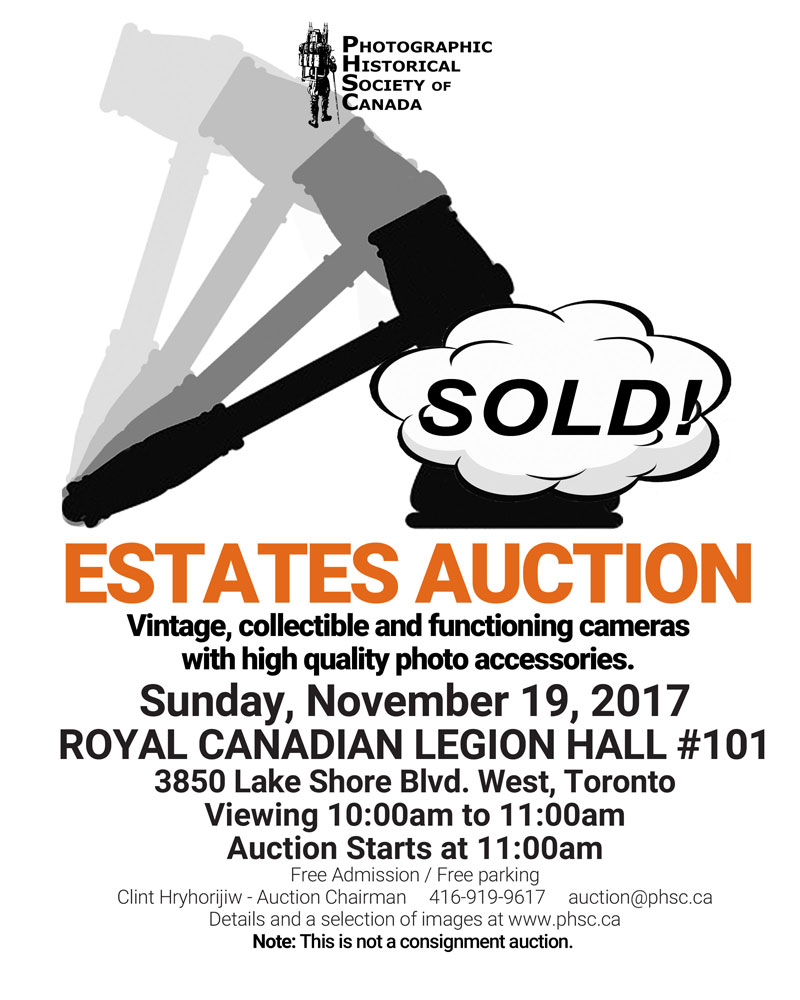
Toronto. Our annual fall auction will be an estate auction. While all people are welcome, we cannot accept any more lots. We do have many interesting and exciting pieces for the collector and film using affection-ado. Included are Leicas, Hasselblads, Canons, Nikons, Manfrotto Tripods, Studio Gear, Lighting, Flash,and much much more. Here is a short PDF list of items – some in the slide show below and some not…

<<Click the icon to see the details – time, place, etc. We did a few posts on some of the cameras, lenses and darkroom gear (A drum you can’t beat, …beginning to see the light, Black is Beautiful, More Fish than Fowl – Leica IIIg, Seven come Eleven…, Some Canons shoot pictures).

There is a slide show of many of the lots (click Continue reading below). Additional photos of lots will be posted to the slide show as they become available. Note that four batches of photos have been uploaded to date, the last thirty or so this evening, November 9th.  And just added November 16th, some Nikon rangefinder cameras, lenses and filters!

Ashley Cook, our Image Show organizer noted that there are a few road closures Sunday, especially downtown. Check out blogTO for details.
Continue reading

Posted in auction | Tagged , , , , , , , , , , | Comments Off on PHSC Estate Auction Nov 19, 2017

PHSC Fall Fair October 15, 2017

PHSC FALL FAIR Click to see details

Toronto. Our PHSC Fall Fair “The Big One” will be held next month on October 15th at Trident Hall in the west end of Toronto.

Lots of parking. Admission $7 – **Students free**

<< Click on the bookmark icon at left for details.

Members will receive the bookmark in our Photographic Canadiana  journal 43-2 which was mailed Friday, September 8th to domestic addresses.

International mailings will follow shortly.

Posted in fair | Tagged , , , | Comments Off on PHSC Fall Fair October 15, 2017

incident light readings

The Famous Norwood Director meter from an ad in the April 1948 issue of Popular Photography

Toronto. I wrap up this series of posts on hand held meters with the famous Norwood Director imported in the States by American Bolex (and later Director Products). Thanks again to George Dunbar for this April 1948 ad from Popular Photography. George mentioned that this was his choice of meter for industrial photography assignments with IBM Canada.

Most meters of the era measured reflected light. The trouble was a light subject tended to be under exposed while a dark subject was over exposed. Reflected light meters had white three dimensional attachments like Weston’s Invercone to read incident light (the light falling on the subject, not reflected by the subject). The Norwood Director was different –  it was designed to be an incident light meter!  The meter recorded the light falling on the subject and matched the same reading as that reflected from a neutral grey subject.

Using an incident light meter gave a more accurate reading for the contrasty colour films of the day. For black and white, the resulting negatives resulted in decent prints. Changing the paper number or development time let you adjust the final result for contrast and tonality.

Posted in camera, photos, processes | Tagged , , , , | Comments Off on incident light readings

an essential tool in the mid last century

Weston Master II Light Meter

Toronto. Continuing yesterday’s theme on hand held exposure meters  (thanks George), this advertisement from Popular Photography’s April 1948 issue shows the famous Weston Master II meter. I bought in less than a decade later with the Master III. Both the II and III had dual scales and used a bakelite disk to switch from bright light to dimmer light.

The meters of that era used light sensitive selenium cells which generated a current when exposed to light – no battery required. Earlier Weston meters used a similar dial. The Master II and later Master III showed minor refinements to the dial. By the time the III was released the famous Weston dial read in ASA numbers, not Weston numbers.

The meter gave excellent results in daylight but sensitivity all but disappeared indoors or at night when a means to determine the correct exposure is most important.

The days of hand held meters were coming to an end. Briefly coupled on-camera meters became common place, then meters were built into cameras. Today, the concept of a separately adjusted meter is obsolete. Cameras and smart phones automatically adjust for the amount of light, shifting speed, aperture, and ISO value. And today’s ISO values were unheard of just a few decades ago, as was optical stabilizing circuitry.

Posted in camera, miscellaneous | Tagged , , , | Comments Off on an essential tool in the mid last century

In the days of hand held meters

LIFE November 18, 1946 advertisement for a GE Exposure Meter.

Toronto. My thanks to George Dunbar for this gentle reminder of days long ago. In mid-November 1946 General Electric advertised its DW-58 hand held exposure meter  answer to Weston in LIFE magazine. You can watch a video of a slightly newer (1949) GE meter here.

The speed of black & white film and the slow shift to colour films necessitated  an accurate means to verify exposure. Films of the day demanded daylight for decent exposures. Night or indoors, photographers had to revert to flood lights or flash bulbs. Professionals already knew and could gauge the best exposure – or bracket any critical shot. Flash was common as a fill-in light or as a means to get a shot – any shot – in dim light.

When I first bought an exposure meter just over a decade later in the late 1950s, I opted for the Weston meter (meters that attached to the accessory shoe and linked to the speed dial were also popular). It was considered the standard while GE was considered an upstart. Those who had no meter could resort to the table that accompanied every roll of film, or use a tried and true rule of thumb.

Amateurs like me were delighted that some shots “came out”. Kodak helped us with its Verichrome black and white film. Verichrome  used two emulsions, a slow one and a fast one layered on a single transparent backing. This technique had the advantage of extending the dynamic range so a slightly under or over exposed shot would still print correctly.

For decades now cameras (and the ubiquitous smart phone) have had built-in exposure meters, initially as separate internal gadgets and later as an automated complement to the camera. Today, like films, glass plate negatives, and flash bulbs, separate hand held exposure meters have been relegated to history.

Posted in camera, photos, processes | Comments Off on In the days of hand held meters

… and now for something entirely different

Ted Talk videos on YouTube

Toronto. Last Saturday I received an email from my good friend John Linsky, our Financial Controller and co-founder of the PHSC. John suggested I watch some videos from recent TED Talks. I watched a few and would heartily recommend the talks to one and all!

Joh says, “Today I got an email from Marc Livingston, the fellow who donated the glass slide collection to PHSC. He sent one Ted Talks Time Lapse Photography presentations – amazing. Here are a few of the Ted Talks presentations on YouTube.com.

“This is addictive! I watched one, then another and another and there’s more. They are an interesting way of viewing what is on the earth, but unusual to see with the Time Lapse photography. Great stuff. ”

Following are three more links John provided. Take a look!

https://www.youtube.com/embed/FiZqn6fV-4Y

https://www.youtube.com/watch?annotation_id=annotation_2963966295&feature=iv&src_vid=FiZqn6fV-4Y&v=IDkSDPgrtjs

https://www.youtube.com/watch?annotation_id=annotation_3179683611&feature=iv&src_vid=FiZqn6fV-4Y&v=gXDMoiEkyuQ

Posted in activities-other | Tagged , , | Comments Off on … and now for something entirely different

Photographic Canadiana 43-2

Photographic Canadiana 43-2

Toronto. We did the address covers and the printing at the top of this Labour Day weekend. Your copy will be in the mail shortly – if you are a member! Not a member yet? No problem. There is a PayPal button and payment options (1 or 3 year domestic; 1 year international) near the top of the right sidebar. And easy-peasy you can be a member too!

We begin with a review of the past three meetings followed by a great article on Zeiss in 1945 during the hectic post-war days.

We cover the spring fair, and our July trunk sale in photo essays. For the photo collector, we discuss pre-confederation CDVs from Canada East and Canada West (with illustrations). And our editor has a lengthy analysis of the D-Day landings in France by Canadian Cine Photographers to give a balanced gravitas to Larry Gubas’ article on Zeiss.


Posted in journal | Tagged , , , , , , | Comments Off on Photographic Canadiana 43-2

September 20th, 2017 Show and Tell

Made by Leitz in Midland Ontario March 1960

Toronto. Traditionally we have held our annual Show and Tell session in December. This year we moved it up to September. And in recognition that it is our 150th anniversary since confederation, we are using a theme of Canadian photographic memorabilia

Bring you favourite Canadian-made collectible bit of photographica and tell us all about it!

And the public is always welcome. Go to our Programs page for times and directions.


Posted in program | Tagged , , | Comments Off on September 20th, 2017 Show and Tell

The Graflex I nearly bought

Toronto. George Dunbar sent out a few more Graflex ads from the late 1940s. One ad struck a chord with me.  In 1960 my main camera was the Exakta VXIIa. I was interested in getting a camera which made a larger negative, so I dropped into my local camera shop, Camera Craft in Barrie. Joe Waterer had a few cameras to show me. He was keen to offer me a 2-1/4 x 3-1/4 inch model B Graflex (like the one in the ad) as one option.

I was put off the Graflex by its antique look and its incredibly awkward shutter. Its focal plane shutter had a long curtain with various widths of slots and various tension springs. A table on the side of the camera showed which slot and which spring to use for a given shutter speed from 1/1o to 1/1000 second.

After looking over the camera I turned it down. Joe then showed me a Japanese knock off called a Rittreck IIa in Canada. It had a modern shutter and came with both 6 x 9 cut film holders and a 120 roll film back. With care, I could use a 2 1/4 square enlarger to print the centre of the rectangular negatives.

I bought the Rittreck but only made a few photographs with it as the Exakta was far more convenient to use –  and looked more like a high end professional or advanced amateur camera to me.

Posted in camera | Tagged , , | Comments Off on The Graflex I nearly bought

Camerama September 24th, 2017

Camerama September 24, 2017

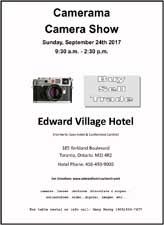
Toronto. Member Gary Perry will host his first fall show for this year at the Edward Village Hotel, 185 Yorkland Blvd on Sunday, September 24th.

Click the icon at left to see or print the show details.

The show is open to all from 9:30 am to 2:30 pm.

Call Gary at 905-550-7477 for table rental or show info.

Posted in fair | Tagged , , , , | Comments Off on Camerama September 24th, 2017