a rash decision

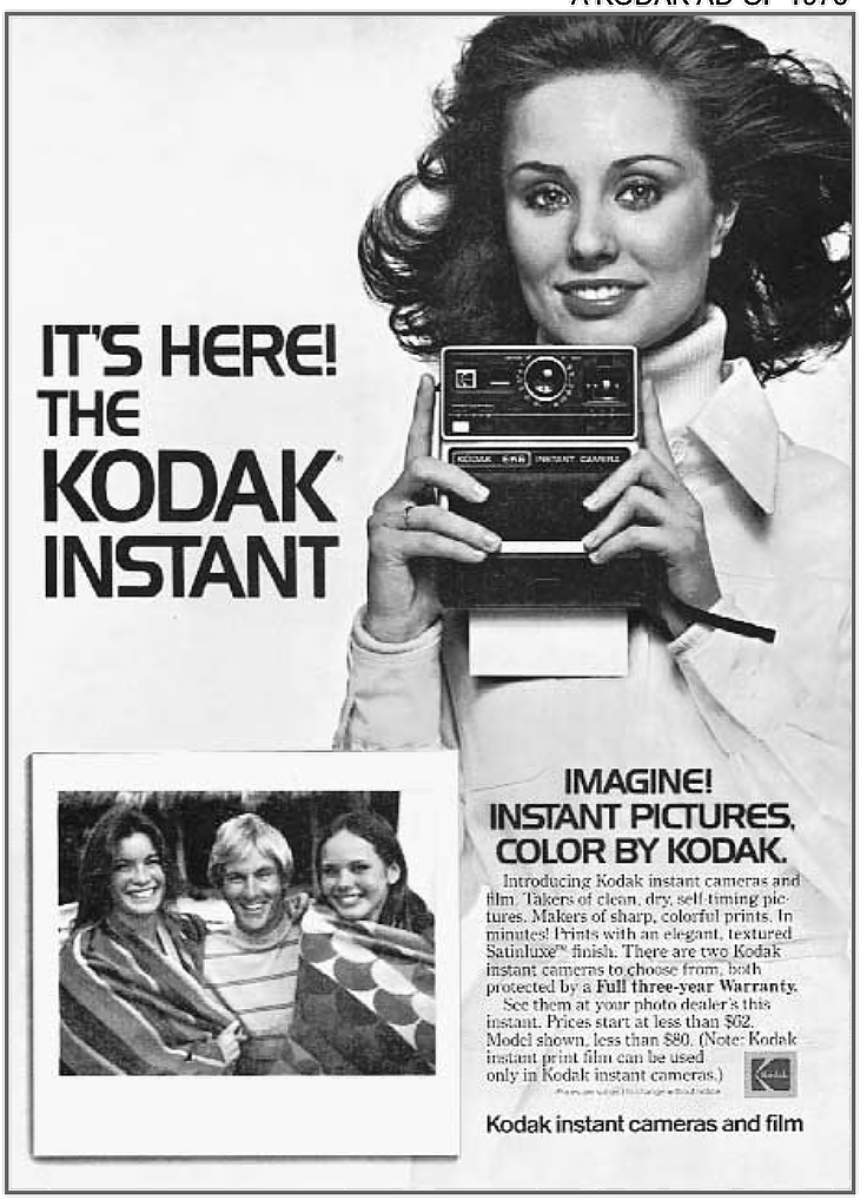
Kodak introduces its version of the Instant Camera

Toronto.  Have you ever heard of a Kodak Instant camera? No? Not surprising, since Kodak was sued by Polaroid and lost the toss. The Kodak Instants (in any condition) were bought back by Kodak for a small sum after the 1986 loss.

In issue 24-4, collector Peter Venema (Caledon, ON) wrote an article titled, “Kodak Instant Cameras – ‘Made in Canada'” (copyright 1998).  Peter’s article is quite lengthy and well illustrated. He begins, “Kodak instant cameras are not a common sight. Born out of a desire to secure a part of the mediocrity market of the instant picture, they appeared on the scene in 1976.

“Kodak had long been aware that Polaroid was doing well with its sales of instant cameras and instant film. The instant cameras were Polaroid’s lifeline with some 90% of its annual gross revenues deriving from it.

“During the period that Kodak was in the instant camera market (entering in 1976 and being forced to withdraw early in 1986), Kodak produced over 16 million instant cameras but its annual revenues from the instant cameras barely made a ripple in its finances. It never represented more than 2% of the company’s annual income.

“Polaroid produced its first instant camera in 1948 and despite rumours that the process was offered for sale to Kodak, nothing came of it. In the 1950s and 60s Kodak continued to do well with its line of films while Polaroid gained a steady increase in its niche market.

“Several events influenced Kodak to alter its decision and jump into the production of instant cameras. By the mid 1960s Polaroid had a stable market in which the sales of its films were higher than the sales of the cameras. This was a good indication of success so it did not go unnoticed in Rochester. As well, market research indicated that an instant camera bearing the Kodak name would be well received by the consumer.

“However, any Kodak instant camera project that might have been in the planning stage at that time fell victim to Kodak’s own success. In 1963 Kodak introduced the Instamatic camera with its 126 film format. Its run-away success shoved the concept of a Kodak instant camera onto the backburner for almost a decade.” …

Members eagerly read all of Peter’s article in the issue 24-4 pdf file on the free member’s only DVD/thumb drive. You can join or renew by following ‘MEMBERSHIP’ above or ‘Membership’ at right. Email any questions to Lilianne at member@phsc.ca.

Posted in history | Tagged , , | Comments Off on a rash decision

describing those old collectibles consistently

Toronto. a big headache to camera collectors was describing an old camera in way that let a prospective buyers figure out the value when sight-unseen. Our exchange member, the LHSA (Leica Historical Society of America) had a particular challenge since the value of many Leica models depended on their condition as well as their rarity. To this end the folks at LHSA printed the chart reproduced in issue 24-4.

Screenshot

Members saw the chart full size in the issue 24-4 pdf on the free members-only DVD/thumb drive. See above ‘MEMBERSHIP’ or at right ‘Membership’ to join or renew. Questions may be sent by email to Lilianne at member@phsc.ca.

Need a Leica for your collection? You may find one today at our famous annual summer trunk sale.

Posted in history | Tagged , , , | Comments Off on describing those old collectibles consistently

nightmare at the fair …

the late Ev Roseborough – photo by Robert Lansdale

Toronto. Our one time journal editor, the late Ev Roseborough was great story teller. Ev ran his own photography studio and being  a risk taker in the business, he had a wealth of fascinating tales.

For editor Bob Lansdale’s issue 24-4, Ev chose a CNE related tale which begins, “This is a continued story; that is, it lasted five days. For my part, it was a fiasco to end all fiascos, and believe me I have run into some dandies!

“August was always a hectic time of the year with the Canadian National Exhibition [CNE] due to open during the last week, to say nothing of Christmas booklets and advertising either in planning or production stages. To make it worse many decision makers were still away on holidays.

“I was fortunate in having an open contract with a large Canadian display firm that was operating around-the-clock to complete sizeable displays for the major motor car manufacturers, oil giants, bakeries and even pickle manufacturers. Although operating outside this company, I was their ‘photographic arm’, supplying photomurals, translite transparencies, slide sequences and almost any other form of photography of which you might think. Most of these jobs were repeat annual affairs.

“The ‘nightmare’ assignment was from a Canadian carpet manufacturer, which had just supplied the Royal York Hotel with a new specially-woven floor covering for their huge lobby. This prestigious achievement was to be the backdrop for a tremendous product exhibit occupying hundreds of square feet in the old Manufacturers’ Building, which has since burned down.” …

Members read all of Ev’s tale -including its surprise ending – in the issue 24-4 pdf on the free members only DVD/thumb drive. Not a member? See Membership above and at right to join. Questions can be sent to Lilianne at member@phsc.ca.

Posted in history | Tagged , , , | Comments Off on nightmare at the fair …

corporate histories

E Leitz NYC

Toronto. Before the internet and web sites caught on, corporations would arranged for their history to be told in books. Some books were coffee table size puff pieces about how great the company is/was; some were rather thin on content as the writer was not that skilled in either writing or research; while others gave a wealth of detailed information.

In issue 24-3, I reviewed a book about Leitz, New York. Well bound and supported by the LHSA, the book is a bit thin on details. The title of my review is, “E. LEITZ, INC. NEW YORK by Emil G. Keller”.

And I  began the review as follows:, “The author is a retired member of the E. Leitz, Inc., New York agency for Leitz, Wetzlar. His reminiscences about the evolution of this important branch of Leitz were self-published in 1996 with support from the Leica Historical Society of America and Manca Inc.

“The book has a 1940s charm. It is large format with a deep-red cloth-bound hard cover of which the material and lettering bring to mind the famous little red fabric-covered boxes that once contained Leica equipment. The paper is a cream tone with the many images printed in black & white. The book is a modest 79 pages with a traditional quality binding.” …

You can tell the book is light on details from the number of words I spent describing its construction … Members can read the entire review in the issue 24-3 pdf on the free member-only DVD/thumb drive. see above or at right (Membership) to join. Email Lilianne at member@phsc.ca should you have questions.

Posted in history | Tagged , | Comments Off on corporate histories

just a minute …

PHSC president Clint Hryhorijiw

Toronto. Exec meeting #60 via ZOOM was held on the glorious 4th (as our neighbours to the south say).

Our treasurer, John Morden, sent out his report before the meeting. In future, this item will be split between John as treasurer and Jeri as financial controller.

Newsletter editor Patrick Gunn  also sent in his written report. The July newsletter is underway. Please note that as response from those wishing to buy/sell items has been slow in light of the many modern alternatives (ie eBay, et al.), Mr Gunn plans to revise the use of this space.

Our fall auction will be hosted on a Sunday in November 2025. A suggestion by Jeri Danyleyko to post the Bidder Form on this website as a convenience for future Auction Bidders met with enthusiasm and it is now posted (See AUCTION> Auction Bidder Registration Form).

Day Lilies – the blossoms last for only a few hours; the plant lives on for decades … like meetings and minutes.

And for those choosing to buy or renew a membership, please remember our journal is now  in ‘pdf format’ only, so an email address is essential. A MailChimp notification is sent to all member emails when each journal pdf is produced and uploaded.

If you are a member but HAVE NOT seen any notification for Photographic Canadiana since you registered or renewed, please email Lilianne at member@phsc.ca.

The PRESS menu item has been modified to note that the Robert Wilson book on Benjamin Baltzly is now out of print. Through the generosity of Dr Wilson’s estate, a pdf copy is now posted for free use by all interested parties.

Arrangements for the fast approaching trunk sale (This Sunday!) are well underway. John Morden has created and issued this clever poster which will remain pinned to the top of page one of this site until the Trunk Sale is is over.

Journal issue 51-1 is underway with work to continue once our editors complete various family tasks. A book on the history of Canadian photography for 1839-1918 is due for release next month and will be reviewed in a coming issue.

Our social media editor, Ms Markovic has provided a brief update for instagram. Take a peak at this interesting site.

And as they say in that old song, “See You In September”.

Posted in activities | Tagged , , , | Comments Off on just a minute …

a weird optical device

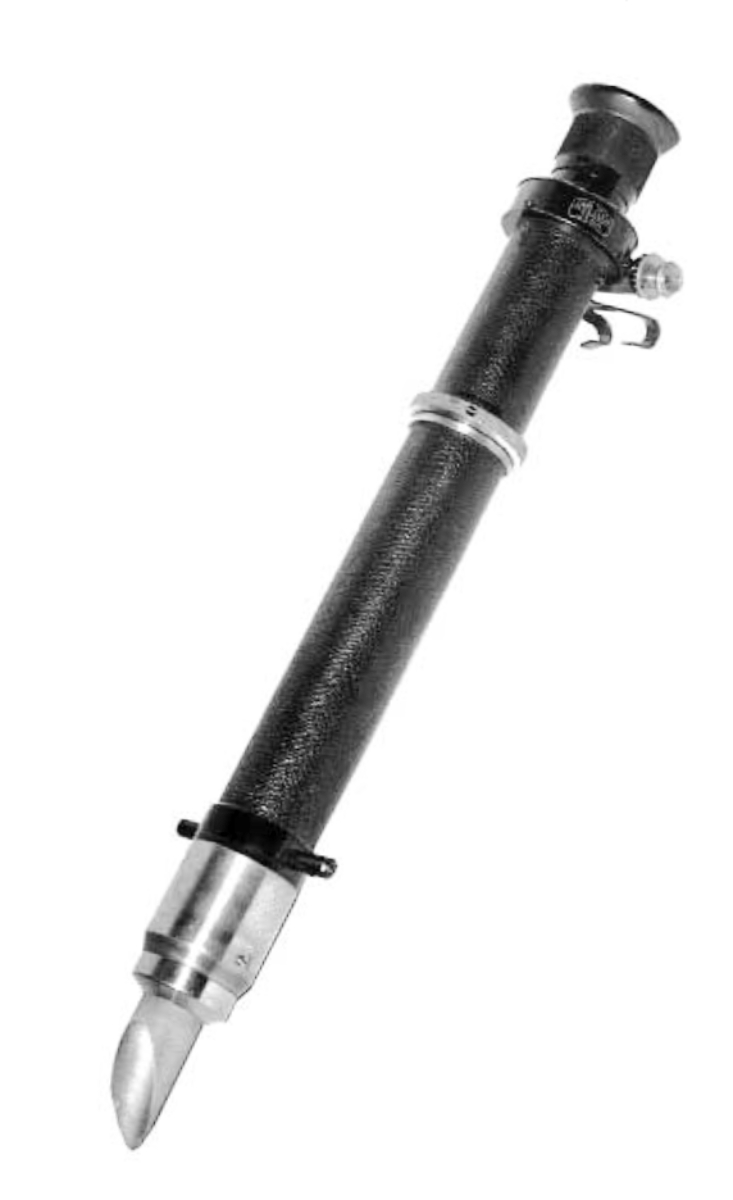
A Refractometer at a 1998 Show and Tell

Toronto. In April of 1998 the society held a ‘Show and Tell’ session at its monthly meeting. The late Ron Anger showed this strange optical device and challenged members to name it.

That naming did occur, thanks to member Egon Kellner. In a brief article titled “A What Is It? Gets Answered”,  Egon writes, ” The optical instrument shown by Ron Anger at the April meeting of the society (Show and Tell) is a refractometer. It is a rather unusual piece of equipment for the camera collector, but an important item found in a medical or biochemistry lab.

“We all know of the refraction of light by a camera lens, similarly a light beam changes direction when it enters a liquid medium as displayed by the apparent bending of a straight rod on entering water. The degree of refraction depends on the atomic or molecular nature of the liquid, as well as its concentration and temperature.

“When a refractive index is determined with an instrument as Ron Anger displayed, then it becomes a simple matter to compute the concentration of a known chemical in a liquid, i.e the protein content in serum.

“Tables that correlate the refractive indecies and concentrations of a large number of organic and inorganic chemicals were developed in 1898 (to give some historical information!) using the instruments manufactured by Carl Zeiss Jena.” … 

The source of this name and more about Ron’s instrument can be read in the issue 24-3  pdf file on the free members-only DVD/thumb drive. See Membership above or at right to join. Drop Lilianne a note at member@phsc.ca if you have a question.

You may not see one of these gadgets at the annual trunk sale, but you will have a great time – and the chance to add to your collection. The Trunk Sale is this Sunday, July 13th – rain or shine. All our PHSC 2025 events are shown to the right!

Posted in history | Tagged , , | Comments Off on a weird optical device

stamp of approval

US Revenue Stamp on back of a CdV photograph

Toronto. Did you ever buy an old image and discover a stamp on its back? PHSC member, sports photographer, writer, etc., etc., Les Jones, offers one explanation in his article published in issue 24-3.

In his article, “What Have CdVs Done for you Phi…Lately?” Les explains that the American government used special ‘revenue’ stamps to pay some federal taxes. The article begins, “There may be more value in those carte de visites (c.d.v.’s) than you think! Run-of-the-mill cdv’s are commonly available at a $1 or less, [fall 1998] though antique dealers may charge $6 or more depending on the content.

“Early American examples may bring a bonus if the photographs were taken during their Civil War. Here the revenue stamp on the back may often be worth more than the actual image; if you are really lucky it could be worth hundreds of dollars.

“Stamps had been in use for several hundred years before there was general adoption of the adhesive stamp for postal uses in 1845. Two years later, in July 1847, the first U.S. government stamps were issued and in 1863 a uniform letter rate was established.” …

Members read this article in full, plus seeing the photos used to illustrate it by viewing the issue 24-3 pdf file on the free members-only DVD/thumb drive. To join, just follow the notes above or at right under Membership. Questions can be emailed to Lilianne at member@phsc.ca.

Old images are often available at PHSC events such as our 2025 events listed at right. Next up is our annual summer trunk sale just days away on Sunday, July 13, 2025.

Posted in history | Tagged , , , , , | Comments Off on stamp of approval

proof of the pudding …

1837 test portrait of M Huet by Louis Daguerre, © Études photographiques, France

Toronto. … is in the eating, or so they say. About two years before announcing the Daguerreotype process, Louise Daguerre tested his process by taking a portrait of M Huet. The reproduction in issue 24-4 is courtesy of and is © Études photographiques, France.

The portrait of M Huet as taken by Daguerre is believed to be [1999] the oldest portrait taken by photography. The image was provided by Luis Nadeau who translated the French write-up to English with this précis, “In a recent issue of the French review Etudes photographiques, the oldest known portrait photograph has been identified as that taken by the inventor himself, Louis Daguerre in 1837. That was two years before the official announcement of the daguerreotype process.”

The actual article begins, “According to Andre Gunthert, the daguerreotype was found some ten years ago at a flea market by Marc Pagneux, an art dealer and one of the most respected French dealers of historical photographs. He paid 600 francs ($240) for the 5.8 x 4.5 cm plate which was mounted within a frame bearing the name of Daguerre.

“This in itself is not significant as there are a lot of plates of this type on the market. As a member of the Societé française de photographie, M. Pagneux asked another member Jacques Roquencourt, one of the better known Daguerre specialists in France, to help him examine the plate further.

“The frame was opened – it contained another frame, invisible from the outside, bearing an inscription: ‘M. Huet / 1837’.” …

Members enjoyed reading this and all the Jan/Feb 1999 Journal by viewing the issue 24-4 pdf file on the free members-only DVD/thumb drive. You can read it too, just join the PHSC following the material above and/or at right titled ‘Membership’. Questions? Email Lilianne at member@phsc.ca.

Posted in history | Tagged , , | Comments Off on proof of the pudding …

these shoes are made for walking …

made for walking …

Toronto. Collectors of cameras and photos haunted garage sales, photo retail stores, antique shops, flea markets, etc. in search of old collectibles. Some even resorted to want ads in the days of newspapers. The mantra was “save the best and sell the rest”.

Photo Historical Societies were a god send. Duplicates and things no longer of interest could be resold to recover the funds paid out and perhaps even make a small profit. At our PHSC, when monthly meetings were in person, excess items were offered at tables before and after each meeting. Annual fairs sprung up. Auctions began as separate shows to move less expensive member items and quickly evolved to estates and higher ticket items from anyone.

Fairs and auctions became twice annual events (and some times more). Such events continue today. Many thrive, especially our fairs and auctions. See the 2025 PHSC Events at right. Next up is our famous annual summer trunk sale on July 13th – rain or shine. See John’s snappy poster for details.

NB. The title of this post is a riff on Nancy Sinatra’s big 1960s song, “These boots are made for walking“.

Posted in history | Tagged , , , , , , , | Comments Off on these shoes are made for walking …

what goes around …

a means to allow digital images on film cameras

Toronto. … comes around. Member Wayne Ridley sent me an email recently about a device to allow film camera collectors and users to convert many popular film cameras to digital by inserting  special ‘digital’ film.

When digital was relatively new to photography, an accessory was announced to fit the 35mm film chamber. The sensor stuck out on an arm to where the film frame would be exposed by the shutter’s action. The device seemed to disappear before wide spread marketing.

A company out of Switzerland now offers a wide range of gadgets to convert many 35mm and medium format film cameras to digital to let the ‘film fans’ dip their toe into the digital world while still using a favourite camera and its lenses.

The company in Switzerland displays its wares here. Note that CHF is Swiss Francs. A Swiss Franc is about 1.714 Canadian dollars at the present exchange rate. Not sure of any duties or shipping costs associated with the items.

Our interest? Well. at some distant point in time these accessories too will become collectible. Meantime dedicated folk can create digital files with their favourite film camera…

Posted in camera | Tagged , , , | Comments Off on what goes around …