even educated fleas do it

Nikon’s version of a microscope camera

Toronto.   The title of this post is a line from a 1928 Cole Porter song (Let’s Do It). I first heard it in the 1950s on a Columbia LP of Noel Coward at the Desert Inn in Las Vegas.

Many camera companies evolved from optical houses and made products like microscopes. Nikon is no exception. Nippon Kogaku made many optical products before its famous F SLR was used in the Vietnam war and later introduced to the USA.

Once Leitz developed a device to connect a 35mm camera to a microscope, others jumped on the band wagon. This included Japanese optical houses. Nikon’s FX-35DX camera shown here was specifically made for scientific use such as on microscopes. No rangefinder. No viewfinder.

This version has a Nikon mount but can also come with a Leica bayonet-mount to fit the Leitz MIKAS. Many microscope makers moved from glass plates to 35mm cameras using special devices like the MIKAS to accurately focus and frame microscope images on the film.

Posted in history | Tagged , , , , , | Comments Off on even educated fleas do it

really, really, close close-ups

Leica IIIc with MIKAS and 1/3 tube on a microscope

Toronto. Like a few other camera factories, Leitz is known for its microscopes. For years the makers of microscopes also made camera like devices to mount on the microscope and record little parts highly magnified.

A few years after the Leica became a marketing success, Leitz made a micro ibso gadget that joined a Leica camera to a microscope while allowing the image to be accurately focussed via a small telescope device.

A leaf shutter in the micro ibso (just above the telescope) ensured there was no obvious shutter movement. Leica’s traditional focal plane shutter – like all such shutters – would cause an asymmetrical vibration and blur the highly magnified image.

Shown is a post war IIIc and a post war MIKAS micro ibso with a 1/3 magnification tube and lens mounted on a c1930 microscope. The focussing telescope is the larger post war version. I picked up my copy of the MIKAS and 1/3 tube in 1984. Various MIKAS devices attached to both  screw-mount and bayonet-mount Leicas as well as movie cameras via a c-mount ring.

The 1/3 tube reduced the microscope image to 1/3 size allowing most of the image to be recorded. Traditionally a glass plate at least about 3x the size of a Leica negative was used.

Posted in history | Tagged , , , | Comments Off on really, really, close close-ups

a head for photography

Helmeted Diver using a screw mount Leica (IIIa?) – Hulton-Deutsch Collection / Corbis via Getty.

Toronto. George Dunbar sent me this image of a diver using a Leica with the special release accessory operated by teeth. This is photo number 17 in the series, “Weird, Wonderful Photos from Another Era” shown in an article by Alan Taylor on June 24th, 2019 in a column called, “InFocus” on The Atlantic website.

Taylor writes, “While doing my job of researching photos for various stories, I always come across more interesting images than I need, or photos that are unrelated to the story yet still remarkable, strange, hilarious, or just great shots. I tuck the best of those into a folder without a clear plan for future use.

“Today, I offer another sampling from that folder—a grab bag of historic images depicting land-speed records, underwater photography, Italian elections, a young Princess Elizabeth, a streamlined ferry, and more—from epic achievements to small moments. There isn’t really a theme here, other than ‘I thought these were neat photos, many rarely seen, and thought you’d enjoy them as well.’ This is part of an ongoing series of collections of interesting photos from the past.”

The cut line for photo #17 in the series is, ” diver demonstrates how he took photographs of the wreck of the Royal Navy submarine HMS Thetis by strapping a Leica camera inside his helmet and holding the trigger between his teeth.”

Posted in history | Tagged , , , | Comments Off on a head for photography

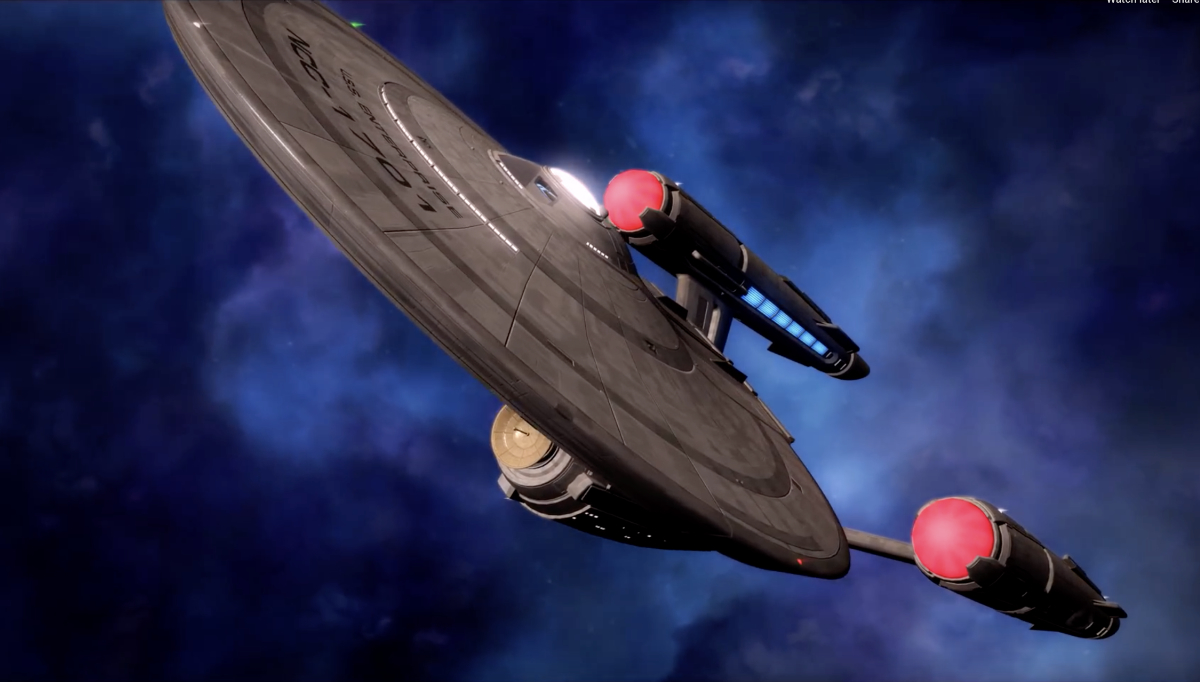
the next generation?

Enterprise from Star Trek

Toronto. Trekkies everywhere will recognize this famous inter-galactic spaceship.

When the art of photography was announced in January, 1839, it too was revolutionary: Two different processes were announced – one in France; one in England. Both were monochromatic,  dead slow, and very technical to use. One gave very contrasty, high resolution, one-off positive results (daguerreotype). The other was low contrast and low resolution but used a negative-positive system to make many prints from one negative (calotype or salted paper).

As time progressed, each generation tackled one issue: speed (faster lenses, faster media), motion (movies), dimensionality (stereo), colour, digital and now perhaps imagery defined by polarized light. Each generation added more converts as capturing a “good” image took less and less skill. With digital, we entered the paperless universe of the average amateur photographer retaining only a digital image using auto-everything cameras now in every smart-phone and uploading the image to social media.

My good friend (often participating at our fairs), Russ Forfar, operated Kominek’s camera repair here in the city for decades before recently fleeing to the bugs and blue skies of the Bruce peninsula. Russ sent me this fascinating article from Science Daily:

Camera brings unseen world to light

“Portable polarization-sensitive camera could be used in machine vision, autonomous vehicles, security, atmospheric chemistry and more”.

Could this be “the next generation” of photography?

Posted in history | Tagged , , | Comments Off on the next generation?

lookin’ for Llewellyn

1913 ad for retouching desk

Toronto. On June 17th, Kay McGinnis wrote me searching for information on Llewellyn Abbott, or more precisely our articles on his photo studio employers in the big smoke. I sent Kay copies as asked and sent her request on to our editor, Bob Lansdale, who is keen on the history of Canadian photographers and studios.

Kay later received a pdf copy of our journal with Ev Roseborough’s article on retouching. As Kay explained, Abbott was listed in Might’s city directory as both a photographer and a retoucher. Abbott spent a decade as a retoucher for Chas Aylett who was well known for his quality portraits of famous people.

She posted the story of Llewellyn Abbot on her blog “McRoberts Avenue” as 25 McRoberts Avenue. Kay wrote a well researched article on Abbott from his early days in Meaford Ontario as a photographer through his various positions here in Toronto before, during, and after the second world war.

She would welcome any additional details and photos of Llewellyn Abbott. Drop me a note or contact Kay via her blog.

Posted in history | Tagged , , | Comments Off on lookin’ for Llewellyn

movies, colour slides, and loose change

Save $12.85 cents in 1956

Toronto.  After about two decades of scrimping, the average person finally had some money for discretionary spending. Marketeers leaped on this largess and pummelled the common man with ideas for things he did not need. In the case of photography, the fresh ideas were home movies and colour slides.

Neither movies nor slides were viewable without a projector so Joe Average just had to have one (or two). And who could deprive his family of his child’s motion, or memories of his family in FULL COLOR?

Ansco and Bell and Howell collaborated to sell colour slide film and a slide projector saving the buyer money. While the savings seem trivial today, in 1956 that amount was a week’s salary to many in small towns. The ad was printed in LIFE magazine in the July 23, 1956 issue. Like many such ads, it was a deal LIMITED to the USA. This was due to other companies having the right to import the branded items and set prices, but deciding NOT to collaborate on the deal.

In the late 1950s I too used Anscochrome and its Easy Loader. The roll of unexposed colour slide film was even notched to fit a 35mm camera. The kit included eight unused cassettes each boldly marked with the Anscochrome logo.

Posted in film | Tagged , , , , | Comments Off on movies, colour slides, and loose change

where the girls are

video on LIFE’s female photographers.

Toronto. We have fought for many kinds of equality over the years. One kind is gender equality. Before retiring almost 30 years ago, I watched Bell struggle to improve gender equality. Recently, our federal government bravely formed a senior group of MPs, half of whom were women. Things didn’t go quite as planned…  And record companies like Ace made compilations of female groups.

In this recent nod to gender equality, the New York Historical Society, mounted an exhibition of some of Life magazine’s better known women photographers called “Women Behind the Lens” and curated by Marilyn Satin Kushner.

The BBC  featured a short video on the subject. Thanks to George Dunbar for bringing this video to my attention.

Posted in people | Tagged , , | Comments Off on where the girls are

“I see”, said the blind man …

Carpenters in 1909
by P H Figary of Toronto

Toronto. — as he picked up his hammer and saw … This old bromide was around when I was a kid. The photograph at left was taken by P (Philip) H Figary, 590 Yonge St, Toronto (west side of Yonge, a few doors above Wellesley. Click to see 590 Yonge St  today from Google Street View). The shot at left is from the TPL and shows  a collection of carpenters. It caught my eye because my mother was born in Toronto West/Junction in 1909 and her grandfather was a carpenter.

Remember, when you do your Canadian photographic research, the wealth of details we have here in our city archives, our schools and our library System. Just saying!

Posted in history | Tagged , , , | Comments Off on “I see”, said the blind man …

the boys of summer

Homer by NY Yankees great Mickey Mantle – photo by Ralph Morse

Toronto. Don Henley was a singer and percussionist for The Eagles before that dysfunctional group imploded. Most of the group went on to play solo – some with their own bands. Henley made a CD called “Building the Perfect Beast”. The lead song was called “The Boys of Summer“, a tag earlier applied to baseball players.

Micky Mantle was one of the great players of his time and he was captured at each base during a home run he hit for his team, the New York Yankees, at Cleveland’s stadium. A serious drinker and womanizer, Mantle paraphrased near the end of his life, “If I’d known I was gonna live this long, I’d have taken a lot better care of myself”.

The homer multiple exposure photo was taken by Ralph Morse for LIFE magazine and appeared in its June 25, 1956 issue on pages 106,7.

It was unusual in that intentional multiple exposures on a single negative with such accuracy were unheard of in that era. So called double exposures in camera were considered a rookie mistake. In the darkroom more than one negative could be and often was used to make a print.

My thanks to George Dunbar for sharing this remarkable photograph with me.

Posted in photos | Tagged , , , | Comments Off on the boys of summer

Al Who’s little Italian Buddy

San Giorgio magnifier for focussing slide c1950

Toronto. The company “San Giorgio” (St George in English) was founded in Genova, Italy in 1905 to manufacture automobiles. Like many companies, products changed to those with more potential for profit. San Giorgio S.I.p.A. dropped automobiles and moved on to optical instruments including cameras.

After the second world war, it briefly made cameras based on screw mount Leicas (the Janua series) and many accessories including a focussing stage and a ground glass magnifier.

Unlike Leitz, they made a shell with inserts for various magnifications. I have a shell plus the 20x and 40x magnification inserts purchased from Robert Pins in the States back in 1988.

Posted in history | Tagged , , , , | Comments Off on Al Who’s little Italian Buddy