get great photo information

Share your email with your society

Toronto. We have seen a seismic shift in photography these past years as the art moved from film to digital. And within digital from discrete cameras to those built into smartphones.

On top of this in 2020, we have seen a pandemic so awful it has fundamentally changed our world. To compensate the lack of contact with our members, our editor and treasurer have gone out of their way to produce specials that are members only. (We will continue to issue our PHSC News which is open to all.)

Sadly, even in this year of 2020, with email now available for over TWENTY years, we still have a few members who do not or choose not to have emails that are shared with the society. We urge all – especially members – to get an email address and tell us what it is. Feel an email is a luxury? Then go for a free email from Google (gmail) or Microsoft (hotmail) or their competitors and use a computer at a friend’s home, or a local library, or a child/grandchild’s home.

If you ARE a member and haven’t seen the emailed pdf files, then email me at info@phsc.ca and I will make sure you are registered both in your membership record and on MailChimp.

Posted in activities | Tagged , , , | Comments Off on get great photo information

electric avenue

EE January 1920 issue cover

Toronto. Over the years, any significant scientific discovery was soon promoted as a nostrum for curing any long-term illness without recourse to the nasty demands of scientific proof. Electricity, Radiation, Atomic Energy, etc. The list goes on including most recently “cures” for Covid-19 from the US President down. But other non-medical uses were touted, often ones very innovative for the time.

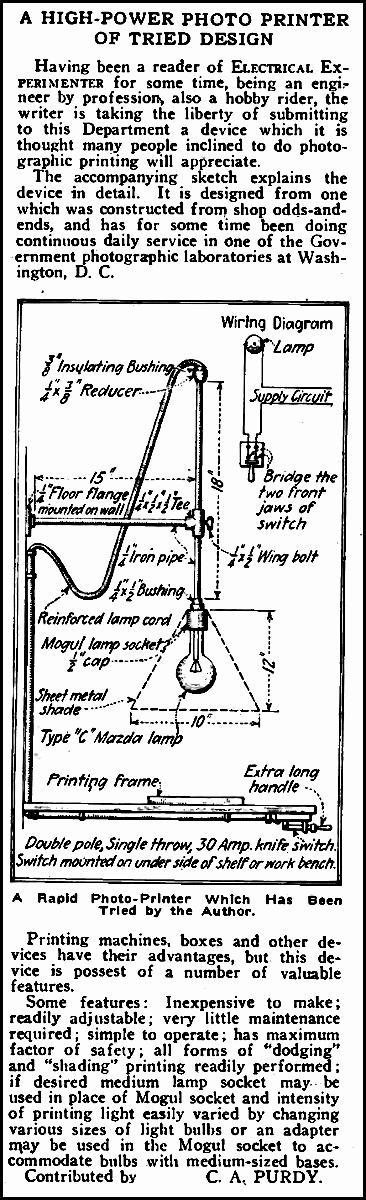
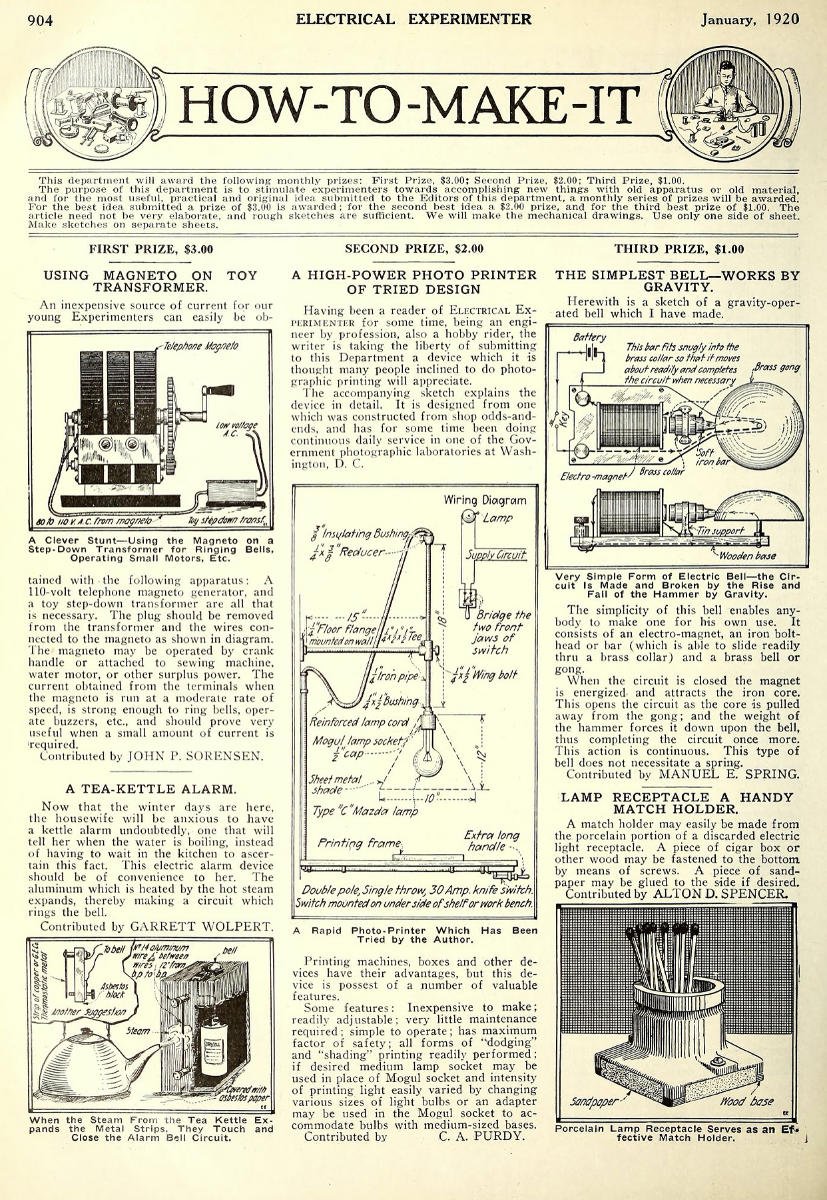
In 1920, a popular American magazine was called “Electrical Experimenter“. Its editor was Hugo Gernsback. While mainly devoted to radio (wireless) and electricity, amongst the January 1920 articles was a photographic piece on page 904 showing how the relatively new electric lighting could be used to contact print indoors. Space between the light bulb and printing frame could allow a degree of dodging and burning if needed. I am surprised that the DPST (double-pole, single throw) knife switch under the shelf didn’t accidentally electrocute the photographer!

NB. The post title comes from Eddie Grant’s 1982 protest song of the same name sang by him in this 2006 upload to YouTube (this tune has a very low res video). As a youth, I read Gernsback’s Radio News and occasionally Science and Mechanics for many years. A tip of the hat and a big thanks to good friend George Dunbar for sharing his research with me.

Posted in history | Tagged , , | Comments Off on electric avenue

Get Me to the Church on Time (Trunk Sale)

Same Place, New date (this Sunday)!

Toronto. After months of COVID-19 restrictions, we can finally host an outdoor event at the Trident Centre. Our first camera show this year is the Trunk Sale delayed from last month and now ready to go August 23rd!

Click on John and  Sonja’s poster icon at left for a larger poster filled with the pertinent details! Or drop down to this link for an alternative poster.

Cameras, accessories, film, darkroom, images etc. have all been available at past sales. One of the first shows in the area this year!

And there really is a church at Trident Hall each Sunday!

NB. This post title is from 1956’s “My Fair Lady”, and the tune of the same name as sung by Stanley Holloway playing Eliza’s Father, Alfred P Doolittle. The play is an adaptation of George Bernard Shaw’s Pygmalion.

Posted in fair | Tagged , , , , , | Comments Off on Get Me to the Church on Time (Trunk Sale)

why everyone should learn photography

smartphone photo
by Harry Guinness

Toronto. Life Savvy posits “why everyone should learn photography” in its post by Harry Guinness back on May 12th. This article is in the “if you can’t beat them, then join them camp” as Harry sets out to teach smartphone owners and users the basics of taking good photos with their smartphone.

Harry writes about photography on How-to Geek, one of the blogs I follow regularly. You might enjoy some other articles on either blog (Life Savvy or How-to Geek) – have a look.

Posted in history | Tagged , , , , | Comments Off on why everyone should learn photography

brave new world

Slide courtesy of Gordon Brown’s talk January 2003

Toronto. Today, almost everyone has a smartphone that includes a sophisticated digital camera and editing apps. Stills, selfies, and videos are taken incessantly.

With some care, and little or no photographic skill, people capture a decent image. In fact, they don’t think twice about snapping off dozens of images – no cost and no delay to see the results. Bad shot? Trash it! Good shot? Email it!

It was nearly 90 years ago in 1931 (when Aldous Huxley wrote his book of the same title) that a roll of film often lasted amateurs – casual or serious – weeks. Cameras were mostly bulky affairs, films or plates were black and white (with the rare colour film/plate for the adventurous). Skill was needed to correctly select, frame, and expose a subject. Tripods were a necessity, not an add-on to show you were a serious photographer.

NB. I discovered Huxley’s works in the early 1960s reading “Brave New World” and a couple of his other novels. “Brave New World” seemed to be a fitting title for this post given the Herculean photographic transition from film to digital this century.

In the 1970s, Kodak experimented with digital cameras but the research was just that. Kodak made most of its profit from the sale of film and paper at the time. However; Kodak’s research into digital technology continued and for a time “Great Yellow Father” was a major factor in digital photographic technology.

By January 2003, when George Hunter first spoke to us on the topic of  “Tales of a Photographer“, professionals were beginning to scan and print. Digital cameras were still too low resolution and too expensive so many pros would shoot film and scan it allowing Photoshop technology to clean up the image and digital printers to create longer lasting prints.

On September 19th, 2007 we had the pleasure of hosting a talk by Gordon Brown called “Photography before computers and after digital“. Gordon was both a scientist and a photographer. He researched subjects for Kodak (like the T-Max name) and taught the ZONE System at the Ansel Adams school. His talk covered the history of digital photography from its beginnings in the laboratories of Kodak to the mid 2000s – spanning some thirty years. The above slide image is from his talk.

By March 2008, when Rob Skeoch (pronounced skew) spoke to us calling his talk  “Observations of a Large Format Photographer“, digital technology had made serious inroads over film. Sports photos, once worth hundreds of dollars a shot had fallen to $25 at most. Instead of a publication paying for a single slide chosen by the photographer to be mailed in; literally hundreds could be emailed to the editor and the editor, not the photographer, could and did pick and choose! Continue reading

Posted in history | Tagged , , , , | Comments Off on brave new world

boxes, bellows, and beyond

Adjustment scale for the Poco camera which uses a bellows and brass rail mechanism

Toronto. Most of the early cameras were big boxy things with relatively small diameter lenses. Early on you changed lenses to change angles of view (wide angle, telephoto) always mindful of the diameter of the circle of confusion – or how much of the plate could be covered without vignetting. Stopping down a lens would improve its coverage

To focus on both near objects and infinity, the awkward old cameras had to be adjusted. The two most common approaches were the box-in-a-box and the  bellows. As cameras shrunk in size, the so called normal lens became shorter. For a brief time both bellows and threaded metal focussing mounts were used. As the minicam revolution in the 1930s took off, threaded metal focussing mounts took over the market. Extension rings, bellows, and auxiliary lenses were used to allow close-ups closer than about one metre – the common near focus distance of a minicam such as the Leica.

In the above photo, you see the distance scale for a Poco camera allowing the lens to be focussed at distances shorter than infinity.

Modern day smart phone cameras are automatically focussed internally leaving most users   with little if any interest in how the technically sophisticated little wonders accomplish such focussing from infinity to a few inches. They are marvels with about a 3mm focal length lens (equal to a 35mm lens or even shorter today) and auto focussed using a square box outline and finger tap on the gorilla glass screen.

Posted in camera | Tagged , , , , , | Comments Off on boxes, bellows, and beyond

that’s life

J.R. Eyerman, Audiences Watches Movie Wearing 3-D Spectacles, 1952. Gelatin silver print, 11 1/2 x 8 1/2 in. Museum of Fine Arts, Boston, 2018.3341

Toronto. Ol’ blue eyes sang “That’s Life” back in 1966. The magazine called LIFE is a fascinating history of the middle class American psyche. Thanks to Google Books, every page can now be read. The magazine’s advertisements are a fertile ground for photographic history research on that art in America – especially its cameras. As the American public is a trend setter, the ads (and often the editorial content) show the historic progress of photography as it evolved from an outdoor, primarily black and white, art form to an outdoor/indoor full colour means to record family history.

The Princeton University Art Museum has produced an exhibition called “LIFE Magazine and the Power of Photography“. Online, a number of videos show what the magazine represents to Americans (and history).

Earlier this month my friend and fellow PHSC member, George Dunbar, wrote, “An absolutely “must watch” video (28 minutes) of Life Magazine and how it came to be an outstanding user of great photography is online [now].

George recomended the first video in the series (upper left on the university site) titled “Exhibition Tour | LIFE Magazine and the Power of Photography”. Enjoy the video bearing in mind that the magazine promotes an American perspective on history. And it was read all over the world. Back when I was a kid in Ontario, my local barbershop had copies of magazines including LIFE and Saturday Evening Post to entertain and educate his shaggy haired cliental waiting for their trim.

Posted in history | Tagged , , , | Comments Off on that’s life

focus magic

Focus Magic

Toronto. A reoccurring problem with photos whether taken with film and scanned or with digital cameras is blur due to either camera motion or being slightly out of focus. Many imaging applications try to fix this issue, usually via the unsharp mask.

Focus Magic is a small app and plugin for other image software programs. Focus Magic works incredibly well. Initially, it was Windows only, but now it comes as a 64 bit Mac plugin for programs like Photoshop or Affinity Photo. While a little pricey for a plugin, the app is a one time purchase with lifetime updates.

I first used Focus Magic about 20 years ago on a Windows computer. It was by far the best application for correcting an image suffering from slight blurring. Take a serious look at the web site, read the reviews, and try it for yourself. Continue reading

Posted in photos | Tagged , , | Comments Off on focus magic

take a (down)load for free – Part B

Lanterns Part B

Toronto. This special is titled, “ALL ABOUT LANTERN SLIDE PROJECTORS (PART B)”. It was sent out Friday to all current members with an email address. If you did NOT get a copy, please email me at info@phsc.ca and I will send you a copy after verification of your membership. Not YET a member? Grab your plastic and register via PayPal on the upper right of this page!

This is a reprint of a 1992 publication in California. The preamble inside the front cover states, “The advertisements and illustrations in this supplement originally appeared in The Photographist, number(s) 93/94, the journal of the Western Photographic Collectors Association (WPCA) in 1992. The WPCA was affiliated with the University of California Museum of Photography and stopped publishing circa 1996, going into dissolution in 2001. For the story of the history of the WPCA, see the article in Special Supplement Vol. 1 No. 1.

“In an effort to make this material available to collectors, historians and those interested in the history of photography, this content was digitized by the Photographic Historical Society of Canada (PHSC) and Milan Zahorcak from the U.S. in 2019 for distribution to PHSC members as a seven part series. Subsequent issues of the series, forthcoming in the following months, are shutters, posing chairs, flash lamps and two parts covering early enlargers. If you have any questions or would like higher resolution scans of any of the images, please contact the PHSC at info@phsc.ca.”

NB. The title of this post is a riff off a line from Robbie Robertson‘s song, “The Weight“. Robertson wrote the song in 1968 after he formed a group called simply, “The Band“.  I bought the first album by the Band called “Music from Big Pink” many years ago. At one point,  Robertson headlined concerts for Bob Dylan. Their final concert was in San Francisco, and was featured in a movie called, “The Last Waltz”. Robertson was born near Brampton and now lives here in Toronto. I saw him down at Indigo on Bloor a few years ago with Leonard Cohen. You can learn more from a documentary on the Band and Robertson featured recently by the CBC.

Posted in journal | Tagged , , , | Comments Off on take a (down)load for free – Part B

taking the red-eye out

red eye courtesy of  Skydocu

Toronto. When we hear that phrase today, we think the speaker is flying over-night to the coast to wake up bleary eyed and fuzzy for breakfast thousands of miles from home But that wasn’t always so. In the 1950s, colour film and on camera flash bulbs combined  to create a new problem. Even today with the ubiquitous modern smartphone cameras and flashes we somes times see red eye pupils.

In dim light, our pupils expand to let in more light. If light reflects back off our retina, the retina appears to be red. With an on camera flash close to the lens. this reflection makes people in the photograph have red, not the usual black pupils. Professional photographers would use off camera or bounce flash to avoid this issue.

When computers and image correction applications came along, a tool was added to allow the red pupils to be covered by a same size-disk of black with soft edges replicating natural pupils. Modern day smartphones have a sufficiently high ISO ratings that in most cases the flash becomes a fill flash and red eye is avoided. If not, similar edit tools on the smartphone apps usually do the job without recourse to computer-based applications as shown in the above image, courtesy of Skydocu Inc. on its iPhone site.

Posted in history | Tagged , , , , , , | Comments Off on taking the red-eye out