a colourful symposium

Symposium April 29 – sign up now via EventBrite

Toronto. As I mentioned yesterday, our April meeting has been shifted to April 29th. Registration is open now at EventBrite.

We have been hard at work on this end and are  collaborating with the ESHPh group and Dr Hanin Hannouch (our guest speaker last July) in an exciting series of presentations and discussion on one of our favourite topics –  THREE-COLOUR PHOTOGRAPHY AROUND 1900. The first 100 attendees will be able to ask questions of the speakers during the Q&A session. Our president, Clint Hryhorijiw, will be one of the three moderators at the symposium, while our programme director, Celio Barreto, will operate behind the scenes.

Be sure to check out the imposing line up of speakers and sign in today! Use this EventBrite link or any of the above links for registration and details of this symposium.

Posted in program | Tagged , , , | Comments Off on a colourful symposium

… and a merry ZOOMas to all!

Toronto. Good heavens! We held our  twenty-fifth executive meeting via ZOOM on Wednesday evening. Clint (and Ashley) announced that he found an alternative place for this year’s spring fair. It is where we hold our auction (NEW FAIR VENUE). Given the COVID sixth wave is underway, we will decide to go or bail late this month on both fair and auction. At that time I will post the fair, auction, and trunk sale dates and venues as appropriate.

As mentioned last month, we are taking March off and moving our April meeting to the LAST FRIDAY of the month (April 29th) to join the ESHPh group in an exciting series of presentations and discussion on our favourite topic.  Title for the symposium is “TECHNOLOGIES, EXPEDITIONS & EMPIRES – THREE-COLOUR PHOTOGRAPHY AROUND 1900”. Eventbrite is ready to accept tickets now. After 100 tickets, the symposium will live stream via our YouTube channel (there’ll be with no option to ask the panel questions via YouTube).

Our president, Clint Hryhorijiw, will be one of the three moderators at the symposium, while our programme director, Celio Barreto, will operate behind the scenes. We will be posting more information both here and on other media such as EventBrite.

Our May presentation is on Japanese photographs and equipment around 1900 with Dr/Reverend Max Dionisio head of the Royal Ontario Museum (ROM) Library. See April’s or May’s PHSC News (or a later post here) for details.

David and Louise report their efforts at creating the third issue of our journal as moving along quite well, but they would still welcome ALL hopeful writers with stories about photography, especially here in Canada.

Finally, remember that our membership year is now from January 1st to December 31st. All those whose memberships previously ended in 2022 will be extended to December 31, 2022 at no added member cost. And our annual general business meeting (AGM) will be moved from April to December.

Posted in activities | Tagged , , , | Comments Off on … and a merry ZOOMas to all!

gone fichin’

An October, 1942 article on a microfilm reader

Toronto. We usually think of photography as synonymous with pictures. But it also had a very practical side as a means of record keeping – even before digital technology and EXIF el al file data. In the 1960s, when I was in our Dorval Quebec data centre, we recorded and stored many files not as paper copies, but as negatives on ‘microfiche‘ cards. A reader was used to view each tiny negative blown up to viewing size. A mechanical device in the reader allowed the fiche to be moved around so  every tiny negative could be placed under the viewing lens as needed.

Two decades later, when I researched our census records in the 1980s, I went to the Ontario Archives (then on Bay street and in reach of millions of people, now days away in Thunder Bay readily accessible by about 0.oo1 percent of the population …).  You called up a reel of negative film to see the census records for a particular year and town, then scrolled through the records to find your ancestors. The actual paper records were long gone, having been destroyed since the negative rolls took up so much less space. If you didn’t know your ancestors by name, town and street, you were out of luck.

Today with Ancestry these film records finally have an index by name – the way one would expect to search. The ‘indexers’ took a stab at translating names and hand writing – sometimes with hilarious and rather opaque results.

Another valuable use of the technology was to allow newspapers to be archived in a much smaller space yet still be read many years later.

This article from the October, 1942 issue of Popular Mechanics shows a new ‘microfilm’ reader. My thanks to George Dunbar for sharing this bit of nostalgia with us. Books like the Leica manuals show documents being copied to negatives. The use of readers doesn’t seem to be illustrated as much. Rendering documents to a far smaller physical space is just another way we could benefit from photography back when film was king.

Posted in history | Tagged , , , , | Comments Off on gone fichin’

celluloid memories

a novel slide viewer in 1942 a few years after 35mm Kodachrome became a colour slide standard

Toronto. The October, 1942 issue of Popular Mechanics magazine has a small article on a little plastic 35mm transparency or film strip viewer. I have a wooden transparency viewer of similar vintage that also uses a frosted screen to spread out ambient light so the slide can be viewed.

In November of 2019, I did a post on a “Komic Kamera” that also used a small film strip.  Such small gadgets seemed very popular for a time giving one an easy way to preview slides and strips before projecting them on screen.

Thank you to my good friend George Dunbar for sharing his find with us. The article brings back memories of a similar toy gadget I had as a child. It was all black and complete with 16mm film strips. I don’t remember if it was a gift or not. Lots of fun looking at the film strips, but put aside and quietly trashed as my childhood attention span moved on.


Posted in history | Tagged , , , , | Comments Off on celluloid memories

a normal spring (we hope) with auctions and shows

Exakta 66 on auction by OCCS in Columbus, OH

Toronto. Well things SEEM to be looking up these days. The folks across the lake in Columbus, Ohio have announced the first camera auction in a while.

OCCS Annual Auction May 6, 2022 from 1-6PM
Preview Starts at Noon
Northwest Masonic Temple
2436 West Dublin Granville Road
Columbus, OH, 43235

Click on this link for more detail or to participate as a seller. The featured Exakta 66 is a rare model of that famous trademark. The model 66 cameras had a great lens set up but rather iffy shutters as I recall (I have a couple of 35mm Exakta cameras which I used for many years (a new VX-IIa and a  used Varex).

Posted in Uncategorized | Tagged , , | Comments Off on a normal spring (we hope) with auctions and shows

dag na bit

Quarterly publication of one of our sister organizations in the States

Toronto. For some image collectors, the only thing they collect are daguerreotypes. For those folks, our exchange group, The Daguerreian Society, in the States is a must organizationto join. Over the years some PHSC members have also been members of this fine organization.

Our late editor, Bob Lansdale, was both a member and their official photographer. And one of our past presidents, Dr Mike Robinson, one of a handful of modern day Daguerreian photographers, was also a past president of the Daguerreian Society.

Give this fine organization  your consideration if you are a serious collector of Daguerreotypes.

Posted in activities-other | Tagged , , | Comments Off on dag na bit

something to think about

December 1923 ad for a Bell and Howell electric 35mm movie camera

Toronto. We are all movie/video/TV fans at heart. But consider this – movies  preceded the minicams of the day (and the smartphones of today). We often think of great movies, but seldom of the equipment used to make them.

While we occasionally think of late Bell and Howell  company post war, the company was the most successful  movie camera maker in the pre Mitchell days of movies (one of our presidents – the late Bill Belier – was once a salesman for B&H).

Movie makers either switched to Bell & Howell’s 35mm standard or used inferior equipment; Bell & Howell led the way to transitioning from wood to metal for their cameras; and Bell & Howell shifted from hand powered cameras to electric to make the cameras steadier, and the frame rate more consistent allowing the cinematographer to concentrate on other issues.

We in the minicam stills era were often blessed by these Bell and Howell movie based innovations.

My thanks to that retired industrial stills and movies expert, my good friend George Dunbar for sourcing this article (and advertisement) and sharing it with us.


Posted in history | Tagged , , | Comments Off on something to think about

hi-yo kinamo

1923 ad for the famous ICA Kinamo 35mm movie camera introduced in 1924

Toronto. In April, 1923 this ad appeared in the American Cinematographer. ICA in Germany announced its 35mm (standard film) Kinamo camera – the smallest movie camera of the time. The Kinamo was designed for both professionals and (advanced) amateurs, hence its use of a strip of 35mm film.

The camera used the famous Zeiss Tessar lens calculated at f/3.5 and 4cm focal length. The lens would be slightly long focus for a single frame camera such as the Kinamo (still 35mm cameras to come a decade later would use a double frame making a 4cm lens slightly wide-angle)

This was on the eve of the formation of Zeiss Ikon which folded in many German camera makers including ICA. Zeiss Ikon was given the task of rationalizing the mighty German camera industry which had begun to cannibalize its retail sales (too may cameras of similar design chasing too few customers).

Thanks to good friend and fellow PHSC member, George Dunbar, for sourcing and sharing this advertisement from nearly a century ago when such cameras as the Kinamo were high quality mechanical marvels.

The name of this post is a riff on the famous call of “Hi-Yo Silver” by the Lone Ranger. I used to listen to a radio broadcast with my friend at his house after school.

Posted in history | Tagged , , , , , , | Comments Off on hi-yo kinamo

lucky seven

ad for the little SEPT in 1923

Toronto. We occasionally see a SEPT camera offered at one of our events. The ad at left is from the January 1923 edition of the American Cinematographer. While the little Sept is described as a ‘movie camera’ in this ad, it could also do stills on the small roll of 35mm film and, shades of Robot, even a burst of rapid sequence shots.

Made by Debrie in Paris, France, special cartridges were used. Manufactured  from about 1922 to about 1927 it was apparently sold into 1940. The tiny marvel offered an owner seven distinct functions, hence the name Sept (seven en Français).

A big thank you goes to George Dunbar for sharing this advertisement with us.

Posted in history | Tagged , , , , , , | Comments Off on lucky seven

for the birds …

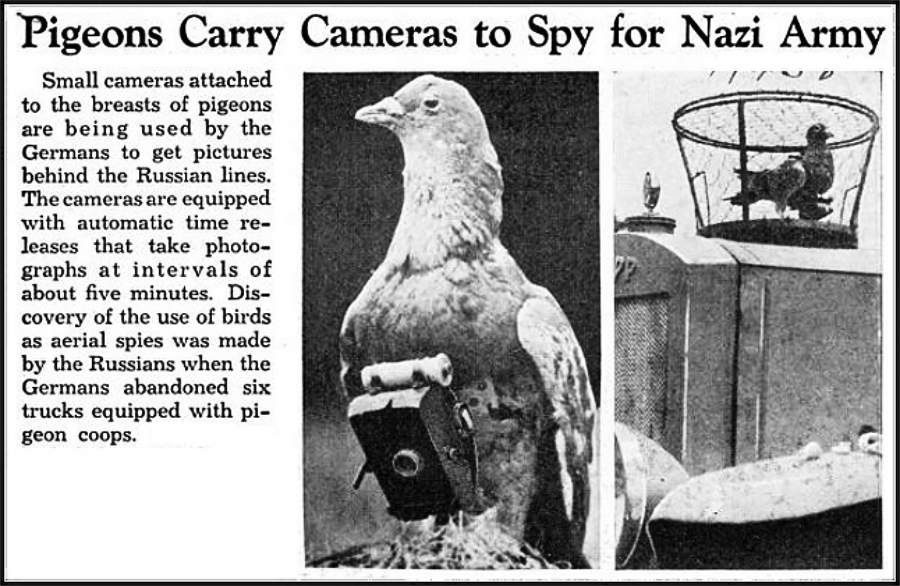
article on wartime avian photographers

Toronto. Some ideas work; some don’t. In 1942, the third Reich experimented with pigeon photographers according to this article in the September, 1942 issue of Popular Mechanics . Cameras were attached to pigeons and set for automatic operation over a period of time. Released over Russia, I guess the Nazis hoped the photographs would offer cheaper aerial surveillance.

War time brought out many new ideas and experiments, but as I suggested, some worked; some didn’t.

Thanks to my good friend, George Dunbar, for finding this article and sharing it with us, Was it a spoof? was it true? Don’t know. Both sides tend to diss the other in any war. WW2 was no different.

Posted in history | Tagged , , , , , | Comments Off on for the birds …