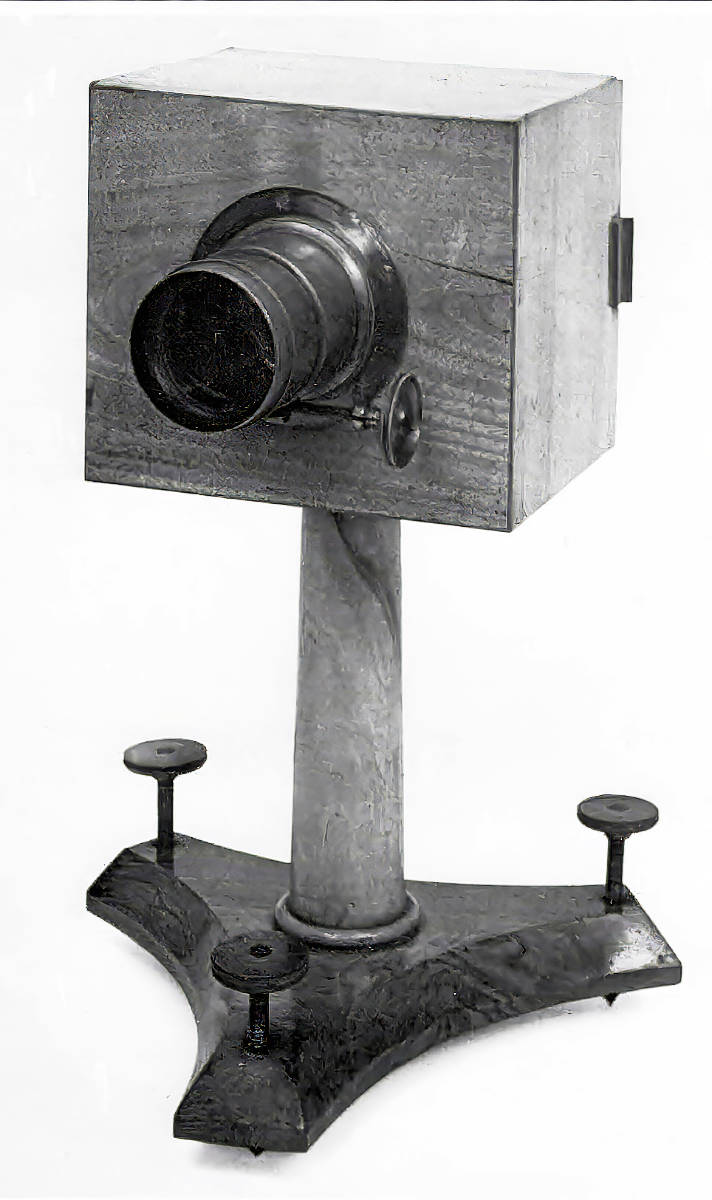
c1840 Daguerreotype camera by Prof Smetana, Plenz CZ
Toronto. The announcement in January, 1839 of the Daguerreotype process electrified the civilized world. First and foremost in improvements were to reduce the time needed to create a ‘likeness’. In 1840 Petzval created a much faster portrait lens to properly expose a Daguerreotype plate in a fraction of the time.
The 1839 News reached professor Smetana in Plzen, Czechoslovakia and in the following year (1840) he announced his Daguerreotype Camera complete with a Petzval lens made by F. Waibl, Vienna.
Editor Ev Roseborough describes the historic table top camera used for the issue 16-5 cover shot thusly. “This camera was used in the 1840’s by Josef Frantisek Smetana, professor at the Plzen Grammar School, to make daguerreotypes. The camera is mounted on a stand fitted with three adjusting screws.
“The earliest cameras of this type were simply placed on a table when in use. There is a Petzval lens constructed by F. Waibl, a renowned Viennese optician. The plate size is 72 x 81 mm (i.e. 1/6 Daguerre Standard Plate). There is also a development box where the pictures taken were made visible by means of mercury vapour.
“Professor Smetana, a cousin of the famous Czech composer Bedrich Smetana, was the first scholar in Bohemia to describe Daguerre photography in the Czech language. This description can be found in his book ‘Silozpyt cili fysika‘, published in 1842.”