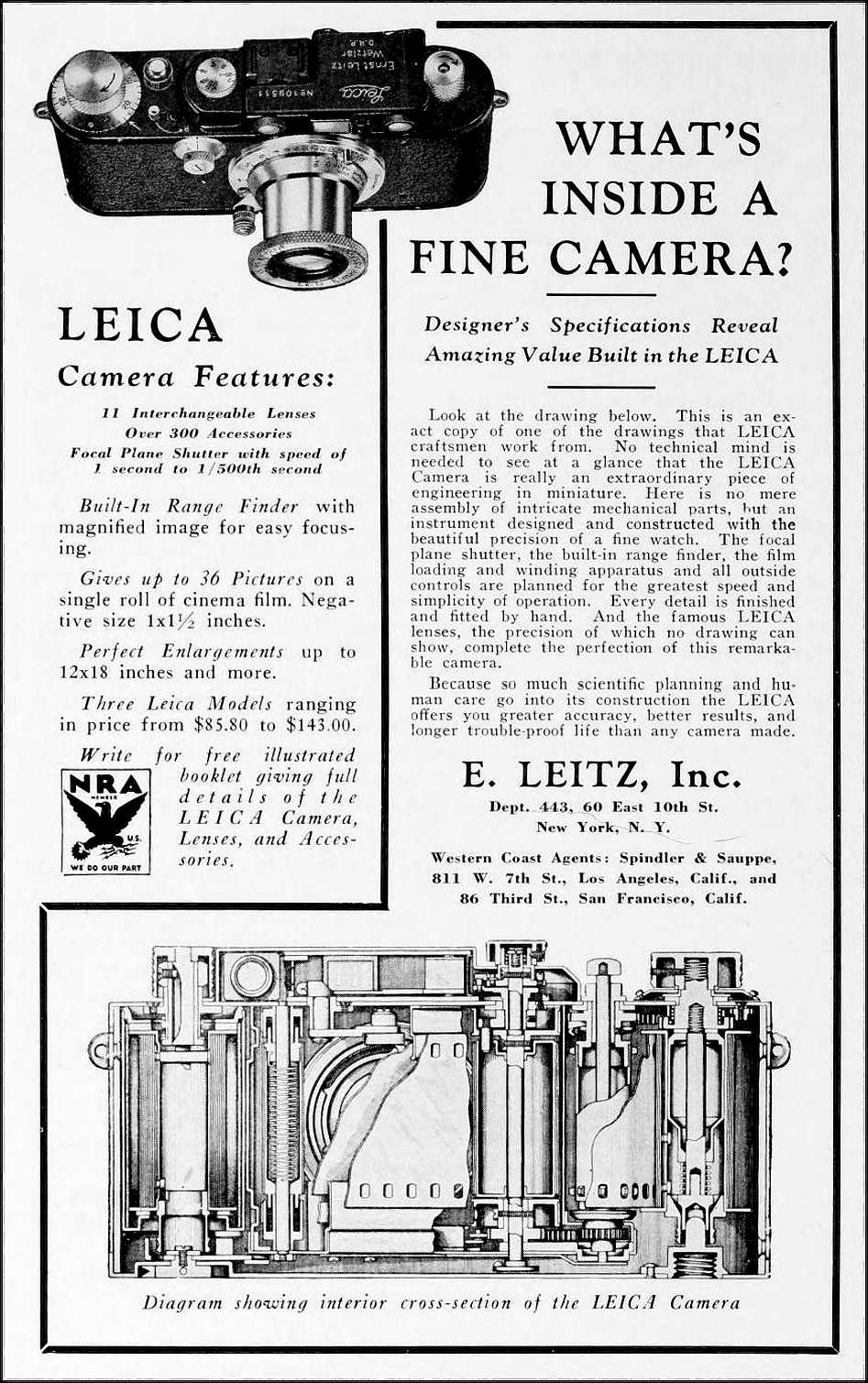
Inside a 1930s Leica
Toronto. While Leica wasn’t the first camera to use 35mm movie film, it was one of the first commercially successful 35mm cameras. The tiny marvel was the brain child of Oscar Barnack. The prototype (UR-Leica) was made by Barnack in 1913. WW1 arrived the following year and the camera was left as a laboratory curiosity, to be slowly improved over time. Post war, Ernst Leitz II struggled to find a product to keep his factory afloat so a decision was made to manufacture the tiny camera which became known as Leica for LEItz CAmera. Leitz himself took street shots with the camera in New York in 1919.
In 1924, commercial manufacture was begun and some cameras were sold. The following year, 1925, the camera was promoted to one and all at the Leipzig Fair. To counter the cameras of the day, Leica was promoted as making a “small negative, big picture”. By the time the great depression settled in, Leica was a system camera intended for professional, scientific and serious amateur photographs. By the mid 1930s the Leica and its competitors sparked the minicam revolution. Production nose-dived during WW2 and a few years after the war the revolutionary M3 arrived on the market world wide.
The ad shown above illustrates how Leitz NY promoted its camera to photographers in 1934. A big thanks is well deserved by my good friend and retired cinematographer, George Dunbar, for finding and sharing this ad from the January, 1934 issue of the International Photographer.