before movies, radio, TV we had …

Quidi Vidi Harbour in NL c1899

Toronto. … stereo cards.  These often well photographed three dimensional cards gave folks  entertainment and education before the many ‘opiates’ of the 20th century became common place (as a child in the 1940s, I was enthralled with a relative’s ‘basket’ of stereo cards and viewer).

Stereo card groups or themes entertained the masses, offered travelogues, taught us medicine and other esoteric topics best seen in 3D for clarity. While long replaced by movies, radio, television, video, and internet sites, collectors pick up interesting cards for their collections; cards often available at our events like the trunk sale this summer.

The cover shot for issue 23-4 shows one half of a travelogue stereo card introducing its viewers to the beauties of Newfoundland. The card shows Quidi Vidi harbour in Newfoundland just before the start of the 20th century.

Editor (late) Bob Lansdale describes the scene as follows, “Stereo card #13173 by B.W. Kilburn of Littleton, N.H. provides our cover image. Inscribed: Beautiful Kitty Vitty the scene shows the harbour of Quidi Vidi in Newfoundland. Kilburn copyrighted the image in 1899. James M. Davis, as primary distributor, has his name imprinted on most cards.”

Be sure to visit our 2025 events as shown at right under “PHSC EVENTS”.

Posted in history | Tagged , , , , | Comments Off on before movies, radio, TV we had …

hand in glove

two astronauts use a ‘glove box’ – photo by Don Pettit courtesy of CTV news

Toronto. In the summer of 1969, we were ecstatic to see on TV a B&W news short of Neil Armstrong walking on the moon. For the first time ever man created enough energy in a rocket to break the hold of  gravity and float to our moon.

Years earlier, in high school I learned that we needed a powerful enough rocket to off-set the pull of gravity before we could ‘escape’ to other worlds/planets. People today seem blasé about such feats, taking the international space station (ISS) in stride.

For the photo at left the CTV news cut line reads, “Superb science: Don Pettit captures the hands of NASA astronauts Nick Hague, left, and Suni Williams inside the Life Sciences Glovebox, a facility at the International Space Station. (Don Pettit/NASA)”.

In a recent email, my friend Clint (PHSC president, auctioneer, fair coordinator, HR department, columnist, etc. – and professional photographer) Sent this link to a CTV news article, “Through an astronaut’s lens: Images from a photographer in space” that displayed some of astronaut Don Pettit’s photos. Take a peek at them – definitely other-worldly …

Posted in activities-other | Tagged , , , , | Comments Off on hand in glove

the minute man in video

Mr Polaroid – Edwin Land in a matrix of SX-70 prints

Toronto. Today’s photographers and snap-shooters know  any photos they take are displayed ‘instantly’, ready to be edited or sent world-wide as is. It wasn’t always the case. In late 1948, Dr Edwin Land first offered his famous B&W Polaroid 95 camera and system in NYC.

My friend, Bill Belier, was a sales rep at the time for the company importing Polaroid cameras in Canada. He told me the news was so electrifying and the camera sold well – beyond the modest stock on hand – that he had to limit products to his clients.

While the digital set today may sneer at the idea of ‘pictures in a minute’, the time interval was revolutionary to film photographers used to anything from hours to days (or longer) before their efforts could be seen.

My friend and fellow PHSC member, president Clint Hryhorijiw, sent me an email recently saying, “A number of members have approached me, especially at the recent fair, about this PBS program . It would be great to let everyone know about it. ”

And with his note was a link to “Mr Polaroid” on PBS. A few videos on the revolutionary process are offered. Chapter 1 begins with the impact of the SX-70 when first introduced in Miami (fast, portable, SLR, and colour prints). Other Polaroid cameras are also shown (both B&W and colour) – then follows a bio of Edwin Land and a history of his company (Polaroid). Have a look and enjoy!

Posted in history | Tagged , , , , | Comments Off on the minute man in video

credit where credit’s due

Professor Marta Braun of Ryerson (now TMU)

Toronto. The PHSC from its beginning has been blessed with many well educated members – lawyers, professors, software designers, managers, professional photographers, etc. For example, issue 23-4 picks out Dr Marta Braun, professor of  Image Arts at Ryerson Polytechnic University (now TMU) in Toronto.

Marta spoke at our October, 1994 meeting on Marey  and his photographic experiments on motion studies.  In 1992 her book on Marey was copyrighted and published in hard cover to world-wide accolades. And four years later (1996) she was honoured by the French government.

The journal article is written by Bruce Piercey of Ryerson/TMU and begins, “Marta Braun, professor of Image Arts at Ryerson Polytechnic University in Toronto, has been honoured by the French government for her acclaimed book on the scientist and photographer Etienne-Jules Marey.

“Prof. Braun was awarded the Knight of the Order of Academic Palms by the government of France in a special ceremony during the “Alliance Française” in Toronto. The French consul general presented her with the medal which is given to those who have rendered services to the cause of French knowledge, culture, scientific progress and education.

“The award is equivalent to the Legion of Honour, being the highest honorific title for academics; both awards were created by Napoleon 1st.” …

Members can look up and read about Marta in the issue 23-4 pdf file on the free members-only DVD/thumb drive. See above or at right under Membership to join/renew (please indicate which). Questions? Email Lilianne at member@phsc.ca.

Posted in history | Tagged , , , , | Comments Off on credit where credit’s due

just desserts

Jeffrey Wood on way to hearing last Friday (bookcased by his legal team. Photo by Chris Tanouye for the CP

Toronto. My friend Clint Hryhorijiw sent me an email recently with a link to CTV news. The next day I had a phone call from good friend George Dunbar who read the same article in the Globe and Mail (The Globe article is behind a pay wall which may restrict your reading).

Some time back (March 16, 2025), I did a post on the arrest of Mr Wood who stole a famous Karsh portrait of Churchill in an Ottawa hotel and replaced it with a fake to deter discovery.

Both Clint and George contacted me to say Wood was sentenced to two years less a day for the theft given the extenuating circumstances. The article is of interest as the portrait is famous, and the photographer was also based in Ottawa. Small world indeed!

Posted in activities-other | Tagged , , , , | Comments Off on just desserts

how much exposure?

girl on beach by John Meredith as displayed in the 1954 Stereo Realist Manual by Morgan & Lester

Toronto. The digital fraternity (and in the waning days of film) have no difficulty with exposure – the camera does the heavy lifting. It wasn’t always so. All of the 19th century (well at least when photography experiments began) and over half the last century, exposure calculation was a major effort.

Ev Roseborough reminisces in this article in issue 23-4 about those earlier times when exposure calculation was both paramount and incredibly difficult for photographers (especially green photographers). The article is reproduced here (click on the icon at top left to see it).

And of course members can also see it in the pdf file for issue 23-4 on the free members-only DVD/thumb drive. Join now – just follow the note above and/or at right. Questions? email Lilianne at member@phsc.ca.

Posted in history | Tagged , , , , | Comments Off on how much exposure?

dating those stereo cards

a Holmes stereo card viewer

Toronto. A common sight at our fairs is the ubiquitous ‘stereo card’. You know, the usually slightly curved cards with two similar images ‘glued’ to the card. Often the cards are undated and it’s difficult to estimate a date.

Past-president, Les Jones, himself a professional sports photographer and entrepreneur (and future author) solved this dilemma by reaching out to others and creating a chart to assist in dating stereo cards.

This chart was reproduced and distributed in issue 23-4 of the journal (January, 1998). The preamble gives this caveat and information sources, “NOTE: All dates are approximate: some photographers and publishers continued to use a certain style long after it had been discontinued elsewhere. There are also differences between European (E) cards and North American (NA) cards. Information courtesy of William Darrah and George Gilbert.”

Members can view and print the chart from the issue 23-4 pdf file on the free members-only DVD/thumb drive. If you have any questions on membership, drop Lilianne an email at member@phsc.ca.  To join, see MEMBERSHIP above and/or Membership at right.

Posted in history | Tagged , , , | Comments Off on dating those stereo cards

…two for the money …

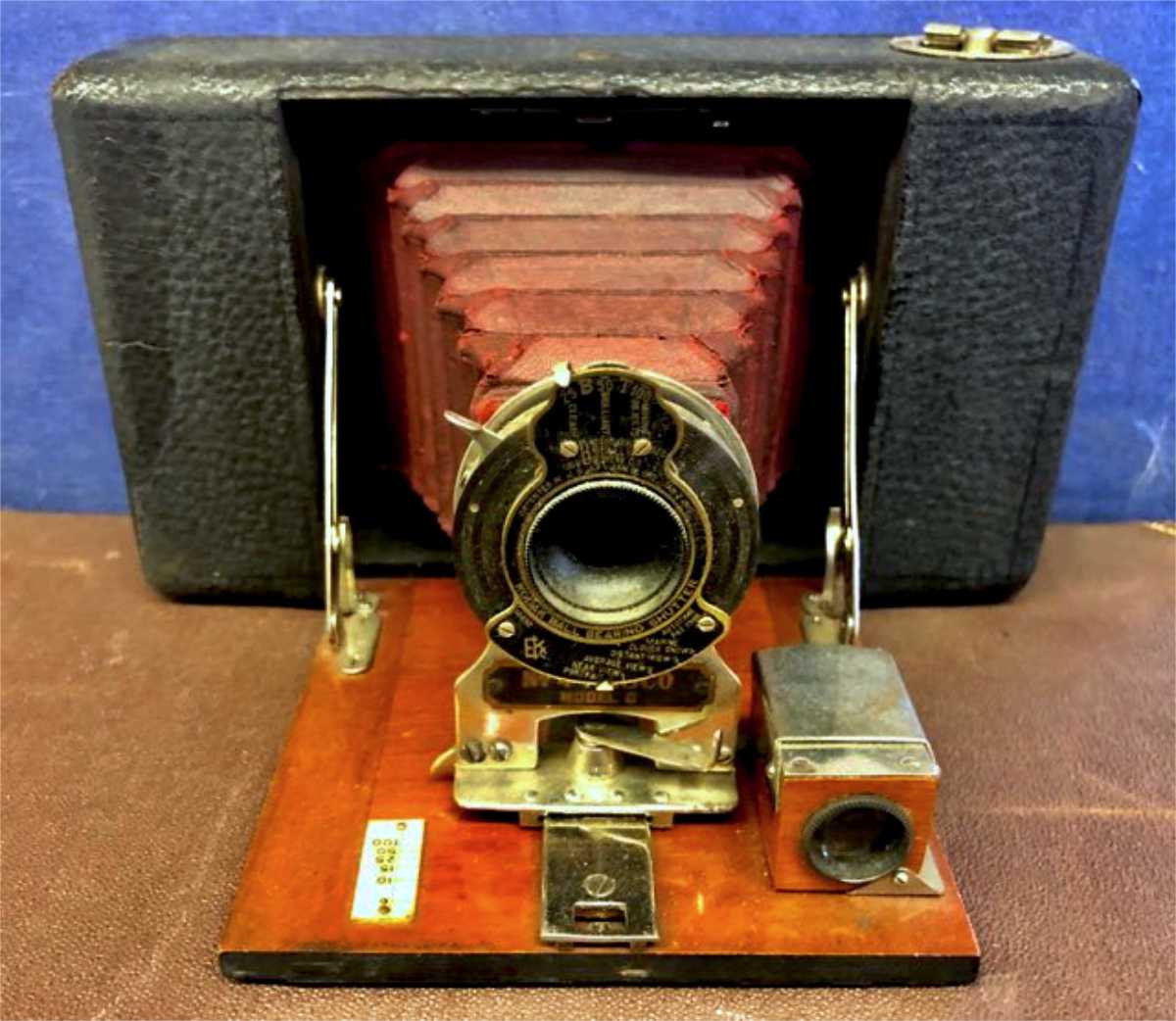
Earlier version of the No. 2 Folding Kodak – from the Robert Wilson Collection

Toronto. In issue 23-5 (spring 1998) the late Bill Belier began his long running column, “A Treasure From My Collection….”. Featured are two “No. 2 Folding Pocket Kodak” cameras from the late 1800s/early 1900s when George Eastman was putting the name ‘Kodak’ on the map.

The cameras are from the collection of the late Robert Wilson who provided the text (edited by Mr Belier).

Bill introduces his new column as, “Commencing with this issue, ‘A Treasure From My Collection’ will be a regular feature of Photographic Canadiana. I have agreed to edit this new column with the hope members of the Society will take the opportunity to share treasures from their own collection.

“Now a treasure does not have to be a rare camera. In fact, it may be an item other than a camera – the criteria being: it is a photographic article that YOU cherish and is part of your collection. Just as interesting as the item’s technical data, is the story leading to its possession. Where did you find it?…was a trade involved?…was it a sleeper at a flea market?…was it a basket-case discard?…or was there some other element of discovery to make it interesting?

“If you have such an item, please contact me at our monthly meetings, at my home address listed in the membership directory or through editor Bob Lansdale of Photographic Canadiana.”

You can read the edited words of Dr Wilson in the pdf file for issue 23-5 on the free members-only DVD/thumb drive. Not a member? Follow the directions at MEMBERSHIP above and/or Membership at right. Questions? Email Lilianne at member@phsc.ca.

Posted in history | Tagged , , , | Comments Off on …two for the money …

fair findings c1997

a Pilot 6 camera made in Dresden, Germany

Toronto. The spring fair back in 1997 was a resounding success by all accounts. The late Bob Lansdale, assisted by another PHSC stalwart, Tiit Kodar, photographed selected cameras to accompany fair chairman Mark Singer’s report.

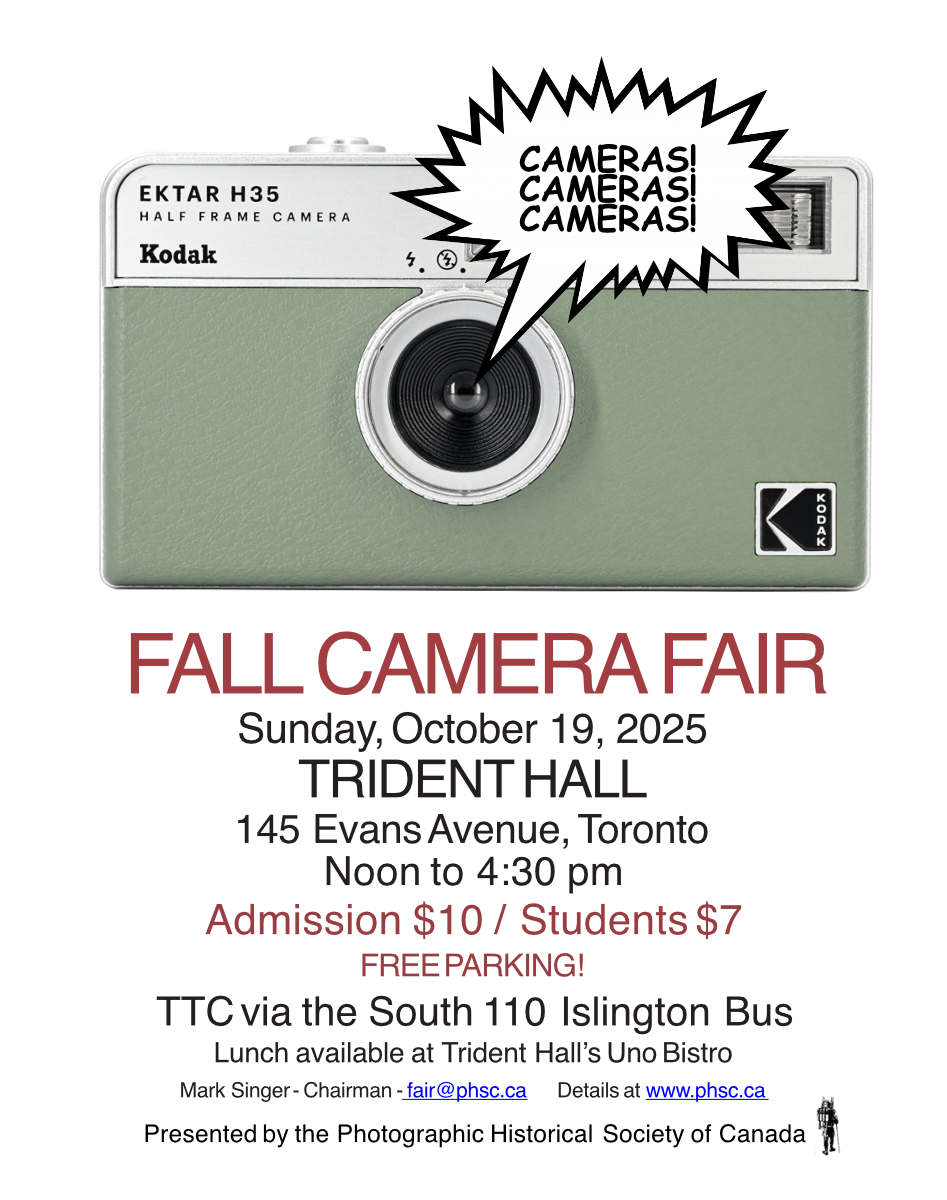
Now, 28 years later, we are hosting our 50th spring fair. And like in 1997, there will be lots of great gear for your consideration. As the attached May 25, 2025 fair poster shows, today’s fair is at the Trident Hall an Evans and Islington.

Easy access, free parking (at the hall and nearby), cheap admission, and great food. That plus bargains for your collection be it, film, digital, photos, cameras, lenses, etc. And a place to see friends and collectors – old and new!

Posted in fair | Tagged , , , , , , , | Comments Off on fair findings c1997

what’s the telegraph got to do with it?

Daguerreotype portrait of Samual F, B. Morse c 1850 – courtesy Library of Congress

Toronto. American Sam Morse planned to be an artist. He was in France in the late 1830s pursuing his artistry when he met Louise Daguerre in 1838. The following year, he enthusiastically embraced the Daguerreotype technology and brought the new art to America where an exuberant and boisterous population embraced it warmly.

Planted in fertile ground, the art exploded in its use. Photographers and studios grew like weeds (Morse had his studio by 1840 and later trained many budding photographers like the civil war photographer Matthew Brady). By the late decades of the 19th century the forefront of this art had shifted to America with the likes of T & H Anthony and Eastman Kodak,

Meanwhile, Samual Morse  became a household name a few years later as the inventor of the telegraph and the Morse code. …

All this is from an email I received a couple of days ago from Les Jones (sports photographer, author, entrepreneur, and past president of the PHSC).

Les wrote in part, the “Metropolitan Museum of Art, New York,  temporary exhibit presents “The New Art: American Photography 1839-1910” drawn from the Schaeffer Collection.

“222 (mainly impressive) images, most never seen before, and a few 19th century cameras. www.metmuseum.org  Through July 20″ 2025.

Les gives his source as, the “Extensive write-up in Antiques & Auction News May 16”.

Be sure to click on and read the links in this post!

NB. The post title is a riff on the 1984 classic song by Tina Turner, “What’s Love Got to Do With It“, sung here by the lady herself.

Posted in history | Tagged , , , , | Comments Off on what’s the telegraph got to do with it?