Camerama Show March 26, 2017

Camerama Show March 26, 2017

Toronto. My friend and PHSC member Gary Perry sent me a note Thursday reminding everyone that his latest Camerama Show will take place on the last Sunday of March (March 26th) at the Edward Village Hotel in Toronto.

Click the icon or here to see his poster with full details.

To order table contact Gary by email  or at 905 550-7477.

Drop by and pick up some items for your collection.

Posted in activities-other, fair | Tagged , , | Comments Off on Camerama Show March 26, 2017

Vancouver panoramas

Part of Vancouver Funeral Panorama

Toronto. George Dunbar found this link to a number of old Vancouver panoramas in the City of Vancouver Archives and sent it to me last Tuesday.

While I have done a few posts on the panoramas (Clocks for Seeing,Groupies,W. J Moore Panorama Photographs, etc.), this one is still an interesting collection. I watch Knowledge Network in Vancouver each weekend. Knowledge often features these old Vancouver panoramas.

Posted in photos | Tagged , , | Comments Off on Vancouver panoramas

Pictures for an Auction March 19, 2017

Kodak Lamp Auction Photo

Toronto. The latest PHSC auction will take place this month. These are some of the items to be auctioned (shown here on our web site – click the small icon that comes up to see the slide show and then click on any small photo for a full size picture of the item.

First out of the block was this attractive Kodak Art Deco Lamp shade. I will post more pictures to the slide show as they are received.

Meantime, see you March 19th, 2017 at the Legion Hall 101 in Long Branch for our General Consignment Auction. Click here for details (and our new poster).

Click the above icon for slide show of some of the items to be auctioned.


Posted in auction | Tagged , , , , | Comments Off on Pictures for an Auction March 19, 2017

a missed opportunity

Front and back of a Luna-Pro exposure meter (courtesy Ollinger’s Collection)

Toronto. When it burst on the scene in the early 1960s, the Gossen Lunasix (Luna-Pro over here) solved the problem of low light readings. Using the recently released Cadmium Sulphide (CdS) photo cell, the meter was both accurate and sensitive. Unlike its predecessor, the Selenium Photo Cell, the CdS cell did not generate an EMF (act like a battery when illuminated). Instead the cell varied its resistance as the light varied.

Gossen made a pricy meter (About $65 when I bought one) but still used a very primitive circuit. Two mercury cells were placed in series with a meter and a resistance. A switch flipped a scale and another resistor in or out to create a two scale instrument for high and low light use. A built-in translucent dome could be moved over the CdS cell to make it an incident light meter. The meter was still a big handful compared to the dainty but sturdy Weston meters. Continue reading

Posted in camera | Tagged , , , , , | Comments Off on a missed opportunity

… and a touch of Selenium

Weston 650 exposure meter c1938

Toronto. In setting a dry plate or roll film camera for a particular scene, the toughest part of all was to determine the light value so the aperture and speed could be estimated. In 1935, Weston Electric Instrument Corporation in Newark NJ (founded in 1888) developed the famous model 650 Universal Exposure Meter.

This wonderful device used a selenium cell to determine the light value then used the traditional nomograph dials to select the film speed, aperture, and shutter speed. An innovation was to use settings either side of the main pointer (a, b) and (u, o) to aid in determining the dynamic range of the scene or compensate for the meter position.

I first learned of Weston meters as a young kid when a friend of mine gave me an old Weston iron-vane “true RMS” meter (0-150v and 0-300v) once used in the General Electric factory quality assurance department at Barrie.  A few years later, I acquired this DC voltmeter (0-30v) made c1900 that once graced the Collingwood, Ontario Bell Telephone Company of Canada test panel. It is the size of a dinner plate and about 4 inches deep.

Posted in Uncategorized | Comments Off on … and a touch of Selenium

Not only fish and snakes have scales

Toronto. An option to actinometers or extinction meters was the more sophisticated scales and nomographs. These devices like the Harrold Exposure Scale patented in 1922, or the JohnsonStandard Exposure” calculator, allowed a photographer to describe a scene and the lighting and then determine various combinations of speed and apertures needed to make a perfect exposure. Johnson was a British company that was known for its darkroom chemicals.

In the mid to late quarter of the last century each film contained a sheet of paper with a small table of the suggested exposures and a given speed and aperture combination. All films used a standard ASA (ISO) or DIN rating for film speed, making such simple papers of use for those without a sophisticated light meter.

Posted in camera | Tagged , , , , | Comments Off on Not only fish and snakes have scales

Extinction meters

Zeiss Diaphot c1930

Toronto. Another popular design to aid the photographer in his pursuit of the correct exposure was the extinction meter. This device relied on the photographer looking though an eyepiece or tiny aperture as a filter was slowly moved across the field of vision until it was extinguished. A dial or table would convert the just extinguished reading to a choice of aperture and speed based on the plate or roll film being used. A small insert lists the various plates and films of the period and the suggested corrections to use.

In 1921 ICA in germany created the elegant Diaphot. This slim watch shaped meter used a blue filter and a wedge that could be rotated across the field of view until the scene shadows just disappeared. In 1926 ICA was merged into the newly formed Zeiss-Ikon group in an attempt to rationalize the German camera industry. Larry Gubas (editor of Zeiss Historica and president of the Zeiss Historical Society) describes the merger in his excellent and massive book “Zeiss and Photography“.

Gubas states that after the merger ICA became the accessory maker for all the Zeiss Ikon companies. The Diaphot ICA created was rebadged Zeiss Ikon (as is mine) and continued manufacture through 1934. From 1936 to 1940 a more modern version was manufactured and sold.

Posted in camera | Tagged , , , | Comments Off on Extinction meters

Actinometers

Wynne’s Infallible Hunter Meter c1915

Toronto. Since the beginning of photography people tried to find reliable ways to predict the correct exposures for a given light and scene. One idea was to expose a sensitized contact paper in the shadows enough to “tint” the paper slightly and then calculate the needed exposure based on how long it took for the paper to tint.

In 1893, Wynne of Wrexham, Wales patented the “Wynne’s Infallible Exposure Meter“.  A few years later, the meter was simplified as the “Infallible Hunter Meter” which was built into a slim pocket watch-like case. On one inner side was a round hole to expose the sensitive paper edged on two sides by tints too light and too dark. A milled ring allowed the hole to be rotated to a fresh spot on the paper. The ring could be aligned with the case hinge and “winder” allowing the ring and its plate to be carefully pulled up to insert a fresh piece of paper. Snapping the case closed protected the paper from light, eliminating the previous need for an orange filter. Continue reading

Posted in camera | Tagged , , , , | Comments Off on Actinometers

Le Posographe of 1923

Le posographe by Kaufmann, France in 1923

Toronto. We are spoiled today. Our digital cameras automatically adjust settings to match the light. What was coal black a century ago is like daylight today. When dry plates and roll films arrived on the scene, development was split from exposure. A plate or film would be processed hours or days after the exposure. This made it critical that the exposure was correct.

Many gadgets and tables were produced all with the objective to give the aspiring photographer an idea of what setting to use for a given scene. In addition to tables and calculators, extinction meters and even exposure meters were offered. Sadly the extinction and exposure meters were far too slow to be of use. Even when I was a youth in the late 1950s, exposure meters were so slow that flash was preferred indoors or outdoors late in the afternoon and in the night (unless special effects were desired).

Continue reading

Posted in camera | Tagged , , , | Comments Off on Le Posographe of 1923

Pictures a century ago

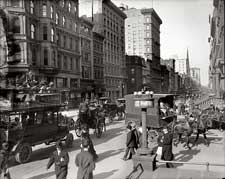
5th Ave and 42nd St in NYC in 1910. Original image named “amerikanskie-goroda-retro-12-940×747.jpg”

Toronto. Mo Patz dropped me a note from BC yesterday. Maureen was president of our Toronto chapter which folded into the national chapter many year sago.

Mo writes, “A friend of mine in the States just sent me this e-mail that brought both of you to mind [me and John Linsky] and I thought that you might enjoy looking at them too and perhaps send them on to others to enjoy (like Mark Singers, whose e-mail I don’t have to hand)….or even you might want to print this e-mail out for the next club meeting.

“Aren’t these pix lovely? I think they are great and I couldn’t resist forwarding them to you.”

You can see the prints too at this site which is a page on Memolition – Explore. Dream. Discover. While they are all American locales, the images capture the scenes of cities in the era. The original photographs were likely taken on glass plates with field cameras on tripods (not pinhole cameras as one site mentions). Roll film was available at the time, but was most commonly used by amateurs.

The image files are all named in Russian as “America Cities, Retro” followed by a sequential number and the image size in pixels. There are many sites on the web with all or some of the same photographs down to the same file names.

Posted in Uncategorized | Comments Off on Pictures a century ago