a Royal visit in 1939

1939 Royal Visit
School Kids and Union Jacks

Toronto. You likely don’t remember the time when the 1939 Royal visit took place. My step-mother vividly remembered going to North Bay with her parents to see the Royal couple as they headed west. Her mother was born in Surrey, England and her father fought in the Great War and her brother in the second World War.

The big daily newspaper here was the Toronto Star which her parents bought each day. Years later, The Star archive was donated to the Toronto Public Library.

This panorama shows the crowd of children in Western Ontario out to welcome the new King and his Queen (parents of Queen Elizabeth II). Thanks to George Dunbar who discovered this amazing photo at the TPL.

Posted in events | Tagged , , , , , | Comments Off on a Royal visit in 1939

photography and the first world war (1914 – 1918)

Aircraft photo WW1

Toronto. The AGO has curated an exhibition called “Photography: First World War 1914 – 1918” as part of this year’s CONTACT festival hosted by Scotiabank

The great war ended a century ago so we often forget how the rudimentary photographic skills in the early 1900s could help us in this tragic event.

Canada came out of the conflict as a better nation after many brave souls willingly embarked to Europe to fight. Many of my relatives returned to a recently left Britain (or to the homeland of their parents).

Posted in events | Tagged , , , , | Comments Off on photography and the first world war (1914 – 1918)

Buying photos and photo gear in Toronto in 1879

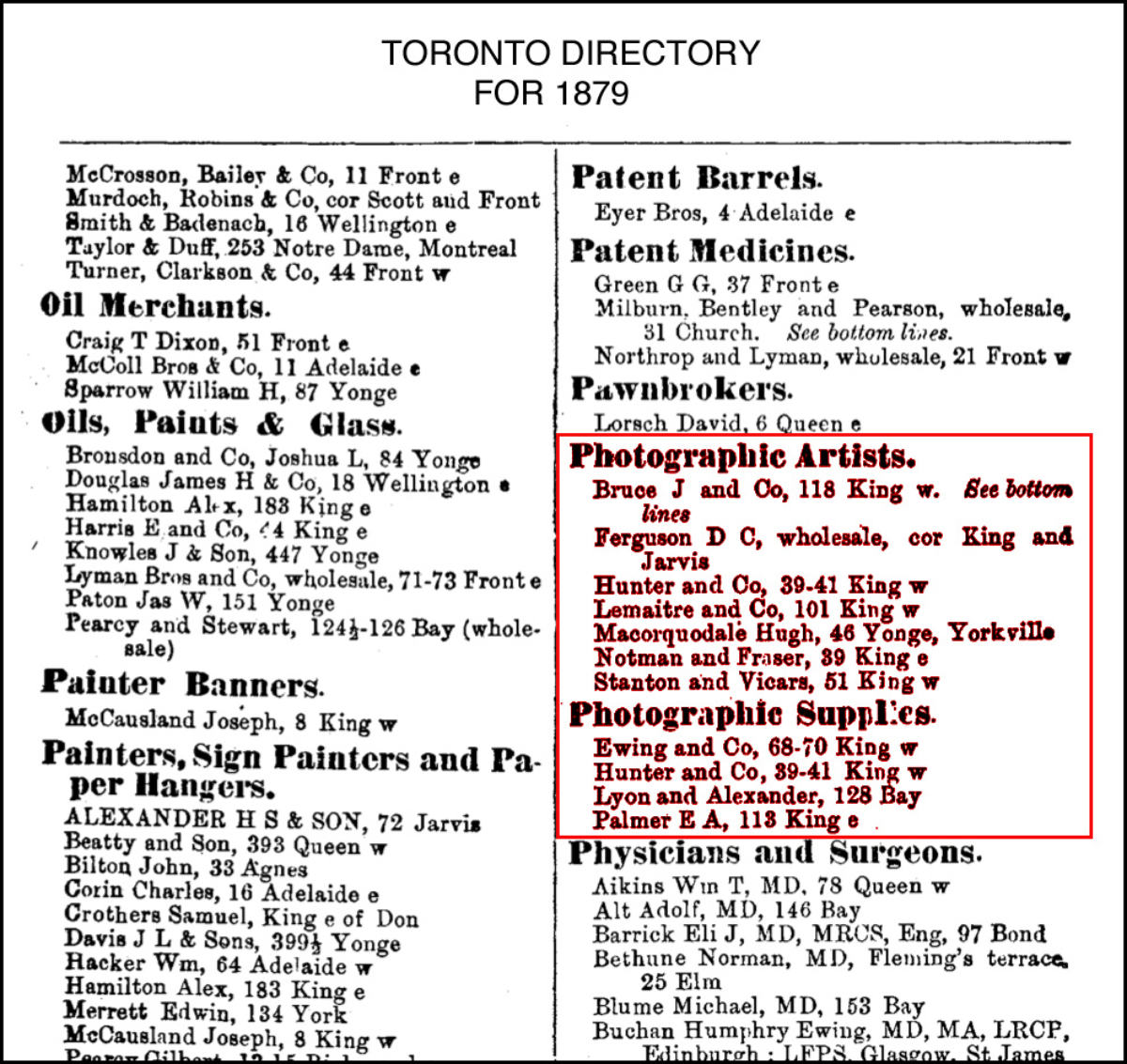
Toronto Directory 1879
Photographic artists and suppliers

Toronto. Our city reached a population of over 86,000 in 1871, a few years before the City Directory of 1879 was published and distributed. Take a look at the Wikipedia entry shown for Toronto to see its interesting history.

In 1879, some four suppliers of photographic gear were listed along with seven studios, including one listed as “Notman and Fraser”. Almost all were clustered around the corner of King and Yonge Streets. The city at the time had a population around the size of that in modern-day Barrie.

Thanks goes to George Dunbar for spotting this bit of history in the City Directory of 1879 which was likely compiled a year earlier. City Directories are a great source for genealogists. I traced my mother’s ancestors on her father’s side from Port Hope to various homes in the Junction/Toronto West. In the 1980s all the houses still existed in the area and I was able to take a photograph of many.

Posted in miscellaneous | Tagged , , , | Comments Off on Buying photos and photo gear in Toronto in 1879

outside in and upside down – a camera obscura exhibition down under

Camera Obscura drawing

Toronto. The earliest known cameras may have been the camera obscura variety. They were often an closed room in an amusement area with a tiny hole or lens on one wall that projected the outdoor scene on the opposite wall upside down.

My thanks goes to George Dunbar for spotting this article in the UK’s Guardian newspaper touting an exhibition in Australia … . Many believe the camera obscura evolved into the modern day camera.

Posted in camera | Tagged , , , , | Comments Off on outside in and upside down – a camera obscura exhibition down under

background to Free Black North exhibition at the AGO

Dr Julia Crooks
by Wayne Gilbert

Toronto. February was Black History month. PHSC member Dr Julie Crooks of the AGO discussed the background to her exhibition, “Free Black North”, and the influence blacks had on photography. She is busy conducting on-going research while performing her regular job. Her research examines the way blacks used photography in migrating north. Fugitivity is a main theme (literal framework) in her research and she quoted Saidiya Hartman‘s definition of the term. Blacks were shown in typical stances in photographs. In 1850, America passed the fugitive slave act which returned anyone even suspected of being a fugitive slave back to the owners. From 1850 to 1860, some 15,000 to 40,000 fugitive slaves escaped to Canada or one of the “free” states in America.

A newspaper article in the Southern Ontario paper, Provincial Freeman, was written by Reverend Horace Hawkins in the mid 1850s. In 1863, Hawkins travelled throughout Ontario investigating the plight of fugitives basically saying that prejudices in Canada meant refusal of accommodation in any hotel or passage on any railroad due to the rapid immigration of blacks and a fear they would take over the western counties as a majority. The reverend settled in Southern Ontario after fleeing Kentucky. Most immigrants to Canada were from Britain and viewed Ontario as a white British colony. Blacks were shown as caricatures and second class citizens. 

Around 1850, the so-called science of phrenology emerged. Phrenology purports to show blacks have lower intelligence. Photography began to offer a means to escape this poor representation. Rochester NY’s North Star newspaper publisher Frederick Douglass (of fugitive portrait fame and one of the most photographed men in history) did an article on the portraits of black men. Douglass felt that white photographers were unable to take impartial portraits of blacks; their work always resulting in caricatures.

 Dr Crooks’ exhibition was an expansion of her research into 27 tintypes and some CDVs of African-Canadians/Americans who once lived in Southern Ontario where countless blacks were photographed (black subjects were accepted since photography was a business and money was money).

Dr Crooks selected prints from two Ontario archives:  1). the Bell/Sloman archives at Brock University’s James Gibson Library building in St Catharines, which has a  rich collection of images and ephemera of blacks ranging from the 1850s to 1970s – Bell rescued a large number of portraits from his mother’s attic. The images were destined for the junk heap!  2). the Alvin McCurdy collection (McCurdy’s brother Howard died the day of this talk), at the Archives of Ontario in Toronto, with its background of many prominent people with fugitive ancestors collected over 40 years. 

A tintype featured in the exhibition was borrowed from the Bell collection. It shows an unnamed girl thought to be a domestic worker. By the time of this portrait, anyone could afford a portrait. 

Dr Crooks discovered an overwhelming number of black girls and women in the collections. She began to close her talk by quoting Harvey Young on cross border traffic. She offered the opinion that, “images of blacks shaped the way photography was used in Canada”. The two archives she used in her exhibition disrupted the concept of migration and forced the movement and settlement from a white British colonial perspective to a more encompassing perspective.

After her talk Dr Crooks enjoyed the relaxation of the spirited Q&A discussions making a very positive impression on those present that evening. 

Posted in program | Tagged , , , , , , , | Comments Off on background to Free Black North exhibition at the AGO

Finding Canada in the NYT Archive

<

Dr Denise Birkhofer RIC

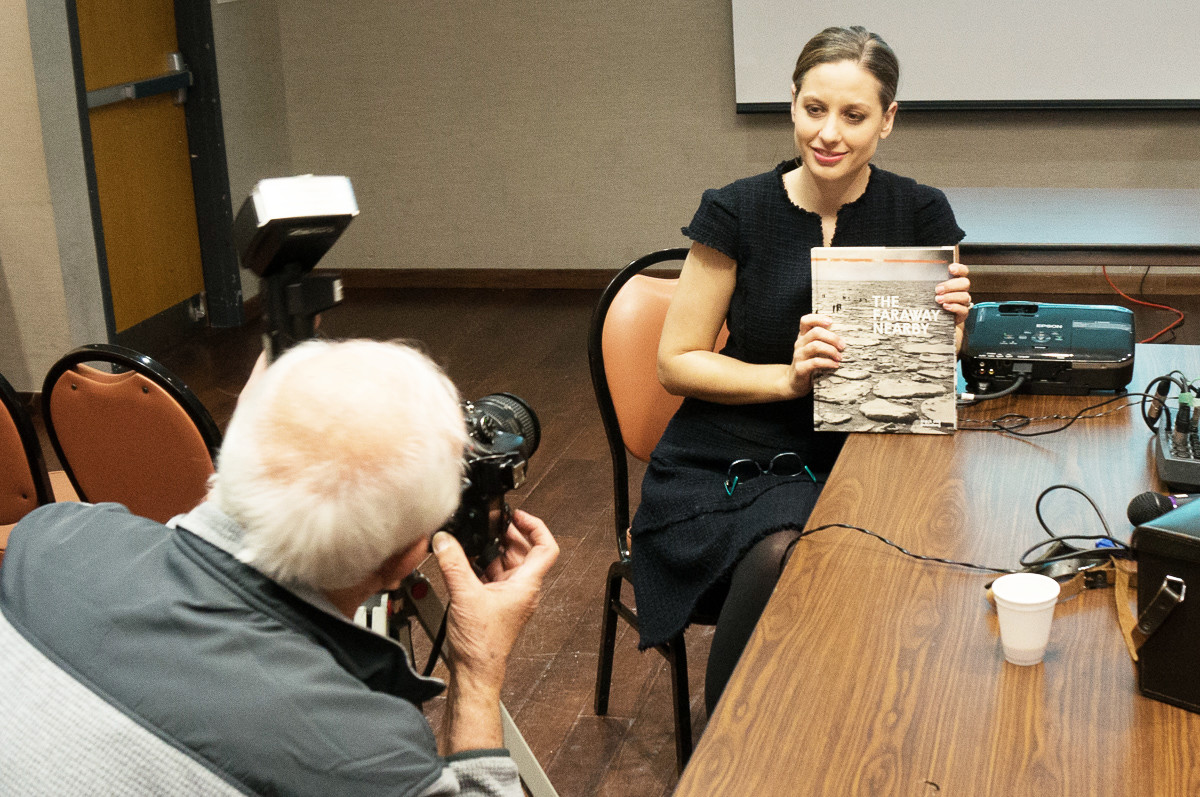
Toronto. Dr Denise Birkhofer of the Ryerson Image Centre spoke on Finding Canada in the New York Times Archive at our January 17th meeting augmenting her recently ended exhibition  at the RIC called “The Faraway Nearby” which uses selected photographs from the Rudolph P. Bratty  Family Collection donation of some 25,000 photographs from the New York Times Photo Archive related to Canada. The exhibition itself was featured in a September 18, 2017 post on our website.

A  few years ago, people visited the NYT press morgue and pulled any files with a reference to Canada. Denise’s talk began with a four minute video highlighting the NYT press morgue titled “Inside The Lively Morgue”. She discussed examples of entries in the NYT press morgue and which date to as early as the First World War (the Archives had very few colour photos).

Gerald McMaster and Dr Birkhofer curated the exhibition. They chose to group the prints as they would appear in a newspaper: National News, International News (some interesting overlaps), Arts & Culture, Peoples of Canada, Travel, Business and Sports. They decided to retain the NY Times retouching lines, cut lines, and red litho separation of elements in many pictures (hand retouching was used to cleanup a print for newspaper use).

The Travel part of the exhibition promoted tourists and tourism. A print of the Dionne Quints had ruby litho to isolate the doctor and baby quints, and two typed cut-lines on yellow “post-it notes” show how the print was used in a NYT article.

One c1930 print from the Newfoundland-Labrador Film Company showing Arctic ice floes and seal hunters was taken by Frank Kirby. It was used on the cover of the exhibition’s companion book. The print was originally reproduced in a photo montage within the NYT’s photogravure section. An earlier advertisement for the exhibition showed the Canadian women skaters who went to the Olympics at Lake Placid NY. The retouching marks proved to be the most interesting since one Canadian skater was cropped out for the NYT’s article. The Sports photos wrapped up the talk and for the next twenty minutes Dr Birkhofer entertained her audience with a spirited Q&A session. And editor Bob Lansdale recorded a portrait of our gracious January speaker.


Posted in program | Tagged , , , , , | Comments Off on Finding Canada in the NYT Archive

Toronto Skyline in 1908

Toronto 1908
Owen Staples, artist

Toronto. The artist Owen Staples (1866 – 1949) was born in England and emigrated to Canada (Hamilton) with his family in 1872. He moved to the States where he began his arts studies. He moved again, this time to Toronto where he was hired by the Telegram’s Robertson. He returned briefly to the States to complete his artist training, returning to Toronto and Canada for the rest of his life.

An oil  painting of Toronto’s skyline in 1908, four years after the devastating fire of 1904, resides today in the City Archives. A photograph “coloured with water colour and gouache, of [the] oil painting [resides in the Baldwin room of the Toronto Public Library]. [It is] laid down on canvas and mounted on [a] stretcher”.

My thanks to the ever prolific and curious PHSC member George Dunbar for discovering this panorama painting/photograph of the city’s 1908 skyline.


Posted in photos | Tagged , , , , | Comments Off on Toronto Skyline in 1908

good grief – it’s spring fair time again!

The BIG ONE – PHSC’s
Spring Photographica-Fair
May 27 2018

Toronto. For over forty years we have hosted the spring photograpica-fair – the BIG ONE! Click on the icon at left to see the poster with full details. Need a map to get there? Then click HERE and see the book mark for our spring fair in the south-west end of the city.  TODAY, SUNDAY MAY 27, 2018!

The poster and bookmark you see were designed by our newsletter editor, Sonja Pushchak. Enjoy them  and print them! All are welcome to this edition of our show – free parking, tasty pirogies, and lots of bargains. It doesn’t get any better!

Posted in fair | Tagged , , , , , , , , | Comments Off on good grief – it’s spring fair time again!

close-ups with a Leica

Leitz Accessory Front lenses
for their 5cm Elmar

Toronto. For many years Leitz made standard lenses for the Leica that focussed as close as a metre. Want to get closer? Too bad. This all changed in around 1927 when Leitz offered supplementary front lenses for its standard 50mm lenses – the Elmar, Hektor and later the Summar.

Leitz offered three lenses to allow close-ups from 39 1/2 inches to 10 1/2 inches. The trio called ELPRO (1*),  ELPIK (2*) and ELPET (3*) were sold from about 1927 to 1958. A special ring adapted the tiny marvels to the larger f/2 Summar lens. The ones marked without the * were meant for very early cameras and lenses.

I bought my trio of Elmar supplementary lenses nearly forty years ago from Stan Weyman down in Connecticut and they arrived by mail on January 10, 1980. Leitz went on to make and sell the famous spider legs, extension tubes, focoslides, and other odd focussing mounts that became feasible after interchangeable lenses arrived around 1930.

Many other cameras adopted close-up lenses and they became common place offerings by filter makers as they easily attached with rings or threads meant for filters. Tables and tape-measures were needed to determine the correct focal distance and frame size. This was simplified by spider legs and the other odd gadgets Leitz made and sold.

Posted in camera | Tagged , , , , , | Comments Off on close-ups with a Leica

PPOC Magazine “Gallerie”

PPOC Magazine Gallery

Toronto.  Many thanks to editor Bob Lansdale for sending me an email announcing the latest edition of this wonderful magazine.

Gallerie is published by the Professional Photographers of Canada (PPOC), an organization Bob was heavily involved with before he became editor of our journal Photographic Canadiana.

As a professional photographer, Bob has continued his membership in the PPOC, as have many of our other members and executive.

Bob’s late wife Margaret, wrote for both the PPOC and the Professional Photographers of Ontario’s magazine. In 1997, a selection of her columns was published in a book titled  … a funny thing happened on the way to the darkroom! Typesetting, layout, and editing was done by husband Robert Lansdale who took a course at Humber College on the use of the program, QuarkXpress, the preeminent professional program of the day.

Posted in activities-other | Tagged , , | Comments Off on PPOC Magazine “Gallerie”